Rose campion
Silene coronaria. Family Caryophyllaceae. Perennial.
Also called Dusty miller, Mullein pink, Lychnis coronaria.
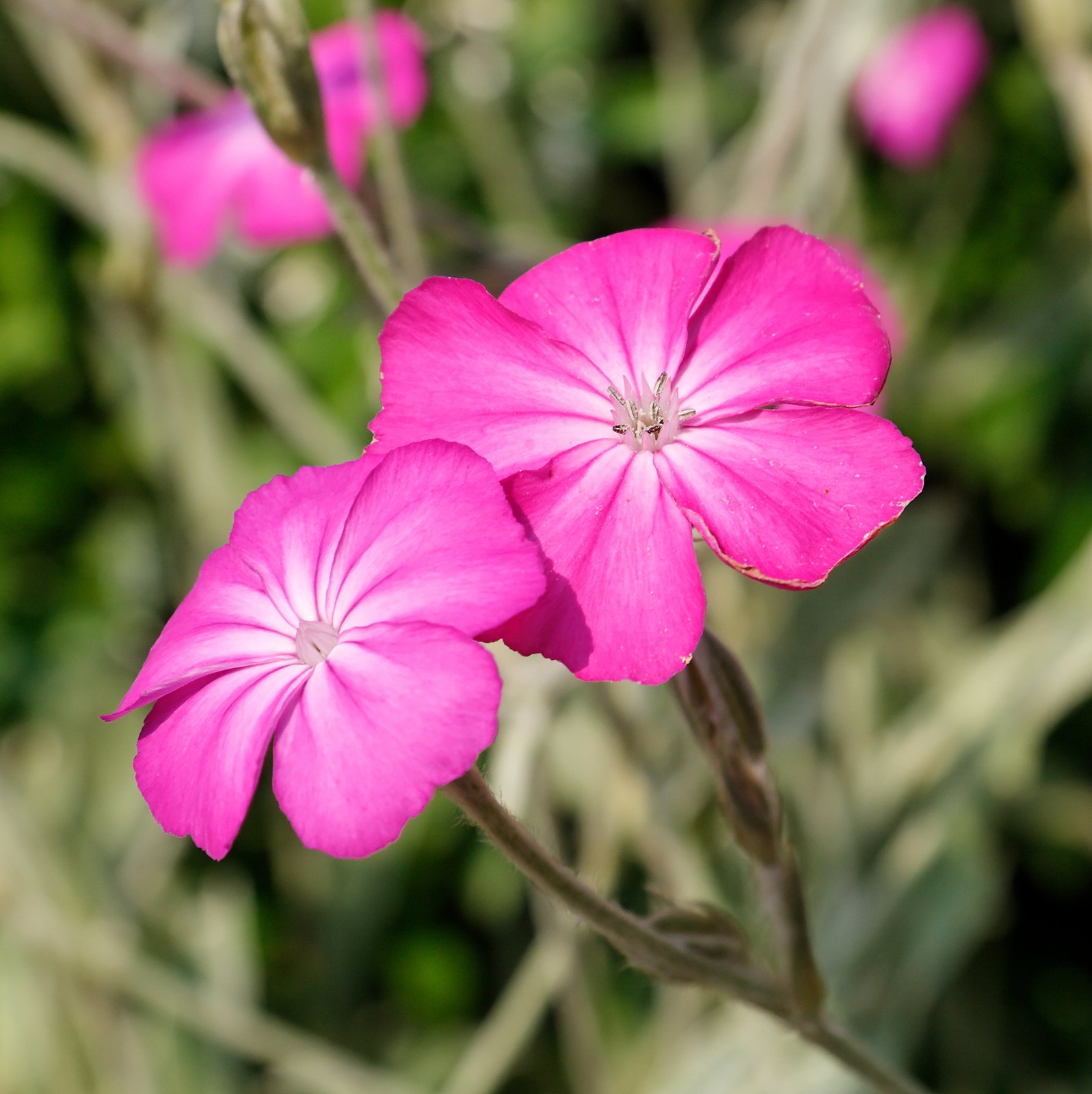
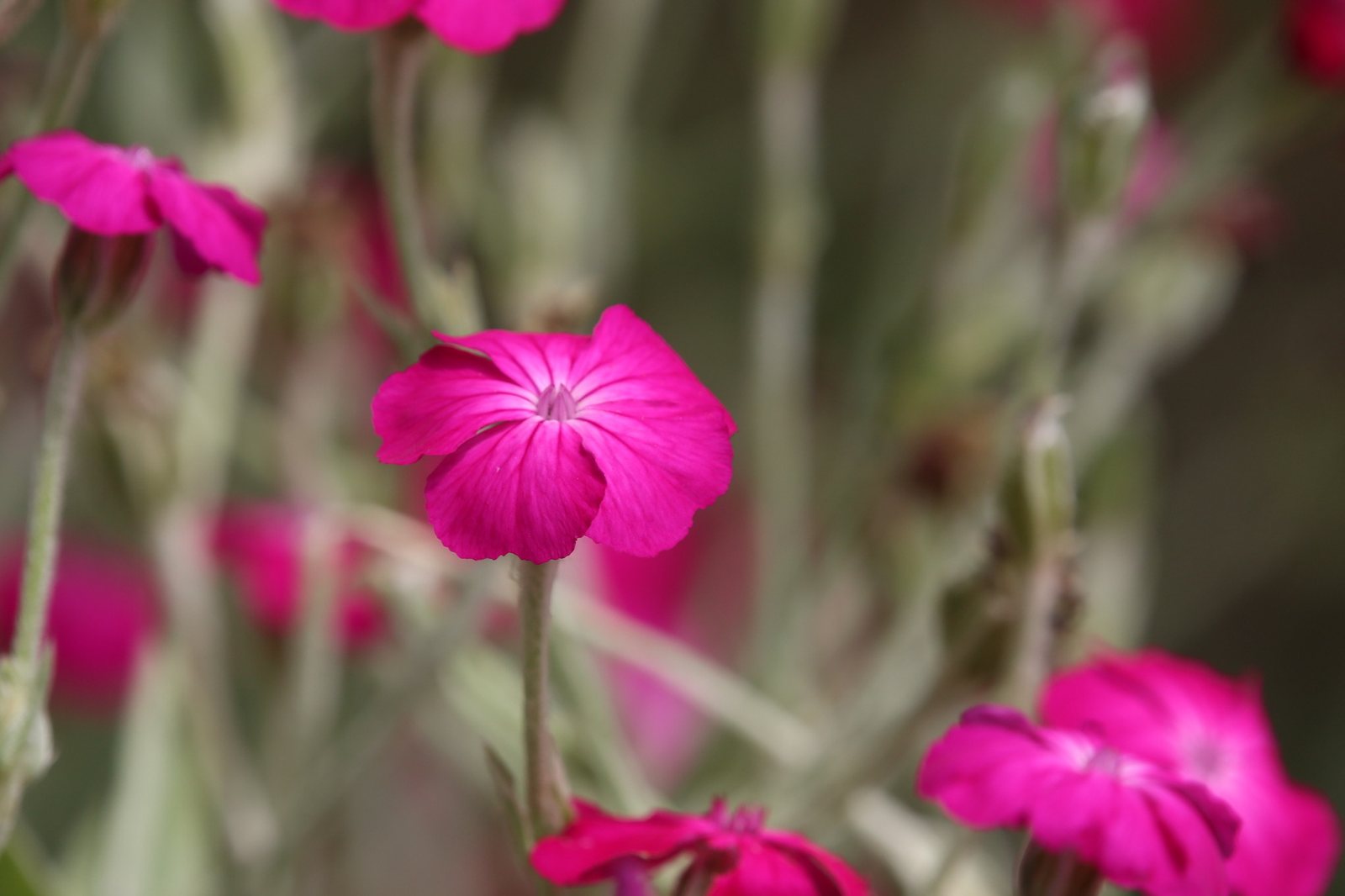
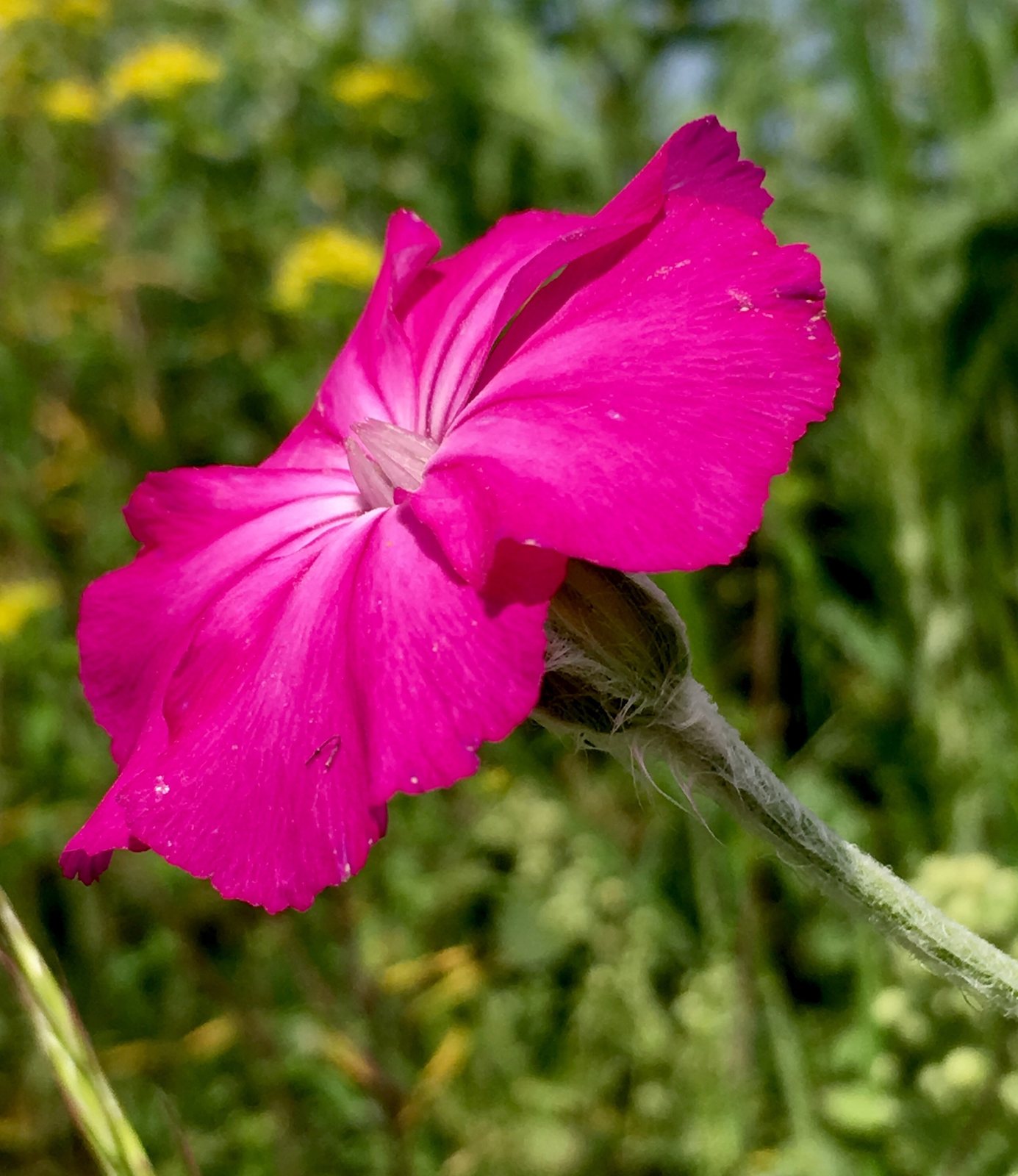
Rose campion is a short-lived perennial, often grown as a biennial, with woolly silver leaves and vivid magenta flowers on branching stems. Gardeners grow it for its strong colour contrast, drought tolerance once established and ability to seed into sunny borders and gravel.
At a glance
- Sun
- Full sun is best; tolerates light partial shade but flowers less freely.
- Water
- Water regularly while establishing, then only during prolonged dry spells. Avoid persistently wet soil, especially in winter.
- Soil
- Well-drained sandy, gravelly or loamy soil, including relatively poor soil; tolerates acidic, neutral and alkaline conditions.
- Height
- 2-3 ft (0.6-0.9 m)
- Spread
- 1-1.5 ft (0.3-0.45 m)
- Flowers
- Late spring through summer; typically vivid magenta, with white and pale pink forms also available.
- Foliage
- Evergreen. Soft, densely woolly, silver-grey leaves form basal rosettes and clothe the upright flowering stems.
- Growth
- Fast; usually forms a leafy rosette in its first year and flowers in its second.
- Care needed
- Low
The year at a glance
- Pollinators
- Deer resistant
- Drought tolerant
- Cold hardy
- Low allergen
| J | F | M | A | M | J | J | A | S | O | N | D | |
|---|---|---|---|---|---|---|---|---|---|---|---|---|
| Flowers | ||||||||||||
| Plant |
Northern hemisphere months. In Australia, shift them by six.
- Difficulty
- Easy
- Toughness
- Very tough
Will it suit your garden?
Pick your zone, country, light and whether you have pets.
Full sun is 6 or more hours of direct sun a day, part shade 3 to 6 hours, shade under 3.
How it grows
Planting day
1 ft (0.3 m)
After 1 year
1.7 ft (0.53 m)
After 2 years
2.5 ft (0.75 m)
full size
About 2 years to full size.
From a typical nursery size, at an average rate for this kind of plant. A rule of thumb, not a forecast.
Good to know
- Cats and dogs
- Safe
- Invasive in
- Australia
- In the garden
- Spreads vigorously: plan to contain it.
- Growth rate
- Fast
Care
Jobs through the year
- WaterApr–May, Sep, every 21 days
- Established plants need water only in prolonged drought; water new plants as soil starts drying.
- WaterJun–Aug, every 14 days
- Water established plants only during prolonged dry spells; allow soil to dry between waterings.
- PruneMar
- Remove dead rosette leaves and thin overcrowded seedlings.
- DeadheadJun–Aug, every 7 days
- Remove faded flowers to extend blooming; leave a few stems for replacement seedlings.
- PruneAug–Sep
- Cut finished flowering stems down to the basal rosette.
- MulchMar–Apr
- Use a light gravel mulch rather than moisture-retentive material around crowns.
- ProtectJan–Feb, Nov–Dec
- Keep wet leaves and organic mulch off crowns and maintain sharp drainage.
- Plant with the crown at soil level in a sunny position with sharp drainage.
- Water new plants when the soil begins to dry; established plants need little supplementary watering.
- Skip routine feeding; rich soil and excess nitrogen encourage floppy growth.
- Use gravel rather than moisture-retentive mulch around the crown.
- Keep a few seedlings to replace ageing plants, and remove unwanted seedlings while small.
Pruning. Remove fading flower stems during summer to prolong flowering and limit self-seeding. After flowering, cut spent stems down to the basal rosette, leaving a few seed heads only where you want replacements.
Through the year
- Early spring
- Remove dead leaves, check crowns for winter rot and thin overcrowded seedlings.
- Spring
- Plant young plants after the soil becomes workable; water until established.
- Late spring
- Sow seed on the surface of well-drained seed compost, pressing it in without burying it.
- Summer
- Deadhead regularly, or mark a few stems to leave for seed.
- Late summer
- Collect ripe seed when capsules turn brown, before they shed it.
- Autumn
- Move small self-sown rosettes into their final positions where winters are mild and drainage is good.
- Winter
- Keep fallen leaves and wet mulch away from the crowns.
In the garden
- Repeat small groups through a sunny cottage border to link other flowers with silver foliage.
- Plant among lavender, catmint and ornamental grasses in gravel gardens for contrasting colour and texture.
- Use magenta-flowered plants beside blue and purple flowers for a strong summer contrast.
- Allow a controlled scattering along sunny path edges, removing seedlings that crowd paving or neighbouring plants.
Garden styles it suits: Cottage garden, English country, Dry gravel garden, Mediterranean, Pollinator garden and Low-maintenance.
Plant it with: Lavender, Catmint, Yarrow, Hardy salvia, Lamb's ears and Feather grass.
Wildlife: Flowers provide nectar and pollen for visiting bees, butterflies and other insects. The plant is not native to the United States, Canada, the United Kingdom or Australia.
Problems to watch for
- Crown or root rot in wet soil: improve drainage, keep mulch clear of the crown and replace badly affected plants.
- Floppy stems in shade or rich soil: move to full sun, stop feeding and support stems discreetly if needed.
- Excessive self-seeding: cut off flower stems before seed capsules ripen and pull surplus seedlings.
- Plants dying after a few flowering seasons: this is normal for a short-lived perennial; retain young rosettes or sow replacements.
Safety
Not generally known to be toxic to people, cats, dogs or horses, though species-specific safety information is limited. It is not an edible plant; avoid eating any part and discourage pets from chewing it.
Where it spreads. Self-seeds freely and can escape into dry, disturbed ground. It is regarded as an environmental weed in parts of Victoria, Australia; prevent seed escape near bushland and check local guidance before planting.
Easily confused with
Lamb's ears (Stachys byzantina)
Both have woolly silver leaves, but lamb's ears forms spreading mats and carries small flowers in dense spikes rather than large, open flowers on branching stems.
White campion (Silene latifolia)
White campion has greener, less densely woolly leaves and white flowers with conspicuously inflated calyces; white-flowered rose campion retains its dense silver felt.
Corncockle (Agrostemma githago)
Corncockle is an annual with narrow, greener leaves and long, pointed calyx lobes extending beyond its pink-purple petals.
The name
The epithet coronaria means 'used for garlands', referring to the plant's historical use in wreaths.
Propagation. Grow from seed sown on the surface of seed compost in spring or early summer; light helps germination. Transplant self-sown rosettes while small. Seedlings may differ in flower colour, and most flower the following year.
Checked against open data
- Accepted botanical name
- Silene coronaria
- In the US and Canada
- Introduced in Canada and the lower 48 states.
- Native range
- Albania, Bulgaria, Czechoslovakia, Greece, Hungary, Iran, Italy, Kazakhstan, Krym, Romania, Tadzhikistan and Transcaucasus.
- Measured
- Average height 60 cm.
Sources: GBIF (CC BY 4.0), USDA PLANTS and Trefle (CC BY 4.0). The care and design notes are LandscapeGPT's own.
See it in your own yard.
Upload a photo of your yard and see it redesigned with plants that suit your climate, each checked against your zone.