Rosemary-leaved barberry
Berberis × stenophylla. Family Berberidaceae. Shrub.
Also called Narrow-leaved barberry, Rosemary barberry.
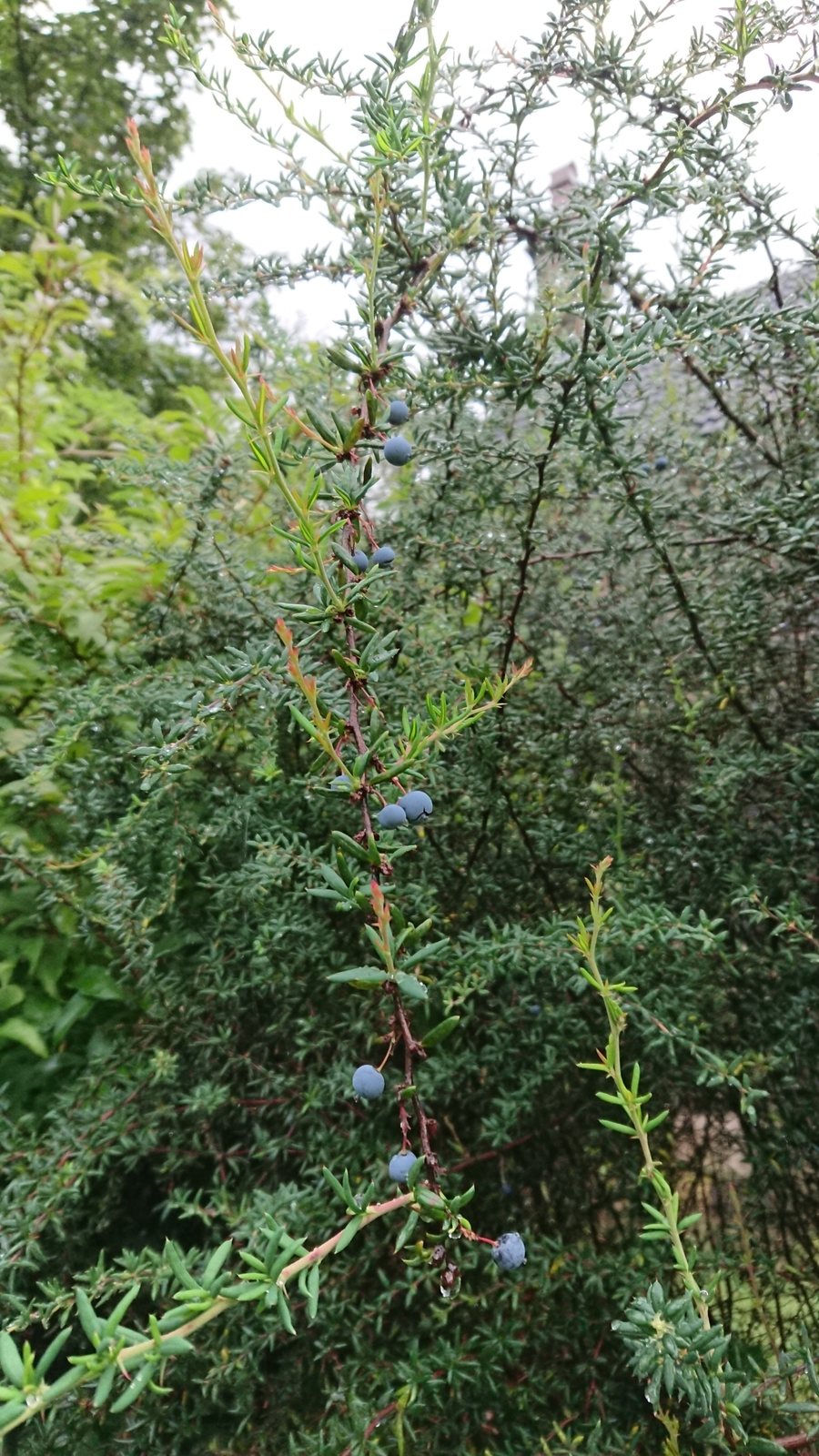
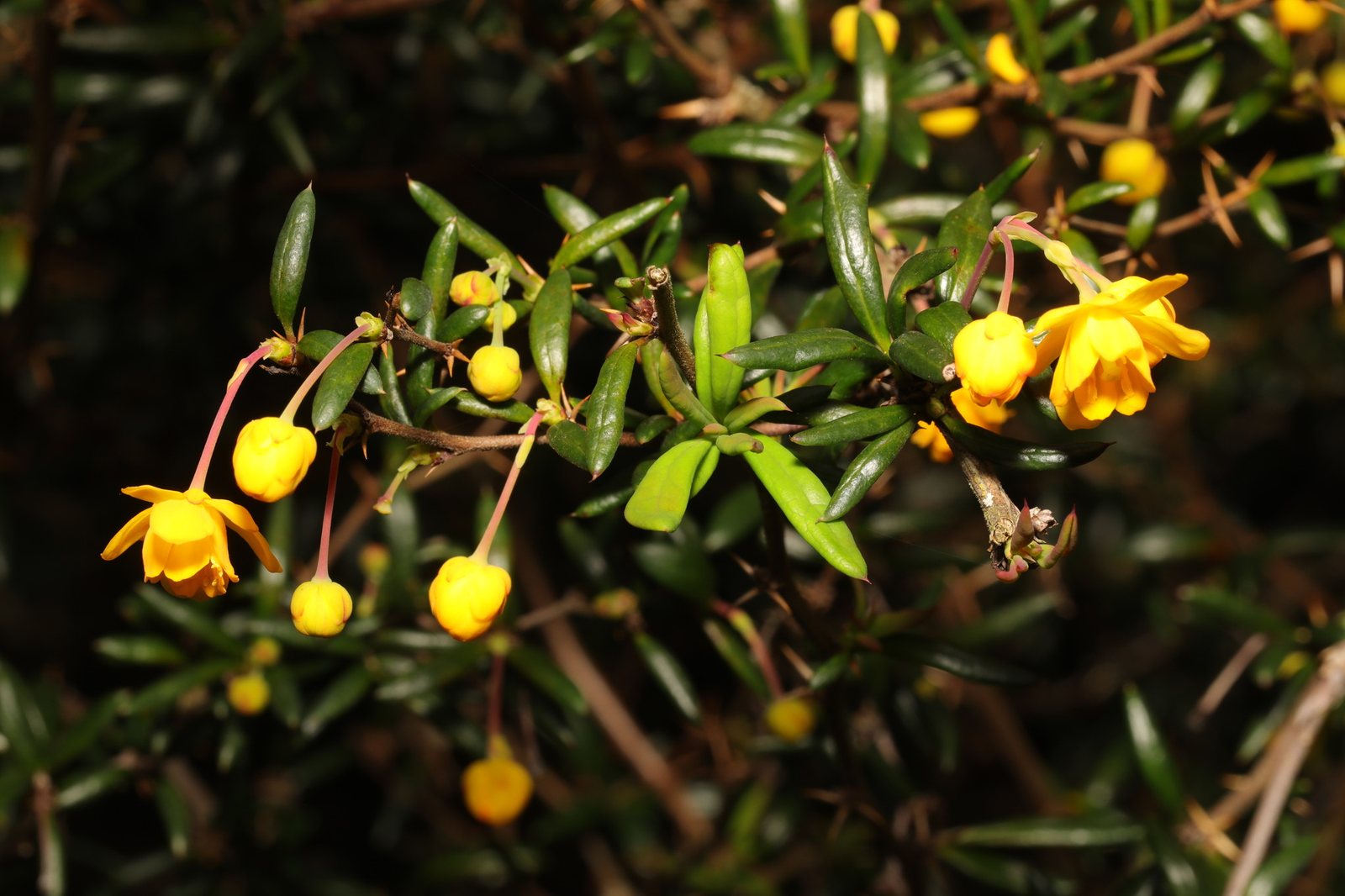
An evergreen, thorny shrub with arching branches, narrow dark-green leaves and masses of golden-yellow spring flowers. Gardeners grow it as an informal hedge, a barrier or a large border shrub; its spreading branches need room away from paths.
At a glance
- Sun
- Full sun or partial shade; flowering is usually best in sun.
- Water
- Moderate while establishing; fairly drought-tolerant once established, but benefits from deep watering during prolonged dry spells.
- Soil
- Well-drained soil, including clay that does not remain waterlogged; tolerates acidic, neutral and alkaline conditions.
- Height
- 8-10 ft (2.4-3 m)
- Spread
- 8-12 ft (2.4-3.7 m)
- Flowers
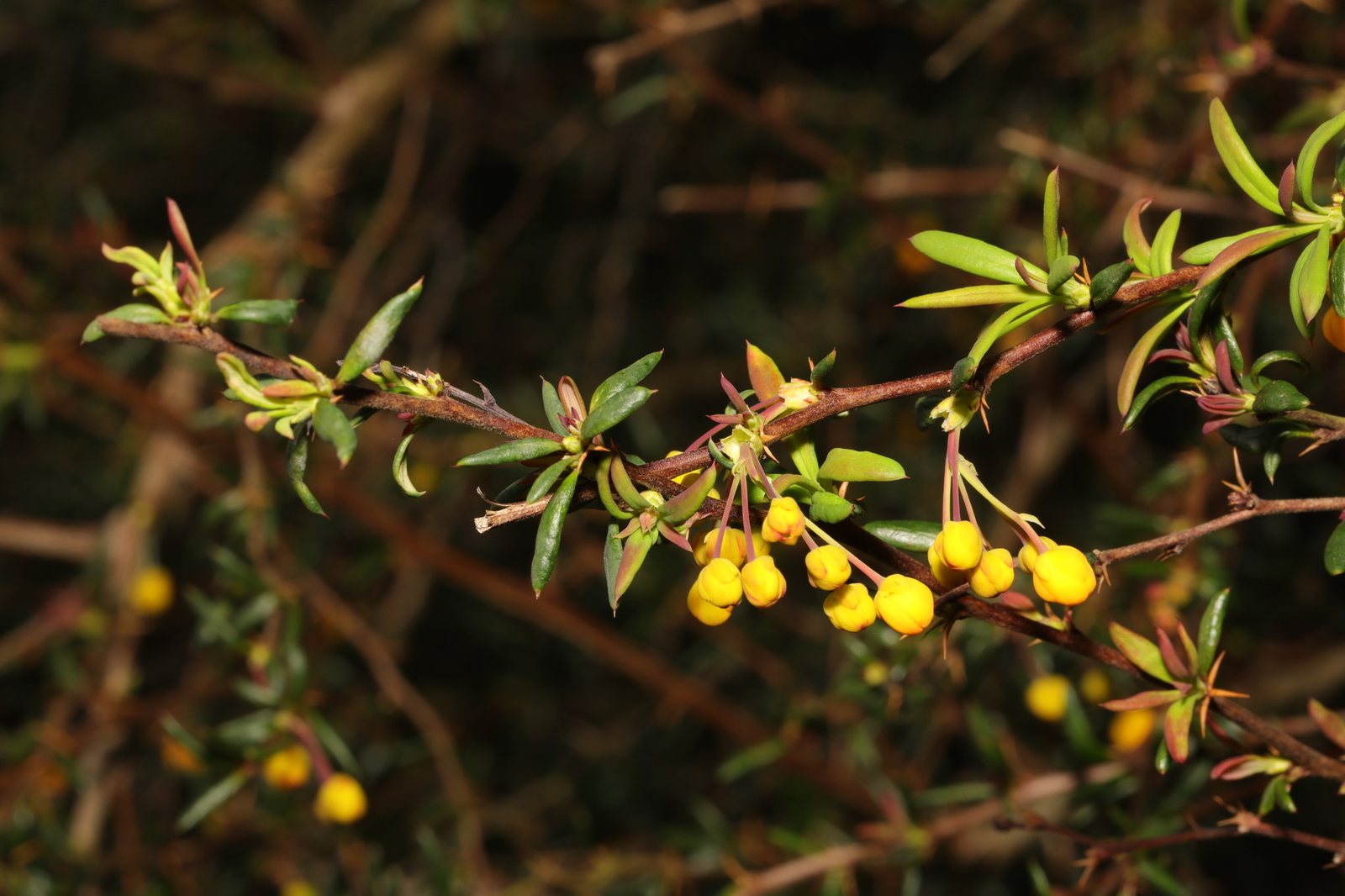
- Golden-yellow flowers in small clusters along the branches in mid- to late spring.
- Foliage
- Small, narrow, dark-green evergreen leaves with rolled-under edges and paler undersides; branches carry sharp spines.
- Growth
- Moderate to fast
- Care needed
- Low
The year at a glance
- Pollinators
- Deer resistant
- Drought tolerant
- Heat tolerant
- Wildlife
- Low allergen
| J | F | M | A | M | J | J | A | S | O | N | D | |
|---|---|---|---|---|---|---|---|---|---|---|---|---|
| Flowers | ||||||||||||
| Fruit | ||||||||||||
| Plant |
Northern hemisphere months. In Australia, shift them by six.
- Difficulty
- Easy
- Toughness
- Very tough
Will it suit your garden?
Pick your zone, country, light and whether you have pets.
Full sun is 6 or more hours of direct sun a day, part shade 3 to 6 hours, shade under 3.
How it grows
Planting day
1.6 ft (0.5 m)
After 1 year
3 ft (1.1 m)
After 2 years
5 ft (1.6 m)
After 3 years
7 ft (2.2 m)
After 5 years
9 ft (2.7 m)
full size
About 4 years to full size.
From a typical nursery size, at an average rate for this kind of plant. A rule of thumb, not a forecast.
Good to know
- Cats and dogs
- Mildly toxic: may upset a stomach
- Growth rate
- Fast
Care
Jobs through the year
- WaterApr–May, Sep–Oct, every 21 days
- Water established shrubs only during prolonged dry spells; water more frequently for the first two growing seasons.
- WaterJun–Aug, every 14 days
- Water established shrubs deeply during prolonged drought, allowing soil to drain between waterings.
- MulchMar–Apr
- Apply 5–8 cm of organic mulch, keeping it clear of the thorny stems.
- PruneMar–Apr
- Remove winter-killed stems once healthy growth is distinguishable; wear thick gloves and protect your arms.
- PruneMay–Jun
- Immediately after flowering, shorten wayward shoots; for renewal remove up to one-third of the oldest stems.
- ProtectJan–Feb, Nov–Dec
- Shelter exposed plants from cold, drying winds, especially near the cold end of their hardiness range.
- Water deeply during dry weather for the first two growing seasons.
- Apply a 2-3 in (5-8 cm) organic mulch in spring, keeping it clear of the stems.
- Avoid routine feeding on reasonably fertile soil; excess nitrogen encourages leafy growth rather than flowers.
- Choose a sheltered position near the cold end of its hardiness range, where winter wind can scorch the foliage.
- Wear thick gloves and protect your arms when handling the thorny branches.
Pruning. Prune immediately after flowering, shortening wayward shoots and removing dead or damaged wood. To renew an overgrown shrub gradually, remove up to one-third of the oldest stems at ground level each year; regular shearing reduces its arching shape and subsequent berry display.
Through the year
- Early spring
- Check for winter damage and remove dead stems once healthy growth is distinguishable.
- Spring
- Refresh the mulch and water newly planted shrubs if rainfall is low.
- Late spring
- After flowering, prune only where needed to control size or renew old stems.
- Summer
- Water young plants during dry spells and check shoot tips for aphids.
- Late summer
- Take semi-ripe cuttings from healthy, non-flowering shoots.
- Autumn
- Plant in mild regions while the soil is moist but not waterlogged; in colder regions, wait until spring.
In the garden
- Grow as an informal boundary hedge where its thorny branches can discourage access.
- Place at the back of a mixed shrub border, allowing space for the branches to arch naturally.
- Use as an evergreen backdrop to spring bulbs and later-flowering perennials.
- Plant on a sunny bank with other drought-tolerant shrubs once established.
Garden styles it suits: English country, Cottage garden, Traditional, Wildlife garden, Native hedgerow and Low-maintenance.
Plant it with: Daffodils, Hardy geraniums, Lavender, Rock roses, Shrubby cinquefoil and Ornamental sages.
Wildlife: Flowers provide pollen and nectar for visiting insects. The blue-black berries are eaten by birds, and dense, thorny growth offers shelter and potential nesting sites.
Problems to watch for
- Waterlogging can cause root decline: improve drainage or move the shrub rather than continuing to water yellowing plants.
- Aphids may gather on young shoots: wash off small colonies and allow ladybirds and other predators to control them.
- Powdery mildew can affect crowded or stressed plants: improve air circulation and water the root zone during drought.
- Cold, drying winds can scorch leaves: provide shelter and remove damaged growth in spring once the extent of injury is clear.
Safety
Not known to be toxic to cats, dogs or horses, although information specific to this hybrid is limited. It is not grown as a food plant: people and pets should not eat the leaves, bark or roots, which contain alkaloids and may cause stomach upset. The sharp spines are a more immediate injury risk.
Easily confused with
Darwin's barberry (Berberis darwinii)
Has broader, glossy, holly-like leaves with obvious teeth and usually deeper orange-yellow flowers; rosemary-leaved barberry has much narrower leaves with rolled edges.
Rosemary (Salvia rosmarinus)
Has strongly aromatic leaves, no sharp branch spines and usually blue or lilac flowers rather than clusters of yellow flowers.
Japanese barberry (Berberis thunbergii)
Usually loses its leaves in winter and has broader, rounded leaves and red berries, unlike this evergreen shrub with narrow leaves and blue-black berries.
The name
The epithet stenophylla means narrow-leaved, while the common name refers to the foliage's resemblance to rosemary; the × marks its hybrid origin from Berberis darwinii and Berberis empetrifolia.
Propagation. Take semi-ripe cuttings in late summer or layer a low branch. Seedlings may differ from the parent because this is a hybrid.
Checked against open data
- Accepted botanical name
- Berberis stenophylla
Sources: GBIF (CC BY 4.0). The care and design notes are LandscapeGPT's own.
See it in your own yard.
Upload a photo of your yard and see it redesigned with plants that suit your climate, each checked against your zone.