Scarlet banksia
Banksia coccinea. Family Proteaceae. Shrub.
Also called Waratah banksia, Albany banksia.
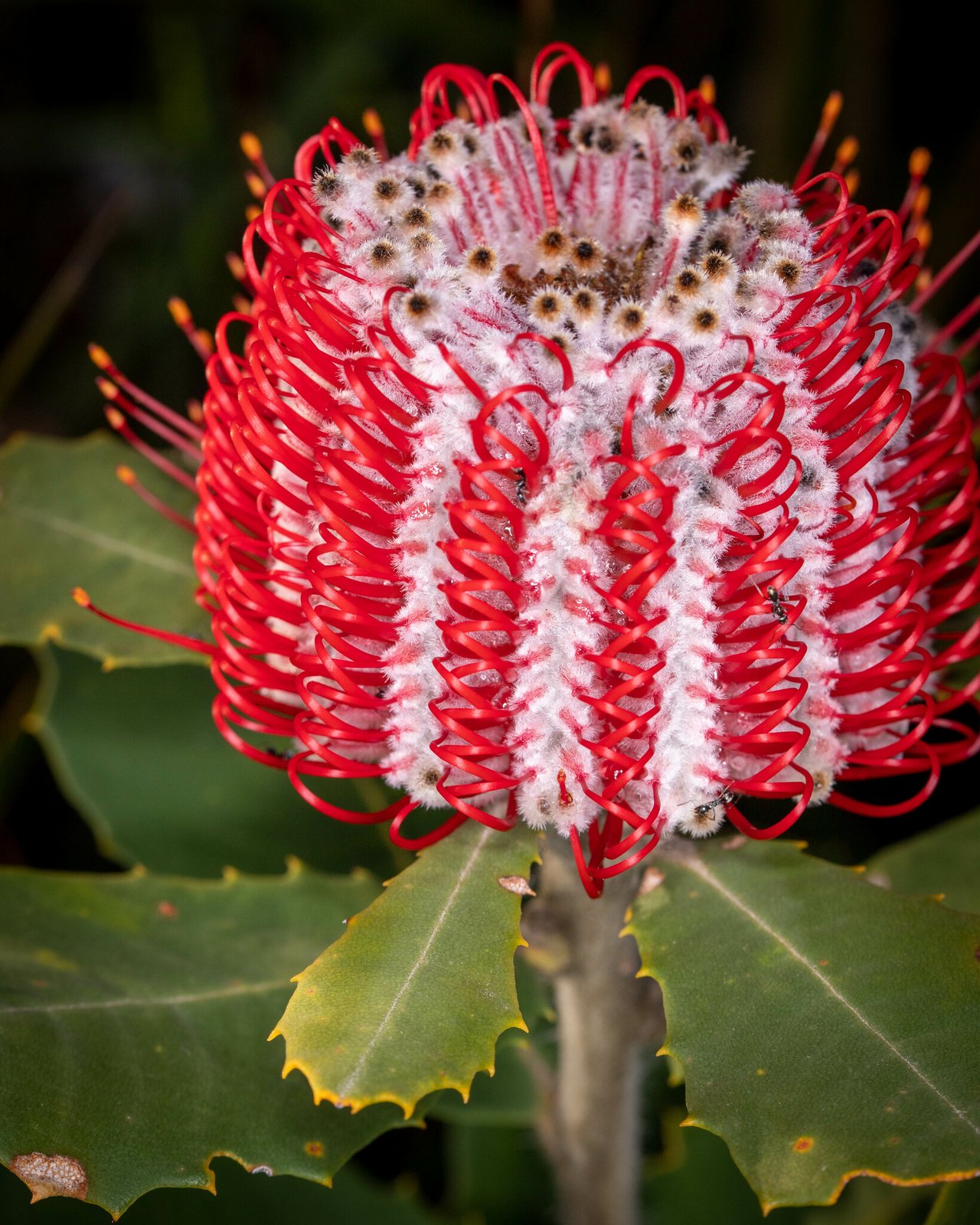
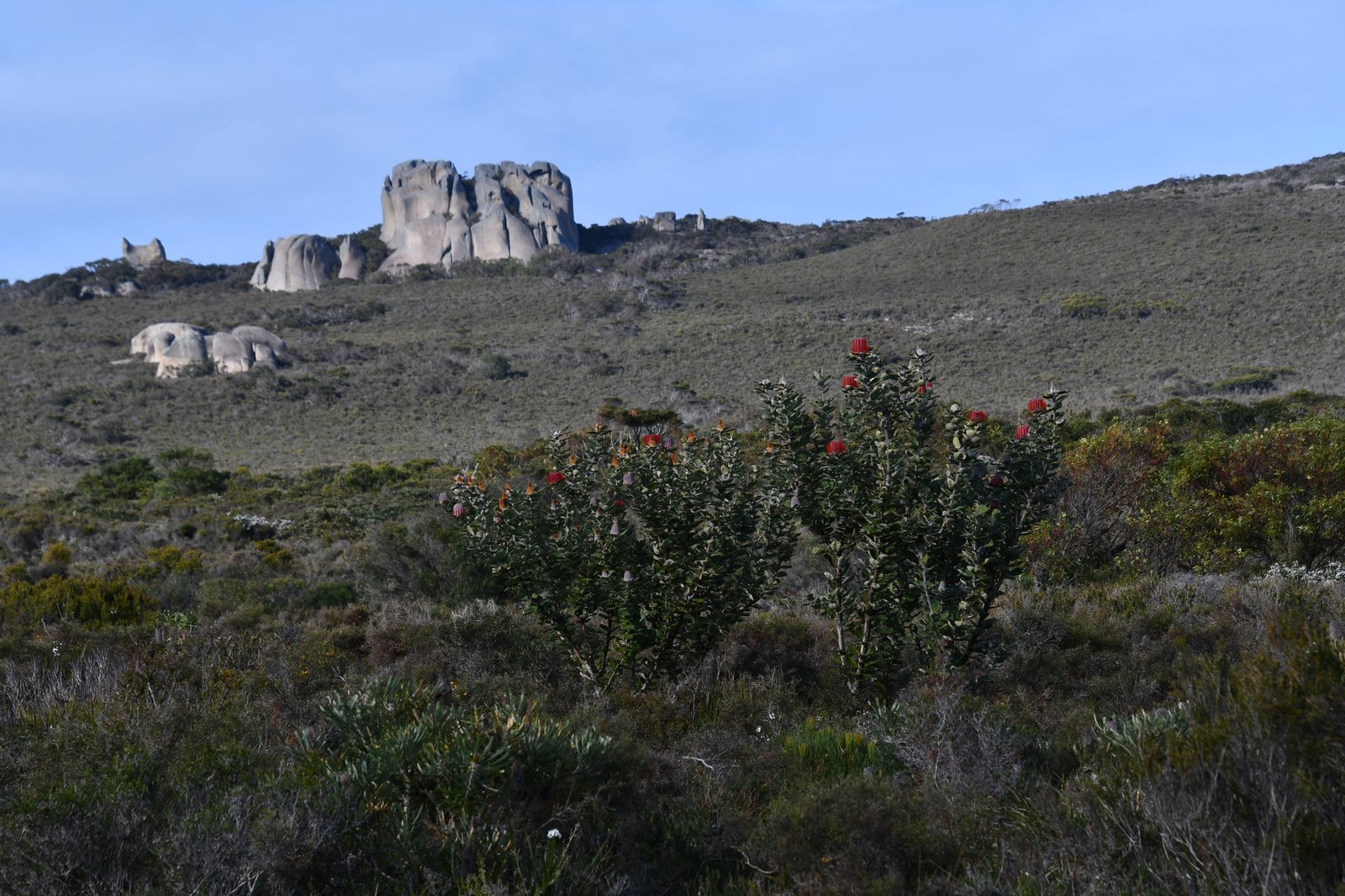
Scarlet banksia is an upright evergreen shrub or small tree from southwestern Australia, grown for its striking red flower heads and leathery, toothed leaves. It performs best in sunny gardens with sandy soil, dry summers and mild winters; humid summers and poorly drained soil make it difficult to grow.
At a glance
- Sun
- Full sun, with good air circulation.
- Water
- Water regularly while establishing, allowing the soil to drain between waterings. Once established, water deeply only during prolonged dry spells; avoid keeping the root zone continuously wet.
- Soil
- Freely drained, acidic to neutral sand or sandy loam with low phosphorus levels. Unsuitable for heavy clay, waterlogged ground or strongly alkaline soil.
- Height
- 6-15 ft (1.8-4.6 m), occasionally reaching 25 ft (7.6 m)
- Spread
- 5-10 ft (1.5-3 m)
- Flowers
- Winter through spring, sometimes extending into early summer; upright flower heads with scarlet styles contrasting with grey-white flowers.
- Foliage
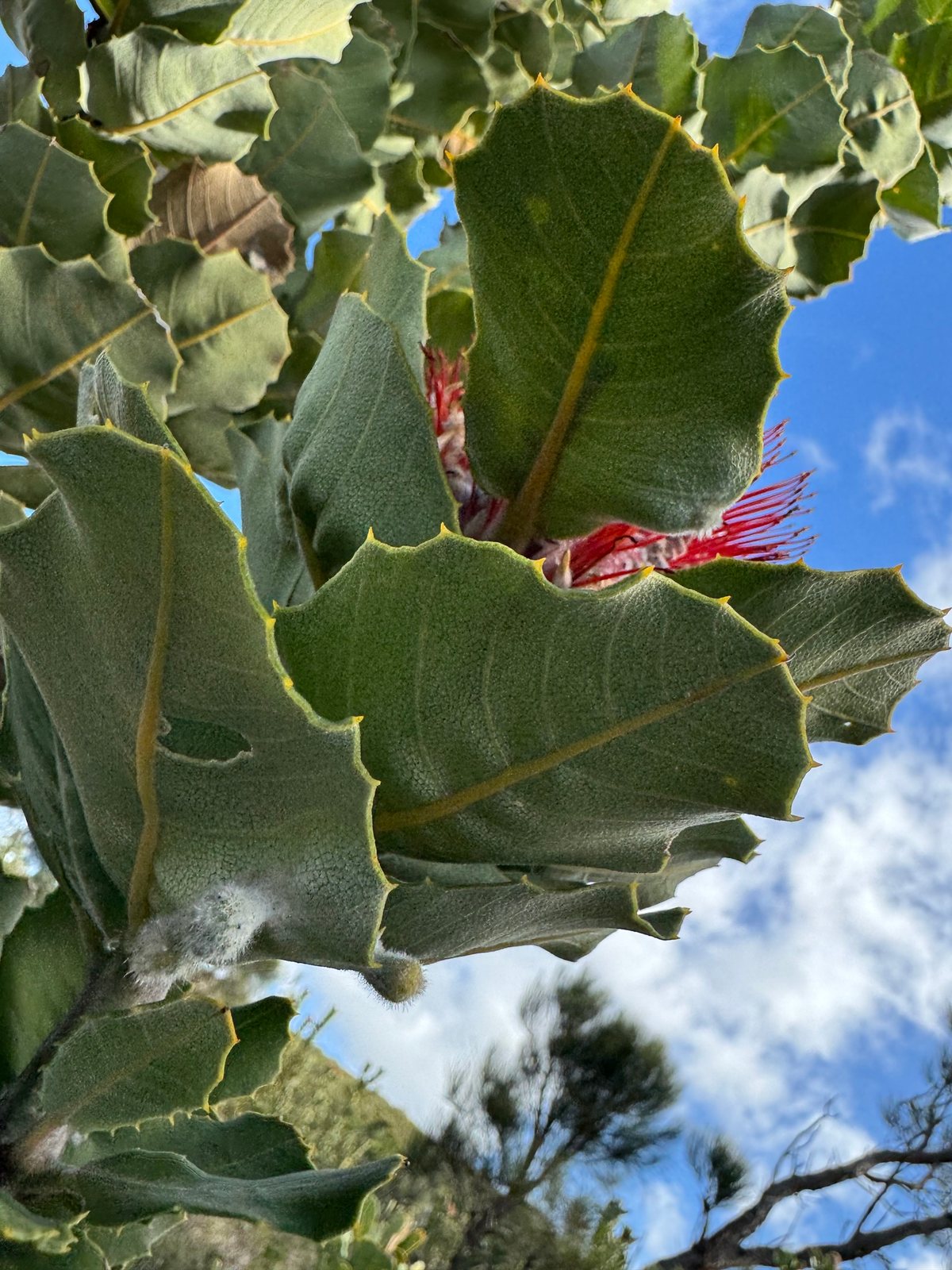
- Evergreen. Broad, leathery, grey-green leaves with blunt, conspicuous teeth and pale, felted undersides.
- Growth
- Moderate in suitable conditions; slow when stressed.
- Care needed
- High
The year at a glance
- Pollinators
- Drought tolerant
- Heat tolerant
- Wildlife
- Low allergen
| J | F | M | A | M | J | J | A | S | O | N | D | |
|---|---|---|---|---|---|---|---|---|---|---|---|---|
| Flowers | ||||||||||||
| Fruit | ||||||||||||
| Plant |
Northern hemisphere months. In Australia, shift them by six.
- Difficulty
- Hard
- Toughness
- Needs looking after
Will it suit your garden?
Pick your zone, country, light and whether you have pets.
Full sun is 6 or more hours of direct sun a day, part shade 3 to 6 hours, shade under 3.
How it grows
Planting day
1.6 ft (0.5 m)
After 1 year
3 ft (0.92 m)
After 2 years
4 ft (1.3 m)
After 3 years
6 ft (1.7 m)
After 5 years
8 ft (2.6 m)
About 7 years to full size.
From a typical nursery size, at an average rate for this kind of plant. A rule of thumb, not a forecast.
Good to know
- Cats and dogs
- Safe
- Native to
- Australia
- Growth rate
- Slow
Care
Jobs through the year
- WaterApr–May, Sep, every 14 days
- Water established plants only when the upper soil dries; young plants and pots need closer checks.
- WaterJun–Aug, every 14 days
- Water established plants deeply during prolonged drought, allowing soil to dry between waterings.
- WaterJan–Mar, Oct–Dec, every 14 days
- Under winter cover, water only as needed after the upper compost dries; never leave pots standing in water.
- FeedMar–Apr
- If needed, feed sparingly with fertiliser specifically formulated for phosphorus-sensitive Australian natives.
- MulchMay
- Apply a light coarse mulch clear of the trunk; avoid manure and phosphorus-rich compost.
- PruneMay–Jun
- After flowering, lightly tip-prune young growth; never cut hard into bare old wood.
- ProtectJan–Apr, Oct–Dec
- Not hardy here; overwinter in a bright, airy, frost-free conservatory with excellent drainage.
- Plant in autumn in mild climates, or spring where winter frost is a concern, without disturbing the root ball.
- Water deeply during establishment, then let the upper soil dry before watering again.
- Use only a low-phosphorus fertiliser formulated for phosphorus-sensitive Australian natives, and feed sparingly.
- Apply a light layer of coarse mulch, keeping it clear of the trunk.
- Keep soil and tools clean to reduce the risk of introducing root-rot pathogens.
- Protect young plants from frost and cold, drying winds.
Pruning. Lightly tip-prune young plants after flowering to encourage branching, and remove dead or damaged growth. Do not cut hard into old, leafless wood: this species lacks a lignotuber and does not reliably regenerate after severe pruning.
Through the year
- Autumn
- Plant in mild-winter areas once the soil is moist but freely drained.
- Winter
- Protect young plants during frost forecasts and check that rainwater drains away promptly.
- Spring
- Enjoy the flowers and watch for birds visiting the nectar-rich heads.
- Late spring
- After flowering, lightly tip-prune young growth without cutting into bare old wood.
- Summer
- Check newly planted shrubs regularly and water deeply when their root zone begins to dry.
- Late summer
- Inspect for dieback and drainage problems; avoid extra watering if the soil is already moist.
In the garden
- Use as a flowering focal point in a sunny Australian native garden.
- Combine with kangaroo paws and waxflowers in a low-phosphorus, sandy-soil planting.
- Plant in a sheltered coastal garden set back from direct salt spray.
- Use its upright form and bold flower heads against a plain wall, leaving space for airflow.
- Include in a wildlife garden where nectar-feeding birds can reach the flowers.
Garden styles it suits: Australian native, Mediterranean, Coastal, Architectural minimal, Wildlife garden and Dry gravel garden.
Plant it with: Kangaroo paw, Geraldton wax, Woolly bush and Coastal rosemary.
Wildlife: Nectar-rich flowers attract honeyeaters and other nectar-feeding birds in Australia, as well as visiting insects. Woody seed follicles provide seed for some birds.
Problems to watch for
- Phytophthora root rot: this species is highly susceptible. Start with healthy nursery plants, maintain excellent drainage and avoid moving contaminated soil; badly affected plants usually need removing.
- Phosphorus toxicity: excessive phosphorus can cause leaf damage, decline and death. Avoid ordinary garden fertilisers, manure and phosphorus-rich compost around the roots.
- Yellow leaves on alkaline soil: grow in naturally acidic to neutral soil rather than relying on repeated treatments to correct an unsuitable site.
- Frost injury: protect young plants with horticultural fleece during brief cold spells and choose a sheltered position; prolonged freezing can kill the plant.
Safety
Not known to be toxic to people, cats, dogs or horses. Species-specific safety information is limited, and no part should be treated as food; discourage pets and children from chewing the leaves, flowers or woody seed heads.
Easily confused with
Bird's nest banksia (Banksia baxteri)
Has rounded yellow-green flower heads rather than scarlet ones, and leaves with much deeper, triangular lobes.
Showy banksia (Banksia speciosa)
Has long, narrow leaves with deep triangular teeth and large cream to pale yellow flower heads, rather than the broad leaves and scarlet heads of scarlet banksia.
The name
Banksia honours botanist Sir Joseph Banks, while coccinea means scarlet, referring to the conspicuous red styles in the flower heads.
Propagation. Usually grown from seed sown into a freely draining, low-phosphorus seed mix in mild weather. Fire or smoke treatment is not normally needed for germination. Cuttings are possible but difficult, and seedlings should be handled carefully to avoid root damage.
Checked against open data
- Accepted botanical name
- Banksia coccinea
- Native range
- Western Australia.
Sources: GBIF (CC BY 4.0) and Trefle (CC BY 4.0). The care and design notes are LandscapeGPT's own.
See it in your own yard.
Upload a photo of your yard and see it redesigned with plants that suit your climate, each checked against your zone.