Scarlet bugler
Penstemon barbatus. Family Plantaginaceae. Perennial.
Also called Beardlip penstemon, Scarlet beardtongue.
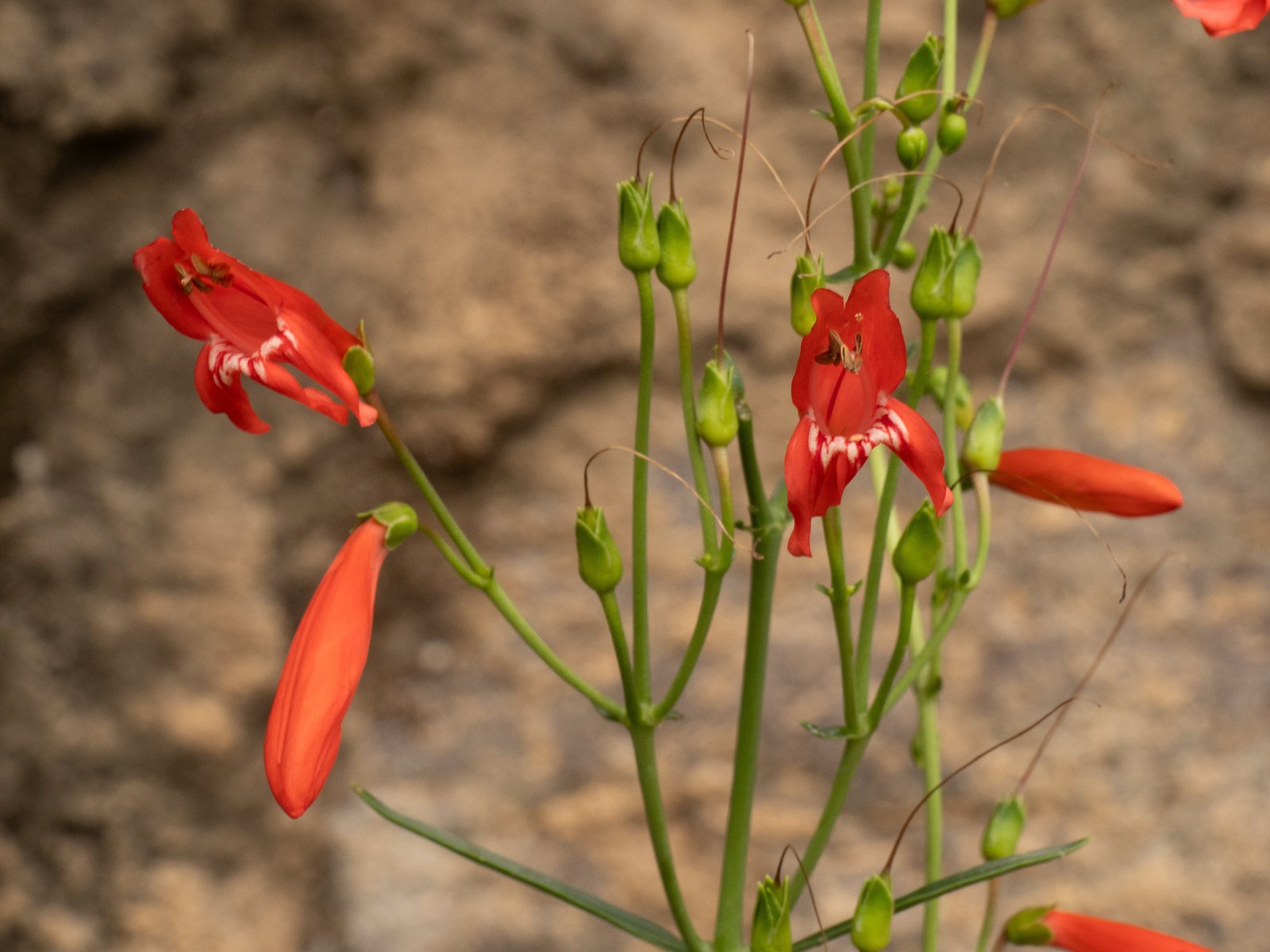
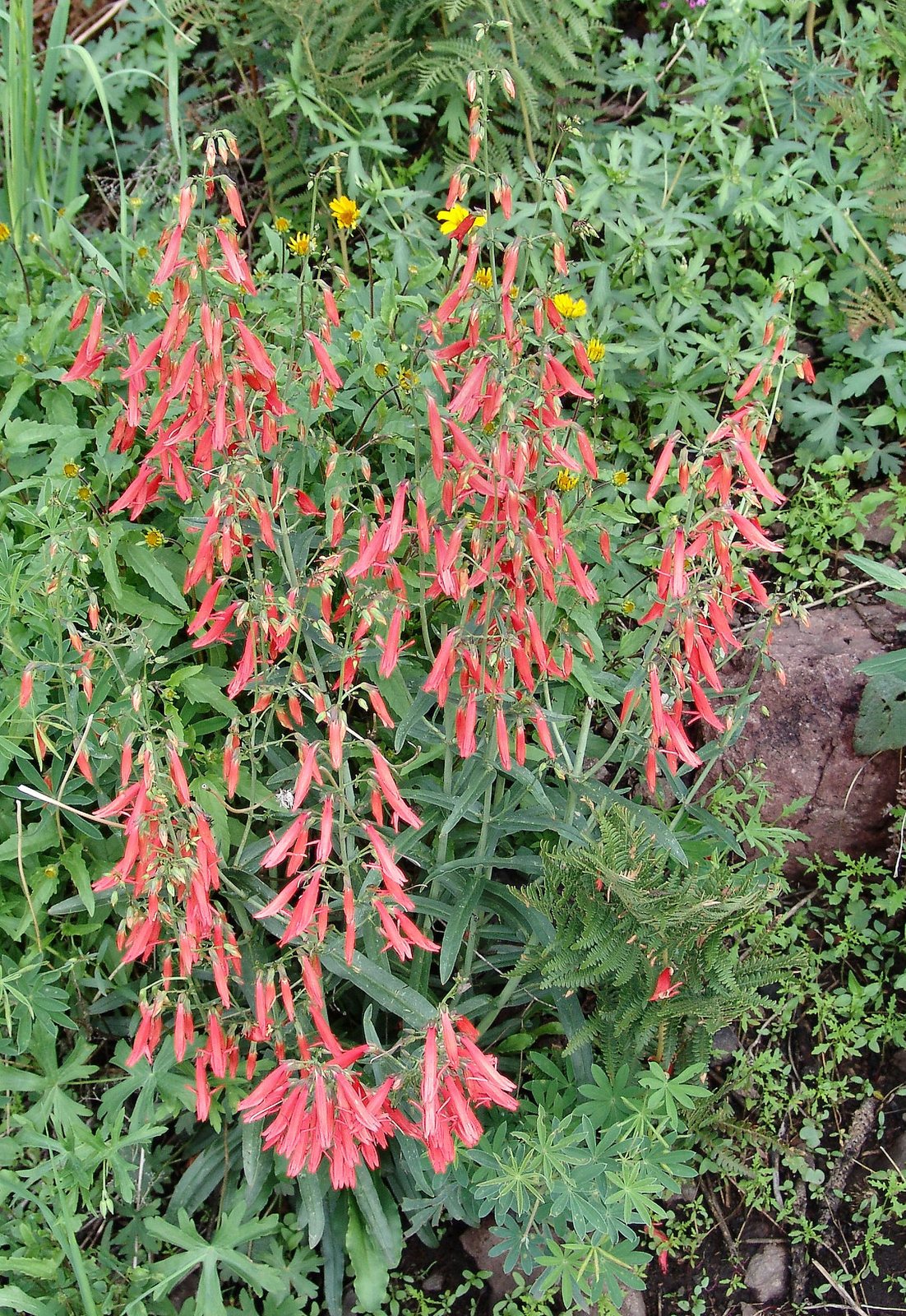
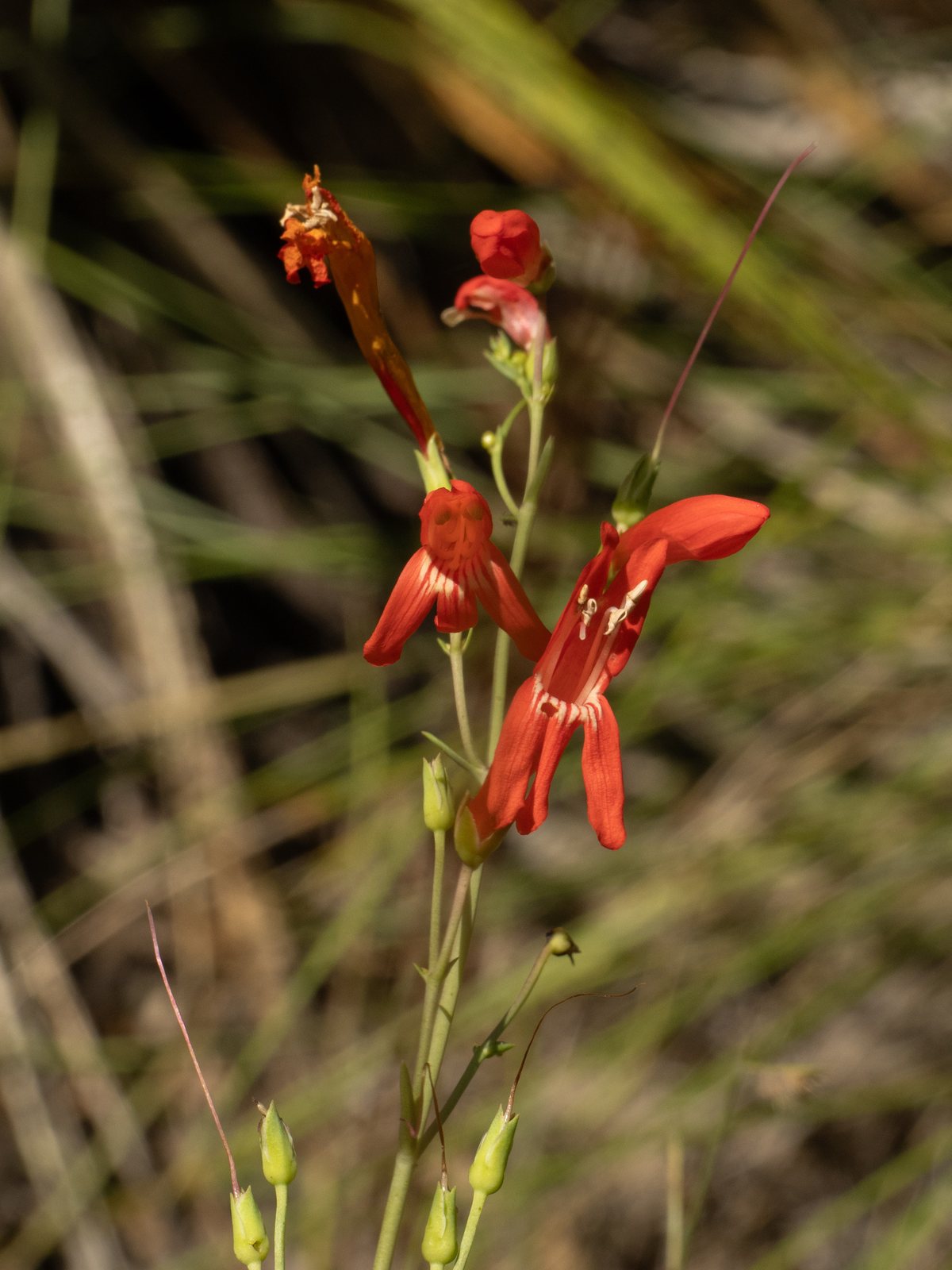
Scarlet bugler is an upright, often short-lived perennial native to the southwestern United States and Mexico. Gardeners grow it for slender spikes of scarlet tubular flowers that attract hummingbirds where they occur. It performs best in sunny, freely drained gardens and dislikes wet winter soil.
At a glance
- Sun
- Full sun; tolerates light afternoon shade in very hot climates.
- Water
- Low once established. Water young plants regularly, then water deeply during prolonged dry spells rather than keeping the soil constantly moist.
- Soil
- Well-drained sandy, gravelly or rocky soil; tolerates lean soil. Avoid heavy, waterlogged clay and heavily enriched planting holes.
- Height
- 2-4 ft (0.6-1.2 m)
- Spread
- 1-2 ft (0.3-0.6 m)
- Flowers
- Late spring through summer, depending on climate; scarlet-red tubular flowers, sometimes followed by a smaller repeat flush.
- Foliage
- Narrow green leaves form a basal clump, with smaller leaves along the upright stems. Basal foliage may persist through mild winters but can die back in colder conditions.
- Growth
- Moderate; flowering stems can reach full height within one growing season.
- Care needed
- Low
The year at a glance
- Pollinators
- Deer resistant
- Drought tolerant
- Cold hardy
- Heat tolerant
- Low allergen
| J | F | M | A | M | J | J | A | S | O | N | D | |
|---|---|---|---|---|---|---|---|---|---|---|---|---|
| Flowers | ||||||||||||
| Fruit | ||||||||||||
| Plant |
Northern hemisphere months. In Australia, shift them by six.
- Difficulty
- Easy
- Toughness
- Very tough
Will it suit your garden?
Pick your zone, country, light and whether you have pets.
Full sun is 6 or more hours of direct sun a day, part shade 3 to 6 hours, shade under 3.
How it grows
Planting day
1 ft (0.3 m)
After 1 year
1.6 ft (0.5 m)
After 2 years
2.3 ft (0.7 m)
After 3 years
3 ft (0.9 m)
full size
About 3 years to full size.
From a typical nursery size, at an average rate for this kind of plant. A rule of thumb, not a forecast.
Good to know
- Cats and dogs
- Safe
- Native to
- the US
- Growth rate
- Moderate
Care
Jobs through the year
- WaterApr–May, Sep, every 21 days
- Water established ground plants only during dry spells; young plants need more frequent watering.
- WaterJun–Aug, every 14 days
- Deeply water established ground plants only during prolonged drought, letting soil dry between soakings.
- PruneMar–Apr
- Remove dead stems once new basal growth appears; retain healthy basal foliage.
- DeadheadJun–Aug, every 14 days
- Cut spent spikes to healthy leafy growth for repeat flowers; leave a few for seed.
- MulchApr
- Apply a thin gravel mulch, keeping the crown exposed.
- ProtectMar–May
- Protect emerging shoots from slugs and snails with hand-picking or approved iron-phosphate bait.
- ProtectJan–Feb, Oct–Dec
- Clear wet debris from the crown and prevent standing water.
- Water through the first growing season whenever the root zone becomes dry; reduce watering once established.
- Keep the crown at soil level and choose a site where winter rain drains away quickly.
- Avoid rich manure and routine high-nitrogen feeding, which encourage weak, leafy growth.
- Use a thin gravel mulch rather than piling damp organic mulch against the crown.
- Support tall stems discreetly in exposed sites if they begin to lean.
Pruning. After the main flowering flush, cut spent flower stems back to healthy leafy growth to encourage further flowers. Leave the basal foliage over winter and remove dead stems in spring once new growth is visible.
Through the year
- Late winter
- Check that water is not collecting around the crown; clear away wet leaves and other debris.
- Spring
- Remove dead stems once new basal growth appears, and plant nursery-grown plants into freely drained soil.
- Late spring
- Check new plants for dry soil and support tall flowering stems in windy positions.
- Summer
- Remove spent flower spikes and water established plants only during extended dry weather.
- Late summer
- Take non-flowering basal cuttings if available, or leave a few flower stems to develop seed.
- Autumn
- Collect ripe seed from dry capsules and leave healthy basal foliage intact for winter.
In the garden
- Plant in loose groups through a sunny gravel garden, where the upright red flowers rise above low-growing plants.
- Combine with blue-flowered catmint or Russian sage for a strong red-and-blue summer contrast.
- Use among fine-textured ornamental grasses in a dry, naturalistic border.
- Place near a patio or path to watch hummingbirds in North American gardens.
Garden styles it suits: Dry gravel garden, Desert / xeriscape, Southwestern, Pollinator garden, Hot border and New perennial (prairie).
Plant it with: Catmint, Russian sage, Yarrow, Blanket flower, Blue grama and Butterfly weed.
Wildlife: The tubular flowers are especially attractive to hummingbirds within their range. Bees also visit, sometimes taking nectar through holes near the flower base.
Problems to watch for
- Crown and root rot in wet soil: improve drainage or move the plant to a raised, gravelly bed; do not keep a rotting crown continually wet.
- Slugs and snails eating young shoots: inspect emerging growth and use barriers, hand-picking or an approved iron-phosphate bait.
- Aphids on tender stems: wash them off with water and encourage natural predators; use insecticidal soap if necessary.
- Flopping stems and poor flowering in shade or rich soil: give more sun, stop nitrogen feeding and support stems if needed.
Safety
Not known to be toxic to people, cats, dogs or horses. Species-specific safety information is limited, so do not treat the flowers, leaves or other parts as edible.
Easily confused with
Firecracker penstemon (Penstemon eatonii)
Also has red tubular flowers, but its leaves are generally broader and its lower flower lobes are less strongly curled backward than those of scarlet bugler.
Cardinal flower (Lobelia cardinalis)
Has broader, toothed leaves and scarlet flowers with a conspicuous spreading three-lobed lower lip. It prefers moist soil rather than the dry, freely drained conditions scarlet bugler needs.
The name
The species name barbatus means 'bearded', referring to the hairs on the lower lip of the flower.
Propagation. Grow from seed or take basal or softwood cuttings from non-flowering shoots in spring or early summer. A period of moist chilling can improve germination of some seed lots. Named cultivars may not come true from seed.
Checked against open data
- Accepted botanical name
- Penstemon barbatus
- In the US and Canada
- Native in the lower 48 states.
- Native range
- Arizona, California, Colorado, Mexico Central, Mexico Gulf, Mexico Northeast, Mexico Northwest, Mexico Southeast, Mexico Southwest, New Mexico, Texas and Utah.
- Measured
- Average height 46 cm.
Sources: GBIF (CC BY 4.0), USDA PLANTS and Trefle (CC BY 4.0). The care and design notes are LandscapeGPT's own.
See it in your own yard.
Upload a photo of your yard and see it redesigned with plants that suit your climate, each checked against your zone.