Scouring rush
Equisetum hyemale. Family Equisetaceae. Perennial.
Also called Rough horsetail, Dutch rush.
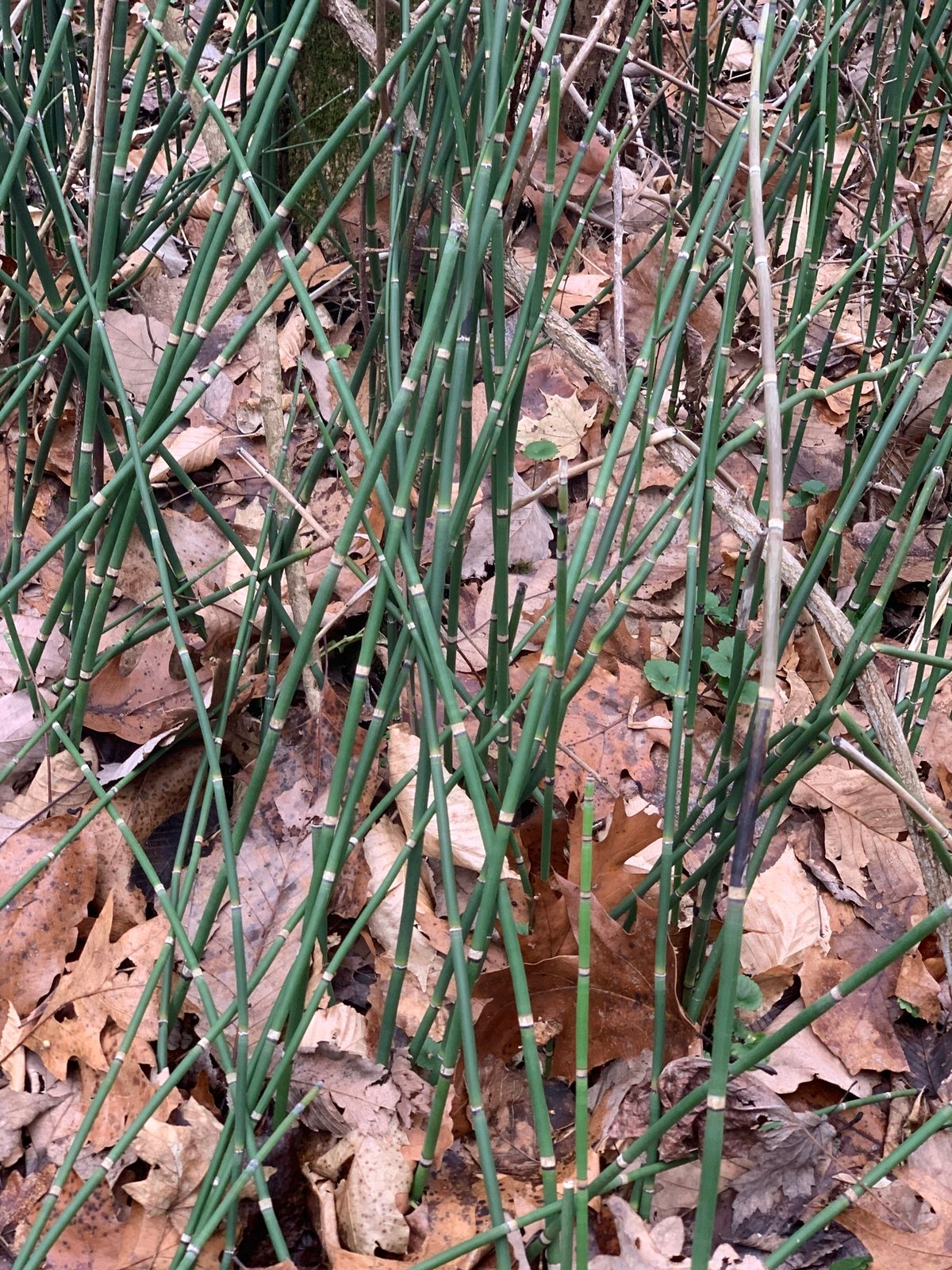
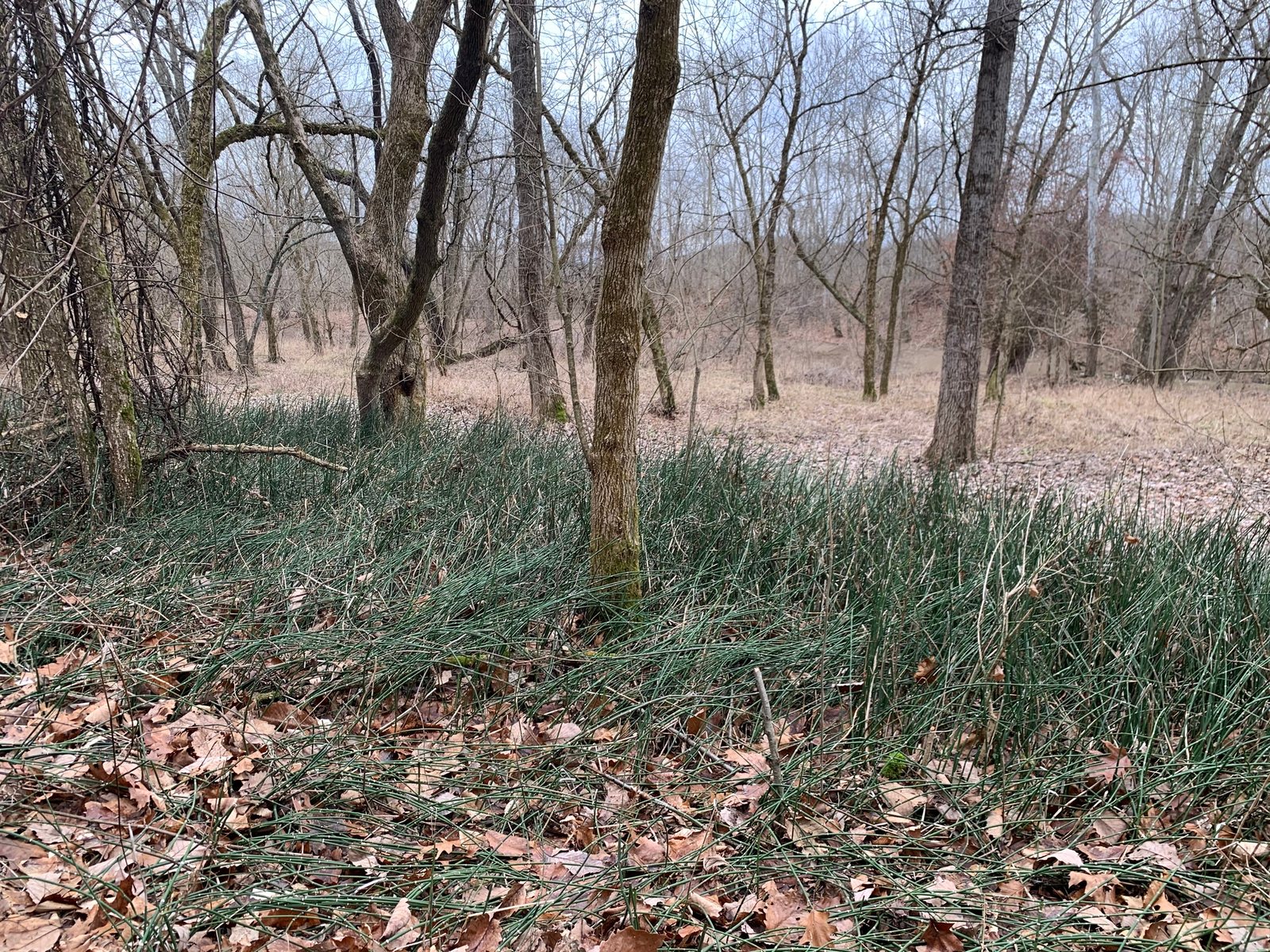
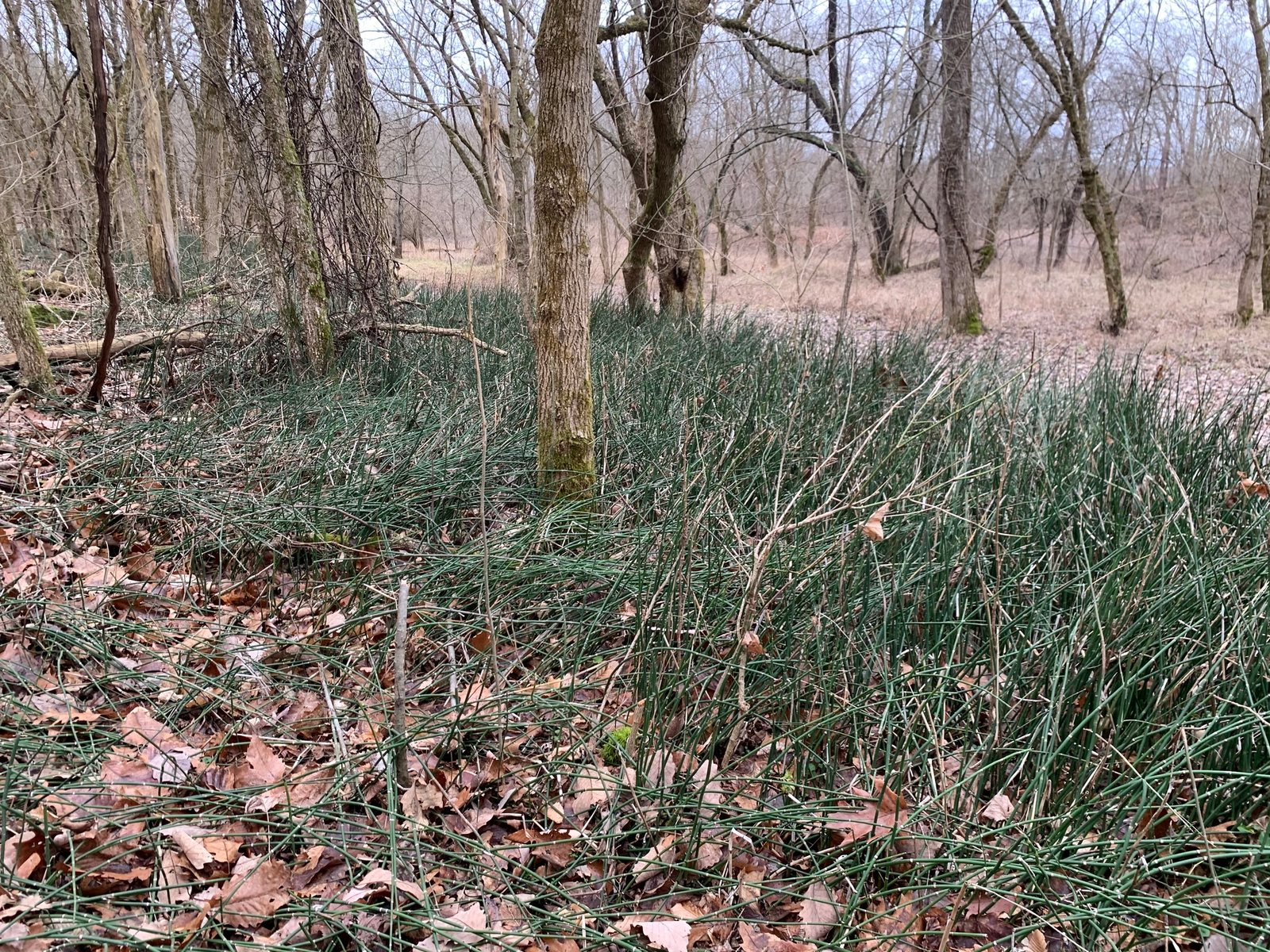
Scouring rush is a spreading, spore-producing perennial grown for its upright, jointed green stems rather than flowers. Its strong vertical lines suit water gardens and architectural containers, but underground rhizomes make it difficult to control in open soil.
At a glance
- Sun
- Full sun to partial shade; tolerates deeper shade but usually grows less densely.
- Water
- Keep consistently moist to wet. Established plants tolerate brief dry spells, but prolonged drying causes brown stems.
- Soil
- Moist or waterlogged soil, including clay, loam and sand; tolerates a wide pH range and shallow standing water.
- Height
- 2-4 ft (0.6-1.2 m)
- Spread
- 3-6 ft (0.9-1.8 m) initially; spreads indefinitely by rhizomes if uncontained.
- Foliage
- Evergreen. Hollow, ridged green stems with dark bands at the joints; true leaves are reduced to tiny scales. Stems are usually unbranched and remain green through mild winters, but may brown in severe cold.
- Growth
- Fast in moist soil once established.
- Care needed
- High
The year at a glance
- Deer resistant
- Cold hardy
- Heat tolerant
- Wildlife
- Low allergen
| J | F | M | A | M | J | J | A | S | O | N | D | |
|---|---|---|---|---|---|---|---|---|---|---|---|---|
| Plant |
Northern hemisphere months. In Australia, shift them by six.
- Difficulty
- Hard
- Toughness
- Very tough
Will it suit your garden?
Pick your zone, country, light and whether you have pets.
Full sun is 6 or more hours of direct sun a day, part shade 3 to 6 hours, shade under 3.
How it grows
Planting day
1 ft (0.3 m)
After 1 year
2 ft (0.61 m)
After 2 years
3 ft (0.9 m)
full size
About 2 years to full size.
From a typical nursery size, at an average rate for this kind of plant. A rule of thumb, not a forecast.
Good to know
- Cats and dogs
- Toxic
- Native to
- the US, Canada and the UK
- Invasive in
- Australia
- In the garden
- Spreads vigorously: plan to contain it.
- Growth rate
- Fast
Care
Jobs through the year
- WaterMar–May, Sep–Oct, every 7 days
- For contained plants, keep soil moist to saturated; skip watering where pond water maintains moisture.
- WaterJun–Aug, every 2 days
- Check contained plants and top up water before soil dries; pond-saturated containers need no extra watering.
- WaterJan–Feb, Nov–Dec, every 14 days
- Check contained plants during frost-free weather and prevent the root zone from drying out.
- PruneFeb–Mar
- Cut brown, broken or leaning stems at soil level, leaving healthy green stems intact.
- DivideMar–Apr
- Divide congested container plants, replanting small healthy sections into secure containment.
- ProtectMar–Oct, every 14 days
- Inspect watertight container rims and nearby ground; remove escaping growth with all attached rhizomes.
- ProtectJan–Feb, Nov–Dec
- Insulate exposed containers against repeated hard freezing without allowing roots to dry.
- Grow in a sturdy, watertight container where rhizomes cannot escape through drainage holes.
- Keep the root zone moist; for pond planting, place the container rim just above the waterline and keep the soil saturated.
- Check container rims and nearby soil regularly for escaping rhizomes, and remove them promptly.
- Feed sparingly; plants in ordinary garden soil rarely need fertilizer.
- Divide congested container plants in spring, removing older rhizomes and replanting small, healthy sections.
Pruning. In late winter or early spring, cut brown, broken or leaning stems at soil level, leaving healthy green stems intact. Avoid shearing the tops, which leaves conspicuous cut ends.
Through the year
- Early spring
- Remove winter-damaged stems at soil level before new shoots develop.
- Spring
- Plant or divide into secure containers and water thoroughly.
- Late spring
- Inspect container rims, drainage openings and nearby ground for escaping growth.
- Summer
- Check moisture frequently, especially in containers, and top up water before the soil dries out.
- Autumn
- Remove fallen stems and dispose of unwanted rhizomes securely, not in garden waste dumped outdoors.
- Winter
- Leave upright green stems for structure; protect exposed containers from repeated hard freezing in cold regions.
In the garden
- Use in tall, sealed containers beside a plain wall to emphasize its jointed stems and vertical lines.
- Plant in contained pond-edge displays with broad-leaved moisture-loving plants for contrasting texture.
- Repeat matching containers along a courtyard or terrace for a restrained architectural rhythm.
- Use as a contained green accent beside stone, gravel or timber in Japanese-inspired gardens.
Garden styles it suits: Contemporary minimal, Architectural minimal, Modern courtyard, Japanese, Bog garden and Winter interest.
Plant it with: Hosta, Astilbe, Rodgersia, Japanese iris, Marsh marigold and Royal fern.
Wildlife: Dense stems can provide shelter for small animals around water, but the plant has no flowers and supplies no nectar or pollen. It is native across much of the temperate Northern Hemisphere; local native status varies.
Problems to watch for
- Unwanted spreading: rhizomes escape through drainage holes and over container rims; use secure containment and remove escapes with all attached rhizomes.
- Brown stems from drought: restore consistent moisture and cut dead stems at the base; damaged stems do not turn green again.
- Winter browning or broken stems: remove damaged growth in early spring and shelter exposed containers from severe cold and wind.
- Sparse or leaning growth in deep shade: move the container to a brighter position while maintaining moist soil.
Safety
Not an edible plant. Horsetails contain thiaminase, which destroys vitamin B1; repeated ingestion is a serious poisoning risk for horses, including in dried material. Keep all parts away from livestock feed. Toxicity information specific to this species in cats, dogs and people is limited, so prevent ingestion rather than assuming it is safe.
Where it spreads. Spreads aggressively by underground rhizomes in gardens in the United States, Canada and the United Kingdom, including places where it is native. Small rhizome fragments can establish new patches. In Australia, check state or territory restrictions before buying, planting or moving horsetails; rules differ by species and jurisdiction.
Easily confused with
Field horsetail (Equisetum arvense)
Its green summer stems usually carry conspicuous whorls of slender branches; scouring rush normally has stout, unbranched stems.
Branched horsetail (Equisetum ramosissimum)
Often develops branches and has paler stem sheaths with a narrower dark band. Unbranched plants can be difficult to distinguish without examining sheath teeth and stem ridges.
Siberian scouring rush (Equisetum hyemale var. affine)
This North American taxon is often sold under the same common name and is sometimes treated as Equisetum praealtum. Mature stem sheaths commonly lose their teeth; reliable separation may require a regional botanical key.
The name
Equisetum means 'horse bristle', hyemale means 'of winter', and 'scouring rush' refers to the silica-rich stems formerly used to scrub cookware and polish surfaces.
Propagation. Divide rhizomes with roots and live buds in spring, planting directly into secure containers. Even small fragments can regrow, so collect all debris and do not put viable rhizomes in a home compost heap.
Checked against open data
- Accepted botanical name
- Equisetum hyemale
- In the US and Canada
- Native in Alaska, Canada, Greenland and the lower 48 states.
- Native range
- Albania, Altay, Amur, Austria, Baltic States, Belarus, Belgium, Bulgaria, Buryatiya, Central European Rus, China North-Central and China South-Central.
- Measured
- Soil pH 7 to 7.5. Average height 42 cm.
Sources: GBIF (CC BY 4.0), USDA PLANTS and Trefle (CC BY 4.0). The care and design notes are LandscapeGPT's own.
See it in your own yard.
Upload a photo of your yard and see it redesigned with plants that suit your climate, each checked against your zone.