Seep monkeyflower
Erythranthe guttata. Family Phrymaceae. Perennial.
Also called Common monkeyflower, Yellow monkeyflower, Mimulus guttatus.
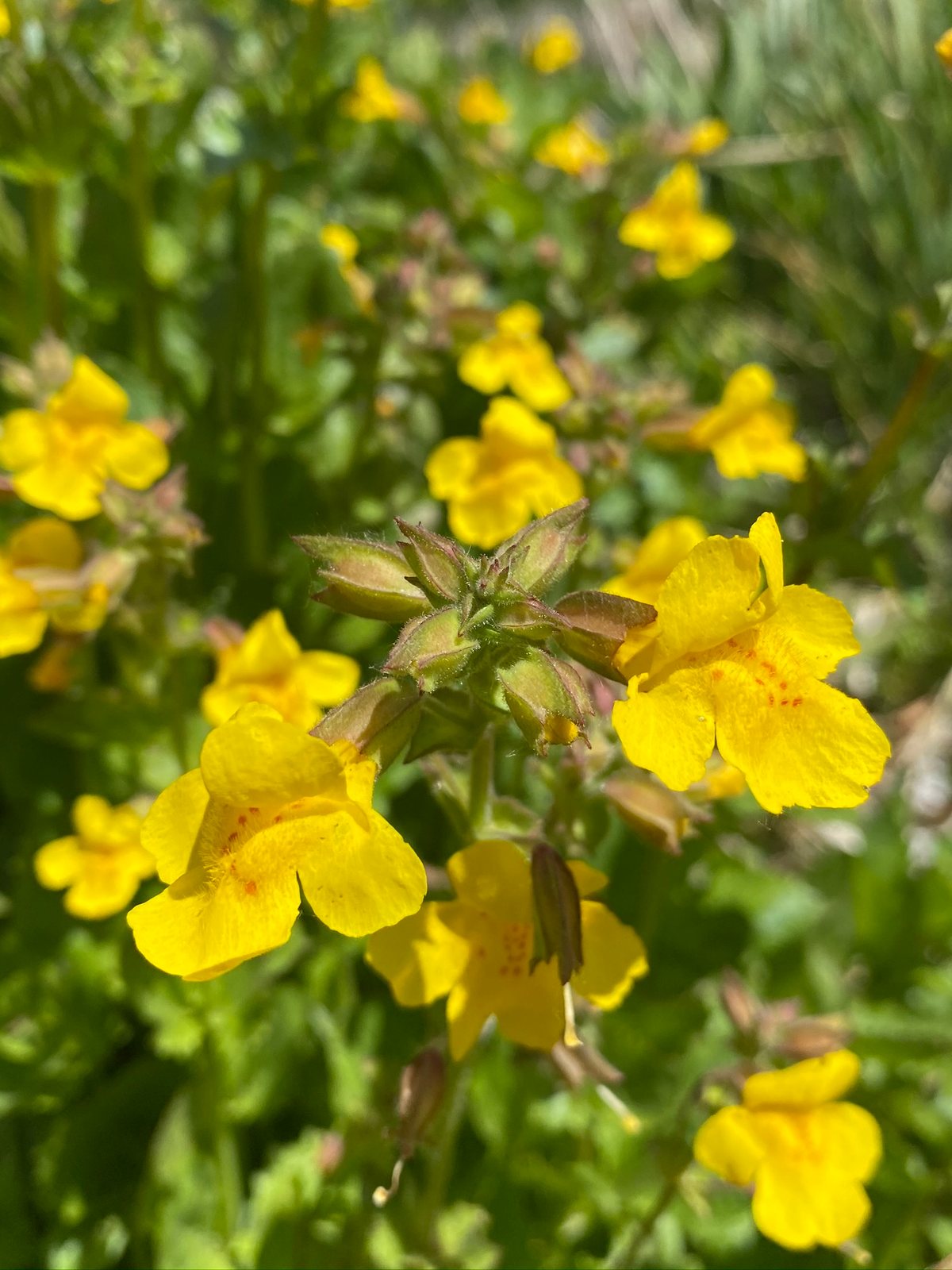
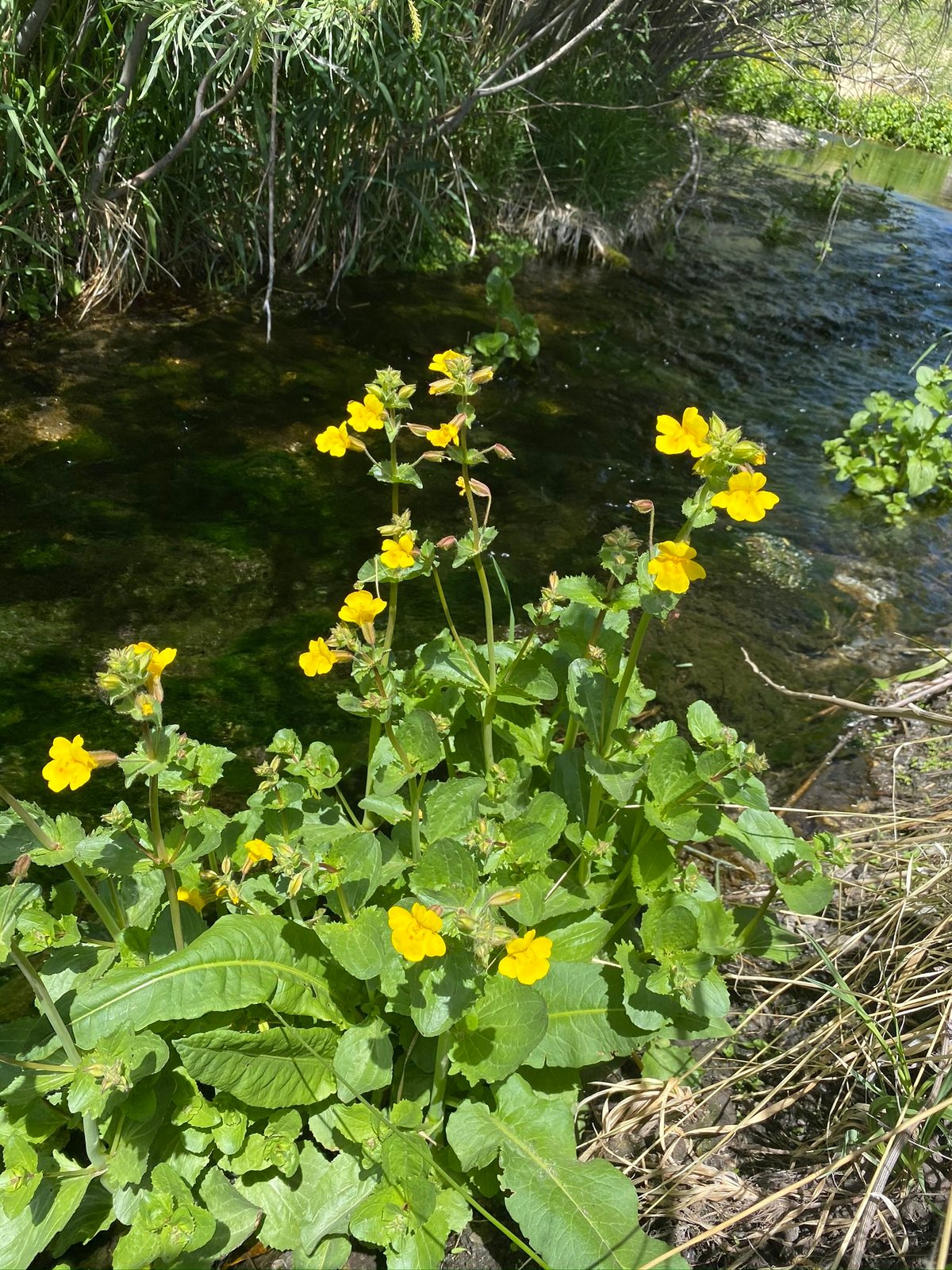
Seep monkeyflower is a moisture-loving western North American wildflower with yellow, red-spotted flowers. Usually a short-lived perennial, though some populations behave as annuals, it brings summer colour to pond margins, bog gardens and other places where the soil stays wet.
At a glance
- Sun
- Full sun to partial shade; afternoon shade helps in hot climates.
- Water
- High; keep the root zone consistently moist to wet. It does not tolerate prolonged drying.
- Soil
- Moisture-retentive, humus-rich soil, including wet clay or silty ground; tolerates saturated soil beside freshwater.
- Height
- 1-3 ft (0.3-0.9 m)
- Spread
- 1-2 ft (0.3-0.6 m), potentially wider where stems root and seedlings establish
- Flowers
- Late spring through summer, sometimes into early autumn; bright yellow, two-lipped flowers with reddish spots in the throat.
- Foliage
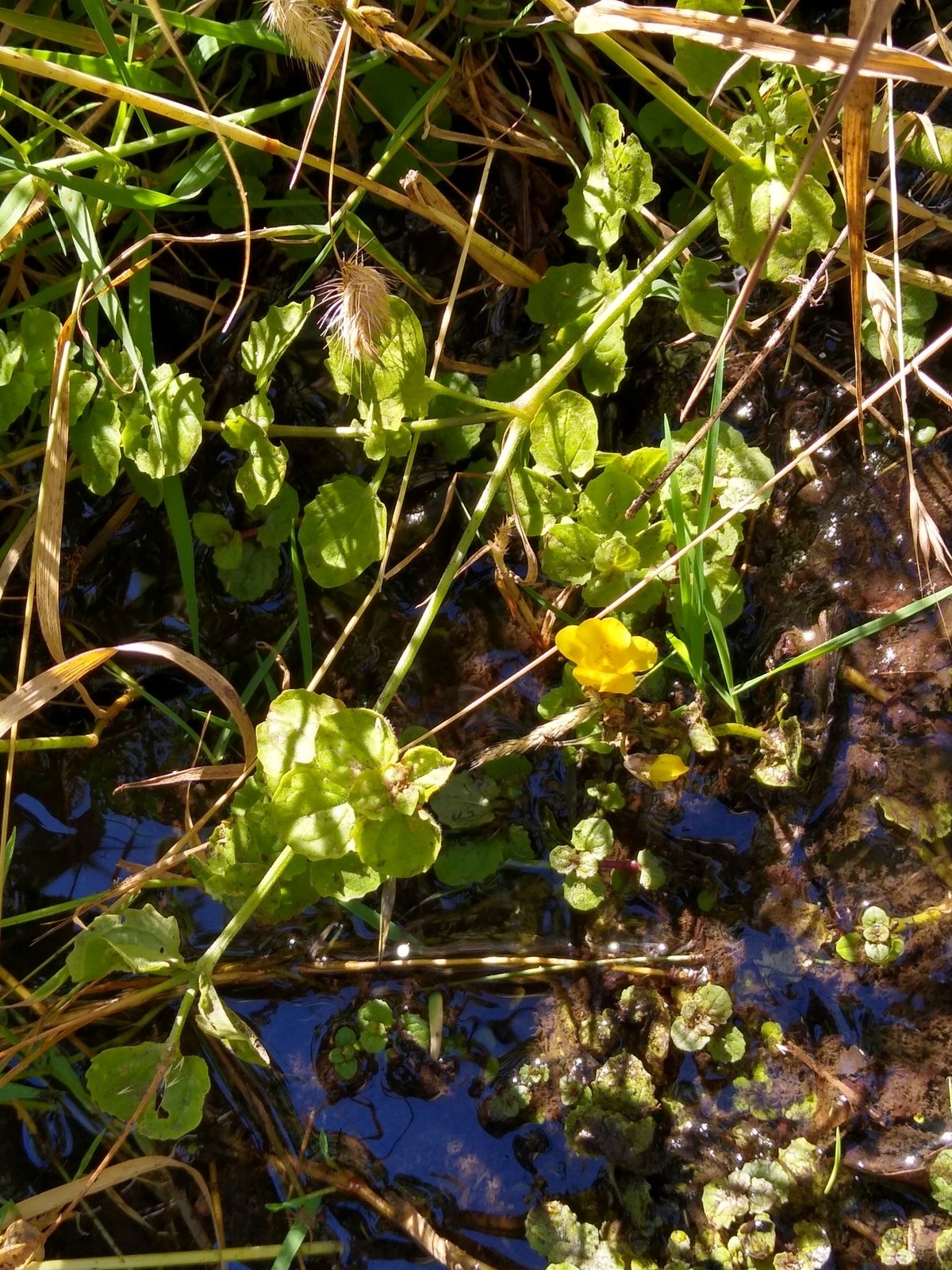
- Opposite, green, oval to rounded leaves with toothed edges; soft stems may root where they touch wet ground.
- Growth
- Fast in wet, fertile conditions
- Care needed
- Medium
The year at a glance
- Pollinators
- Wildlife
- Low allergen
| J | F | M | A | M | J | J | A | S | O | N | D | |
|---|---|---|---|---|---|---|---|---|---|---|---|---|
| Flowers | ||||||||||||
| Plant |
Northern hemisphere months. In Australia, shift them by six.
- Difficulty
- Moderate
- Toughness
- Needs looking after
Will it suit your garden?
Pick your zone, country, light and whether you have pets.
Full sun is 6 or more hours of direct sun a day, part shade 3 to 6 hours, shade under 3.
How it grows
Planting day
1 ft (0.3 m)
After 1 year
1.5 ft (0.45 m)
After 2 years
2 ft (0.6 m)
full size
About 2 years to full size.
From a typical nursery size, at an average rate for this kind of plant. A rule of thumb, not a forecast.
Good to know
- Cats and dogs
- Safe
- Native to
- Canada
- Invasive in
- the UK
- In the garden
- Spreads vigorously: plan to contain it.
- Growth rate
- Fast
Care
Jobs through the year
- WaterMar–May, Sep–Oct, every 3 days
- Check established plants and water unless soil remains moist to wet; new plants need closer attention.
- WaterJun–Aug
- Check daily and water if needed to keep roots wet; a naturally damp site is best.
- MulchMar–Apr
- Apply a thin compost top-dressing without burying living basal growth.
- DivideMar–Apr
- Divide crowded clumps and replant immediately into wet soil.
- PruneFeb–Mar
- Cut dead stems to the base, preserving living basal growth.
- PruneMay–Sep, every 14 days
- Pull unwanted seedlings and remove creeping stems escaping the planting.
- DeadheadMay–Sep, every 7 days
- Remove faded flower stems to encourage bloom and restrict self-seeding.
- ProtectMar–May, every 7 days
- Check young shoots for slugs and hand-pick or use labelled iron-phosphate bait.
- Plant where the soil remains moist through summer, rather than relying on occasional watering.
- Water thoroughly during dry spells; container-grown plants may need daily attention in warm weather.
- Add a thin layer of compost in spring; avoid heavy feeding that encourages weak, leafy growth.
- Divide crowded perennial clumps in spring and replant promptly into wet soil.
- Remove unwanted seedlings and creeping stems before they colonise neighbouring planting.
Pruning. Remove faded flower stems during summer to limit seed production and encourage further flowering. Cut dead stems back to the base in late winter or early spring, leaving any living basal growth intact.
Through the year
- Early spring
- Cut away dead stems and check whether established plants have survived winter.
- Spring
- Plant or divide clumps into moist soil and water them in thoroughly.
- Late spring
- Remove excess seedlings and check that spreading stems are not crowding smaller plants.
- Summer
- Keep the soil wet during dry weather and remove faded flowers if you want to restrict self-seeding.
- Autumn
- Remove seed-bearing stems where escape is a concern; leave healthy basal foliage in place.
In the garden
- Plant beside a garden pond, with the crown at the wet edge rather than deeply submerged.
- Combine with sedges and rushes in a bog garden for yellow flowers against fine-textured foliage.
- Use in a contained, irrigated rain-garden basin that stays moist between storms.
- Include in western North American native wetland planting where it is locally appropriate.
Garden styles it suits: Bog garden, Wildlife garden, Pollinator garden, Pacific Northwest woodland, California native and Wildflower.
Plant it with: Tufted hair grass, Soft rush, Slough sedge, Water avens and Western blue flag.
Wildlife: The flowers attract bees, including bumblebees. Dense growth can provide shelter for small invertebrates around a pond.
Problems to watch for
- Wilting and scorched leaves: the roots have dried out; water deeply and move the plant to a reliably wetter position if necessary.
- Slugs and snails: protect young shoots with hand-picking and, where needed, a labelled iron-phosphate bait.
- Powdery mildew: improve spacing and airflow, keep the roots moist and remove badly affected foliage.
- Excessive self-seeding and rooting stems: remove flower heads before seed ripens and pull unwanted plants while small.
Safety
Not known to be toxic to people, cats, dogs or horses. Species-specific safety information is limited, so do not assume that any part is suitable to eat.
Where it spreads. Spreads by seed and rooting stems in wet ground. It is naturalised and locally invasive along waterways in the United Kingdom and Ireland, and is invasive in New Zealand; it is also naturalised in parts of southern Australia, including Victoria and Tasmania. Outside its native range, keep it out of natural streams and drains and check local weed guidance before planting.
Easily confused with
Musk monkeyflower (Erythranthe moschata)
Usually lower-growing, with conspicuously hairy, sticky foliage and smaller, paler yellow flowers; a musky scent may be present but is not a dependable distinction.
Scarlet monkeyflower (Erythranthe cardinalis)
Has elongated, scarlet-red tubular flowers with projecting stamens, rather than broad yellow flowers with a spotted throat.
The name
The species name guttata means spotted, referring to the markings inside the flowers, while seep monkeyflower describes its preference for wet seepage ground.
Propagation. Divide perennial clumps or detach rooted stems in spring. Sow the fine seed on the surface of moist compost in spring, without burying it, and keep it consistently moist; plants may also self-seed freely.
Checked against open data
- Accepted botanical name
- Erythranthe guttata
- Native range
- Alaska, Alberta, Aleutian Is., Arizona, British Columbia, California, Colorado, Idaho, Mexico Northeast, Mexico Northwest, Montana and Nebraska.
- Measured
- Soil pH 6 to 8. Average height 40 cm.
Sources: GBIF (CC BY 4.0) and Trefle (CC BY 4.0). The care and design notes are LandscapeGPT's own.
See it in your own yard.
Upload a photo of your yard and see it redesigned with plants that suit your climate, each checked against your zone.