Shrubby germander
Teucrium fruticans. Family Lamiaceae. Shrub.
Also called Tree germander, Bush germander.
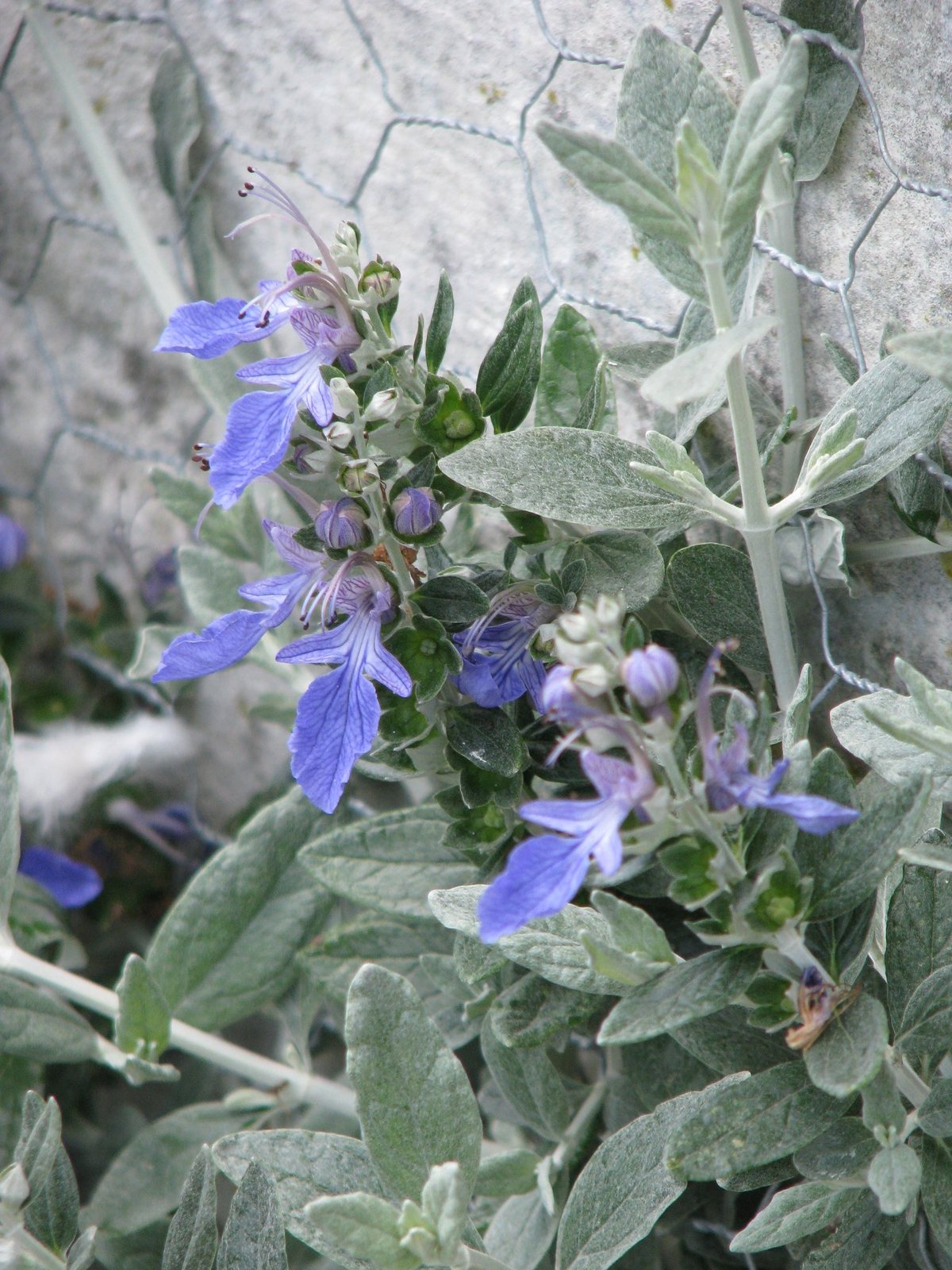
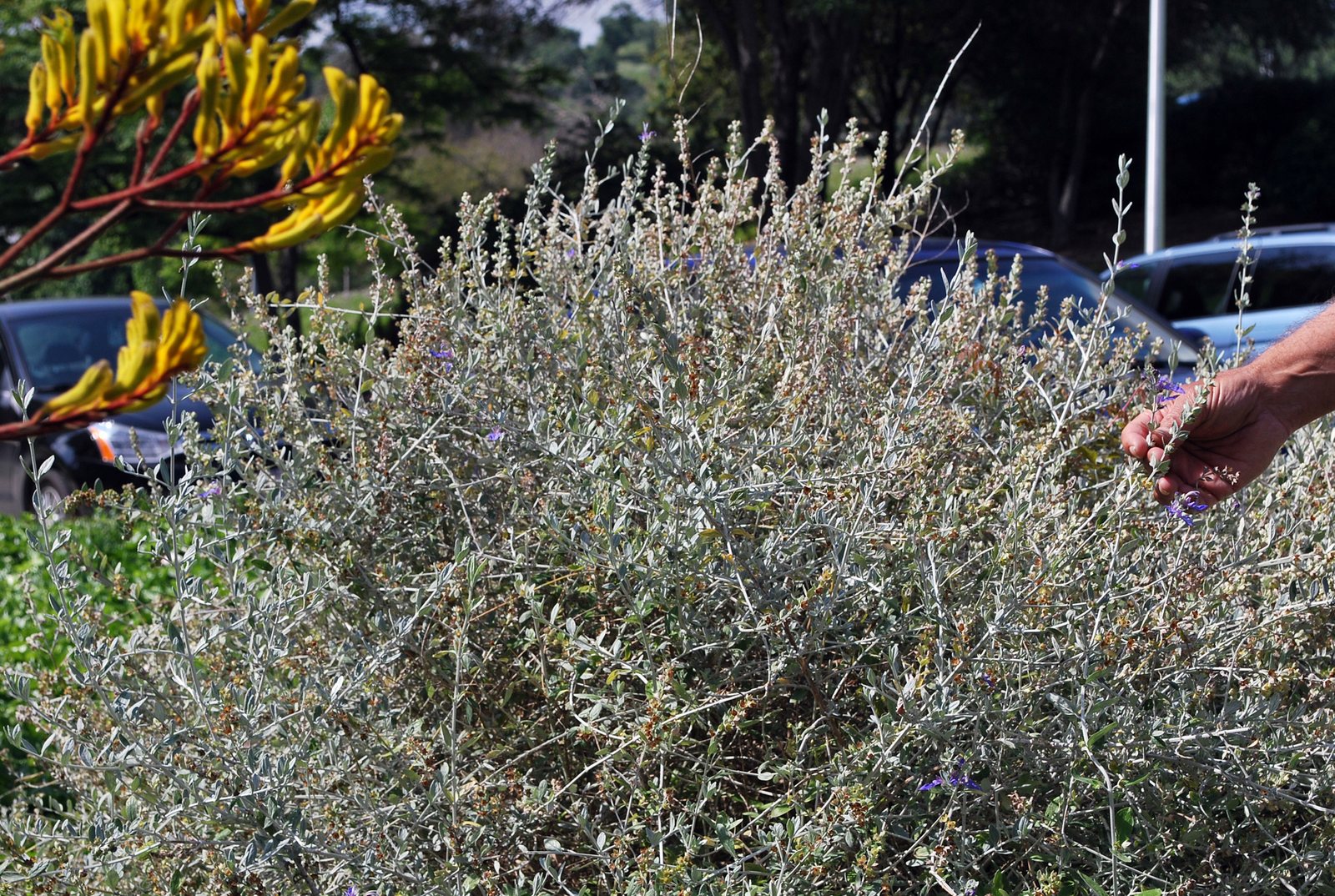
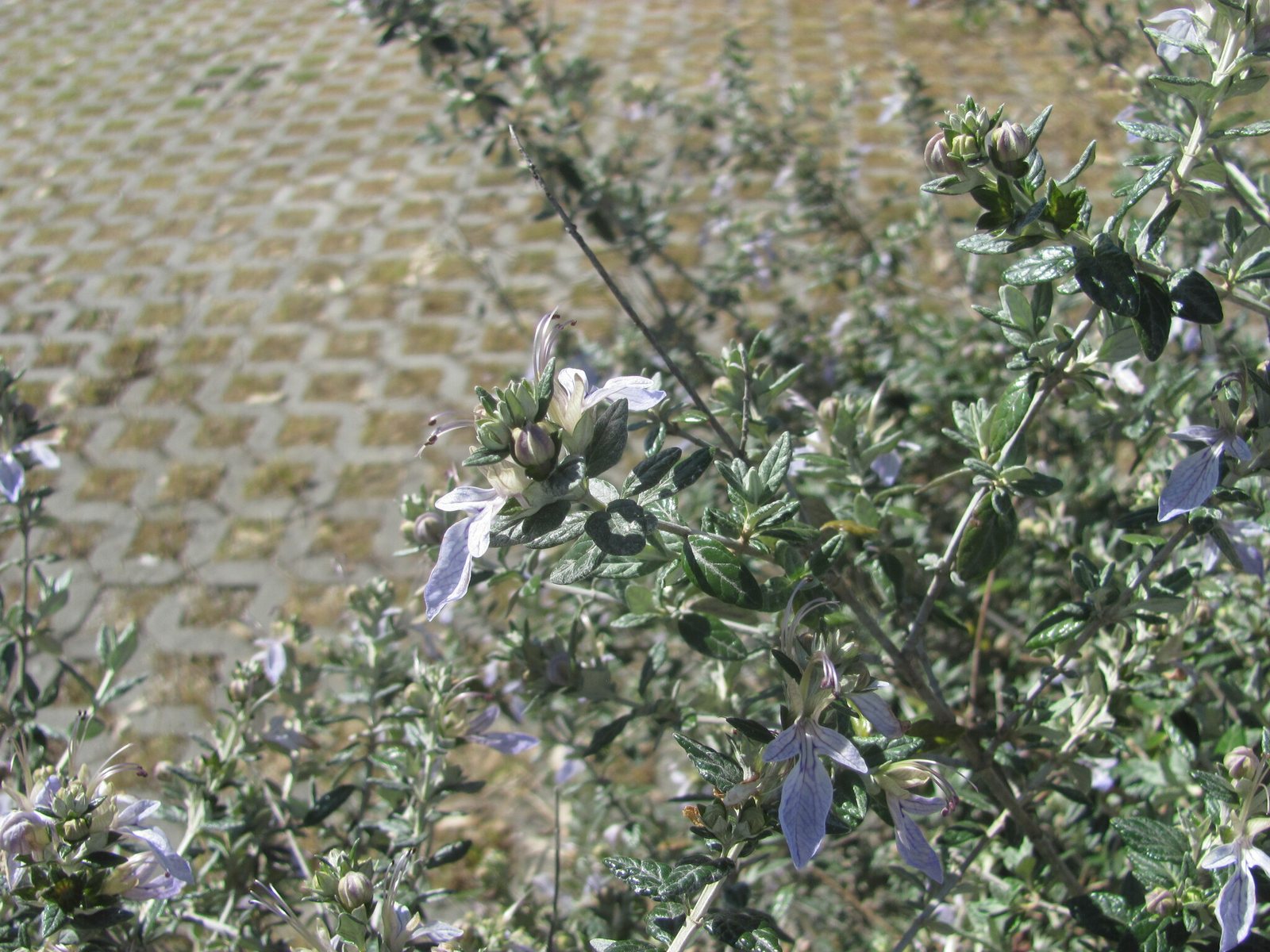
Shrubby germander is a Mediterranean evergreen shrub grown for its silvery foliage, white-felted stems and pale blue flowers. It makes a loose, rounded shrub or a clipped hedge in sunny, dry gardens, but needs protection from severe frost and wet winter soil.
At a glance
- Sun
- Full sun; flowering and growth become less dense in shade.
- Water
- Water regularly while establishing, then deeply during prolonged dry spells. Established plants tolerate drought; avoid persistently damp soil.
- Soil
- Well-drained sandy, gravelly or loamy soil, including alkaline soil. Avoid heavy clay unless drainage is substantially improved.
- Height
- 4-8 ft (1.2-2.4 m)
- Spread
- 4-8 ft (1.2-2.4 m)
- Flowers
- Pale blue to lavender-blue flowers, mainly in spring and summer; flowering can begin in late winter in mild climates.
- Foliage
- Evergreen. Small, oval, grey-green leaves with white-felted undersides, carried on pale, woolly stems.
- Growth
- Moderate to fast in warm, sunny conditions.
- Care needed
- Low
The year at a glance
- Pollinators
- Deer resistant
- Drought tolerant
- Heat tolerant
- Low allergen
| J | F | M | A | M | J | J | A | S | O | N | D | |
|---|---|---|---|---|---|---|---|---|---|---|---|---|
| Flowers | ||||||||||||
| Plant |
Northern hemisphere months. In Australia, shift them by six.
- Difficulty
- Moderate
- Toughness
- Fairly tough
Will it suit your garden?
Pick your zone, country, light and whether you have pets.
Full sun is 6 or more hours of direct sun a day, part shade 3 to 6 hours, shade under 3.
How it grows
Planting day
1.6 ft (0.5 m)
After 1 year
2.7 ft (0.83 m)
After 2 years
4 ft (1.1 m)
After 3 years
5 ft (1.5 m)
After 5 years
6 ft (1.8 m)
full size
About 4 years to full size.
From a typical nursery size, at an average rate for this kind of plant. A rule of thumb, not a forecast.
Good to know
- Cats and dogs
- Safe
- Growth rate
- Fast
Care
Jobs through the year
- WaterApr–May, Sep, every 28 days
- Water established shrubs only during prolonged drought; water young plants more frequently.
- WaterJun–Aug, every 21 days
- Give established shrubs a deep soaking only during prolonged dry spells.
- MulchApr–May
- Apply a light gravel mulch, keeping it clear of the stems.
- PruneApr–May
- Remove frost-killed shoots once new growth reveals which stems are alive.
- PruneJul–Aug
- Lightly shorten leafy shoots after the main flowering flush; never cut into bare old wood.
- ProtectJan–Mar, Nov–Dec
- Not reliably hardy in zones 6–7; use bright frost-free container shelter where winters exceed its tolerance.
- Plant in spring in colder areas; autumn planting suits mild climates with well-drained soil.
- Water deeply during the first growing season, allowing the soil surface to dry between waterings.
- Use a gravel mulch and keep it clear of the stems.
- Avoid routine feeding; rich soil and excess nitrogen encourage soft, sprawling growth.
- Choose a sheltered position near its cold limit, and protect young plants during hard freezes.
Pruning. After the main flowering flush, shorten leafy shoots to keep the shrub compact; light clipping can maintain a hedge, though it removes some flowers. Remove frost-damaged growth in spring once new growth shows, and avoid cutting deeply into bare old wood.
Through the year
- Spring
- Check for frost damage and remove dead shoots once healthy new growth is visible.
- Spring
- Plant in colder areas and water thoroughly to settle soil around the roots.
- Late spring
- Take softwood cuttings from healthy, non-flowering shoots.
- Summer
- Trim after the main flowering flush, leaving leafy growth on each branch.
- Summer
- Water young plants during dry weather; give established shrubs water only during prolonged drought.
- Autumn
- Plant in mild climates, but avoid heavy pruning before winter.
- Winter
- Keep drainage outlets clear and protect young shrubs if severe frost is forecast.
In the garden
- Clip into a silver-grey hedge along a sunny path or courtyard boundary.
- Use as a rounded foliage anchor among lavender, rosemary and rock roses.
- Plant in gravel gardens to contrast with dark green shrubs and upright grasses.
- Grow against a warm, sheltered wall in cooler gardens.
- Use in coastal gardens where drainage is good and exposure is not extreme.
Garden styles it suits: Mediterranean, Modern Mediterranean, Dry gravel garden, Coastal, Desert / xeriscape and Formal.
Plant it with: Lavender, Rosemary, Rock rose, Santolina, Jerusalem sage and Bearded iris.
Wildlife: Flowers provide nectar for bees and other pollinating insects. Frequent clipping reduces the number of flowers available.
Problems to watch for
- Root rot and winter dieback in wet soil: improve drainage or move to a raised planting position; do not keep watering damp ground.
- Frost damage: use a sheltered site and wait until spring growth begins before removing damaged stems.
- Sparse, sprawling growth in shade or rich soil: provide full sun, stop unnecessary feeding and trim lightly after flowering.
- Poor regrowth after severe pruning: retain leafy shoots when cutting and replace shrubs that remain bare.
Safety
Not known to be toxic to people, cats, dogs or horses, but reliable species-specific safety information is limited. It is an ornamental plant, not a culinary herb; do not eat the leaves, flowers or other parts.
Easily confused with
Jerusalem sage (Phlomis fruticosa)
Has much larger, wrinkled, felted leaves and yellow flowers arranged in distinct whorls around the stems.
Texas sage (Leucophyllum frutescens)
Has silver-grey foliage but rounded, bell-shaped pink or purple flowers rather than germander's blue flowers with a prominent lower lip.
Wall germander (Teucrium chamaedrys)
Forms a much lower plant with small, glossy green, toothed leaves and pink-purple flowers, rather than a tall, silver-grey shrub.
The name
The species name fruticans means shrubby or bushy, referring to its woody growth.
Propagation. Take softwood cuttings in late spring or semi-ripe cuttings in summer, using non-flowering shoots and a free-draining rooting mix.
Checked against open data
- Accepted botanical name
- Teucrium fruticans
- In the US and Canada
- Introduced in the lower 48 states.
- Native range
- Albania, Algeria, Corse, France, Italy, Libya, Morocco, Portugal, Sardegna, Sicilia, Spain and Tunisia.
- Measured
- Soil pH 5 to 5.5.
Sources: GBIF (CC BY 4.0), USDA PLANTS and Trefle (CC BY 4.0). The care and design notes are LandscapeGPT's own.
See it in your own yard.
Upload a photo of your yard and see it redesigned with plants that suit your climate, each checked against your zone.