Silver banksia
Banksia marginata. Family Proteaceae. Shrub.
Also called Silver honeysuckle.
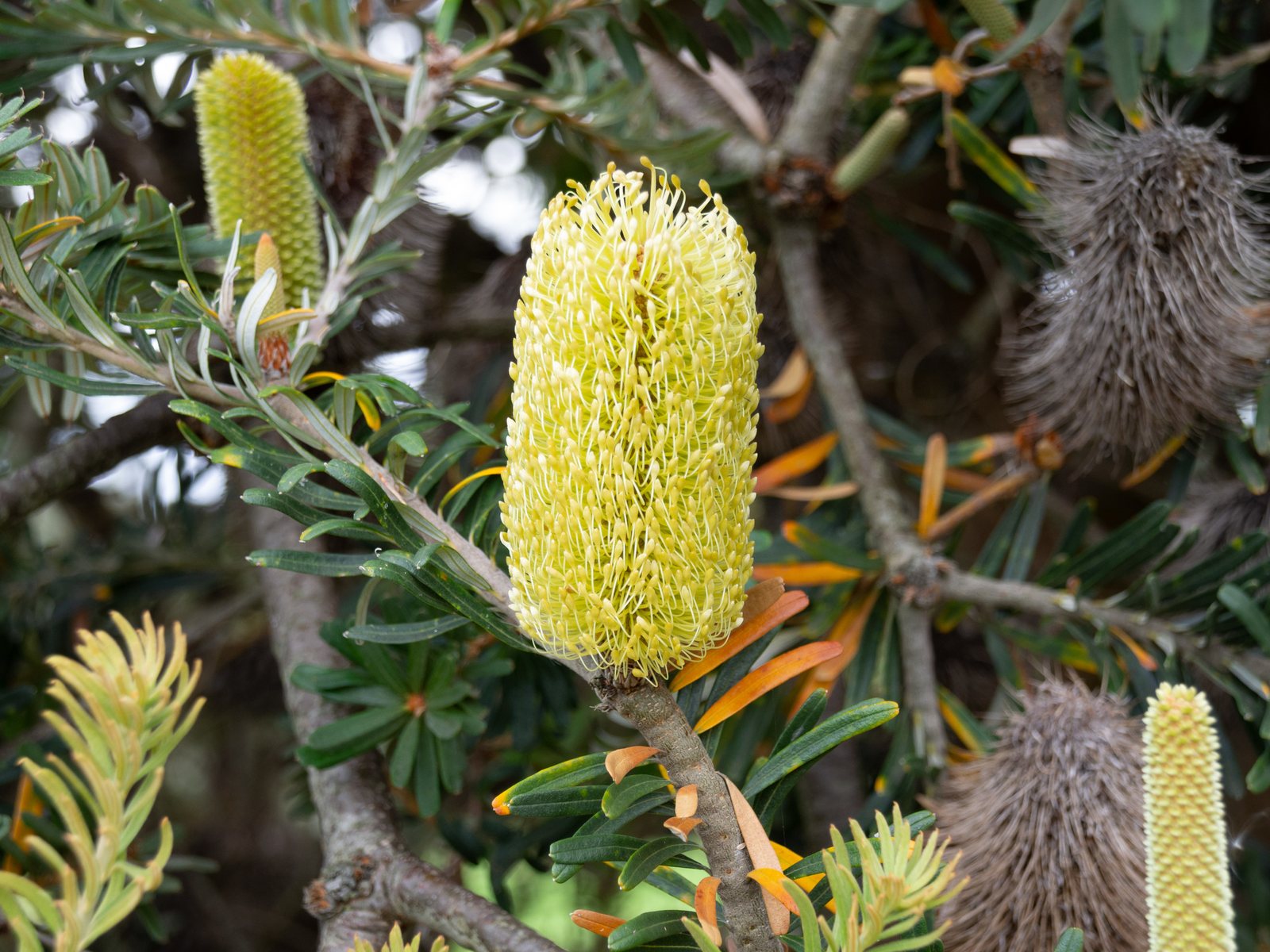
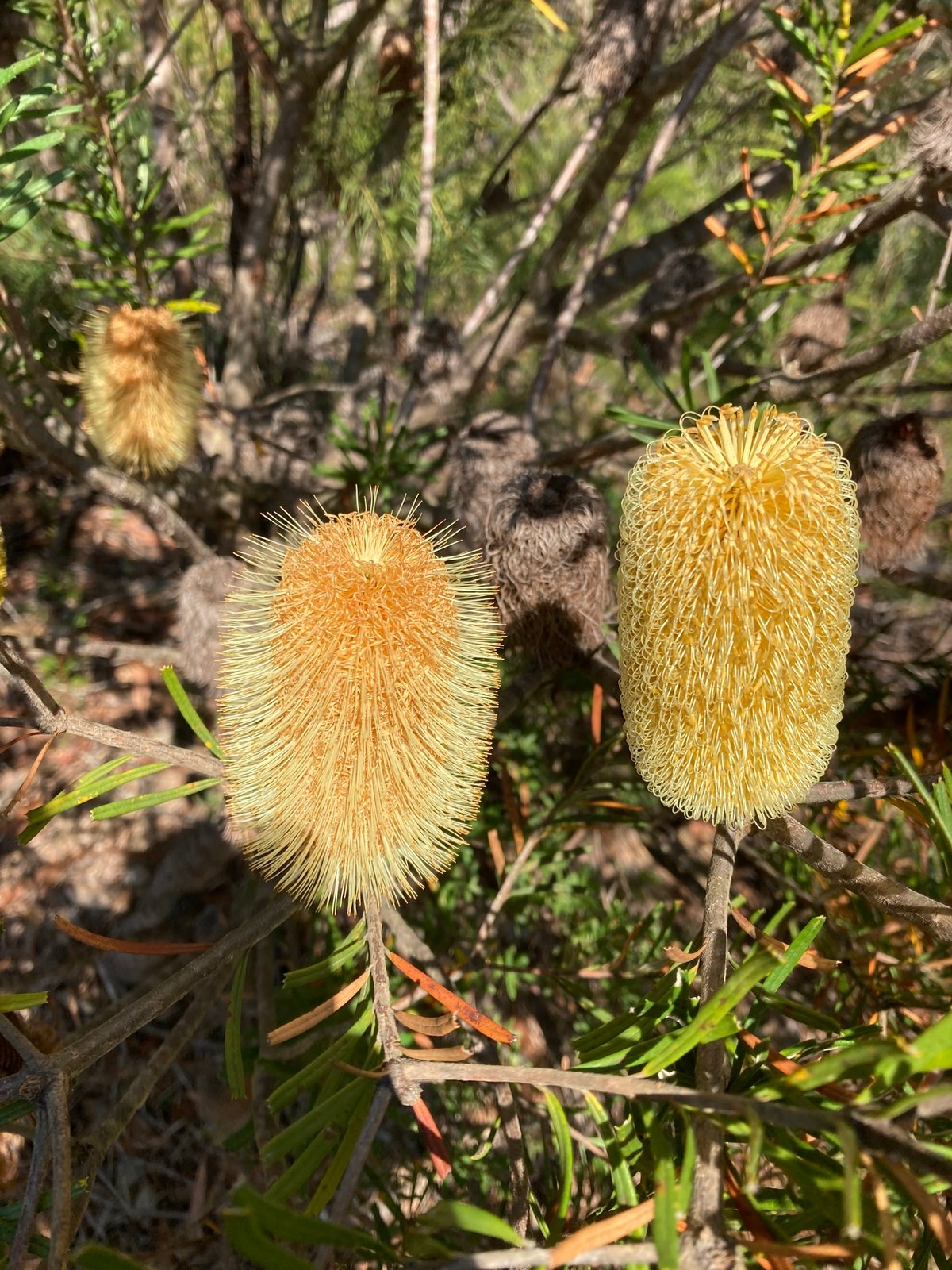
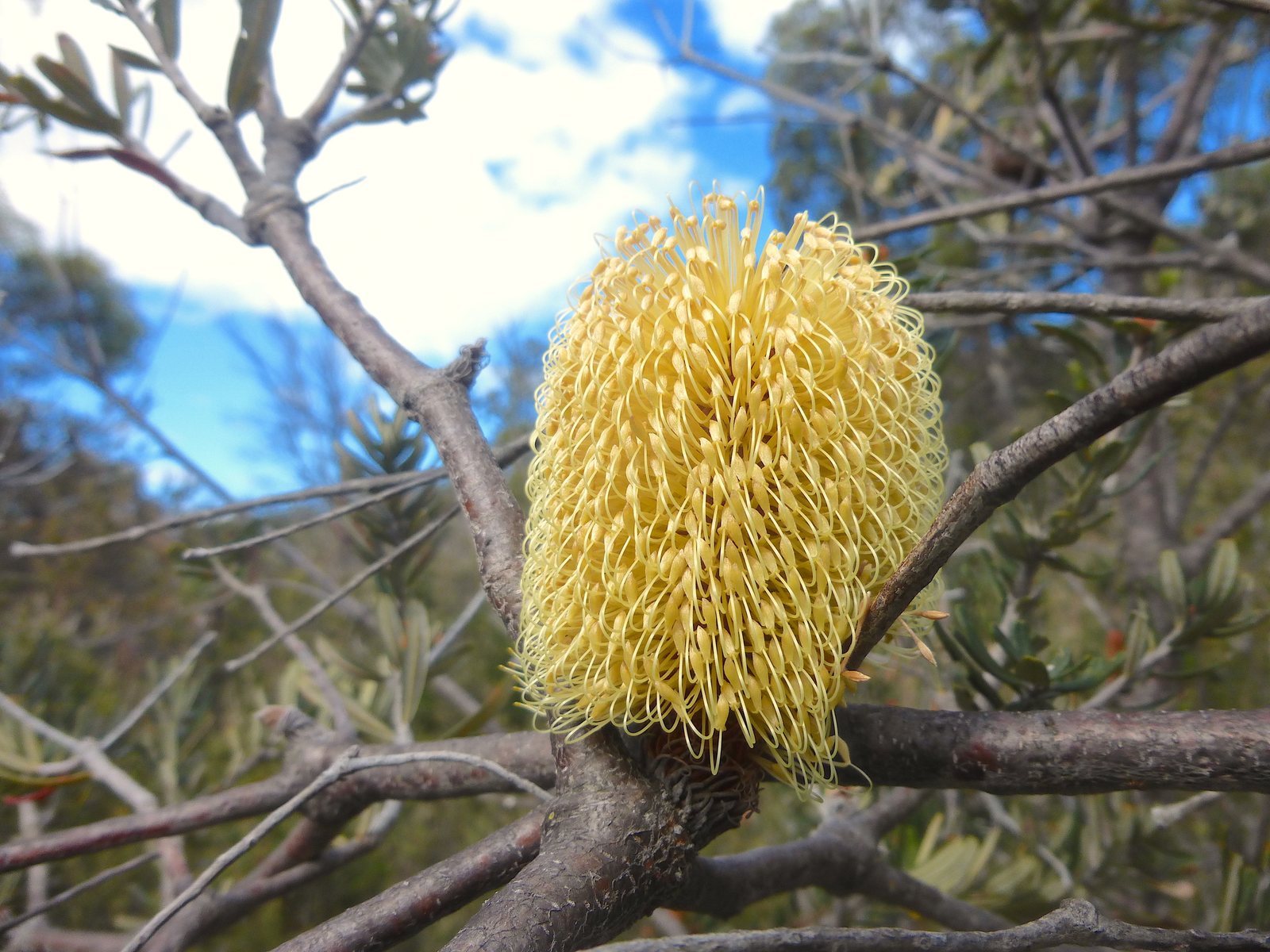
Silver banksia is a variable evergreen shrub or small tree from southeastern Australia, grown for its pale yellow flower spikes and leaves with silvery undersides. It suits sunny, well-drained gardens and provides nectar for wildlife. Check the mature size and origin of nursery stock: compact coastal forms and taller inland forms can behave quite differently.
At a glance
- Sun
- Full sun is best; tolerates light partial shade but flowers less freely.
- Water
- Water regularly during establishment, allowing the surface soil to dry between waterings. Established plants tolerate dry spells, but prolonged drought may require occasional deep watering.
- Soil
- Well-drained, acidic to neutral soil with low phosphorus levels. Sandy loam is ideal; avoid waterlogged ground and strongly alkaline soil.
- Height
- Usually 6-30 ft (1.8-9 m), depending on provenance; some forms remain smaller.
- Spread
- Usually 6-20 ft (1.8-6 m), depending on form.
- Flowers
- Pale yellow to golden cylindrical flower spikes, usually from late summer through winter, sometimes into spring; timing varies with climate and provenance.
- Foliage
- Evergreen. Narrow, leathery green leaves with conspicuously silvery-white undersides; margins may be toothed or nearly smooth.
- Growth
- Moderate in suitable conditions.
- Care needed
- Low
The year at a glance
- Pollinators
- Drought tolerant
- Heat tolerant
- Wildlife
- Low allergen
| J | F | M | A | M | J | J | A | S | O | N | D | |
|---|---|---|---|---|---|---|---|---|---|---|---|---|
| Flowers | ||||||||||||
| Fruit | ||||||||||||
| Plant |
Northern hemisphere months. In Australia, shift them by six.
- Difficulty
- Hard
- Toughness
- Needs looking after
Will it suit your garden?
Pick your zone, country, light and whether you have pets.
Full sun is 6 or more hours of direct sun a day, part shade 3 to 6 hours, shade under 3.
How it grows
Planting day
2.1 ft (0.65 m)
After 1 year
5 ft (1.6 m)
After 2 years
8 ft (2.5 m)
After 3 years
11 ft (3.5 m)
After 5 years
18 ft (5.4 m)
full size
About 5 years to full size.
From a typical nursery size, at an average rate for this kind of plant. A rule of thumb, not a forecast.
Good to know
- Cats and dogs
- Safe
- Native to
- Australia
- Growth rate
- Moderate
Care
Jobs through the year
- WaterMay, Sep, every 14 days
- Water established ground-grown plants only if dry; young plants and pots need closer checks.
- WaterJun–Aug, every 14 days
- Deep-water established ground-grown plants in prolonged drought; check pots more frequently.
- WaterJan–Apr, Oct–Dec, every 10 days
- Check sheltered pots and water when the surface dries; never leave roots standing in water.
- MulchMay
- Apply a light coarse mulch, keeping it away from the trunk.
- FeedMay
- Feed only if needed, using a low-phosphorus Australian native-plant product.
- PruneApr–May
- After flowering, lightly trim leafy tips; avoid bare old wood and retain some seed cones.
- ProtectSep–Oct
- Move container plants into bright frost-free shelter; ordinary zone 6–7 winters are too cold.
- ProtectJan–Apr, Nov–Dec
- Keep sheltered, brightly lit and freely drained; flowering timing varies with provenance and conditions.
- Plant in spring in frost-prone districts, or autumn in mild climates, with the root crown at soil level.
- Water deeply through the first one or two growing seasons; avoid keeping the root zone constantly wet.
- Use no fertilizer unless needed; if feeding, choose a low-phosphorus product formulated for Australian native plants.
- Apply a light layer of coarse mulch, keeping it clear of the trunk.
- Protect young plants from severe frost and choose locally proven stock where winters are cold.
Pruning. Lightly trim young plants after flowering to encourage branching, and remove dead or damaged growth when needed. Avoid hard cuts into bare old wood: the ability to reshoot varies between forms.
Through the year
- Spring
- Plant in colder districts once severe frost has passed; water thoroughly and mulch lightly.
- Summer
- Check new plants during dry spells and water deeply when the root zone begins to dry.
- Late summer
- Inspect foliage for yellowing and check drainage and fertilizer use before adding nutrients.
- Autumn
- Plant in mild-winter districts while the soil is still warm and seasonal rain is returning.
- Winter
- Keep roots free of standing water and protect young plants during unusually hard frosts.
- After flowering
- Lightly shorten leafy shoots if shaping is needed; retain some old flower spikes for their woody seed cones.
In the garden
- Use a tree-form specimen as a small evergreen focal point, allowing room for its natural crown.
- Plant shrubby forms in an informal screen with other low-phosphorus-tolerant Australian natives.
- Combine with tussock grasses and mat rushes in a coastal or gravel garden for contrasting leaf textures.
- Place near a seating area where visiting nectar-feeding birds and the silvery leaf undersides can be seen.
Garden styles it suits: Australian native, Coastal, Wildlife garden, Dry gravel garden, Low-maintenance and Architectural minimal.
Plant it with: Spiny-headed mat rush, Kangaroo grass, Common everlasting, Coastal rosemary, Common correa and Prickly tea-tree.
Wildlife: Nectar-rich flowers attract honeyeaters in Australia, as well as bees and other insects. Birds may take seeds from the woody cones, and dense shrubby forms provide shelter.
Problems to watch for
- Phytophthora root rot: prevent with excellent drainage, clean nursery stock and careful watering; remove badly affected plants rather than replanting another susceptible banksia in the same wet spot.
- Phosphorus toxicity: avoid ordinary high-phosphorus fertilizers; stop feeding if leaves develop unexplained yellowing, browning or dieback.
- Yellow leaves on alkaline soil: check soil pH and drainage; use an appropriate iron treatment for temporary relief, but choose a more suitable site if the soil is strongly alkaline.
- Scale insects: inspect stems and leaf undersides; prune small infestations out or apply a labelled horticultural oil, avoiding hot weather and open flowers.
Safety
Not known to be toxic to people, cats, dogs or horses, and no particular part is established as poisonous. Specific animal-safety information is limited; do not encourage pets or livestock to eat the foliage or woody cones.
Easily confused with
Coast banksia (Banksia integrifolia)
Usually has larger leaves arranged in conspicuous whorls, with mostly smooth adult leaf margins; silver banksia generally has smaller, scattered leaves.
Saw banksia (Banksia serrata)
Has much larger, coarsely saw-toothed leaves and thick, rough bark; silver banksia has narrower leaves with smaller teeth or smooth margins.
Heath banksia (Banksia ericifolia)
Has very short, needle-like leaves and usually orange to reddish flower spikes, rather than the broader, silver-backed leaves and pale yellow flowers of silver banksia.
The name
Banksia honours botanist Sir Joseph Banks, while marginata refers to the leaf margins and the common name describes the silvery leaf undersides.
Propagation. Sow seed into a free-draining, low-phosphorus seed mix and keep moist but not saturated. Seedlings vary in size and habit; cuttings can preserve selected forms but are less straightforward and may root inconsistently.
Checked against open data
- Accepted botanical name
- Banksia marginata
- Native range
- New South Wales, Tasmania and Victoria.
- Measured
- Average height 500 cm.
Sources: GBIF (CC BY 4.0) and Trefle (CC BY 4.0). The care and design notes are LandscapeGPT's own.
See it in your own yard.
Upload a photo of your yard and see it redesigned with plants that suit your climate, each checked against your zone.