Spotted beebalm
Monarda punctata. Family Lamiaceae. Perennial.
Also called Spotted bee balm, Dotted horsemint, Spotted horsemint.
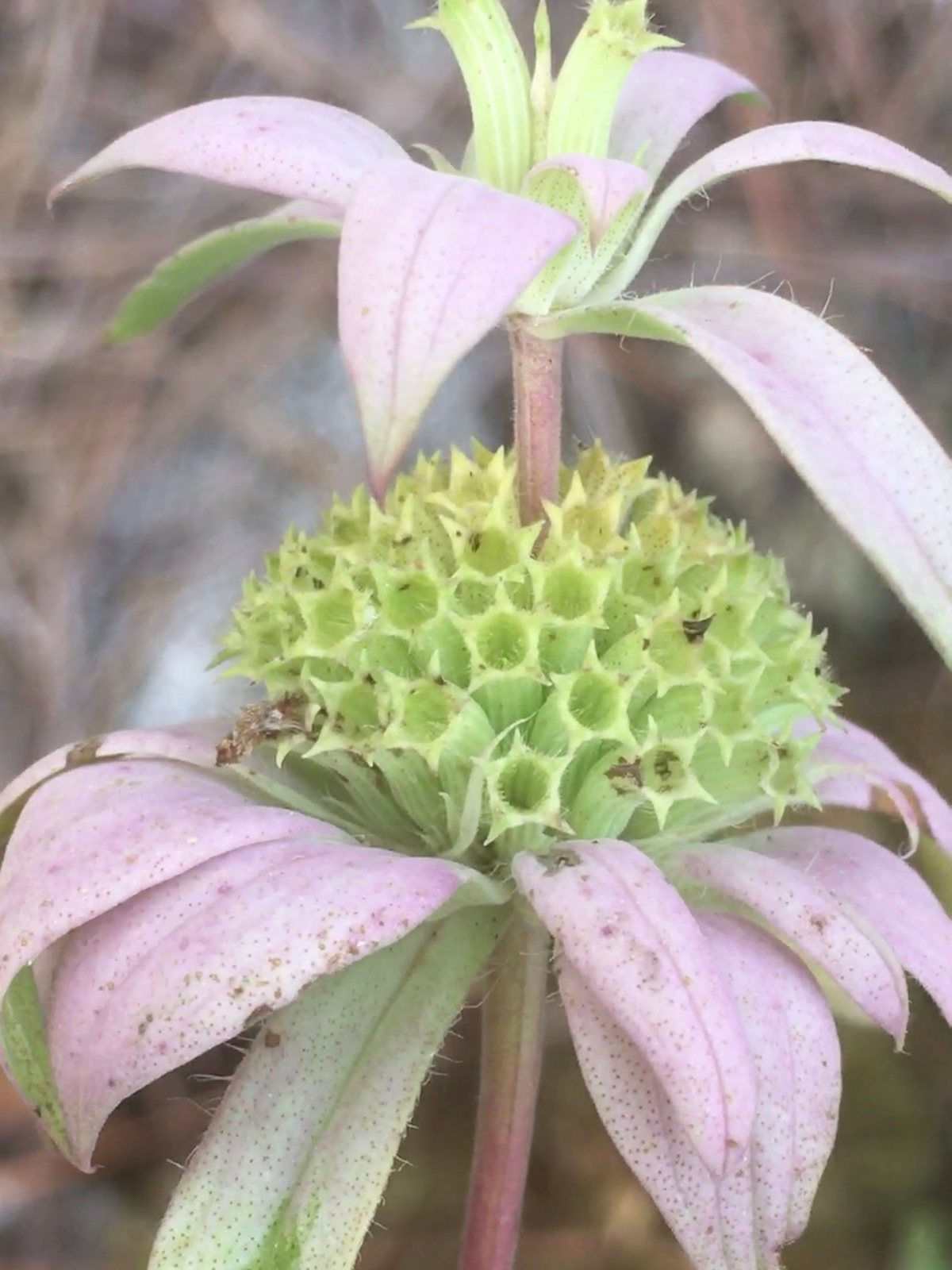
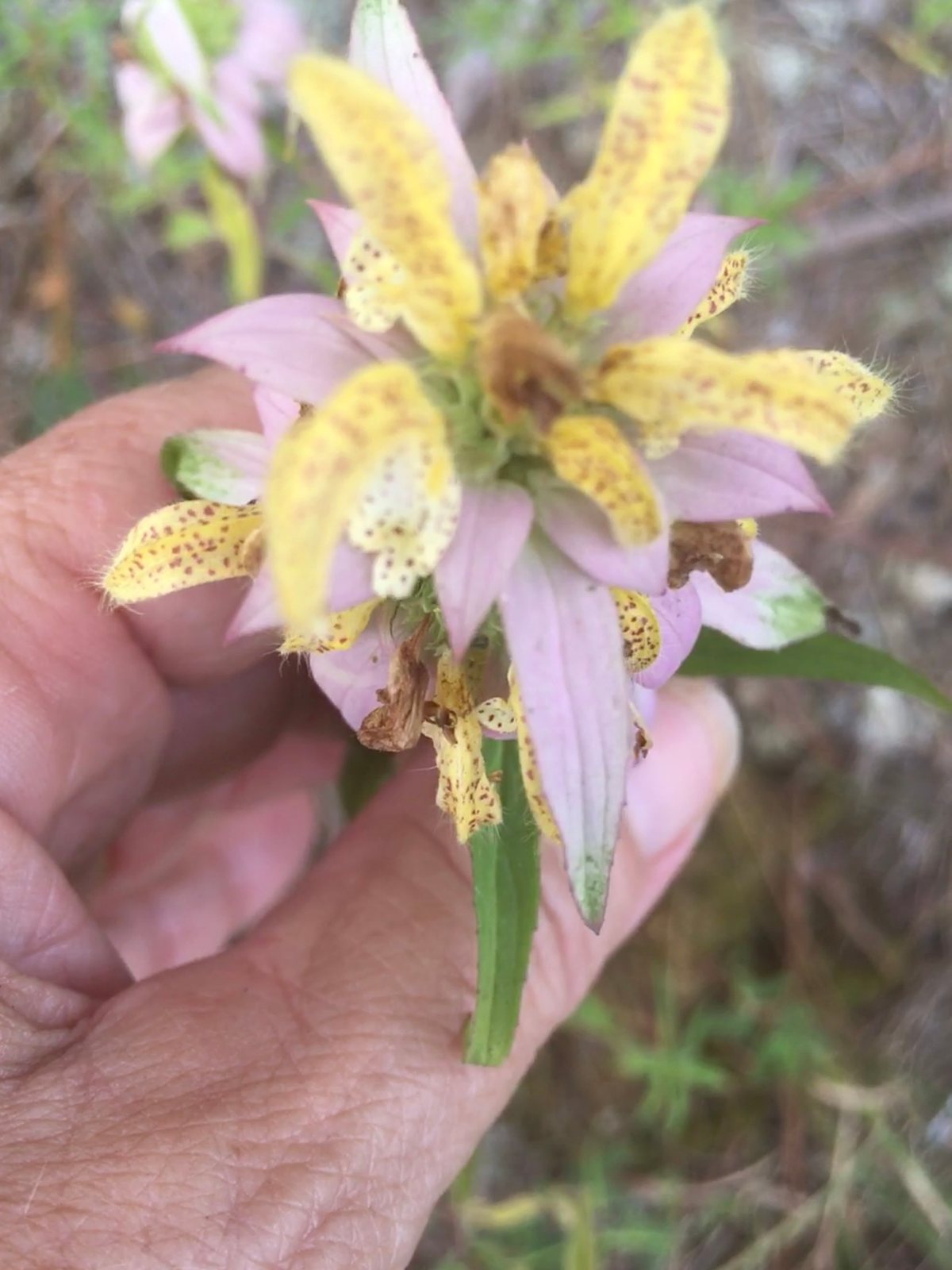
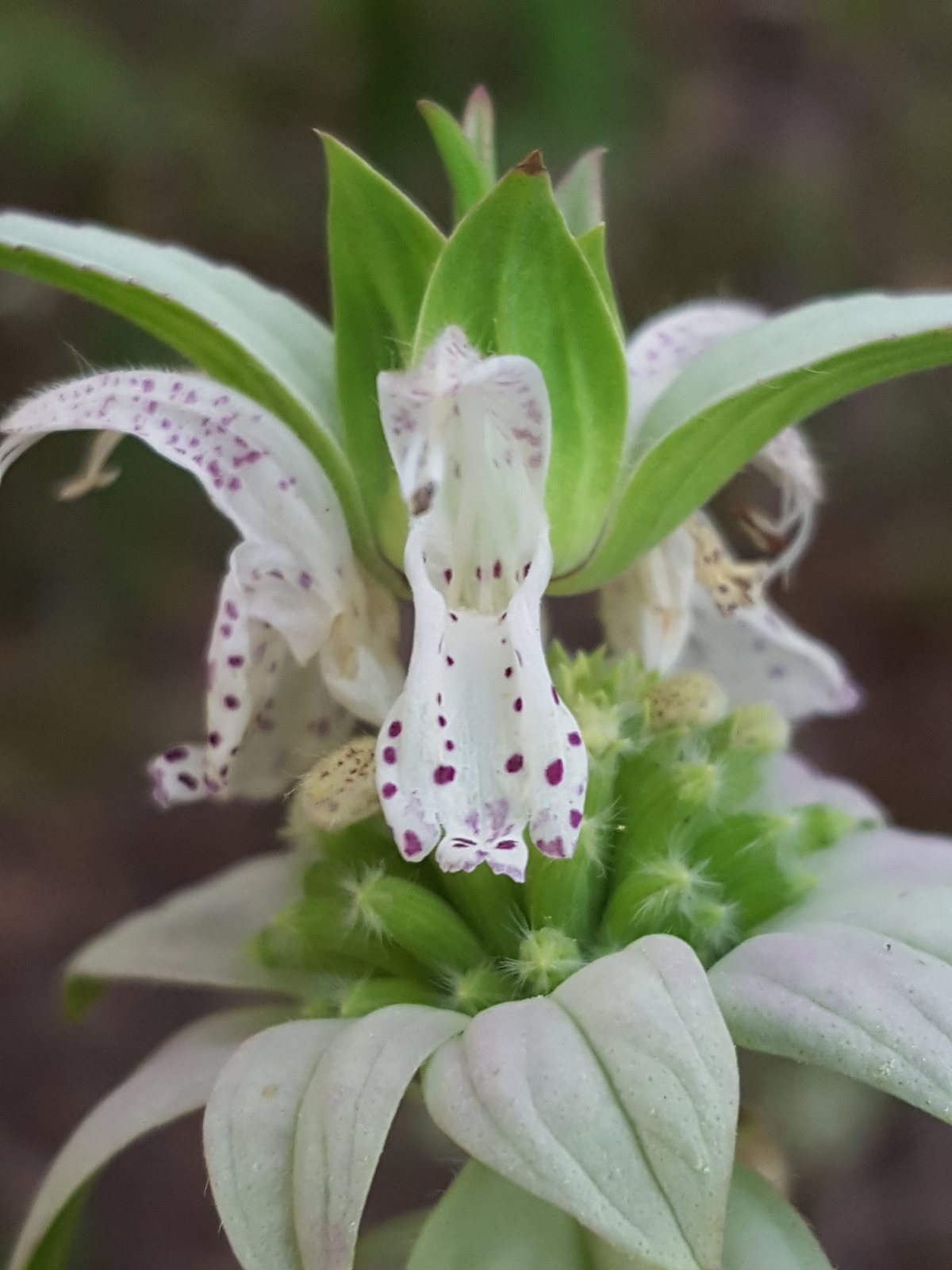
Spotted beebalm is a short-lived North American native perennial with tiers of spotted yellow flowers surrounded by showy pink to lavender bracts. Gardeners grow it for its unusual flower heads, aromatic leaves and strong appeal to pollinating insects; individual plants may behave as annuals or biennials.
At a glance
- Sun
- Full sun; tolerates light shade, but flowers best in an open position.
- Water
- Low to moderate; water while establishing, then mainly during prolonged drought.
- Soil
- Well-drained sandy, gravelly or loamy soil; tolerates poor, dry ground but dislikes waterlogged soil, especially in winter.
- Height
- 1-3 ft (0.3-0.9 m)
- Spread
- 1-2 ft (0.3-0.6 m)
- Flowers
- Summer into early autumn; pale yellow tubular flowers dotted with purple, held above pink, lavender or nearly white bracts.
- Foliage
- Narrow, toothed green to grey-green leaves on square stems, with a strong thyme-like scent when rubbed.
- Growth
- Fast; may flower in its first year from an early sowing.
- Care needed
- Low
The year at a glance
- Pollinators
- Deer resistant
- Drought tolerant
- Cold hardy
- Heat tolerant
- Disease resistant
- Wildlife
- Low allergen
- Fragrant
| J | F | M | A | M | J | J | A | S | O | N | D | |
|---|---|---|---|---|---|---|---|---|---|---|---|---|
| Flowers | ||||||||||||
| Fruit | ||||||||||||
| Plant |
Northern hemisphere months. In Australia, shift them by six.
- Difficulty
- Easy
- Toughness
- Very tough
Will it suit your garden?
Pick your zone, country, light and whether you have pets.
Full sun is 6 or more hours of direct sun a day, part shade 3 to 6 hours, shade under 3.
How it grows
Planting day
1 ft (0.3 m)
After 1 year
1.5 ft (0.45 m)
After 2 years
2 ft (0.6 m)
full size
About 2 years to full size.
From a typical nursery size, at an average rate for this kind of plant. A rule of thumb, not a forecast.
Good to know
- Cats and dogs
- Safe
- Native to
- the US and Canada
- Growth rate
- Fast
Care
Jobs through the year
- WaterApr–May, Sep, every 21 days
- Water established plants only during extended dry spells; water new plants more often until rooted.
- WaterJun–Aug, every 14 days
- Water deeply during prolonged drought, letting soil dry between soakings.
- PruneFeb–Mar
- Cut overwintered stems near ground level before new growth begins.
- DeadheadJul–Sep, every 14 days
- Remove selected spent heads to limit seedlings; retain some to replace short-lived plants.
- ProtectJan–Feb, Nov–Dec
- Keep crowns free of wet leaves and thick mulch to prevent winter rot.
- Water new plants regularly until rooted, then allow the soil to dry between waterings.
- Avoid rich manure and routine feeding; fertile soil can produce weak, floppy growth.
- Keep the crown free of thick, moisture-holding mulch.
- Thin crowded seedlings to maintain airflow and leave room for each plant.
- Let a few flower heads set seed to replace short-lived plants; remove unwanted seedlings while small.
Pruning. Remove spent flower heads during summer if you want to limit self-seeding. Leave remaining stems standing through winter, then cut them back near ground level in late winter or early spring before new growth develops.
Through the year
- Early spring
- Cut back old stems and remove weeds around emerging shoots.
- Spring
- Surface-sow seed in trays or a prepared seedbed; press it into the soil without burying it.
- Late spring
- Plant out young plants after severe frost risk has passed and water until established.
- Summer
- Water during prolonged drought and remove selected spent heads to control seed production.
- Autumn
- Collect seed from dry, brown heads or let some fall naturally.
- Winter
- Check that crowns are not sitting in wet soil or buried beneath wet leaves.
In the garden
- Plant in loose groups in a sunny pollinator border, where the tiered flower heads are easy to see.
- Mix with little bluestem and butterfly weed in a dry native meadow.
- Use among gravel and drought-tolerant perennials where drainage is sharp and soil is lean.
- Place near a path so you can enjoy the scented foliage and watch visiting insects.
Garden styles it suits: Native meadow, Pollinator garden, Wildlife garden, Dry gravel garden, Cottage garden and Desert / xeriscape.
Plant it with: Butterfly weed, Little bluestem, Purple coneflower, Lanceleaf coreopsis, Black-eyed Susan and Prairie dropseed.
Wildlife: Flowers attract bumblebees, other native bees, butterflies and beneficial solitary wasps. Standing stems can provide overwintering shelter for insects.
Problems to watch for
- Root or crown rot in wet soil: improve drainage or move plants to a raised, sandy bed; avoid winter-wet sites.
- Powdery mildew: grow in sun, thin crowded plants and water the soil rather than the foliage; this species is generally less susceptible than many other beebalms.
- Floppy stems in rich soil or shade: stop feeding and move plants to a sunnier, leaner site.
- Plants disappearing after a few seasons: this is often their naturally short lifespan; retain seedlings or sow fresh seed.
Safety
Not known to be toxic to people, cats, dogs or horses in ordinary garden contact or incidental small ingestion. Species-specific animal safety information is limited; do not assume concentrated extracts or essential oils are safe to swallow.
Easily confused with
Wild bergamot (Monarda fistulosa)
Usually has rounded terminal heads of lavender flowers rather than stacked tiers of yellow, purple-spotted flowers with conspicuous pale bracts.
Lemon beebalm (Monarda citriodora)
Also has tiered flower heads, but its flowers are pink to lavender rather than yellow with purple spots; its foliage usually smells lemony.
Scarlet beebalm (Monarda didyma)
Has broader leaves and usually bright red flowers in terminal heads, rather than the spotted yellow flowers and stacked pale bracts of spotted beebalm.
The name
Monarda honours the Spanish physician and botanist Nicolás Monardes, while punctata means spotted, referring to the purple dots on the flowers.
Propagation. Grow from seed, surface-sown because light aids germination. A period of cold, moist conditions can improve germination; autumn sowing outdoors provides this naturally. Young volunteer seedlings can be moved in spring.
Checked against open data
- Accepted botanical name
- Monarda punctata
- In the US and Canada
- Native in Canada and the lower 48 states.
- Native range
- Alabama, Arkansas, Connecticut, District of Columbia, Florida, Georgia, Illinois, Indiana, Iowa, Kansas, Kentucky and Louisiana.
- Measured
- Average height 42 cm.
Sources: GBIF (CC BY 4.0), USDA PLANTS and Trefle (CC BY 4.0). The care and design notes are LandscapeGPT's own.
See it in your own yard.
Upload a photo of your yard and see it redesigned with plants that suit your climate, each checked against your zone.