Sundaville mandevilla
Mandevilla sanderi. Family Apocynaceae. Climber.
Also called Dipladenia, Sundaville dipladenia, Brazilian jasmine.
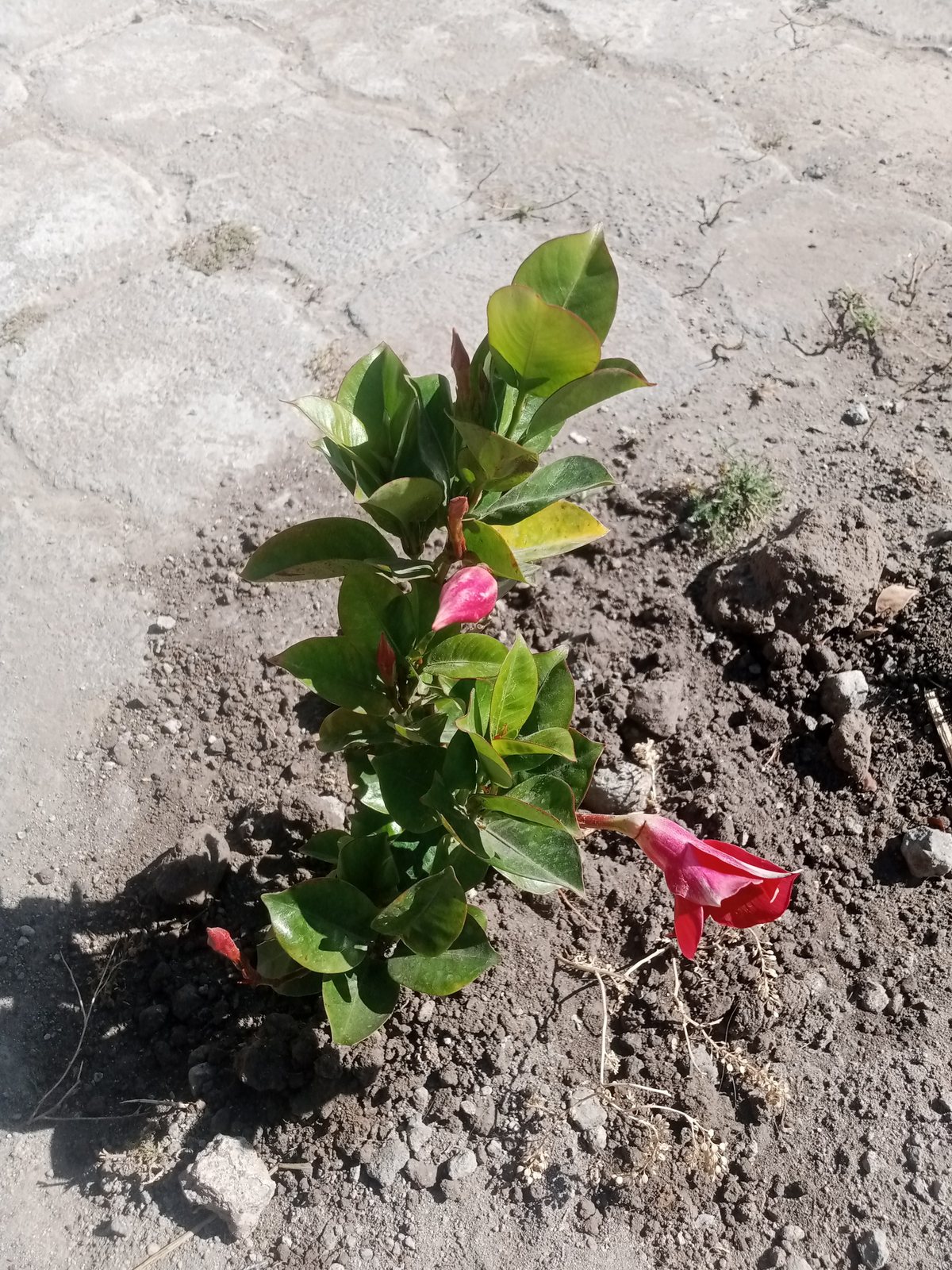
Sundaville is a series of frost-tender mandevillas grown for glossy leaves and trumpet-shaped flowers over a long warm season. Often sold as Mandevilla sanderi or dipladenia, these plants include hybrids whose size and climbing habit vary by selection. In colder climates, they are grown as a summer annual or overwintered indoors.
At a glance
- Sun
- Full sun to partial shade; afternoon shade helps in very hot climates. Indoors, provide the brightest available light.
- Water
- Water thoroughly when the top 1 in (2.5 cm) of compost feels dry; let excess water drain away. Water much less during cool, slow winter growth.
- Soil
- Fertile, well-drained soil or a free-draining container compost; avoid heavy soil that stays wet.
- Height
- 3-6 ft (0.9-1.8 m) with support; compact selections may stay smaller
- Spread
- 2-3 ft (0.6-0.9 m)
- Flowers
- Late spring to autumn, sometimes longer under warm, bright conditions; trumpet-shaped flowers in red, pink or white, depending on selection.
- Foliage
- Evergreen. Opposite, glossy, dark green, oval leaves with pointed tips.
- Growth
- Fast in warm weather
- Care needed
- Medium
The year at a glance
- Pollinators
- Heat tolerant
- Low allergen
| J | F | M | A | M | J | J | A | S | O | N | D | |
|---|---|---|---|---|---|---|---|---|---|---|---|---|
| Flowers | ||||||||||||
| Plant |
Northern hemisphere months. In Australia, shift them by six.
- Difficulty
- Moderate
- Toughness
- Fairly tough
Will it suit your garden?
Pick your zone, country, light and whether you have pets.
Full sun is 6 or more hours of direct sun a day, part shade 3 to 6 hours, shade under 3.
How it grows
Planting day
2 ft (0.6 m)
After 1 year
3 ft (1.1 m)
After 2 years
5 ft (1.5 m)
After 3 years
6 ft (1.8 m)
full size
About 3 years to full size.
From a typical nursery size, at an average rate for this kind of plant. A rule of thumb, not a forecast.
Good to know
- Cats and dogs
- Mildly toxic: may upset a stomach
- Growth rate
- Fast
Care
Jobs through the year
- WaterApr–May, Sep–Oct, every 7 days
- Use a container in this climate; water when the top 2.5 cm dries and let excess drain.
- WaterJun–Aug, every 3 days
- Check compost frequently in heat and water when the top 2.5 cm dries.
- WaterJan–Mar, Nov–Dec, every 14 days
- Under winter cover, water sparingly when the surface dries; never leave standing water.
- FeedApr–Sep, every 14 days
- Apply flowering-plant fertilizer at the label rate while growth is active.
- PruneFeb–Mar
- Remove weak or dead stems and shorten long shoots above leaf pairs; wear gloves against sap.
- ProtectMay–Jun
- Harden off and provide climbing support; move outside only when nights stay above 10°C.
- ProtectSep–Oct
- Inspect for pests and move into bright shelter above 10°C before nights turn cold.
- Move outdoors only after frost risk has passed and nights are consistently above 50°F (10°C); introduce strong sun gradually.
- Use a pot with drainage holes and empty standing water from saucers.
- Feed container plants every two weeks during active growth with a flowering-plant fertilizer at the label rate.
- Give climbing selections a trellis or obelisk and loosely tie in young stems.
- Before cold weather, move plants to a bright, frost-free position, ideally above 50°F (10°C), and reduce watering.
Pruning. In late winter or early spring, remove dead or weak stems and shorten overlong shoots to just above a pair of leaves. Pinch young shoots to encourage branching, and wear gloves to avoid the milky sap.
Through the year
- Late winter
- Prune before strong new growth begins and check indoor plants for pests.
- Spring
- Repot if root-bound and resume regular feeding as growth increases.
- Late spring
- Harden off gradually and move outdoors once frost has passed and nights stay warm.
- Summer
- Check container moisture frequently, feed regularly and guide stems onto their support.
- Autumn
- In cold climates, inspect for pests and bring indoors before nights fall below 50°F (10°C).
- Winter
- Keep in bright, frost-free conditions; water sparingly and stop feeding while growth is slow.
In the garden
- Train up a small obelisk in a patio pot for vertical colour without a large footprint.
- Use matching containers beside a sunny doorway, with low-growing annuals around the edges.
- Grow against a sheltered balcony trellis to soften railings with foliage and flowers.
- Combine with cannas and ornamental sweet potato vines for a summer tropical display.
Garden styles it suits: Tropical, Modern tropical, Modern courtyard, Luxury resort, Small-space and Entertainer's garden.
Plant it with: Lantana, Angelonia, Pentas, Cannas, Ornamental sweet potato vine and Calibrachoa.
Wildlife: Flowers may attract butterflies and, where present, hummingbirds. Its value to local wildlife varies, and it is not a substitute for locally native flowering plants.
Problems to watch for
- Spider mites cause fine stippling and webbing, especially indoors: rinse leaf undersides and use a labelled insecticidal soap if needed.
- Aphids, whiteflies or mealybugs gather on soft growth and leaf undersides: isolate affected pots, remove visible pests and treat with a labelled insecticidal soap.
- Root rot causes yellowing and wilting in wet compost: improve drainage, let the surface dry between waterings and never leave pots standing in water.
- Sparse flowering or bud drop can follow low light, cold nights or repeated drying out: provide brighter light, warmth and more consistent watering.
Safety
Treat all parts as potentially harmful if eaten by people, cats or dogs; ingestion may cause digestive upset, and the milky sap can irritate skin and eyes. Evidence for serious poisoning is limited, and specific toxicity to horses is not well documented. Keep away from grazing animals and pets that chew plants.
Easily confused with
Chilean jasmine (Mandevilla laxa)
A more vigorous climber with strongly fragrant white flowers and less glossy leaves; it commonly loses its leaves in cool conditions.
Golden trumpet (Allamanda cathartica)
Usually has large yellow trumpet flowers and leaves arranged in whorls of three or four, rather than opposite pairs.
Madagascar periwinkle (Catharanthus roseus)
Forms a low, self-supporting bedding plant with flatter, pinwheel-like flowers rather than a woody climber with deep trumpet-shaped flowers.
The name
Mandevilla honours Henry Mandeville, a British diplomat and gardener, while sanderi honours nurseryman Henry Frederick Conrad Sander.
Propagation. Softwood or semi-ripe cuttings can root with warmth and high humidity in late spring or summer. Seed does not reliably reproduce a named selection; many Sundaville selections are protected by plant breeders' rights or patents, so check restrictions before propagating.
Checked against open data
- Accepted botanical name
- Mandevilla sanderi
- Native range
- Brazil Southeast.
Sources: GBIF (CC BY 4.0) and Trefle (CC BY 4.0). The care and design notes are LandscapeGPT's own.
See it in your own yard.
Upload a photo of your yard and see it redesigned with plants that suit your climate, each checked against your zone.