Sweet briar
Rosa rubiginosa. Family Rosaceae. Shrub.
Also called Eglantine, Sweetbriar rose.
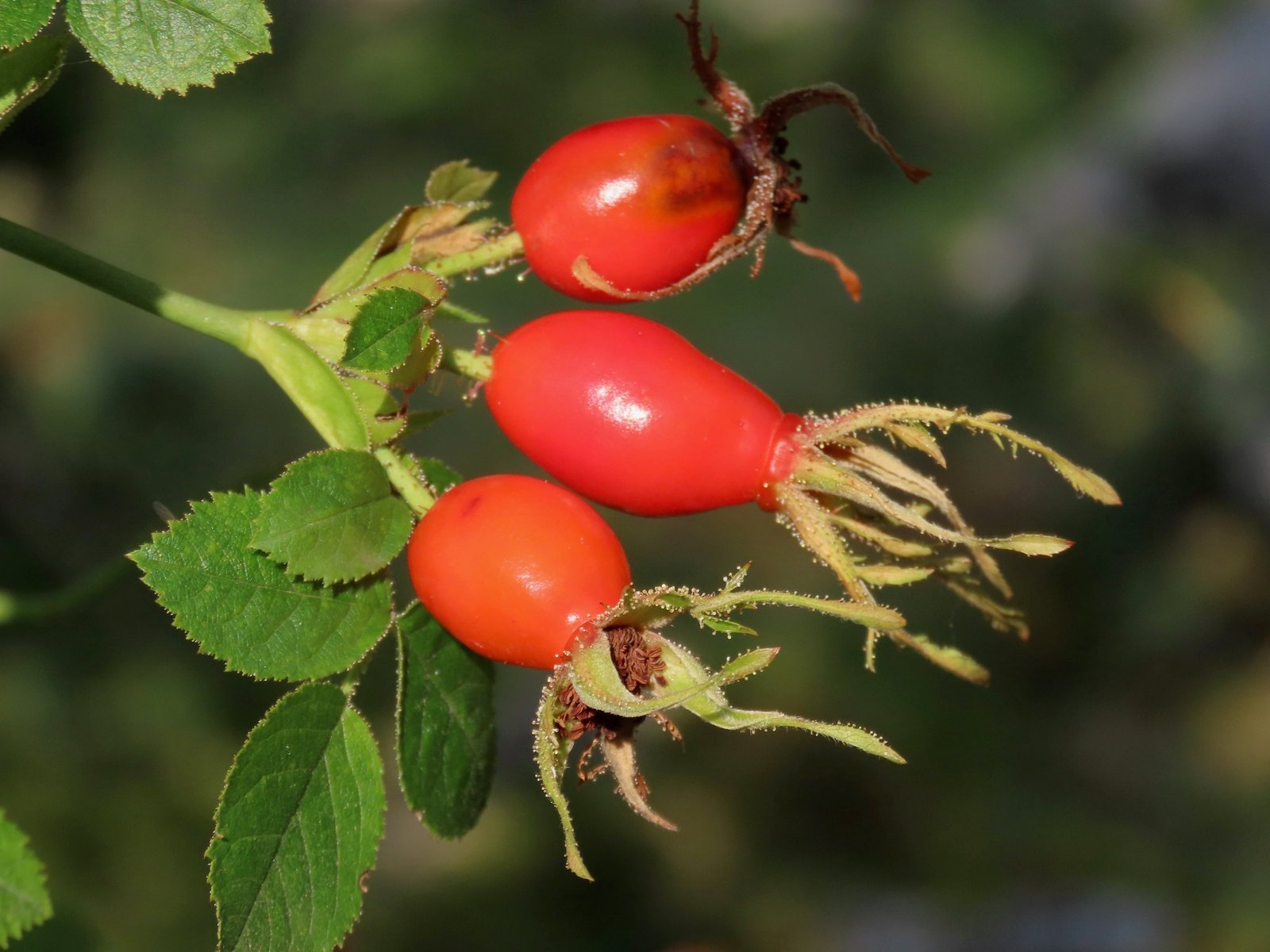
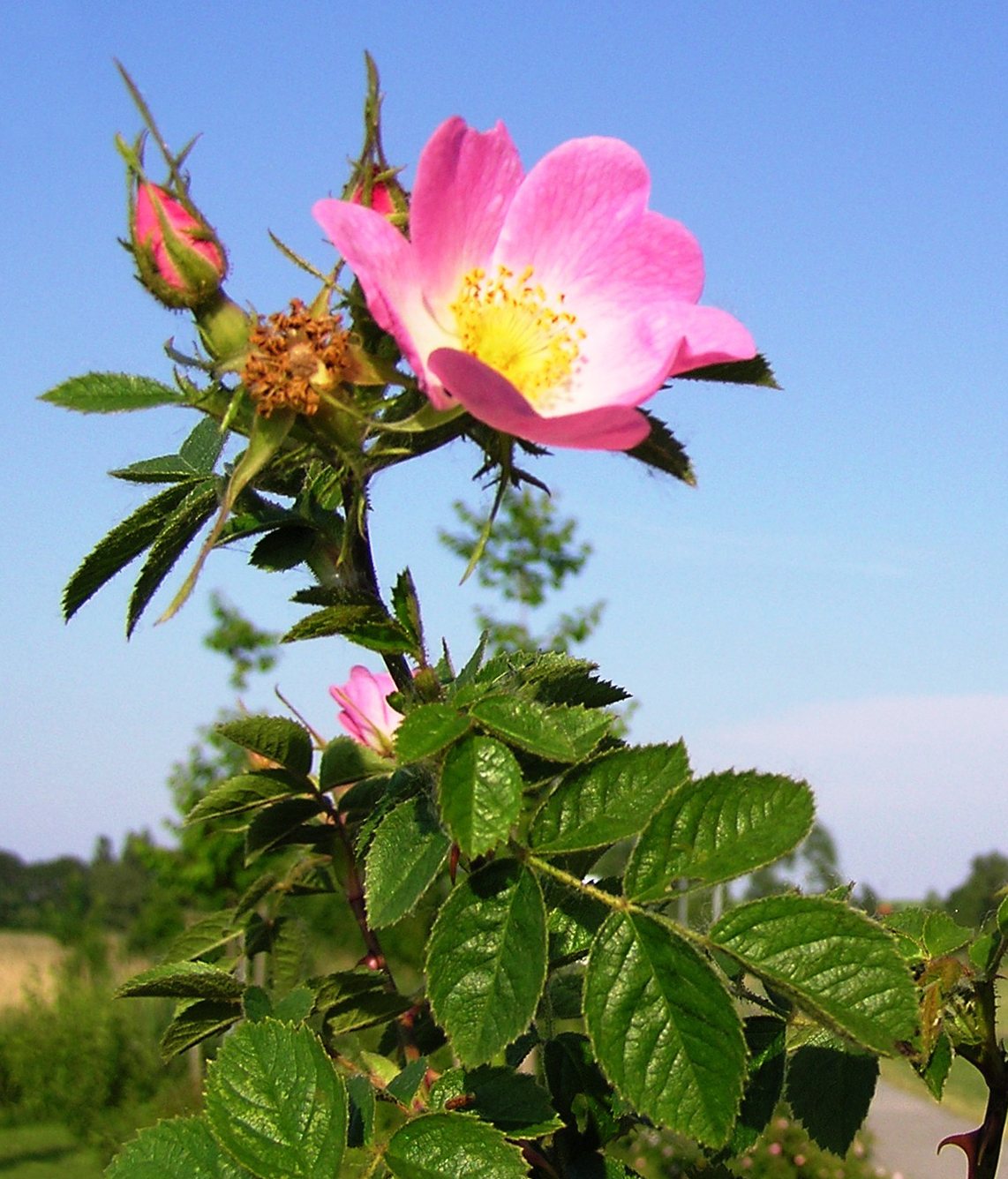
Sweet briar is a large, deciduous wild rose with arching, thorny stems, small pink flowers and red autumn hips. Gardeners grow it for informal hedges, wildlife cover and its apple-scented leaves, especially noticeable after rain or when brushed. It needs room and can spread beyond its planting site.
At a glance
- Sun
- Full sun is best; tolerates light partial shade, with fewer flowers and hips.
- Water
- Water regularly during the first growing season; established plants tolerate some drought but benefit from deep watering during prolonged dry spells.
- Soil
- Well-drained soil, including clay and chalk; tolerates a wide pH range. Avoid persistently waterlogged ground.
- Height
- 6-10 ft (1.8-3 m)
- Spread
- 6-10 ft (1.8-3 m), potentially wider through suckering
- Flowers
- Single, pale to rosy pink flowers with yellow centres in late spring and early summer; usually flowers once.
- Foliage
- Deciduous, divided green leaves with small, toothed leaflets. Glands beneath the leaves release an apple-like scent.
- Growth
- Moderate to fast
- Care needed
- Medium
The year at a glance
- Pollinators
- Drought tolerant
- Cold hardy
- Heat tolerant
- Wildlife
- Low allergen
- Fragrant
| J | F | M | A | M | J | J | A | S | O | N | D | |
|---|---|---|---|---|---|---|---|---|---|---|---|---|
| Flowers | ||||||||||||
| Fruit | ||||||||||||
| Plant |
Northern hemisphere months. In Australia, shift them by six.
- Difficulty
- Moderate
- Toughness
- Very tough
Will it suit your garden?
Pick your zone, country, light and whether you have pets.
Full sun is 6 or more hours of direct sun a day, part shade 3 to 6 hours, shade under 3.
How it grows
Planting day
1.6 ft (0.5 m)
After 1 year
3 ft (0.98 m)
After 2 years
5 ft (1.5 m)
After 3 years
6 ft (1.9 m)
After 5 years
8 ft (2.4 m)
full size
About 4 years to full size.
From a typical nursery size, at an average rate for this kind of plant. A rule of thumb, not a forecast.
Good to know
- Cats and dogs
- Safe
- Native to
- the UK
- Invasive in
- the US, Canada and Australia
- In the garden
- Spreads vigorously: plan to contain it.
- Growth rate
- Fast
Care
Jobs through the year
- WaterApr–May, Sep–Oct, every 21 days
- Water established shrubs only during prolonged dry spells; water young plants more regularly.
- WaterJun–Aug, every 14 days
- Give a deep soak during extended drought, skipping when soil remains moist.
- PruneFeb–Mar
- Remove damaged and crossing stems, thinning a few old canes to ground level if crowded.
- MulchMar–Apr
- Refresh organic mulch while keeping the stem bases clear.
- FeedApr
- Apply balanced rose fertiliser only on poor soil, following the labelled rate.
- PruneApr–Oct, every 30 days
- Remove unwanted suckers at their origin; wear thick gloves.
- ProtectMay–Jun, every 7 days
- Check tender shoots for aphids and wash off colonies with water.
- DeadheadJul–Aug, every 14 days
- Only where seed spread is a concern, remove spent flowers before hips develop; otherwise retain for birds.
- Water deeply during dry weather in the first growing season.
- Mulch in spring, keeping mulch clear of the stem bases.
- On poor soil, apply a balanced rose fertiliser in spring at the labelled rate; avoid heavy nitrogen feeding.
- Remove unwanted suckers at their point of origin before the clump expands.
- Leave spent flowers if you want autumn hips.
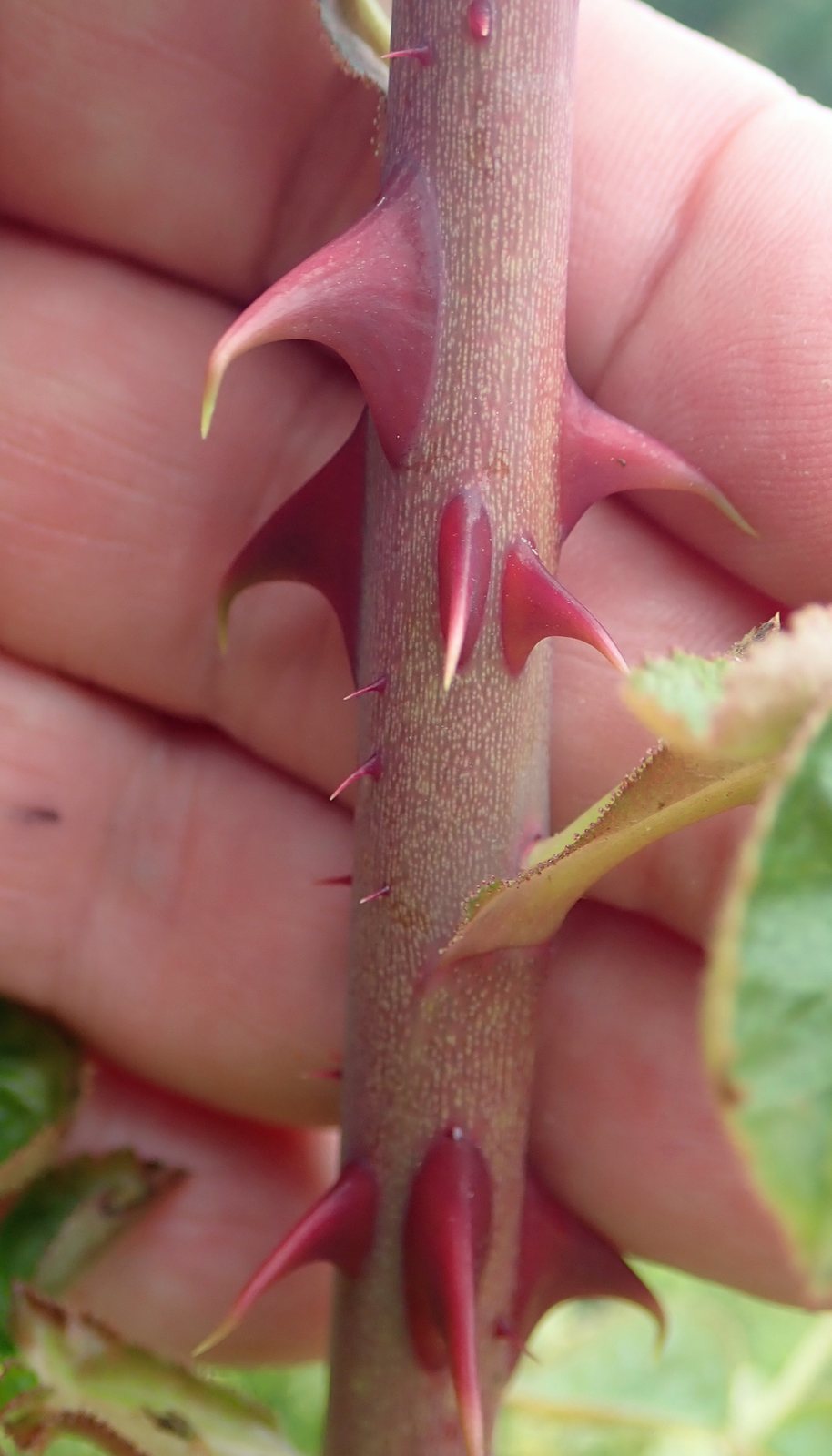
- Wear thick gloves and keep thorny stems away from narrow paths and play areas.
Pruning. In late winter, remove dead, damaged and crossing stems, cutting a few of the oldest canes to ground level when needed. Shape lightly after flowering, remembering that removing flowered shoots also removes developing hips.
Through the year
- Autumn
- Plant while the soil is workable, water thoroughly and mulch.
- Winter
- Plant bare-root plants during mild weather when the ground is neither frozen nor waterlogged.
- Late winter
- Remove damaged wood and thin congested growth.
- Spring
- Refresh mulch, feed if needed and remove unwanted suckers.
- Early summer
- Check new shoots for aphids and shape lightly after flowering if necessary.
- Summer
- Water young plants during dry spells and retain spent flowers for hips.
- Late autumn
- Leave hips for birds where spread is not a concern; otherwise remove them before wildlife disperses the seeds.
In the garden
- Use in a mixed informal hedge with hawthorn and hazel for flowers, fruit and shelter.
- Place at the back of a large cottage border, with hardy geraniums covering the lower stems.
- Grow as a loose boundary thicket where its arching habit and thorns have space.
- Position near, but not overhanging, a broad path so the scented foliage can be enjoyed safely.
Garden styles it suits: Cottage garden, English country, Native hedgerow, Wildlife garden, Sensory garden and Romantic rose garden.
Plant it with: Hawthorn, Hazel, Hardy geranium, Catmint, Yarrow and Oxeye daisy.
Wildlife: Open flowers provide pollen for bees and other insects. Hips feed birds, while dense, thorny growth offers nesting cover; birds can also carry seeds into nearby habitats.
Problems to watch for
- Black spot: remove fallen infected leaves, improve airflow and water at soil level rather than over the foliage.
- Powdery mildew: prevent drought stress, mulch and thin crowded stems to improve airflow.
- Aphids: wash colonies from soft shoots with water and allow ladybirds and other predators to feed.
- Unwanted spread: remove suckers promptly and remove hips before seed dispersal; choose another shrub where it is invasive.
Safety
Not known to be toxic to cats, dogs, horses or people. Thorns can cause puncture wounds, and the fine hairs surrounding the seeds inside the hips can irritate the mouth, skin and digestive tract.
Where it spreads. Spreads by seed and suckers. It is invasive in parts of southeastern Australia, including New South Wales, Victoria, South Australia and Tasmania, and in New Zealand. It is also invasive or locally troublesome in parts of western North America, including California, Colorado and British Columbia. Check local restrictions before planting.
Easily confused with
Dog rose (Rosa canina)
Has similar arching stems, hooked thorns and pink flowers, but its leaves lack sweet briar's strong apple scent and abundant scented glands beneath the leaflets.
Japanese rose (Rosa rugosa)
Has strongly wrinkled leaves, densely prickly stems, larger flowers and broad, flattened hips; sweet briar has smaller leaflets and generally more elongated hips.
The name
The Latin rubiginosa means rust-coloured, referring to the rusty-looking glands beneath the leaves, while sweet briar refers to the scented foliage and thorny stems.
Propagation. Take hardwood cuttings during the dormant season or detach rooted suckers while dormant. Seed needs cold stratification and can be slow and irregular to germinate; do not propagate or distribute it where invasive.
Checked against open data
- Accepted botanical name
- Rosa rubiginosa
- In the US and Canada
- Introduced in Canada and the lower 48 states.
- Native range
- Albania, Austria, Baltic States, Belarus, Belgium, Bulgaria, Central European Rus, Corse, Czechoslovakia, Denmark, East European Russia and France.
- Measured
- Soil pH 7.5 to 8. Average height 200 cm.
Sources: GBIF (CC BY 4.0), USDA PLANTS and Trefle (CC BY 4.0). The care and design notes are LandscapeGPT's own.
See it in your own yard.
Upload a photo of your yard and see it redesigned with plants that suit your climate, each checked against your zone.