Thornless blackberry 'Triple Crown'
Rubus 'Triple Crown'. Family Rosaceae. Shrub.
Also called Triple Crown blackberry.
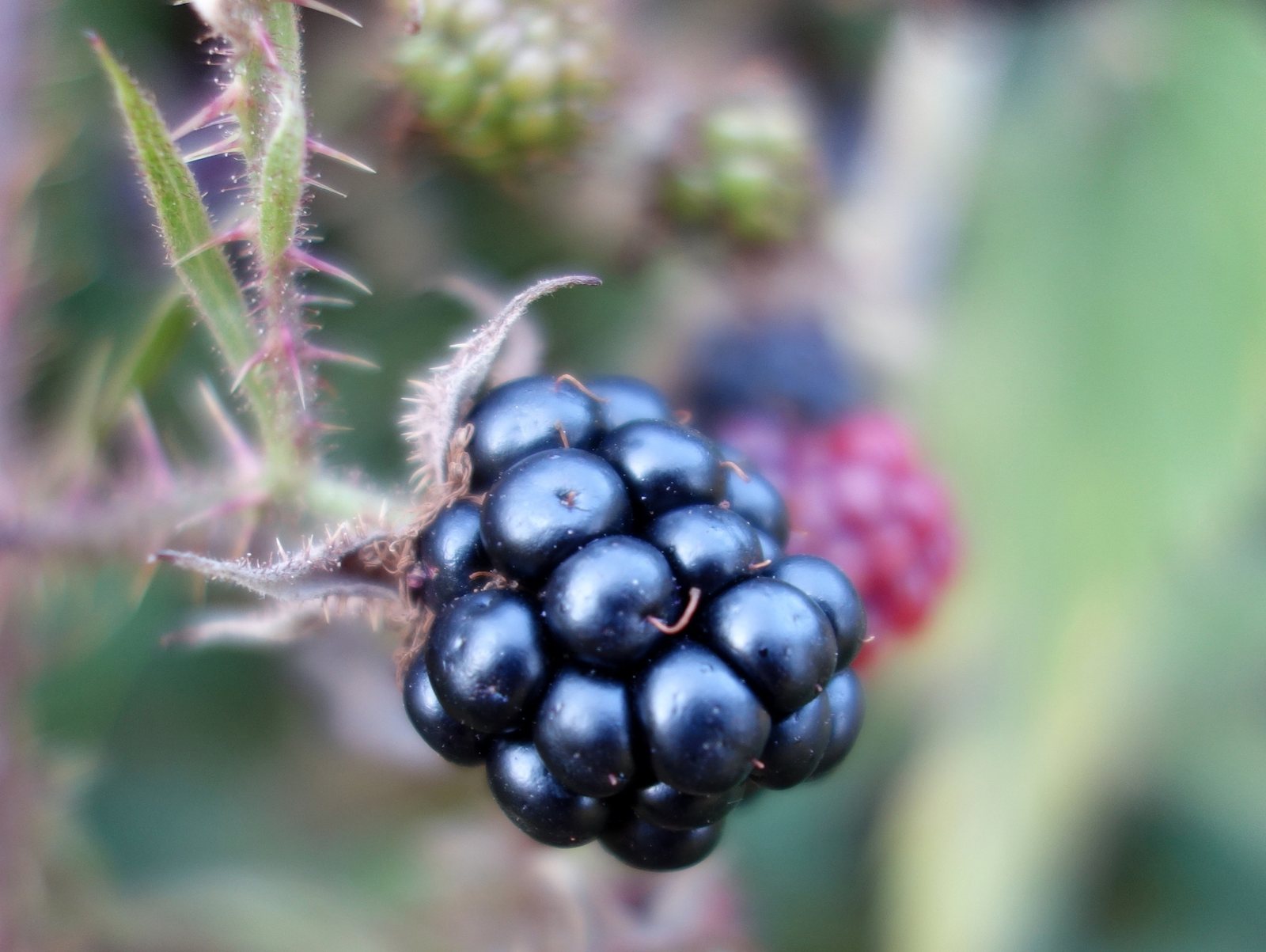
'Triple Crown' is a vigorous, thornless blackberry with long, semi-erect canes and large, sweet black berries. It is self-fertile, so one plant can crop, but it needs a sturdy support and annual pruning. Its relatively late harvest makes it less dependable in cool areas with short summers.
At a glance
- Sun
- Full sun for the best crops; tolerates light shade but fruit ripens more slowly.
- Water
- Keep the root zone evenly moist, especially during flowering and fruit swelling; avoid waterlogged soil.
- Soil
- Fertile, well-drained loam with plenty of organic matter; slightly acidic soil, around pH 5.5-6.5, is ideal.
- Height
- 5-6 ft (1.5-1.8 m) when trained; unsupported canes can grow 10-15 ft (3-4.6 m) long.
- Spread
- 6-8 ft (1.8-2.4 m) when trained, potentially wider if cane tips root.
- Flowers
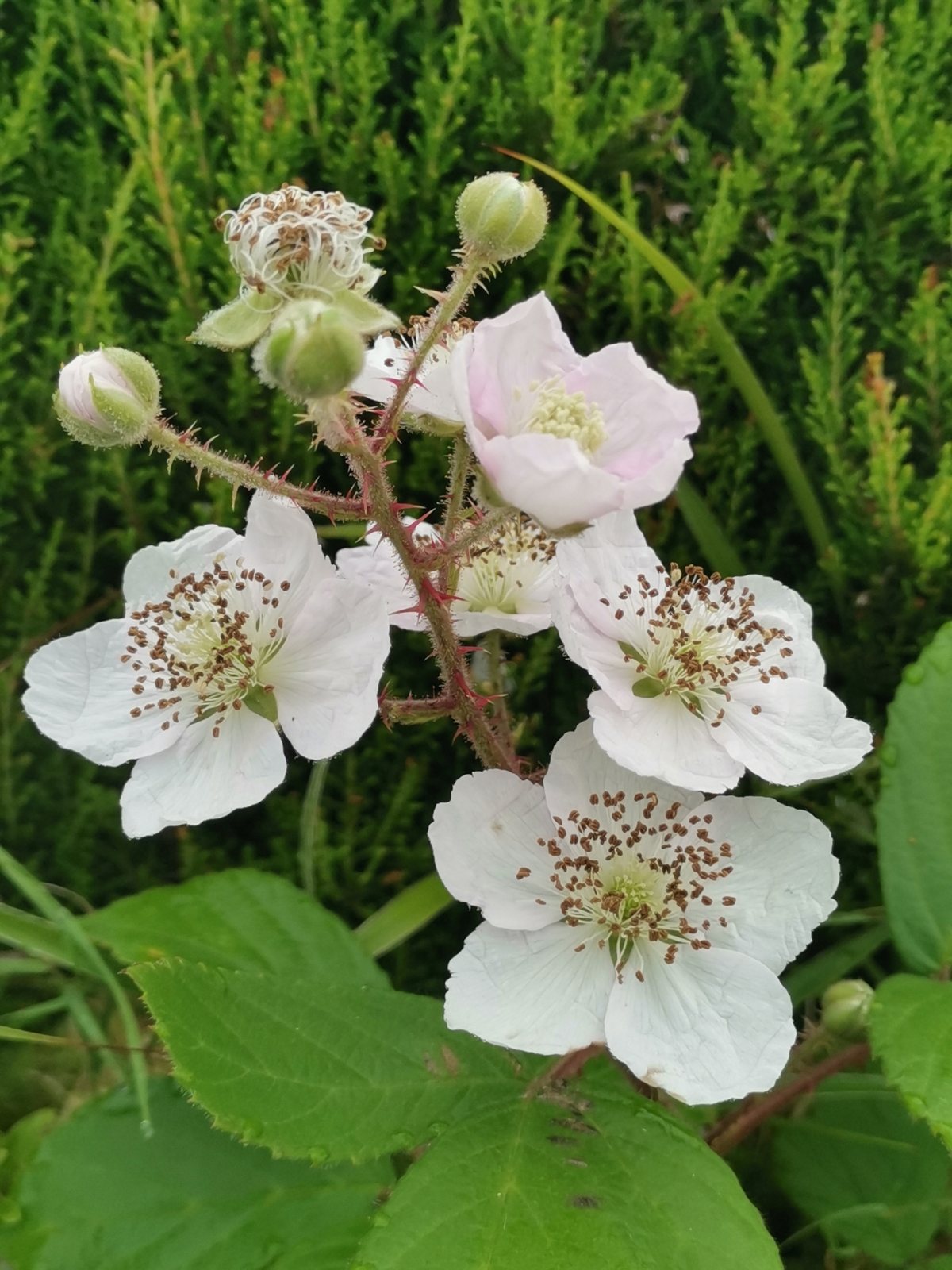
- White to pale pink flowers in late spring and early summer.
- Foliage
- Green, toothed leaves, usually divided into three or five leaflets; deciduous, though some leaves may persist in mild winters.
- Growth
- Fast
- Care needed
- Medium
The year at a glance
- Pollinators
- Heat tolerant
- Wildlife
- Low allergen
- Edible
| J | F | M | A | M | J | J | A | S | O | N | D | |
|---|---|---|---|---|---|---|---|---|---|---|---|---|
| Flowers | ||||||||||||
| Fruit | ||||||||||||
| Plant |
Northern hemisphere months. In Australia, shift them by six.
- Difficulty
- Moderate
- Toughness
- Fairly tough
Will it suit your garden?
Pick your zone, country, light and whether you have pets.
Full sun is 6 or more hours of direct sun a day, part shade 3 to 6 hours, shade under 3.
How it grows
Planting day
1.6 ft (0.5 m)
After 1 year
2.8 ft (0.85 m)
After 2 years
4 ft (1.2 m)
After 3 years
5 ft (1.6 m)
After 5 years
5 ft (1.7 m)
full size
About 3 years to full size.
From a typical nursery size, at an average rate for this kind of plant. A rule of thumb, not a forecast.
Good to know
- Cats and dogs
- Safe
- In the garden
- Spreads vigorously: plan to contain it.
- Growth rate
- Fast
Care
Jobs through the year
- WaterApr, Oct, every 14 days
- Water established plants deeply if soil is drying; newly planted canes need closer moisture checks.
- WaterMay–Sep, every 7 days
- During fruit development, supply 2.5–5 cm weekly including rain; split applications in hot, dry weather.
- FeedMar
- Apply balanced fruit fertilizer at the labelled rate; avoid excessive nitrogen.
- MulchMar–Apr
- Refresh a 5–8 cm organic mulch layer, keeping the crown clear.
- PruneFeb–Mar
- Keep four to six strong replacement canes and shorten their side shoots to 30–45 cm.
- PruneJun–Jul
- Tip new canes at 1.2–1.5 m to encourage branching.
- ProtectMay–Aug, every 14 days
- Tie new canes separately from fruiting canes and keep tips off the soil.
- ProtectJul–Sep
- If birds take fruit, cover with taut wildlife-safe netting secured against entanglement.
- HarvestJul–Sep
- Pick fully black, plump berries that release easily; refrigerate promptly.
- PruneSep–Oct
- Once harvest finishes, remove all fruited canes at ground level and retain healthy replacements.
- PruneNov
- Remove unwanted rooted cane tips and diseased growth.
- Install a strong post-and-wire trellis before the canes become heavy.
- Water deeply during dry spells, aiming for roughly 1-2 in (2.5-5 cm) of water weekly during fruit development, including rainfall.
- Apply a balanced fruit fertiliser in early spring according to its label; avoid excessive nitrogen.
- Mulch with 2-3 in (5-8 cm) of composted bark or other organic material, keeping it clear of the crown.
- Tie new canes separately from fruiting canes and keep their tips off the soil to prevent unwanted rooting.
Pruning. After harvest, cut all canes that bore fruit to ground level, retaining about four to six strong new canes for next year's crop. Tip new canes at about 4-5 ft (1.2-1.5 m) in summer to encourage branching, then shorten their side shoots to 12-18 in (30-45 cm) in late winter.
Harvest
Pick in mid- to late summer, sometimes continuing into early autumn, when berries are fully black, plump and release with a gentle pull; black but firm berries may still taste sour. Harvest every few days and refrigerate promptly, as ripe berries soften quickly. Expect the first useful crop in the second growing season, with fuller production commonly reached in the third.
Through the year
- Late winter
- Thin retained canes, shorten side shoots and secure canes to the trellis.
- Early spring
- Plant dormant stock when soil is workable; feed established plants and renew mulch.
- Late spring
- Keep flowering plants watered and leave flowers accessible to pollinating insects.
- Early summer
- Tie in new canes and tip them when they reach the chosen training height.
- Mid- to late summer
- Pick ripe berries frequently; use taut wildlife-safe netting if birds take the crop.
- After harvest
- Remove spent fruiting canes at ground level and tie in their replacements.
- Late autumn
- Remove unwanted rooted tips and check trellis posts and ties before winter.
In the garden
- Train along a sunny boundary fence, leaving access for picking and pruning.
- Grow on a freestanding trellis as a productive divider in a kitchen garden.
- Use in a dedicated berry row with currants or gooseberries nearby, allowing enough space for each crop.
- Place at the sunny edge of a food forest, where its canes can be contained and fruit can ripen.
Garden styles it suits: Potager (kitchen garden), Cottage garden, Edible landscape, Homestead, Food forest and Family-friendly.
Plant it with: Chives, Thyme, Calendula, Sweet alyssum, Redcurrant and Gooseberry.
Wildlife: Flowers provide nectar and pollen for bees and other insects. Birds and small mammals eat the berries; if protecting fruit, use taut wildlife-safe netting secured so animals cannot become entangled.
Problems to watch for
- Spotted wing drosophila can cause soft, leaking fruit with small larvae inside: pick frequently, remove overripe berries and use fine insect mesh after flowering where practical.
- Cane diseases can cause purple lesions, cracking or dieback: remove affected canes in dry weather, disinfect tools and improve spacing and airflow.
- Wet-soil root rot causes weak growth and declining canes: improve drainage or move plants to a raised bed; do not keep the crown saturated.
- Poor winter survival or fruit that fails to ripen can occur near the cold limit or in short summers: choose a sheltered, sunny site and consider an earlier cultivar if crops repeatedly fail.
Safety
Not known to be toxic to people, cats, dogs or horses. Ripe berries are edible; eating large quantities may cause digestive upset.
Where it spreads. Can spread beyond its allotted space when arching cane tips touch soil and root. 'Triple Crown' is not generally singled out as an invasive cultivar, but blackberry planting and movement are restricted in parts of Australia; check state or territory rules because exemptions differ among cultivars.
Easily confused with
Black raspberry (Rubus occidentalis)
Ripe raspberries pull away from their central plug and are hollow inside; blackberries retain the plug. Black raspberry canes also usually have prickles and a pale, waxy coating.
Himalayan blackberry (Rubus armeniacus)
Usually has stout, strongly prickly canes and often five leaflets with pale undersides. 'Triple Crown' has thornless canes, although leaves alone cannot reliably identify a blackberry cultivar.
The name
Rubus is the Latin name for a bramble, while blackberry refers to the dark colour of the ripe fruit.
Propagation. Tip-layer a healthy new cane in late summer by burying its tip shallowly in a pot or patch of soil. Once well rooted, usually by the following spring, sever it from the parent and transplant; avoid propagating plants showing disease symptoms.
Checked against open data
- Accepted botanical name
- Rubus
Sources: GBIF (CC BY 4.0). The care and design notes are LandscapeGPT's own.
See it in your own yard.
Upload a photo of your yard and see it redesigned with plants that suit your climate, each checked against your zone.