Tropical sage
Salvia coccinea. Family Lamiaceae. Perennial.
Also called Scarlet sage, Blood sage, Texas sage.
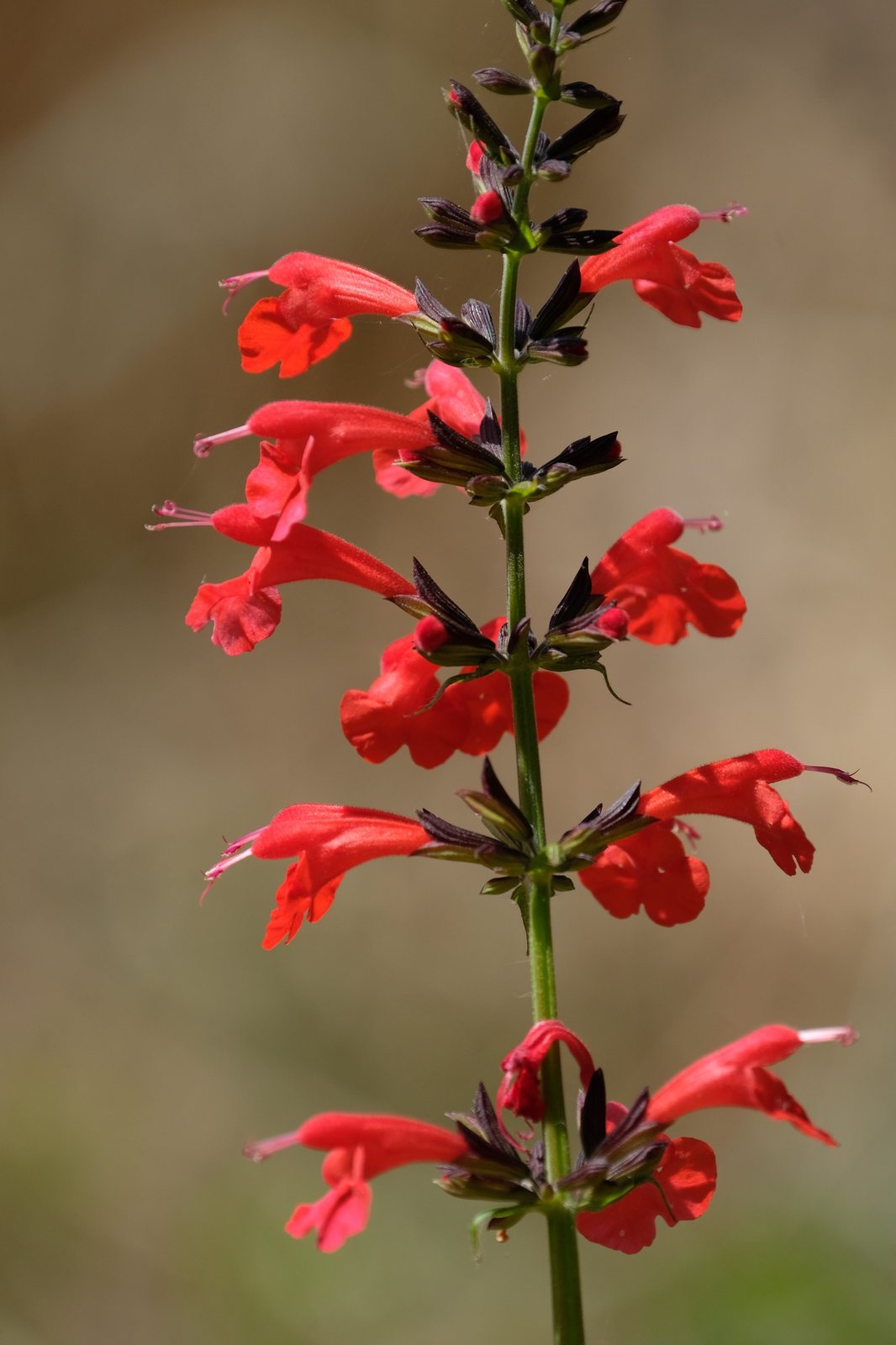
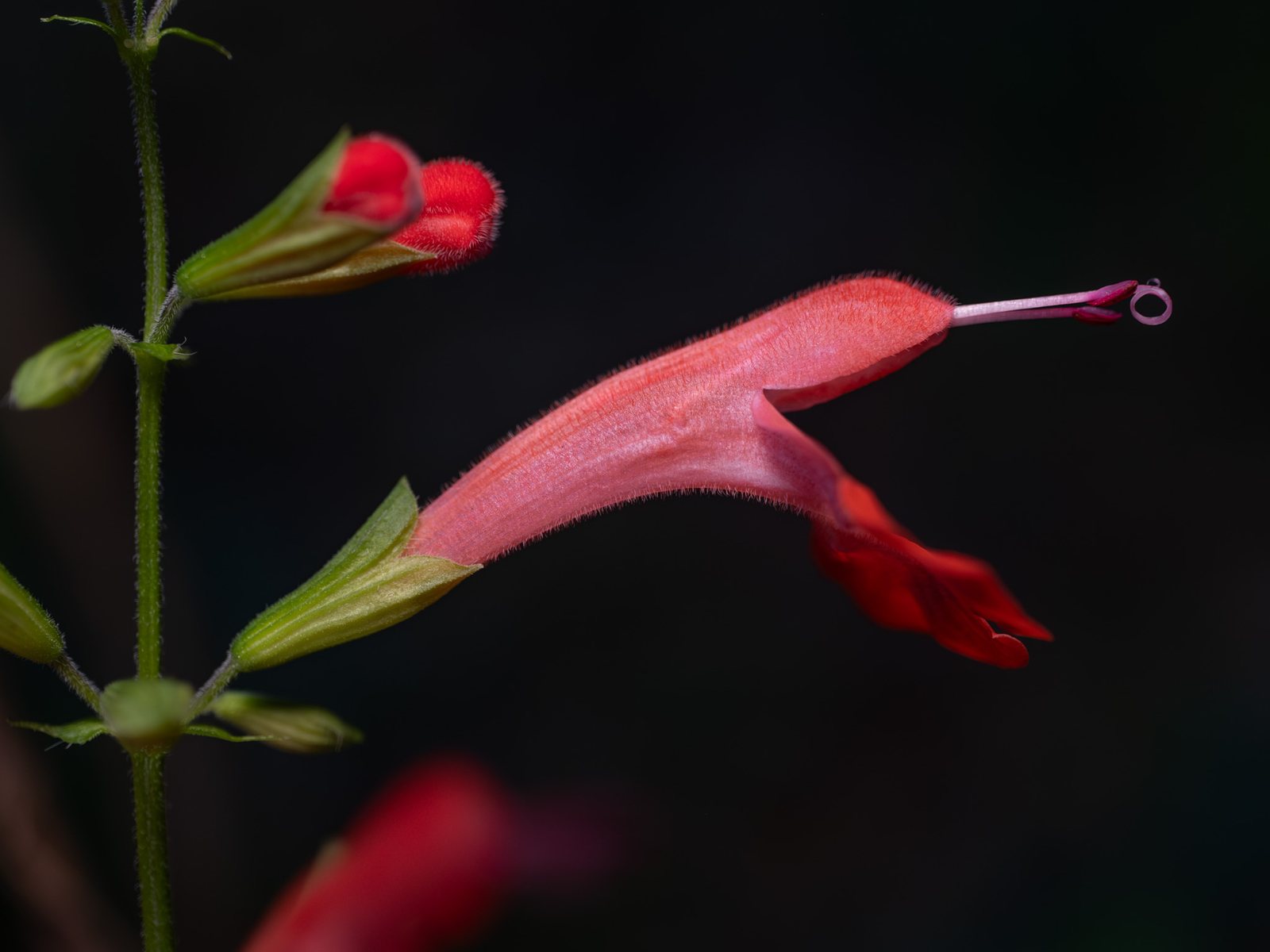
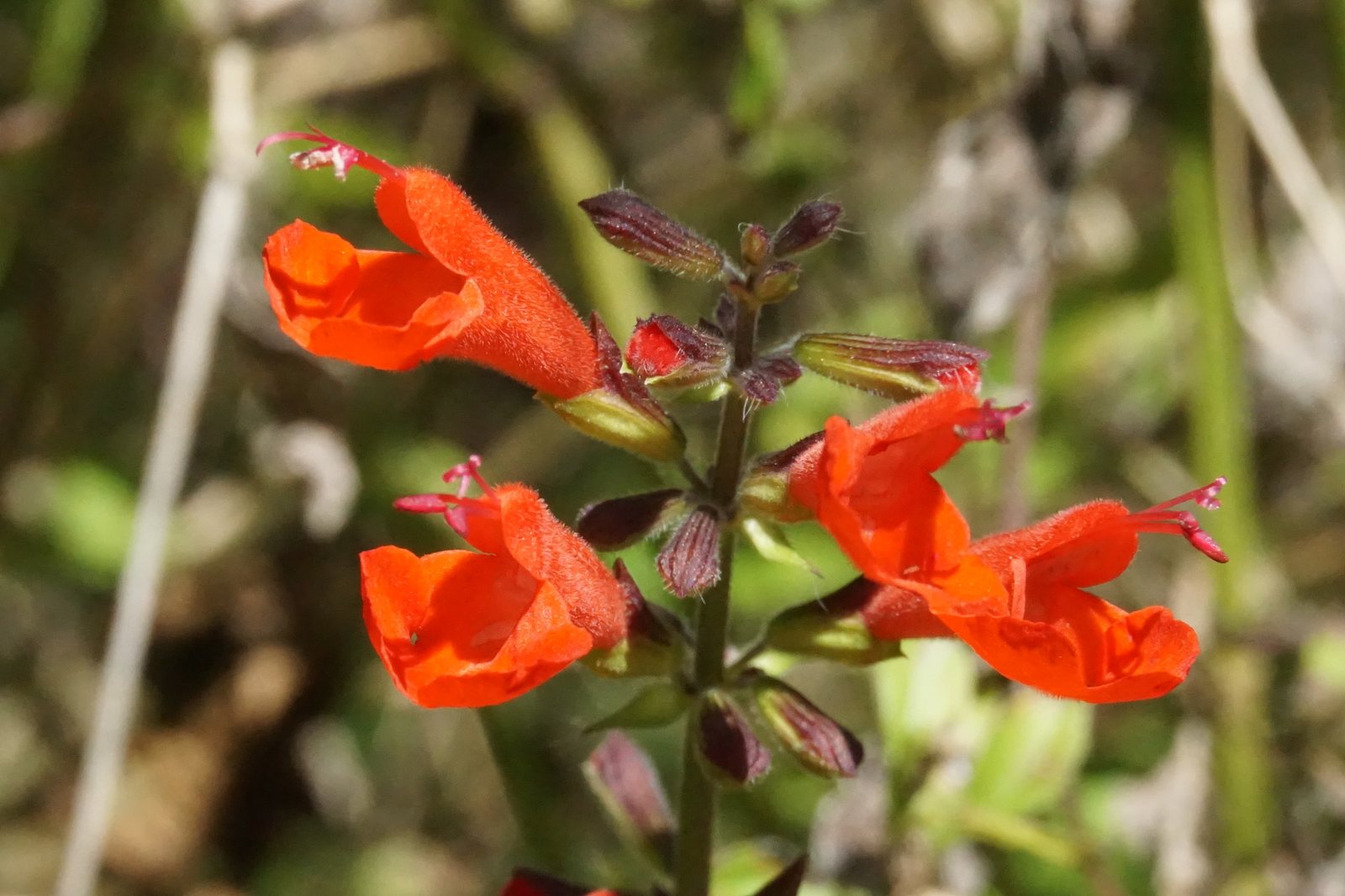
Tropical sage is a short-lived, frost-tender perennial with loose spikes of tubular flowers, usually scarlet, that attract hummingbirds and butterflies. It is grown as an annual in colder climates and flowers readily in its first year from seed. Its airy habit suits informal borders, containers and wildlife gardens.
At a glance
- Sun
- Full sun to partial shade; afternoon shade is helpful in very hot climates.
- Water
- Water regularly while establishing, then when the upper soil dries. Established plants tolerate brief dry spells but flower better with occasional deep watering.
- Soil
- Well-drained sandy, loamy or moderately rich soil; avoid waterlogged ground and excessive fertility.
- Height
- 1-3 ft (0.3-0.9 m)
- Spread
- 1-2 ft (0.3-0.6 m)
- Flowers
- Summer to autumn, until frost; potentially much longer in frost-free climates. Usually scarlet, with pink, coral and white forms available.
- Foliage
- Evergreen. Soft, green, triangular to oval leaves with toothed edges on branching, square stems; foliage can persist year-round in frost-free conditions.
- Growth
- Fast; flowers in its first growing season.
- Care needed
- Low
The year at a glance
- Pollinators
- Deer resistant
- Heat tolerant
- Low allergen
| J | F | M | A | M | J | J | A | S | O | N | D | |
|---|---|---|---|---|---|---|---|---|---|---|---|---|
| Flowers | ||||||||||||
| Fruit | ||||||||||||
| Plant |
Northern hemisphere months. In Australia, shift them by six.
- Difficulty
- Easy
- Toughness
- Fairly tough
Will it suit your garden?
Pick your zone, country, light and whether you have pets.
Full sun is 6 or more hours of direct sun a day, part shade 3 to 6 hours, shade under 3.
How it grows
Planting day
1 ft (0.3 m)
After 1 year
1.5 ft (0.45 m)
After 2 years
2 ft (0.6 m)
full size
About 2 years to full size.
From a typical nursery size, at an average rate for this kind of plant. A rule of thumb, not a forecast.
Good to know
- Cats and dogs
- Safe
- Invasive in
- Australia
- In the garden
- Spreads vigorously: plan to contain it.
- Growth rate
- Fast
Care
Jobs through the year
- WaterMay, Sep–Oct, every 14 days
- Water established ground plants if the upper soil is dry; new transplants need more frequent watering.
- WaterJun–Aug, every 7 days
- Water deeply at soil level when upper soil dries; skip after useful rain.
- MulchMay–Jun
- Apply a thin mulch after planting, keeping it away from stems.
- PruneMay–Jun
- Pinch young shoot tips once to encourage bushy growth.
- DeadheadJun–Oct, every 7 days
- Remove faded flower spikes; leave a few late spikes only if seed is wanted.
- ProtectMay–Jun
- Protect new transplants from slugs with hand-picking or suitable barriers.
- PruneOct–Nov
- Grown as an annual here; remove frost-killed plants.
- Plant out after frost danger has passed and the soil has warmed.
- Space plants 1-2 ft (0.3-0.6 m) apart to allow branching and airflow.
- Water at soil level when the upper soil dries; do not leave container plants standing in water.
- Use little fertilizer in garden soil; feed container plants lightly during active growth.
- Apply a thin mulch to conserve moisture, keeping it clear of the stems.
Pruning. Pinch young shoot tips to encourage bushier growth, and remove spent flower spikes to prolong flowering and limit self-seeding. In frost-free gardens, shorten leggy stems in early spring, cutting just above healthy leafy growth.
Through the year
- Early spring
- In cold climates, sow seed indoors about 6-8 weeks before the last expected frost; press it onto the surface and barely cover.
- Spring
- In frost-free gardens, trim overwintered plants back to healthy leafy growth.
- Late spring
- Harden off seedlings and plant outside after frost danger has passed.
- Summer
- Water during dry spells and remove faded flower spikes.
- Early autumn
- Allow a few spikes to ripen for seed where self-seeding is welcome, or remove them before seed falls.
- Late autumn
- Remove frost-killed plants in cold climates; keep surviving plants on the dry side during cool weather.
In the garden
- Thread through a mixed border with ornamental grasses for loose, upright accents.
- Group near a patio or path where visiting butterflies and, in the Americas, hummingbirds can be watched.
- Combine scarlet forms with blue-flowered salvias and purple verbena for a strong summer colour contrast.
- Use compact forms in sunny containers with trailing plants around the edges.
Garden styles it suits: Cottage garden, Wildlife garden, Pollinator garden, Hot border, Tropical and Florida subtropical.
Plant it with: Mealycup sage, Zinnias, Cosmos, Purple coneflower, Butterfly milkweed and Tall verbena.
Wildlife: Tubular flowers provide nectar for hummingbirds in the Americas, as well as butterflies and some bees. Leave a few seed heads where self-seeding is acceptable.
Problems to watch for
- Slugs and snails can eat young seedlings; protect new transplants with barriers, hand-picking or an approved iron-phosphate bait.
- Aphids may cluster on soft shoots; wash them off with water and encourage natural predators.
- Whiteflies can build up on sheltered or indoor plants; inspect leaf undersides and use insecticidal soap if needed, following the label.
- Root rot and winter losses occur in wet soil; improve drainage and avoid frequent watering in cool weather.
Safety
Not known to be toxic to people, cats, dogs or horses. No part is generally recognised as poisonous, but this is an ornamental sage, not a substitute for culinary sage, and it should not be treated as food.
Where it spreads. Readily self-seeds in warm climates. It is naturalised and regarded as an environmental weed in parts of eastern Australia, including Queensland and New South Wales; remove seed heads and check local guidance before planting near bushland.
Easily confused with
Bedding scarlet sage (Salvia splendens)
Usually has denser, more compact flower spikes with conspicuous coloured calyces; tropical sage has more widely spaced flowers on airy spikes.
Pineapple sage (Salvia elegans)
Usually grows into a larger, bushier plant with pineapple-scented leaves and longer, narrower red flowers, often flowering later in the season.
Autumn sage (Salvia greggii)
Forms a woody shrub with smaller, narrower leaves; tropical sage has broader, toothed leaves and softer, mostly herbaceous stems.
The name
Salvia comes from the Latin salvere, meaning to be well or healthy, while coccinea means scarlet, referring to the usual flower colour.
Propagation. Grow from seed sown indoors before the last frost or directly outside once conditions are warm. Softwood cuttings taken during active growth preserve particular flower colours; seedlings may vary.
Checked against open data
- Accepted botanical name
- Salvia coccinea
- Native range
- Alabama, Argentina Northeast, Argentina Northwest, Bahamas, Belize, Bolivia, Brazil West-Central, Colombia, Cuba, Dominican Republic, Ecuador and El Salvador.
Sources: GBIF (CC BY 4.0) and Trefle (CC BY 4.0). The care and design notes are LandscapeGPT's own.
See it in your own yard.
Upload a photo of your yard and see it redesigned with plants that suit your climate, each checked against your zone.