Turnip
Brassica rapa subsp. rapa. Family Brassicaceae. Annual.
Also called White turnip, Garden turnip.
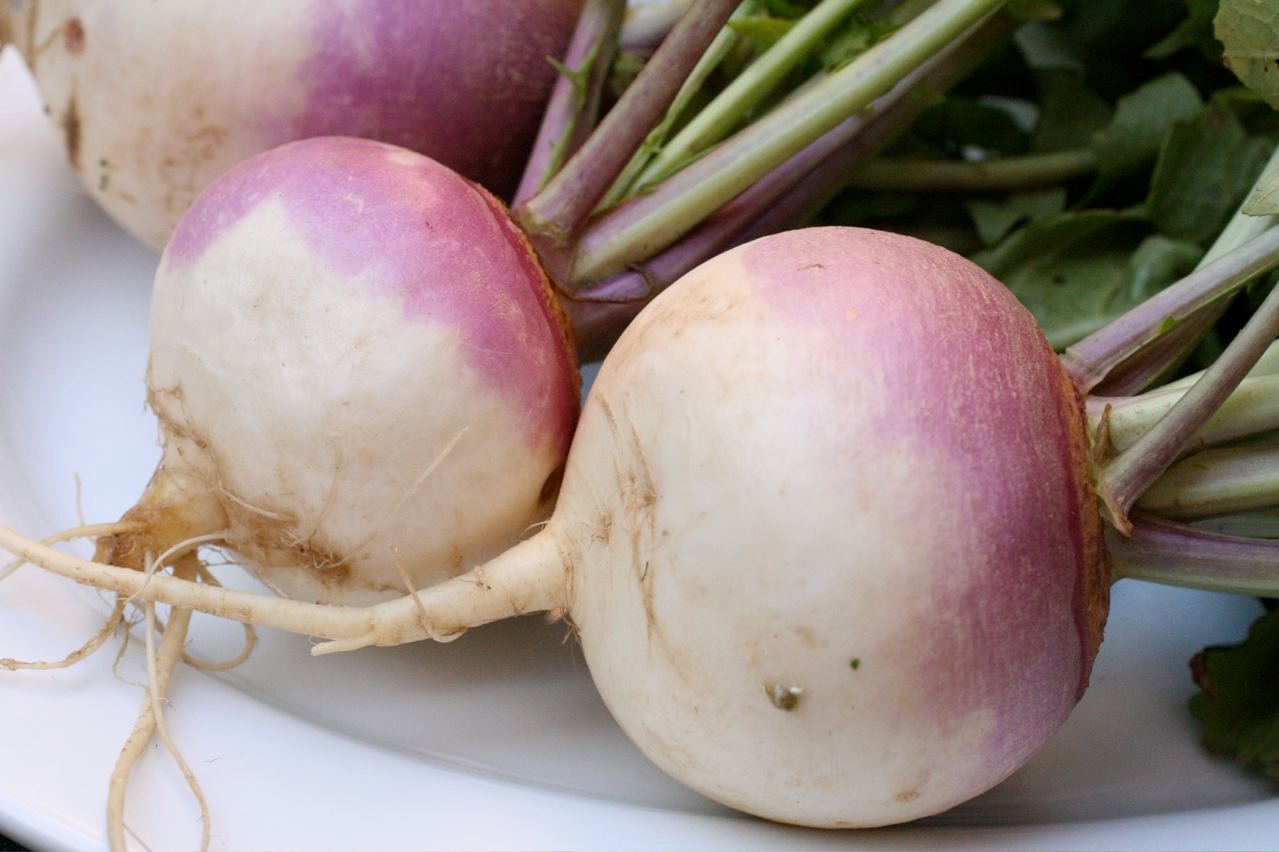
Turnip is a cool-season vegetable grown for its swollen root and edible leaves. Although botanically a biennial, it is grown as an annual and usually harvested within two months of sowing. Spring and late-summer sowings give the best roots in temperate gardens; in warm climates, grow it through the cooler months.
At a glance
- Sun
- Full sun; light afternoon shade is useful in warmer climates.
- Water
- Keep soil evenly moist, especially during germination and root swelling; avoid waterlogging.
- Soil
- Loose, moisture-retentive, well-drained soil with a pH of about 6.0-7.5. Avoid compacted ground and fresh manure.
- Height
- 1-1.5 ft (0.3-0.45 m) in leaf; flowering stems can reach 2-3 ft (0.6-0.9 m).
- Spread
- 0.5-1 ft (0.15-0.3 m)
- Flowers
- Yellow, four-petalled flowers in spring or early summer if plants overwinter and are allowed to flower.
- Foliage
- Green, rough-textured leaves, often lobed, forming a low rosette above the root.
- Growth
- Fast; many varieties produce usable roots in 35-60 days.
- Care needed
- Low
The year at a glance
- Low allergen
- Edible
| J | F | M | A | M | J | J | A | S | O | N | D | |
|---|---|---|---|---|---|---|---|---|---|---|---|---|
| Flowers | ||||||||||||
| Fruit | ||||||||||||
| Plant |
Northern hemisphere months. In Australia, shift them by six.
- Difficulty
- Easy
- Toughness
- Fairly tough
Will it suit your garden?
Pick your zone, country, light and whether you have pets.
Full sun is 6 or more hours of direct sun a day, part shade 3 to 6 hours, shade under 3.
How it grows
Planting day
0.5 ft (0.15 m)
After 1 year
1.2 ft (0.38 m)
full size
Full size in one season.
From a typical nursery size, at an average rate for this kind of plant. A rule of thumb, not a forecast.
Good to know
- Cats and dogs
- Mildly toxic: may upset a stomach
- Growth rate
- Fast
Care
Jobs through the year
- WaterMar–May, Sep–Nov, every 5 days
- Keep established crops evenly moist if rain is insufficient; check germinating seed daily.
- WaterJun–Aug, every 3 days
- Water growing crops during dry weather to prevent tough roots; seedlings may need daily light watering.
- MulchMar–Apr, Aug–Sep
- Work mature compost into the bed before sowing, then lightly mulch established seedlings clear of crowns.
- ProtectMar–Apr, Aug–Sep
- Cover immediately after sowing with fine insect mesh, seal edges, and thin seedlings to 8–15 cm apart.
- HarvestMay–Jul, Sep–Nov
- Pull young roots at the variety's recommended size; pick leaves sparingly and lift storage roots before hard freezes.
- ProtectOct–Nov
- Mulch crops kept briefly in the ground against light frost; harvest before prolonged freezing.
- Sow directly about 0.5 in (1 cm) deep; transplanting can distort the roots.
- Thin seedlings to 3-6 in (8-15 cm) apart, following the variety's spacing guidance.
- Water during dry spells so roots grow steadily without becoming tough.
- Work mature compost into the bed before sowing; avoid heavy nitrogen feeding, which favours leaves over roots.
- Apply a light mulch once seedlings are established, keeping it clear of their crowns.
- Use insect mesh from sowing and rotate crops away from other brassicas.
Pruning. No pruning is needed. Pick a few outer leaves for greens, leaving the central growing point and enough foliage to support root growth.
Harvest
Pull roots when they reach the variety's recommended size, usually about 2-3 in (5-8 cm) across, before they become woody or pithy. Pick young, tender leaves as needed, or harvest whole plants for greens; taking many leaves reduces root growth. Lift storage crops before the ground freezes hard, remove the tops and store the roots cool and humid.
Through the year
- Early spring
- Prepare a loose seedbed with mature compost and sow once the soil is workable.
- Spring
- Thin seedlings, cover with insect mesh and make small repeat sowings for a steady harvest.
- Late spring
- Harvest spring roots while young; stop sowing if hot weather is approaching.
- Late summer
- Sow an autumn crop, allowing roughly 6-10 weeks before persistent freezing weather.
- Autumn
- Harvest roots as they size up; in mild or warm climates, continue cool-season sowings.
- Late autumn
- Lift roots for storage before hard freezes, or protect short-term crops with mulch where winters are mild.
In the garden
- Plant in short rows in a kitchen garden for quick crops between slower vegetables.
- Use blocks of leafy rosettes in a potager alongside lettuce and beetroot.
- Grow compact varieties in deep containers or raised beds close to the kitchen.
- Follow cleared summer crops with turnips to keep edible beds productive into autumn.
Garden styles it suits: Potager (kitchen garden), Cottage garden, Homestead, Edible landscape, Small-space and Family-friendly.
Plant it with: Lettuce, Spinach, Peas, Beetroot and Spring onions.
Wildlife: Leaves feed several moth and butterfly caterpillars, which may damage the crop. Plants left to flower provide pollen and nectar for bees and other insects.
Problems to watch for
- Flea beetles chew small holes in young leaves: cover seedlings with fine insect mesh immediately after sowing and keep them well watered.
- Cabbage root fly larvae tunnel into roots: use insect mesh with buried or securely sealed edges, and rotate brassica beds.
- Clubroot causes swollen, distorted roots and wilting: avoid affected ground, improve drainage and test soil before liming; resting beds from brassicas for several years helps reduce risk.
- Woody, pithy roots or premature flowering result from heat, water stress or delayed harvest: sow in cool seasons, maintain moisture and pull roots young.
Safety
Roots and leaves are edible for people and are not known to be toxic to cats or dogs in ordinary food amounts, although large servings can cause digestive upset. Large or prolonged brassica intake can affect thyroid function; heavy consumption by horses and other grazing livestock can also cause serious illness, so do not offer unrestricted access or piles of crop waste.
Easily confused with
Swede or rutabaga (Brassica napus Napobrassica Group)
Usually has a larger, slower-maturing root with a more distinct neck, often yellow flesh, and smoother, waxier blue-green leaves; turnip leaves are generally rougher and brighter green.
Radish (Raphanus sativus)
Some round white radishes resemble turnips, but their roots usually taste distinctly peppery. Flowering radishes generally have white, pink or lilac flowers, often with darker veins, rather than turnip's yellow flowers.
The name
The botanical name combines Brassica, the Latin name for cabbage, with rapa, the Latin word for turnip.
Propagation. Grow from seed sown directly where the plants will mature. For seed saving, selected plants usually need winter chilling before flowering and can cross with other flowering Brassica rapa crops, including pak choi and some mustards.
Checked against open data
- Accepted botanical name
- Brassica rapa rapa
Sources: GBIF (CC BY 4.0). The care and design notes are LandscapeGPT's own.
See it in your own yard.
Upload a photo of your yard and see it redesigned with plants that suit your climate, each checked against your zone.