Virginia bluebells
Mertensia virginica. Family Boraginaceae. Perennial.
Also called Virginia cowslip, Lungwort oysterleaf.
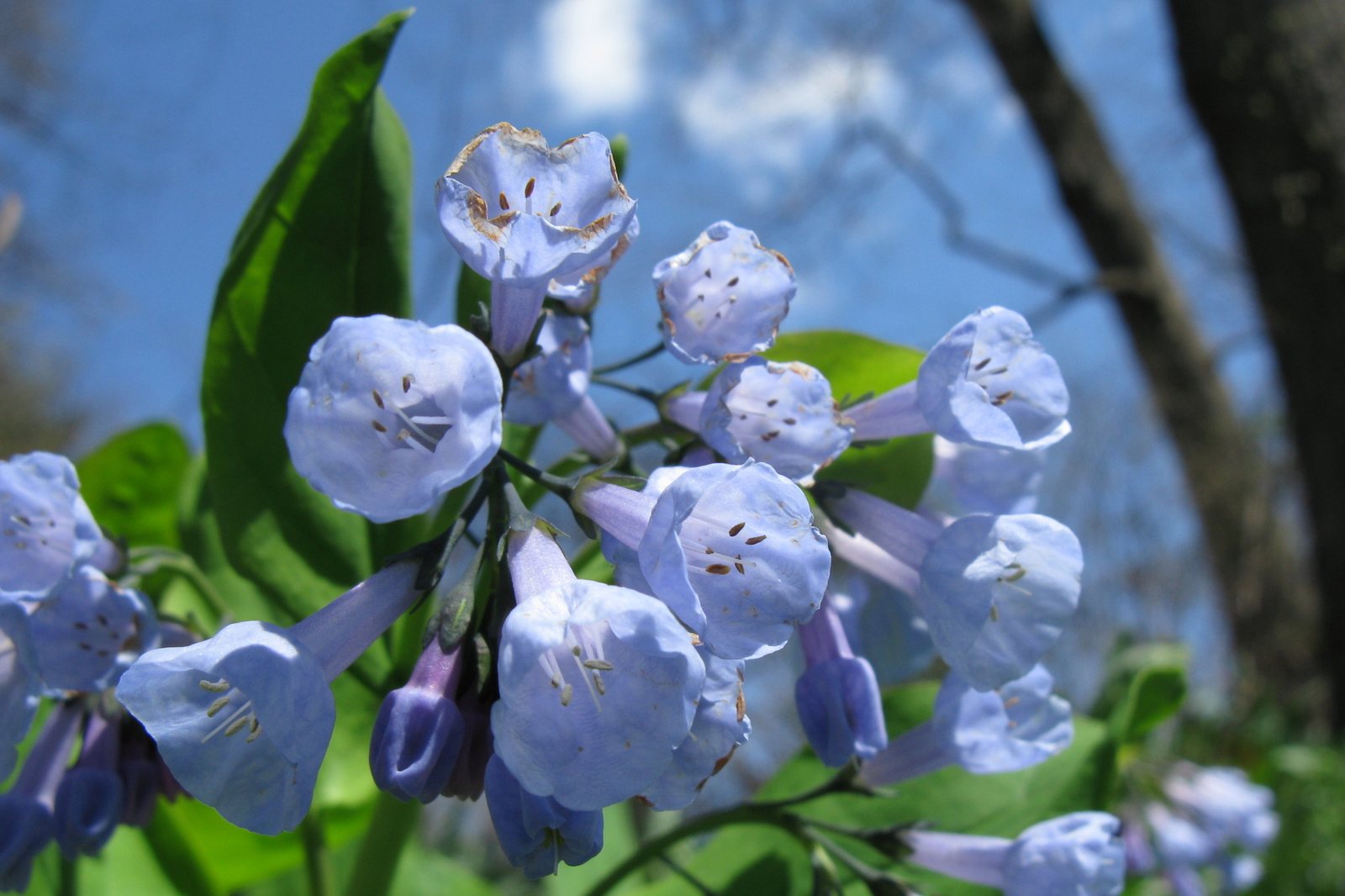
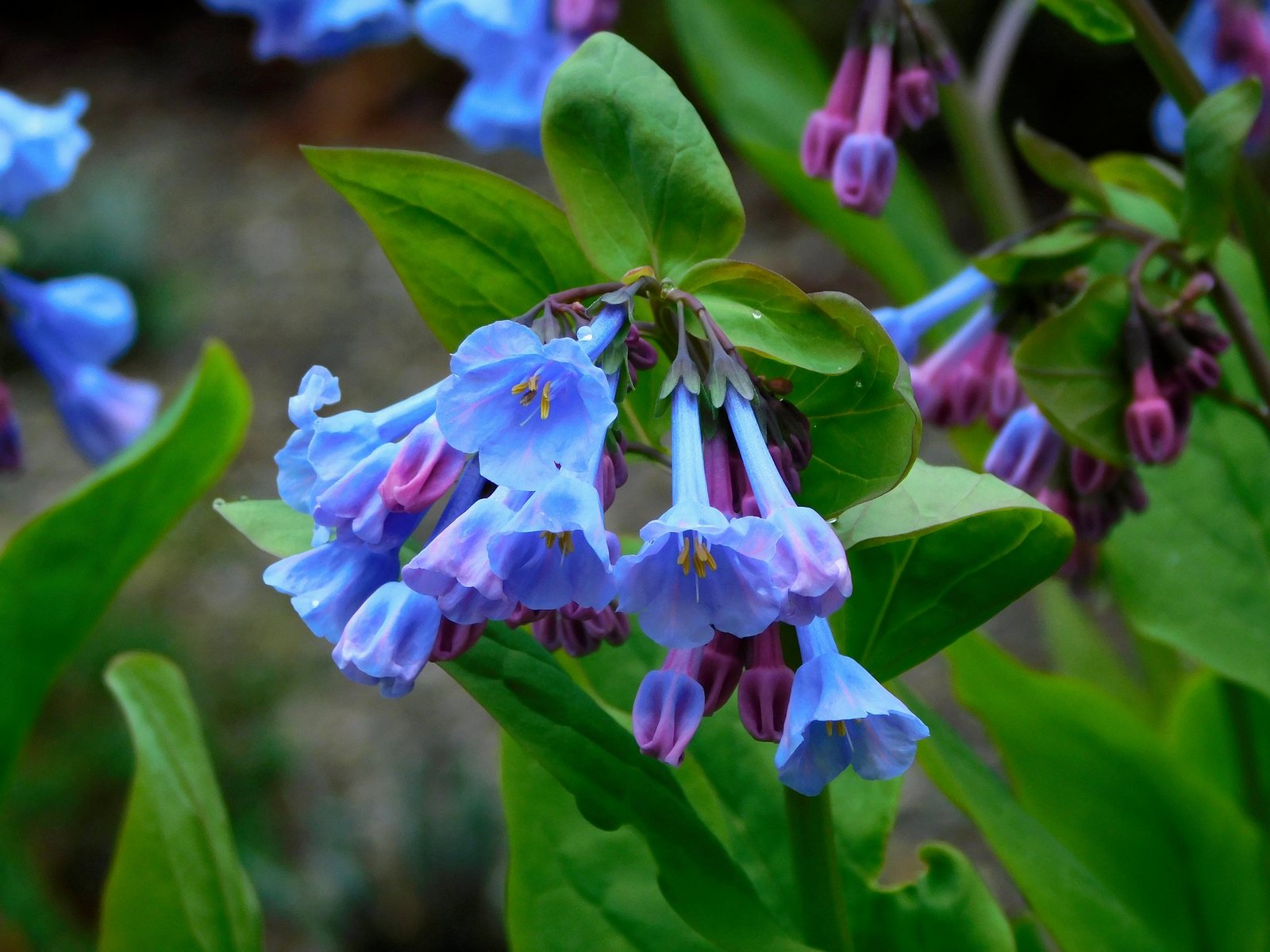
Virginia bluebells is a spring-flowering woodland perennial native to eastern North America, grown for clusters of blue, bell-shaped flowers opening from pink buds. Its leaves disappear in summer, so plant it among later-emerging perennials that will cover the gap. It grows best in regions with cold winters and cool, moist springs.
At a glance
- Sun
- Partial shade to full shade; spring sunshine beneath deciduous trees is ideal.
- Water
- Keep evenly moist during spring growth. Once dormant, it tolerates some drying, but avoid prolonged severe drought and waterlogged soil.
- Soil
- Humus-rich, moisture-retentive but well-drained soil; mildly acidic to mildly alkaline.
- Height
- 1-2 ft (0.3-0.6 m)
- Spread
- 1-1.5 ft (0.3-0.45 m) per clump; seedlings can gradually form colonies.
- Flowers
- Spring, usually March-May in the Northern Hemisphere; pink buds open into sky-blue bells.
- Foliage
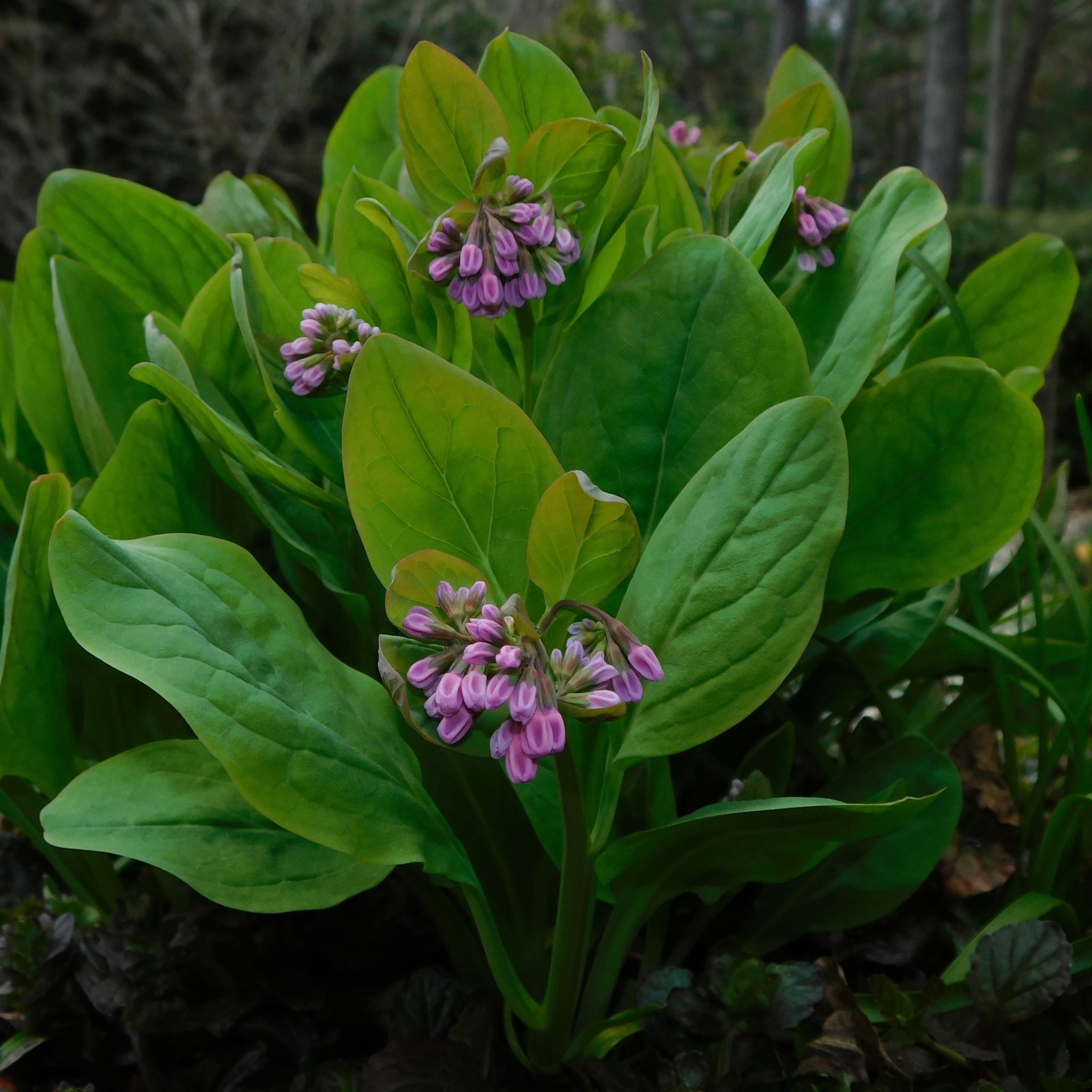
- Soft, smooth, oval leaves emerge with a purplish tint, become blue-green, then yellow and die back after flowering.
- Growth
- Moderate; takes a few seasons to establish a substantial clump.
- Care needed
- Low
The year at a glance
- Pollinators
- Deer resistant
- Cold hardy
- Low allergen
| J | F | M | A | M | J | J | A | S | O | N | D | |
|---|---|---|---|---|---|---|---|---|---|---|---|---|
| Flowers | ||||||||||||
| Plant |
Northern hemisphere months. In Australia, shift them by six.
- Difficulty
- Easy
- Toughness
- Fairly tough
Will it suit your garden?
Pick your zone, country, light and whether you have pets.
Full sun is 6 or more hours of direct sun a day, part shade 3 to 6 hours, shade under 3.
How it grows
Planting day
1 ft (0.3 m)
After 1 year
1.1 ft (0.35 m)
After 2 years
1.3 ft (0.4 m)
After 3 years
1.5 ft (0.45 m)
full size
About 3 years to full size.
From a typical nursery size, at an average rate for this kind of plant. A rule of thumb, not a forecast.
Good to know
- Cats and dogs
- Safe
- Native to
- Canada
- Growth rate
- Moderate
Care
Jobs through the year
- WaterMar–May, every 7 days
- Water established plants during dry weather to maintain evenly moist soil; new plants need closer checks.
- WaterJun–Aug, every 21 days
- Water dormant established crowns only during prolonged severe drought; avoid saturated soil.
- MulchOct–Nov
- Spread a thin layer of leaf mould or compost without burying crowns.
- PruneJun–Jul
- Remove foliage only once fully yellow and dead; mark the dormant clump.
- DivideSep–Oct
- Divide dormant clumps only if necessary; otherwise leave established roots undisturbed.
- ProtectMar–Apr
- Check emerging shoots for slugs and use hand-picking or labelled iron-phosphate bait if needed.
- Plant beneath deciduous trees or in a sheltered, shaded border with rich soil.
- Water during dry spells while leaves and flowers are growing.
- Apply a thin layer of leaf mould or compost in autumn; routine fertiliser is rarely needed.
- Mark the planting position before the foliage disappears to avoid digging into dormant crowns.
- Leave established clumps undisturbed unless division is necessary.
Pruning. No shaping is needed. Let the leaves yellow and collapse naturally after flowering, then remove the dead growth; remove spent flowers earlier only if you want to limit seedlings.
Through the year
- Early spring
- Watch for emerging shoots and protect them from slugs and snails if damage appears.
- Mid-spring
- Water during dry weather and enjoy the flowers; avoid disturbing the roots.
- Late spring
- Allow leaves to yellow naturally and mark each clump before it becomes dormant.
- Summer
- Leave dormant crowns undisturbed; remove fully dead foliage and avoid keeping the ground saturated.
- Autumn
- Plant dormant crowns or divide only where necessary, then mulch lightly with leaf mould.
In the garden
- Plant in drifts beneath deciduous trees for spring colour before the canopy closes.
- Combine with ferns and hostas, whose expanding foliage hides the summer gap.
- Use beside shaded paths where the nodding flowers can be seen closely.
- Mix with other native woodland flowers in a naturalistic spring planting.
Garden styles it suits: Woodland, Cottage garden, Wildlife garden, Pollinator garden, Romantic rose garden and New England.
Plant it with: Hostas, Lady fern, Foamflower, Wild ginger, White trillium and Solomon's seal.
Wildlife: Flowers provide spring nectar and pollen for bees, especially bumblebees; butterflies also visit. Deer usually leave the foliage alone, though no plant is completely deer-proof.
Problems to watch for
- Slugs and snails can damage new shoots: remove hiding places, hand-pick at dusk or use an appropriate iron-phosphate bait according to its label.
- Dry spring soil causes wilting and poor flowering: water deeply during dry spells and mulch with leaf mould.
- Persistently waterlogged soil can rot crowns: improve drainage or move plants to a better-drained site.
- Hot, exposed positions shorten the display and can weaken plants: provide deciduous shade and reliable spring moisture.
Safety
Not known to be toxic to people, cats, dogs or horses, but reliable species-specific safety information is limited. No particular part is established as poisonous; this is not a recommendation to eat it.
Easily confused with
English bluebell (Hyacinthoides non-scripta)
English bluebells grow from bulbs and have narrow, strap-shaped leaves with flowers arranged along an arching stem; Virginia bluebells have broad leaves and branched clusters of flowers.
Siberian bugloss (Brunnera macrophylla)
Siberian bugloss has rough, heart-shaped leaves and tiny, flat, forget-me-not-like blue flowers rather than hanging bells; its foliage usually remains through summer.
The name
Mertensia honours the German botanist Franz Carl Mertens, while virginica means 'of Virginia'.
Propagation. Sow freshly collected seed promptly outdoors in a protected pot or seed bed; germination can be slow and normally requires winter cold. Established plants also self-seed in suitable soil. Divide dormant clumps in autumn only when necessary, handling the fleshy roots carefully.
Checked against open data
- Accepted botanical name
- Mertensia virginica
- Native range
- Alabama, Arkansas, Delaware, District of Columbia, Georgia, Illinois, Indiana, Iowa, Kansas, Kentucky, Maine and Maryland.
- Measured
- Soil pH 4.5 to 8. Average height 76 cm.
Sources: GBIF (CC BY 4.0) and Trefle (CC BY 4.0). The care and design notes are LandscapeGPT's own.
See it in your own yard.
Upload a photo of your yard and see it redesigned with plants that suit your climate, each checked against your zone.