Virginia rose
Rosa virginiana. Family Rosaceae. Shrub.
Also called Common wild rose.
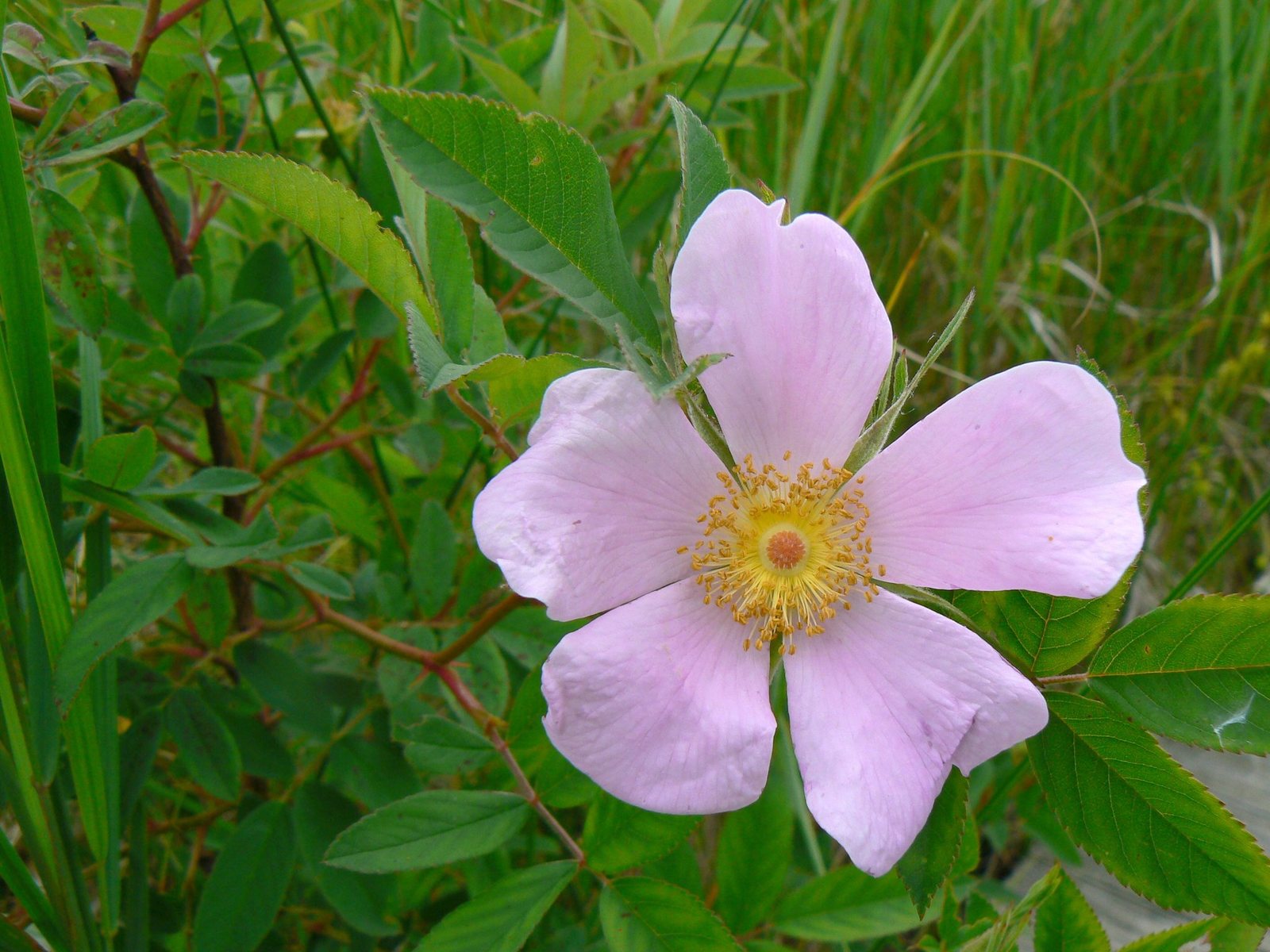
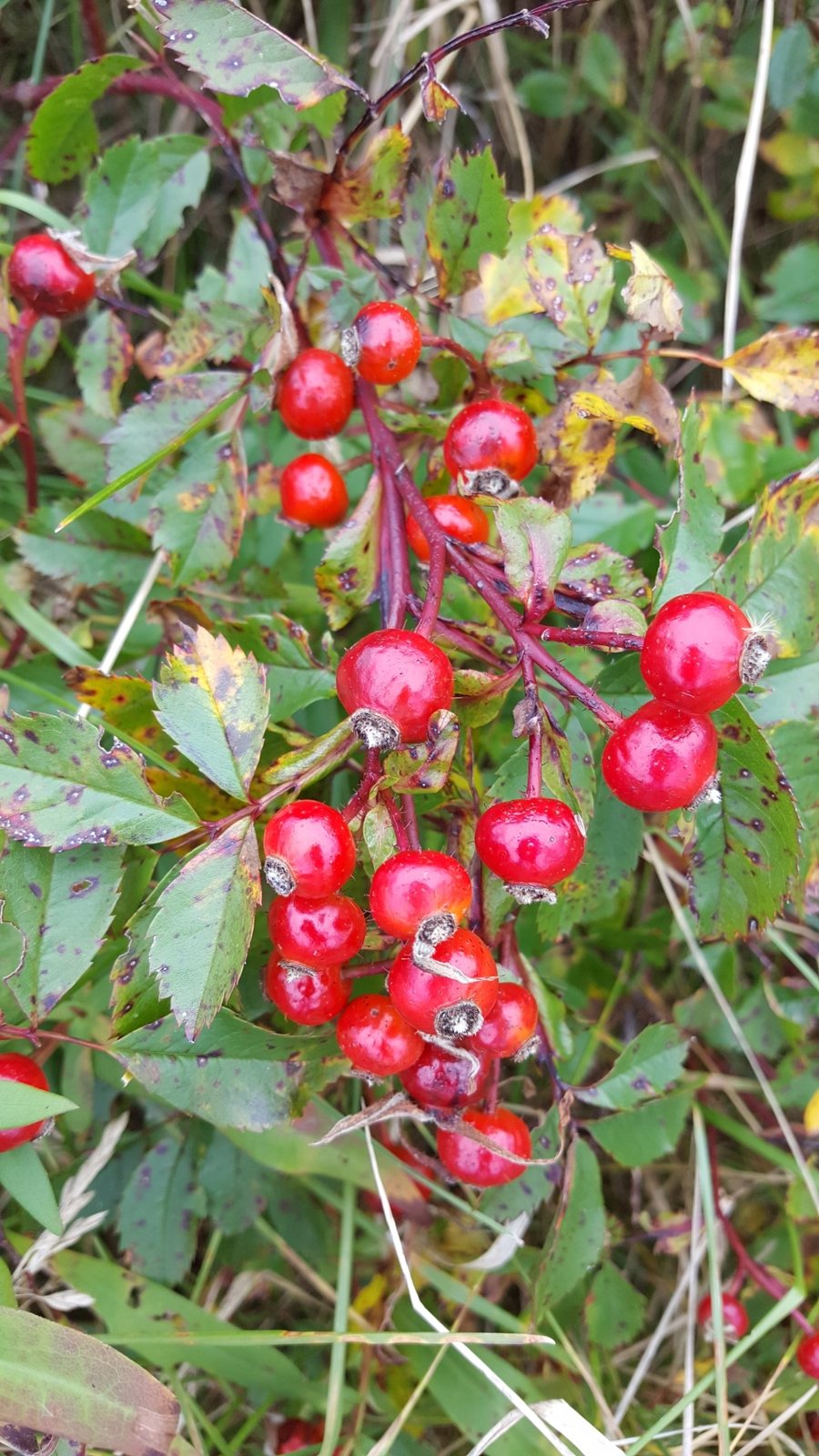
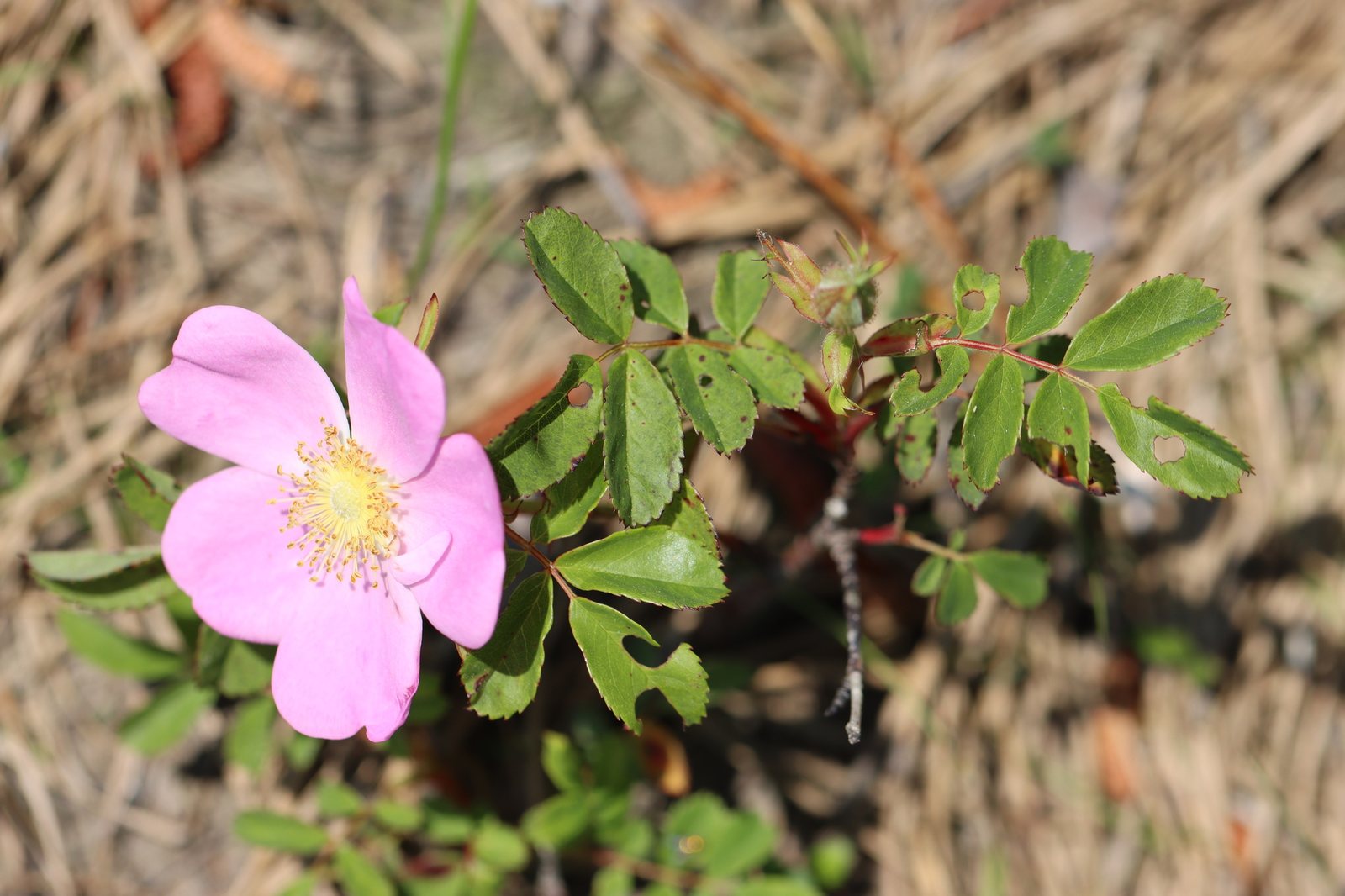
Virginia rose is a deciduous shrub native to eastern North America, grown for fragrant, single pink flowers, red hips and orange-red autumn foliage. It spreads by suckers to form a thorny thicket, making it useful for wildlife hedges and naturalistic planting where it has room.
At a glance
- Sun
- Full sun to light shade; flowering and autumn colour are best in full sun.
- Water
- Moderate; water during establishment and prolonged dry spells. Established plants tolerate some drought.
- Soil
- Well-drained soil, including sandy, loamy or clay soils; tolerates coastal conditions and moderately poor ground. Avoid persistently waterlogged sites.
- Height
- 4-6 ft (1.2-1.8 m)
- Spread
- 4-6 ft (1.2-1.8 m), spreading farther over time by suckers
- Flowers
- Late spring to midsummer: fragrant pink flowers with five petals and yellow stamens, usually in one main flush.
- Foliage
- Glossy green leaves divided into toothed leaflets, turning yellow, orange or red in autumn. Rounded red hips often remain into winter.
- Growth
- Moderate
- Care needed
- Low
The year at a glance
- Pollinators
- Drought tolerant
- Cold hardy
- Wildlife
- Low allergen
- Fragrant
| J | F | M | A | M | J | J | A | S | O | N | D | |
|---|---|---|---|---|---|---|---|---|---|---|---|---|
| Flowers | ||||||||||||
| Fruit | ||||||||||||
| Plant |
Northern hemisphere months. In Australia, shift them by six.
- Difficulty
- Easy
- Toughness
- Very tough
Will it suit your garden?
Pick your zone, country, light and whether you have pets.
Full sun is 6 or more hours of direct sun a day, part shade 3 to 6 hours, shade under 3.
How it grows
Planting day
1.6 ft (0.5 m)
After 1 year
2.3 ft (0.7 m)
After 2 years
3 ft (0.9 m)
After 3 years
4 ft (1.1 m)
After 5 years
5 ft (1.5 m)
full size
About 5 years to full size.
From a typical nursery size, at an average rate for this kind of plant. A rule of thumb, not a forecast.
Good to know
- Cats and dogs
- Mildly toxic: may upset a stomach
- Native to
- the US and Canada
- In the garden
- Spreads vigorously: plan to contain it.
- Growth rate
- Moderate
Care
Jobs through the year
- WaterApr–May, Sep–Oct, every 14 days
- Water established shrubs only if the root zone is dry; young plants need more frequent watering.
- WaterJun–Aug, every 10 days
- Water deeply at soil level during prolonged dry spells; skip when rainfall is adequate.
- FeedMar–Apr
- Top-dress with compost; avoid heavy nitrogen feeding.
- MulchMar–Apr
- Renew organic mulch while keeping the stem bases clear.
- PruneFeb–Mar
- Remove dead or broken wood only; retain live flowering growth.
- PruneJul–Aug
- After flowering, remove a few oldest canes if crowded; retain spent flowers for hips.
- PruneApr–Oct, every 30 days
- Check colony edges and remove unwanted suckers at their underground origin.
- ProtectOct–Nov
- Collect diseased fallen leaves to reduce black spot carryover, leaving hips for birds.
- Water deeply during the first growing season whenever the root zone becomes dry.
- Apply a layer of organic mulch, keeping it clear of the stems.
- Top-dress with compost in spring; avoid heavy feeding with nitrogen.
- Remove unwanted suckers at their point of origin to keep the colony within bounds.
- Leave spent flowers if you want hips for autumn colour and wildlife.
Pruning. After flowering, remove dead or damaged stems and cut a few of the oldest canes to ground level if the shrub is crowded. Avoid clipping the whole shrub before flowering, as this removes flower-bearing growth.
Through the year
- Autumn
- Plant while the soil is workable and moist; allow space for suckering.
- Late winter
- Remove dead or broken wood and check whether suckers need controlling.
- Spring
- Top-dress with compost and renew mulch without burying the stem bases.
- Summer
- After flowering, thin crowded older stems if needed; retain spent flowers for hips.
- Summer
- Water young plants during dry weather and inspect foliage for disease or beetle damage.
- Winter
- Leave hips for birds and enjoy the shrub's winter structure.
In the garden
- Plant as an informal boundary hedge where its thorny stems provide cover for birds.
- Combine with native grasses and flowering perennials along a sunny meadow edge.
- Use in coastal gardens as a loose, salt-tolerant shrub mass away from narrow paths.
- Plant on sunny banks where a suckering colony can help hold soil.
Garden styles it suits: Wildlife garden, Native hedgerow, Native meadow, Coastal, Cottage garden and New England.
Plant it with: Little bluestem, Switchgrass, Butterfly weed, Wild bergamot, New England aster and Black-eyed Susan.
Wildlife: The open flowers supply pollen for bees and other insects. Birds and small mammals eat the hips, while dense, thorny growth provides shelter and nesting cover.
Problems to watch for
- Unwanted suckering: remove shoots promptly, tracing them back to their underground connection; give the plant a defined area rather than a tightly packed border.
- Black spot: grow in good light with airflow, water at soil level and collect badly affected fallen leaves.
- Aphids: dislodge colonies with water and allow ladybirds and other predators to feed on them.
- Japanese beetles, where present in North America: hand-pick into soapy water; avoid placing beetle traps beside the shrub.
Safety
Not known to be toxic to people, cats, dogs or horses. Thorns can cause puncture wounds, and the fine hairs inside the hips can irritate the mouth and digestive tract if eaten.
Where it spreads. Spreads by underground suckers and can form extensive colonies in garden beds. This is a space-management issue rather than an invasive designation within its native eastern North American range.
Easily confused with
Rugosa rose (Rosa rugosa)
Rugosa rose has strongly wrinkled, leathery leaflets, densely prickly stems and much larger, flattened hips; Virginia rose has smoother, glossy leaflets and smaller, rounded hips.
Multiflora rose (Rosa multiflora)
Multiflora rose usually bears large clusters of small white flowers and has conspicuously fringed stipules at the leaf bases; Virginia rose has larger pink flowers, singly or in small clusters.
The name
The botanical name virginiana means 'of Virginia', referring to the region historically associated with the plant.
Propagation. Lift rooted suckers while dormant, or take softwood cuttings in early summer. Seed needs dormancy-breaking treatment and can germinate slowly and unevenly.
Checked against open data
- Accepted botanical name
- Rosa virginiana
- In the US and Canada
- Native in Canada, the lower 48 states and St. Pierre and Miquelon.
- Native range
- Connecticut, Delaware, District of Columbia, Kentucky, Maine, Maryland, Masachusettes, Michigan, Missouri, New Brunswick, New Hampshire and New Jersey.
- Measured
- Soil pH 5 to 7.
Sources: GBIF (CC BY 4.0), USDA PLANTS and Trefle (CC BY 4.0). The care and design notes are LandscapeGPT's own.
See it in your own yard.
Upload a photo of your yard and see it redesigned with plants that suit your climate, each checked against your zone.