Weeping yaupon holly
Ilex vomitoria 'Pendula'. Family Aquifoliaceae. Tree.
Also called Weeping yaupon.
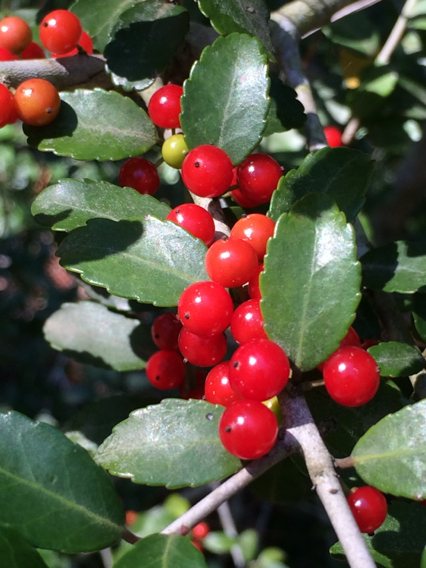
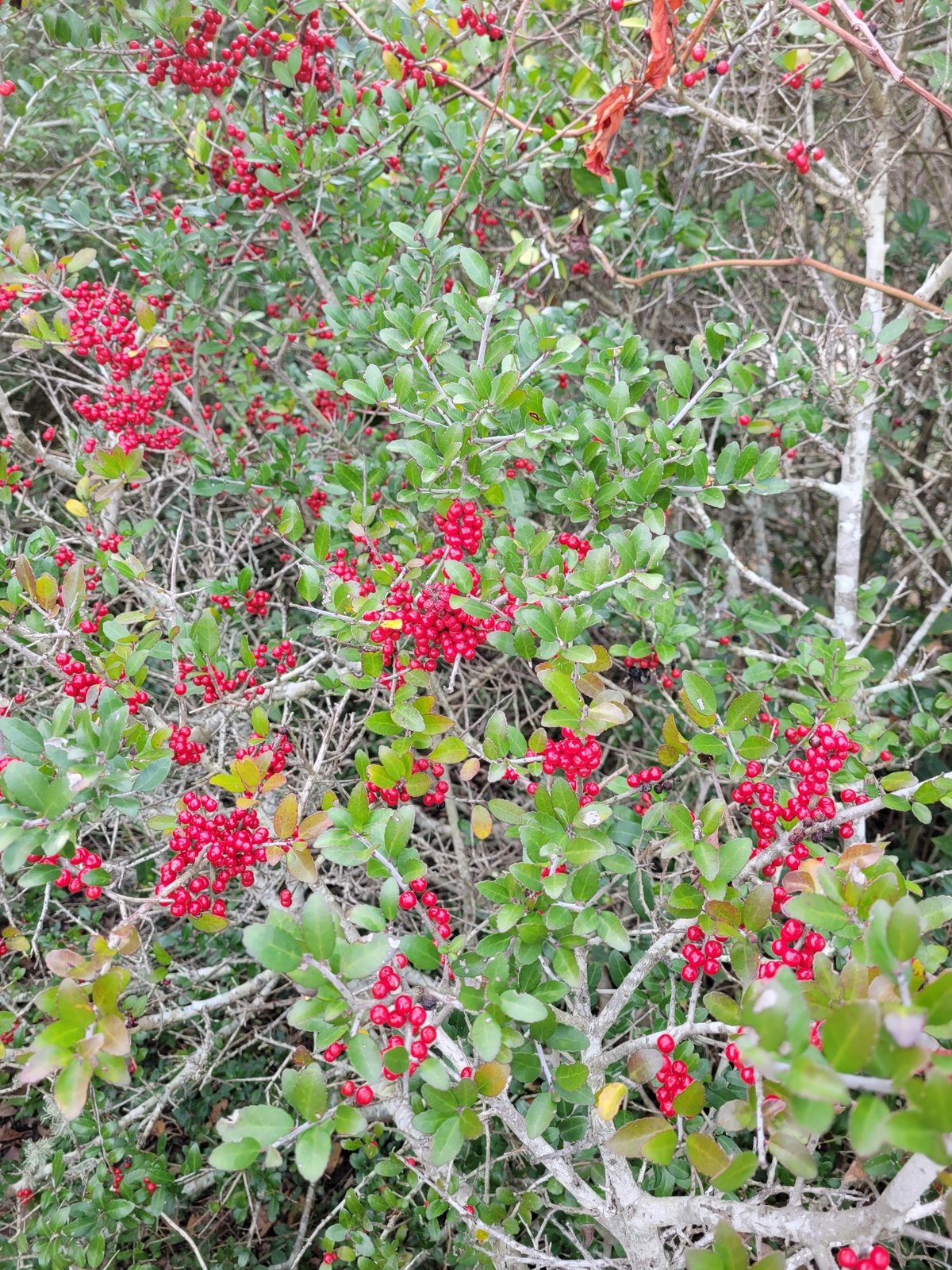
This evergreen form of a southeastern United States native holly develops arching limbs and long, hanging branchlets. Gardeners grow it for its distinctive outline, small glossy leaves and red berries that often persist into winter. It needs room for its spreading canopy and a nearby male yaupon holly for reliable fruiting.
At a glance
- Sun
- Full sun to partial shade; the canopy is usually denser and fruiting better in full sun.
- Water
- Water regularly while establishing; established trees tolerate drought but benefit from deep watering during prolonged dry spells.
- Soil
- Adaptable to sandy, loamy or clay soils, including moderately alkaline soil; best in moist soil with good drainage. Tolerates brief wet periods and coastal salt spray.
- Height
- 15-25 ft (4.6-7.6 m)
- Spread
- 10-15 ft (3-4.6 m)
- Flowers
- Small white flowers in spring, mostly hidden among the leaves.
- Foliage
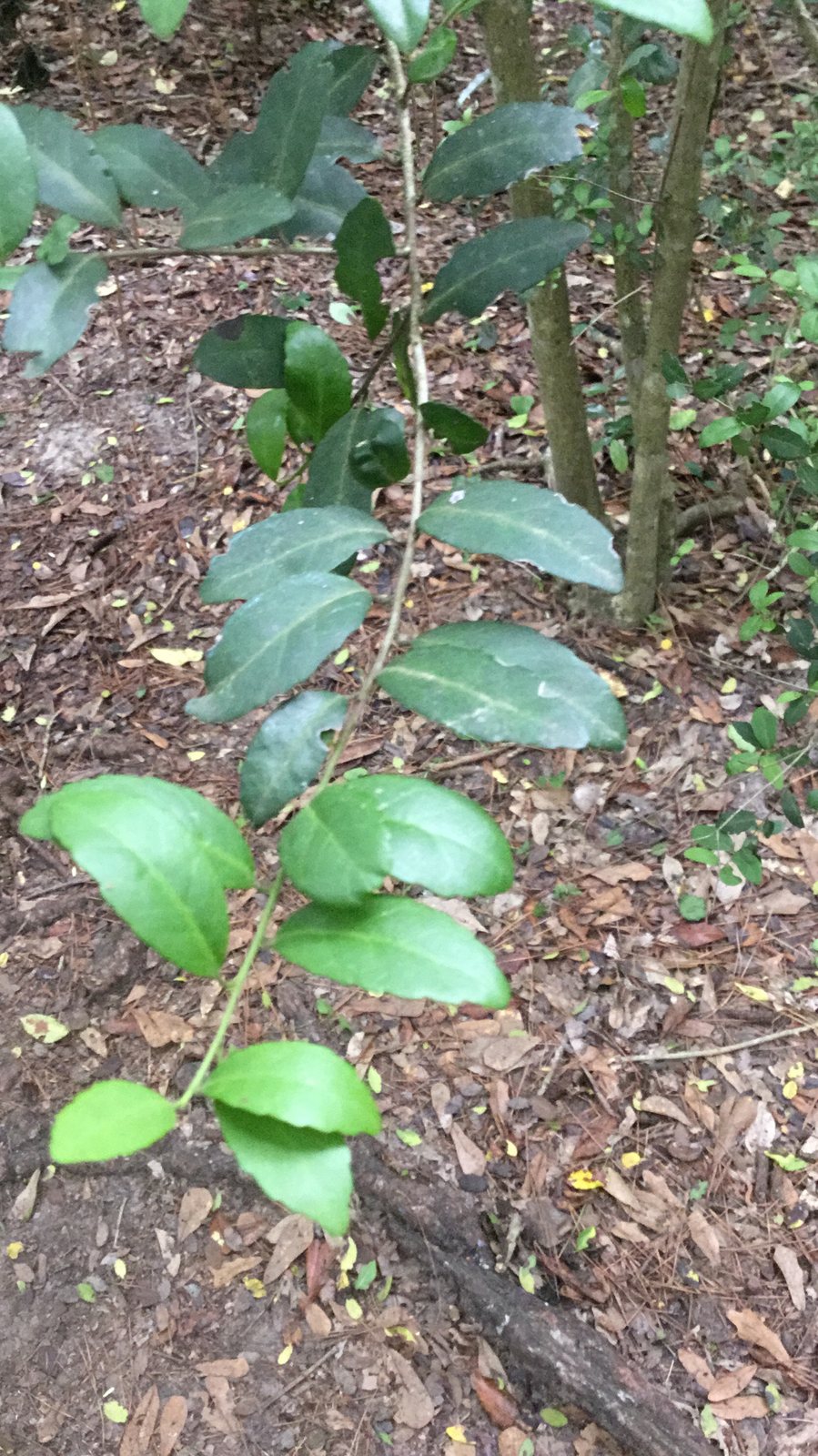
- Evergreen. Small, glossy, dark green oval leaves with rounded teeth rather than sharp spines.
- Growth
- Moderate to fast in warm climates with adequate moisture.
- Care needed
- Medium
The year at a glance
- Pollinators
- Drought tolerant
- Heat tolerant
- Wildlife
- Low allergen
| J | F | M | A | M | J | J | A | S | O | N | D | |
|---|---|---|---|---|---|---|---|---|---|---|---|---|
| Flowers | ||||||||||||
| Fruit | ||||||||||||
| Plant |
Northern hemisphere months. In Australia, shift them by six.
- Difficulty
- Moderate
- Toughness
- Very tough
Will it suit your garden?
Pick your zone, country, light and whether you have pets.
Full sun is 6 or more hours of direct sun a day, part shade 3 to 6 hours, shade under 3.
How it grows
Planting day
7 ft (2 m)
After 1 year
7 ft (2.3 m)
After 2 years
8 ft (2.5 m)
After 3 years
9 ft (2.8 m)
After 5 years
11 ft (3.3 m)
About 16 years to full size.
From a typical nursery size, at an average rate for this kind of plant. A rule of thumb, not a forecast.
Good to know
- Cats and dogs
- Toxic
- Native to
- the US
- Growth rate
- Fast
Care
Jobs through the year
- WaterApr–May, Sep–Nov, every 21 days
- Water established trees only during extended dry weather; young trees need more frequent watering for two years.
- WaterJun–Aug, every 14 days
- Deep-water established trees during prolonged drought; allow the soil surface to dry between waterings.
- FeedApr
- Feed lightly only if growth is weak or a soil test confirms a deficiency.
- PruneFeb–Mar
- Develop the trunk framework and remove damaged or crossing wood without shearing the weeping canopy.
- PruneMay–Sep, every 30 days
- Remove unwanted root suckers at their origin when present.
- MulchApr
- Maintain 5-8 cm of organic mulch over the roots, keeping the trunk clear.
- ProtectJan–Mar, Nov–Dec
- Use a sheltered zone-7 site and shield young trees from severe cold winds; this is unreliable outdoors in zone 6.
- Plant with the root flare at soil level and allow space for the hanging branches to develop without blocking paths.
- Water deeply through the first two growing seasons, letting the soil surface begin to dry between waterings.
- Spread 2-3 in (5-8 cm) of mulch over the root area, keeping it clear of the trunk.
- Feed lightly in spring only if growth is weak or a soil test indicates a deficiency.
- Remove unwanted root suckers promptly, and retain or plant a male yaupon holly nearby if berries are important.
Pruning. Prune in late winter or early spring, removing dead, crossing or poorly placed branches and gradually establishing the desired trunk structure. Shorten only branches that obstruct access; repeated shearing spoils the weeping habit and reduces flowering and berries.
Through the year
- Late winter
- Remove damaged or crossing wood and make any necessary structural pruning cuts.
- Spring
- Plant where winters are cold; check soil moisture regularly as new growth begins.
- Late spring
- Check for flowers and confirm that a male yaupon nearby flowers at the same time if fruit is wanted.
- Summer
- Water young trees during dry weather, remove suckers and inspect leaves and stems for scale insects.
- Autumn
- Plant in mild-winter areas and refresh mulch without piling it against the trunk.
- Winter
- Enjoy the berries and leave them for birds; water newly planted trees during dry, frost-free weather.
In the garden
- Use as a specimen in a lawn or broad planting bed where its hanging branches can reach towards the ground.
- Place beside a large courtyard or terrace, far enough from paving to avoid repeated clearance pruning.
- Underplant with low evergreen sedges or ferns to contrast with the arching canopy.
- Combine with native shrubs and grasses in a wildlife planting, retaining its winter berries for birds.
Garden styles it suits: Southern, Architectural minimal, Wildlife garden, Coastal, Traditional and Winter interest.
Plant it with: Dwarf palmetto, Pink muhly grass, Oakleaf hydrangea, Christmas fern, Virginia sweetspire and Dwarf mondo grass.
Wildlife: Spring flowers provide nectar and pollen for bees and other insects. Birds eat the berries and use the dense evergreen canopy for shelter.
Problems to watch for
- Scale insects can cause yellowing, sticky honeydew and black sooty mould; inspect stems and leaf undersides, conserve beneficial insects and use a labelled horticultural oil when needed.
- Spider mites may cause fine stippling and dull foliage in hot, dry weather; rinse foliage with water and avoid unnecessary broad-spectrum insecticides.
- Persistently waterlogged soil can cause root decline; improve drainage or move young plants rather than continuing to water saturated ground.
- Few or no berries usually means insufficient pollination, heavy shade or pruning that removed flowering wood; provide a male yaupon nearby, improve light where practical and prune less.
Safety
Treat the berries and foliage as toxic to people, cats, dogs and horses if eaten. Berries can cause vomiting, diarrhoea and abdominal discomfort; foliage contains caffeine and other compounds and is not suitable as animal forage. Small accidental berry ingestions usually cause gastrointestinal upset rather than severe poisoning, but seek medical or veterinary advice after ingestion.
Easily confused with
Yaupon holly (Ilex vomitoria)
The ordinary species has similar small, rounded-toothed leaves and red fruit, but usually forms an upright shrub or small tree without the long, curtain-like hanging branchlets.
Japanese holly (Ilex crenata)
Its small evergreen leaves can look similar, but its fruit is black rather than red and most forms lack the strongly weeping tree habit.
Weeping English holly (Ilex aquifolium 'Pendula')
It also has hanging branches and red berries, but its leaves are much larger and commonly have sharp spines.
The name
The cultivar name 'Pendula' comes from Latin for hanging or pendulous and describes its drooping branches.
Propagation. Root semi-ripe cuttings in summer to preserve the weeping cultivar. Seedlings vary, will not reliably retain the weeping habit and may take several years to flower.
Checked against open data
- Accepted botanical name
- Ilex vomitoria
- In the US and Canada
- Native in the lower 48 states.
- Native range
- Alabama, Arkansas, Cuba, Florida, Georgia, Louisiana, Mexico Southeast, Mississippi, North Carolina, Oklahoma, South Carolina and Texas.
- Measured
- Soil pH 4.5 to 7. Average height 415 cm.
Sources: GBIF (CC BY 4.0), USDA PLANTS and Trefle (CC BY 4.0). The care and design notes are LandscapeGPT's own.
See it in your own yard.
Upload a photo of your yard and see it redesigned with plants that suit your climate, each checked against your zone.