Yellow asphodel
Asphodeline lutea. Family Asphodelaceae. Perennial.
Also called King's spear, Yellow king's spear.
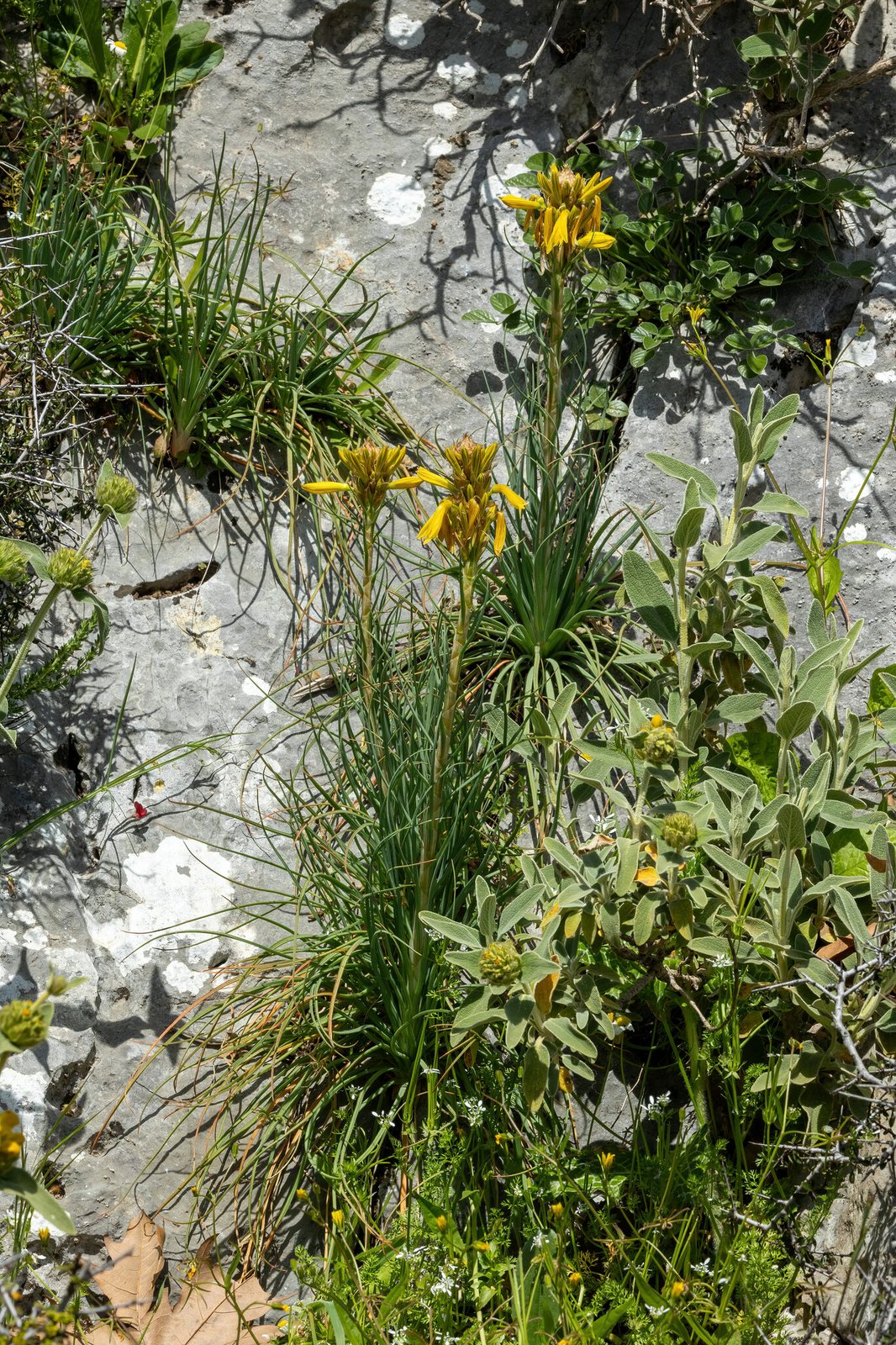
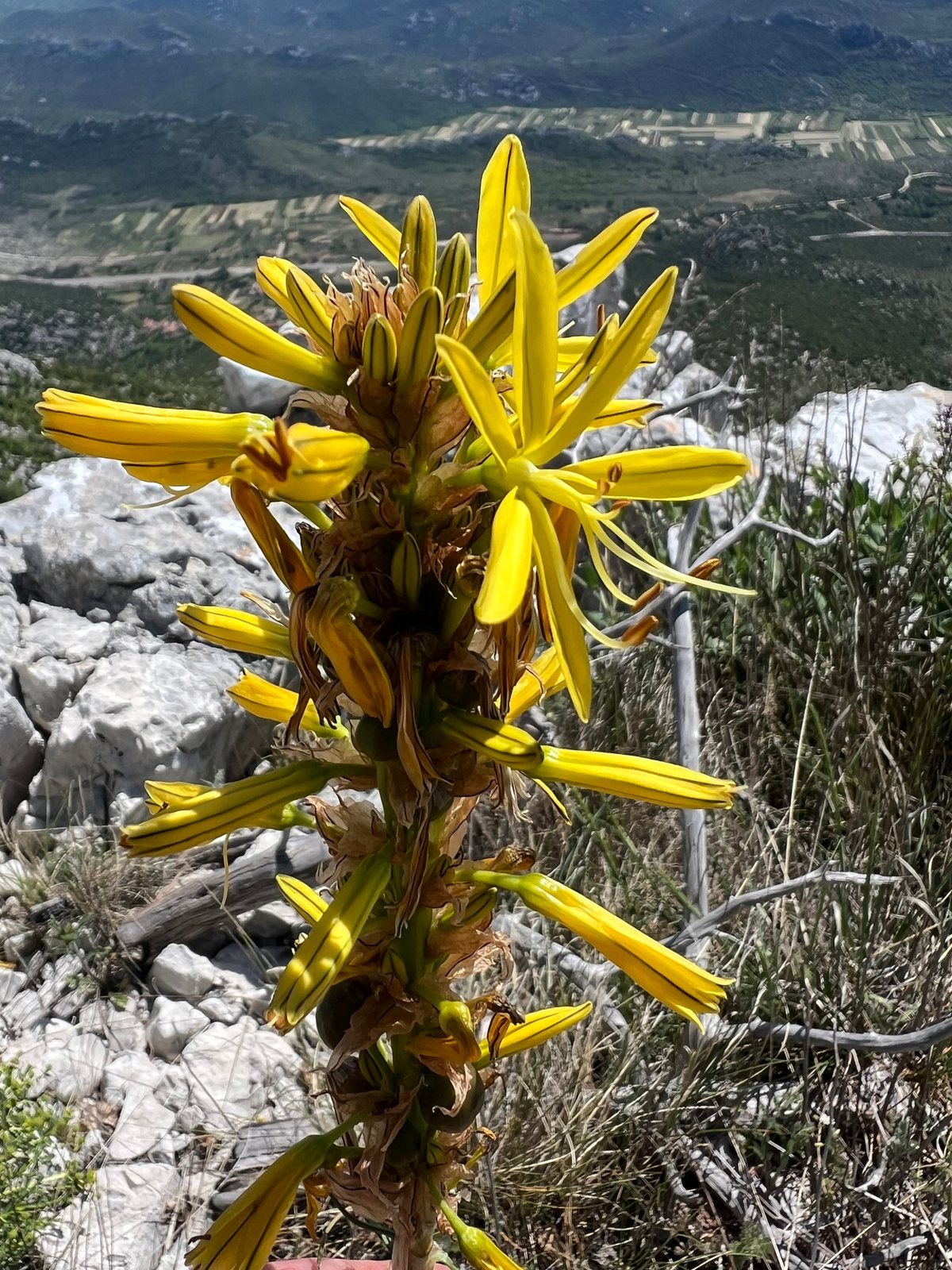
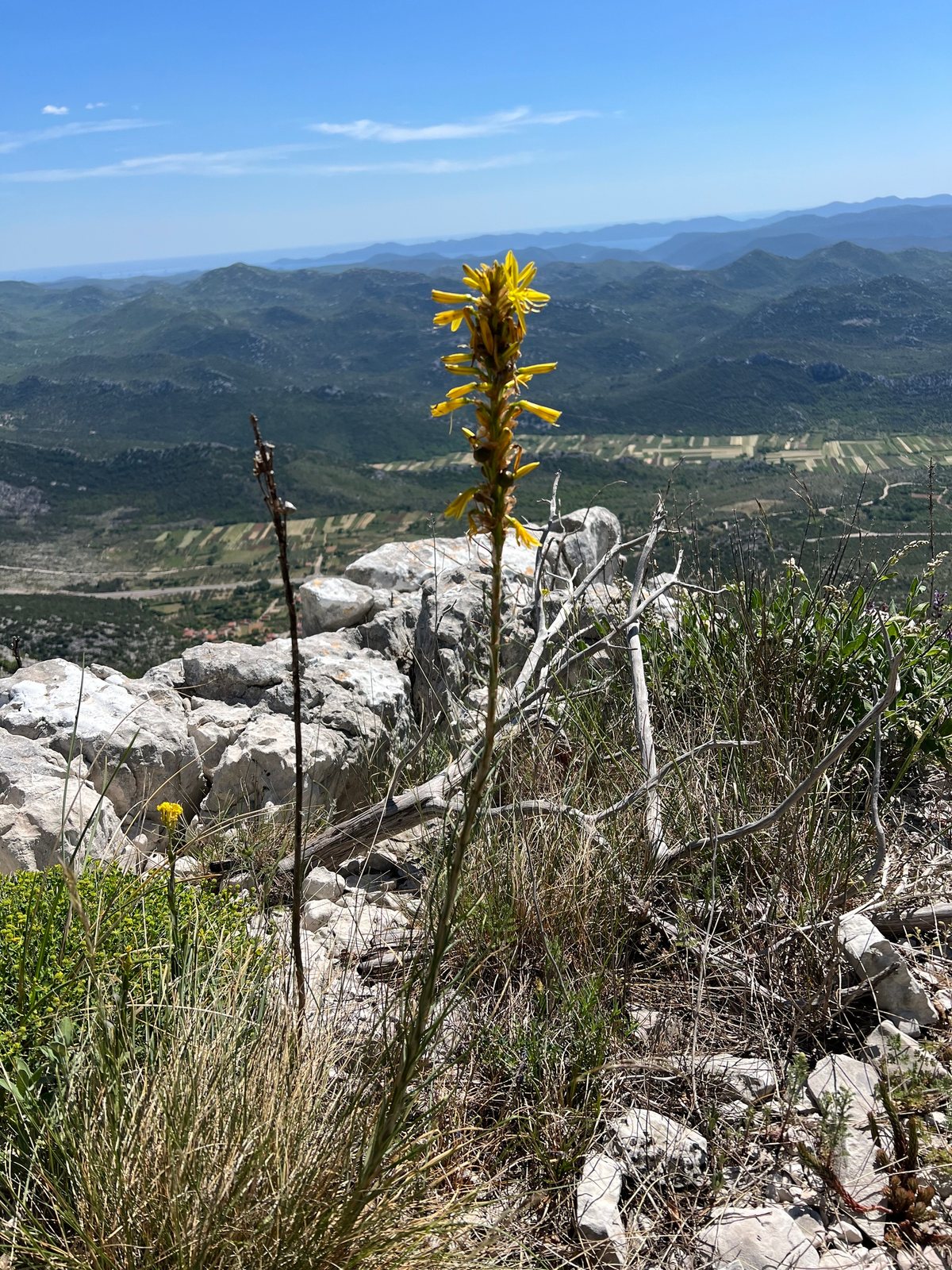
Yellow asphodel is a clump-forming perennial with narrow, blue-green leaves and tall spikes of star-shaped yellow flowers. Gardeners grow it for its upright shape in sunny borders and gravel gardens, where sharp drainage helps it survive winter.
At a glance
- Sun
- Full sun; flowering is best in an open, sunny position.
- Water
- Water regularly while establishing, then sparingly. Established plants tolerate dry spells but dislike persistently wet soil, especially in winter.
- Soil
- Well-drained sandy, gravelly or stony soil, preferably neutral to alkaline. Avoid heavy clay unless drainage is substantially improved.
- Height
- 3-4 ft (0.9-1.2 m)
- Spread
- 1-2 ft (0.3-0.6 m)
- Flowers
- Late spring to early summer; yellow, star-shaped flowers open successively along tall spikes.
- Foliage
- Narrow, grass-like, blue-green leaves form basal clumps and extend up the flowering stems. Often evergreen in mild climates, but may die back in cold winters or during summer drought.
- Growth
- Moderate; clumps enlarge gradually.
- Care needed
- Low
The year at a glance
- Pollinators
- Deer resistant
- Drought tolerant
- Heat tolerant
- Low allergen
| J | F | M | A | M | J | J | A | S | O | N | D | |
|---|---|---|---|---|---|---|---|---|---|---|---|---|
| Flowers | ||||||||||||
| Fruit | ||||||||||||
| Plant |
Northern hemisphere months. In Australia, shift them by six.
- Difficulty
- Easy
- Toughness
- Very tough
Will it suit your garden?
Pick your zone, country, light and whether you have pets.
Full sun is 6 or more hours of direct sun a day, part shade 3 to 6 hours, shade under 3.
How it grows
Planting day
1 ft (0.3 m)
After 1 year
1.8 ft (0.55 m)
After 2 years
2.6 ft (0.8 m)
After 3 years
3 ft (1.1 m)
full size
About 3 years to full size.
From a typical nursery size, at an average rate for this kind of plant. A rule of thumb, not a forecast.
Good to know
- Cats and dogs
- Safe
- Growth rate
- Moderate
Care
Jobs through the year
- WaterApr–May, Sep, every 21 days
- Water established plants only if the root zone is dry; new plants need regular first-year watering.
- WaterJun–Aug, every 14 days
- Water sparingly during prolonged dry spells, allowing soil to dry between waterings.
- MulchMar–Apr
- Use gravel around the crown rather than moisture-retaining organic mulch.
- PruneFeb–Mar
- Remove dead leaves while retaining healthy green foliage.
- DivideMar–Apr
- Divide only congested clumps with declining flowering, as fresh growth begins.
- PruneJun–Jul
- Cut finished flower stems to the base, or retain some for decorative seed capsules.
- ProtectOct–Nov
- Clear fallen leaves from crowns and keep drainage routes open before winter.
- Plant in spring in colder regions, setting the crown at soil level.
- Water through the first growing season, allowing the soil to dry somewhat between waterings.
- Avoid rich feeding; use only a light spring feed if growth is weak on very poor soil.
- Use gravel around the crown rather than moisture-holding organic mulch.
- Divide congested clumps in spring when flowering declines; routine annual division is unnecessary.
Pruning. Cut spent flower stems to the base after flowering, or leave some for their rounded seed capsules. Remove dead leaves in late winter or early spring without cutting healthy green foliage.
Through the year
- Late winter
- Remove dead foliage and check that water is not collecting around the crowns.
- Spring
- Plant new specimens or divide established clumps as fresh growth begins.
- Late spring
- Check new plants during dry weather and water deeply when the root zone becomes dry.
- Early summer
- Remove finished flower stems unless you want seed capsules or seed for propagation.
- Late summer
- Collect ripe seed when the capsules turn brown and begin to open.
- Autumn
- Clear fallen leaves from the crowns and keep drainage channels open before winter rain.
In the garden
- Plant repeated clumps through a gravel garden to give low, spreading plants a strong vertical contrast.
- Combine with lavender, sage and other sun-loving plants in a Mediterranean-style border.
- Set among low ornamental grasses so the yellow flower spikes rise above a softer background.
- Use near the middle of a sunny mixed border, with later-flowering perennials nearby to extend the display.
Garden styles it suits: Mediterranean, Dry gravel garden, Architectural minimal, Cottage garden, Pollinator garden and Desert / xeriscape.
Plant it with: Lavender, Catmint, Jerusalem sage, Bearded iris, Yarrow and Blue fescue.
Wildlife: The flowers attract bees and other flower-visiting insects.
Problems to watch for
- Crown or root rot in wet soil: improve drainage or move the plant to a raised, gravelly bed; avoid winter irrigation.
- Slugs and snails on young growth: inspect emerging shoots and use barriers, hand-picking or locally approved slug controls.
- Poor flowering in shade: move the clump to full sun.
- Weak, floppy growth in rich soil: stop high-nitrogen feeding and avoid heavy compost applications.
Safety
Not known to be toxic to people, cats, dogs or horses. Species-specific information on ingestion is limited, so do not treat any part as confirmed safe to eat.
Easily confused with
Branched asphodel (Asphodelus ramosus)
Has white to pale pink flowers with darker central stripes, usually on branched flower stalks, rather than yellow flowers on predominantly unbranched spikes.
Yellow daylily (Hemerocallis lilioasphodelus)
Has broader, arching strap-shaped leaves and large, trumpet-shaped yellow flowers on leafless stalks; yellow asphodel has small star-shaped flowers and leafy stems.
The name
Asphodeline refers to its resemblance to plants in the genus Asphodelus, while the Latin lutea means yellow.
Propagation. Divide clumps carefully in spring, retaining healthy roots and shoots on each piece. Sow ripe seed in pots in a sheltered outdoor position; seedlings take several years to reach flowering size.
Checked against open data
- Accepted botanical name
- Asphodeline lutea
- Native range
- Albania, Algeria, Bulgaria, Cyprus, East Aegean Is., Greece, Italy, Kriti, Krym, Lebanon-Syria, North Caucasus and Palestine.
- Measured
- Average height 73 cm.
Sources: GBIF (CC BY 4.0) and Trefle (CC BY 4.0). The care and design notes are LandscapeGPT's own.
See it in your own yard.
Upload a photo of your yard and see it redesigned with plants that suit your climate, each checked against your zone.