Blue vervain
Verbena hastata. Family Verbenaceae. Perennial.
Also called Swamp vervain, American blue vervain.
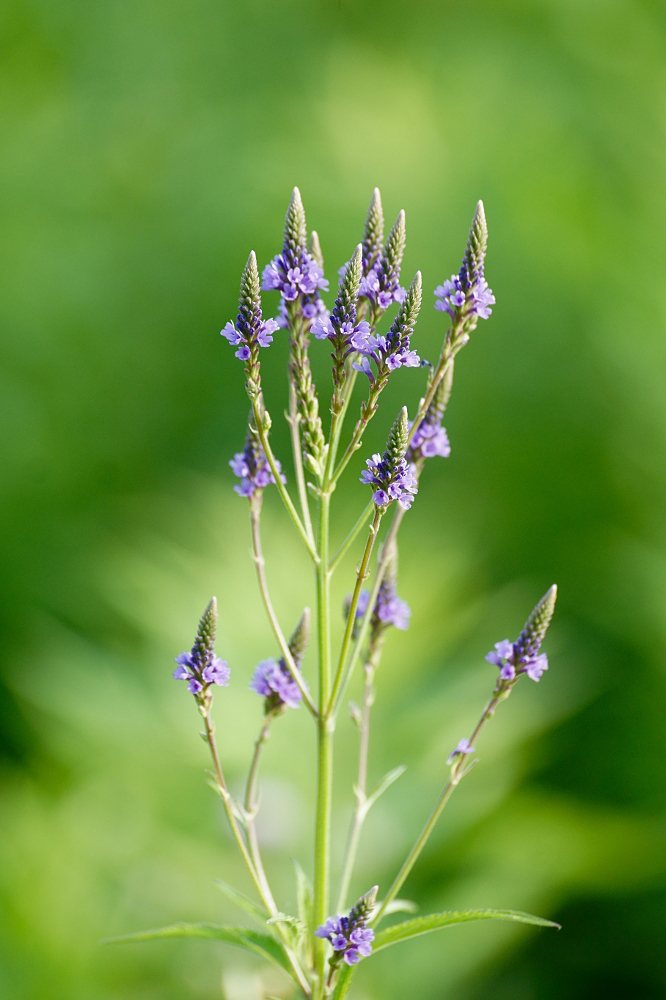
Blue vervain is a tall, upright North American perennial with branching spires of small violet-blue flowers. Gardeners grow it for its long summer flowering, value to pollinators and ability to thrive in damp ground.
At a glance
- Sun
- Full sun is best; tolerates light partial shade, but may flower less and lean.
- Water
- Keep the soil consistently moist. Established plants tolerate wet ground and occasional flooding, but prolonged drought causes stress.
- Soil
- Moisture-retentive loam or clay, preferably rich in organic matter; tolerates poorly drained soil and a broad pH range.
- Height
- 3-6 ft (0.9-1.8 m)
- Spread
- 1-2.5 ft (0.3-0.75 m)
- Flowers
- Summer to early autumn; small violet-blue flowers open progressively along narrow, upright spikes.
- Foliage
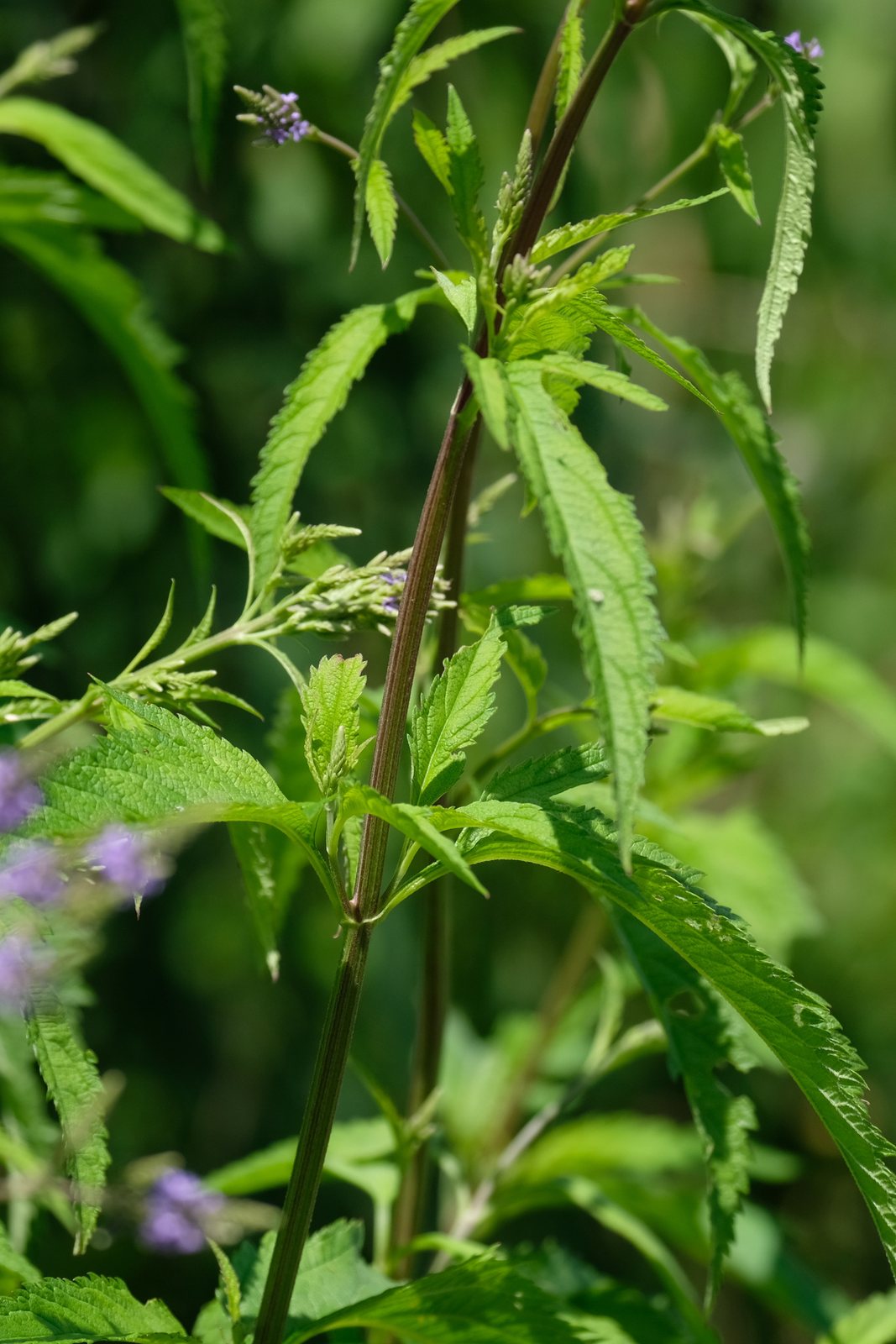
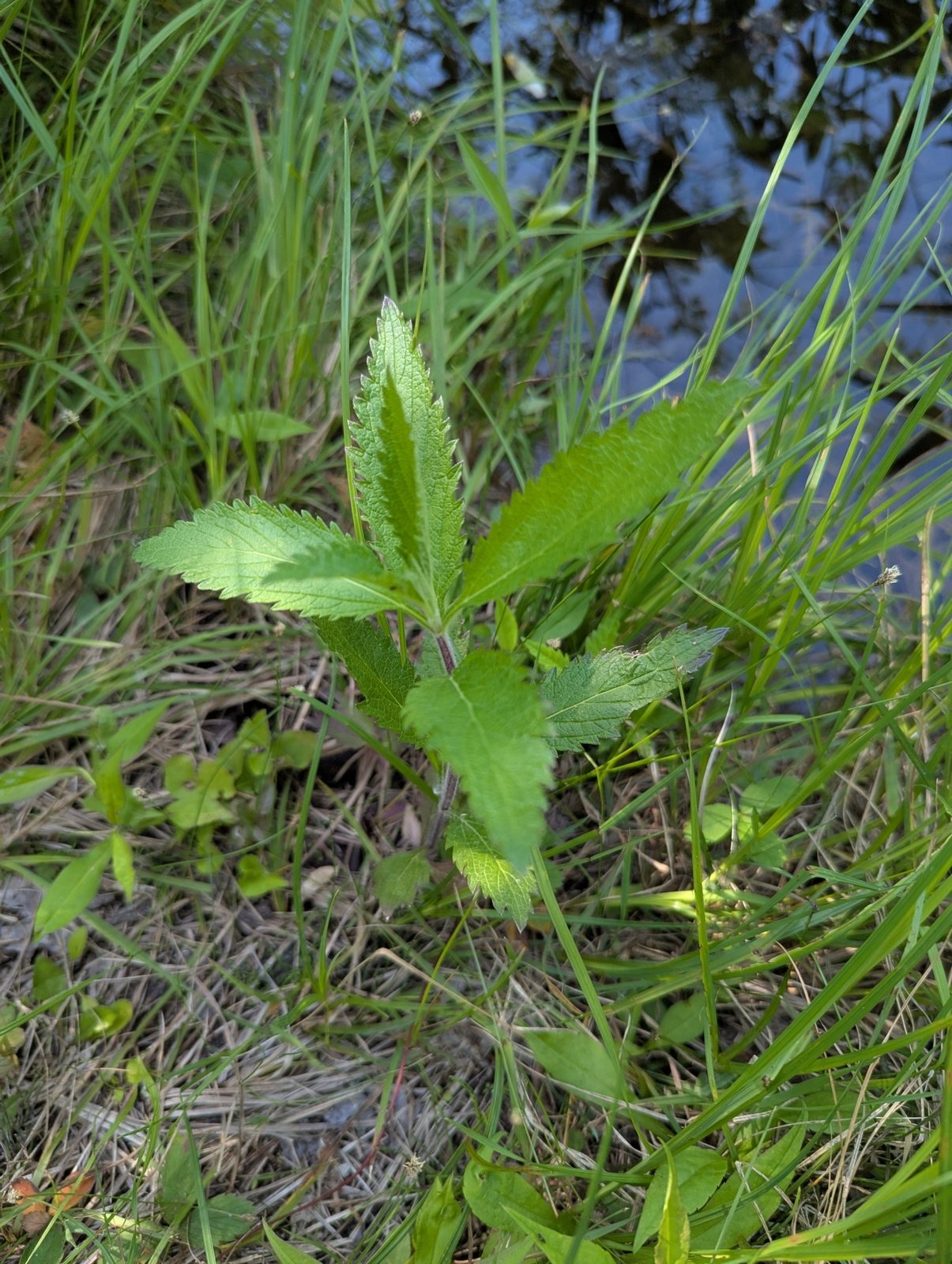
- Opposite, sharply toothed, lance-shaped green leaves on upright, square stems; foliage dies back in winter.
- Growth
- Moderate to fast; may flower in its first year from an early sowing.
- Care needed
- Low
The year at a glance
- Pollinators
- Deer resistant
- Cold hardy
- Heat tolerant
- Wildlife
- Low allergen
| J | F | M | A | M | J | J | A | S | O | N | D | |
|---|---|---|---|---|---|---|---|---|---|---|---|---|
| Flowers | ||||||||||||
| Fruit | ||||||||||||
| Plant |
Northern hemisphere months. In Australia, shift them by six.
- Difficulty
- Easy
- Toughness
- Fairly tough
Will it suit your garden?
Pick your zone, country, light and whether you have pets.
Full sun is 6 or more hours of direct sun a day, part shade 3 to 6 hours, shade under 3.
How it grows
Planting day
1 ft (0.3 m)
After 1 year
2.4 ft (0.74 m)
After 2 years
4 ft (1.2 m)
After 3 years
4 ft (1.4 m)
full size
About 2 years to full size.
From a typical nursery size, at an average rate for this kind of plant. A rule of thumb, not a forecast.
Good to know
- Cats and dogs
- Mildly toxic: may upset a stomach
- Native to
- the US and Canada
- Growth rate
- Fast
Care
Jobs through the year
- WaterApr–May, Sep–Oct, every 7 days
- Keep established plants' root zones moist; skip watering in wet soil and water new plants more often.
- WaterJun–Aug, every 4 days
- Water when rainfall is insufficient to keep soil consistently moist; do not let roots dry out.
- MulchApr
- Apply organic mulch to retain moisture, keeping it clear of the crown.
- PruneFeb–Mar
- Cut overwintered dead stems to just above ground before new shoots emerge.
- DivideMar–Apr
- Divide congested clumps in spring and water divisions thoroughly.
- DeadheadAug–Sep
- Remove fading spikes before seeds ripen only where self-seeding is unwanted.
- Water new plants regularly and do not let the root zone dry out during establishment.
- Apply an organic mulch in spring to retain moisture, keeping it clear of the crown.
- Avoid routine high-nitrogen feeding, which can produce tall, floppy growth.
- Support exposed plants with twiggy stakes or neighbouring perennials before the stems lean.
- Divide congested clumps in spring and remove unwanted seedlings while small.
Pruning. Leave seedheads standing through winter for birds and structure, then cut dead stems to just above ground level in late winter or early spring. To limit self-seeding, remove fading flower spikes before the seeds ripen.
Through the year
- Late autumn
- Sow fresh seed outdoors in pots or a prepared seedbed so winter cold can help break dormancy.
- Late winter
- Cut down last year's dead stems before new shoots emerge.
- Spring
- Plant or divide clumps, water thoroughly and mulch the surrounding soil.
- Early summer
- Add discreet supports where plants are exposed to wind or growing in partial shade.
- Summer
- Water during dry spells to keep the root zone moist.
- Early autumn
- Remove spent spikes if seedlings are unwanted, or leave some seedheads for birds.
In the garden
- Plant in drifts through a damp meadow with moisture-loving grasses for repeated vertical accents.
- Use at the back of a sunny border with Joe-Pye weed and sneezeweed for late-season colour.
- Place along pond margins or in the seasonally wet part of a rain garden, rather than in deep standing water.
- Combine with cardinal flower and swamp milkweed in a moist pollinator planting.
Garden styles it suits: Native meadow, New perennial (prairie), Wildlife garden, Pollinator garden, Bog garden and Cottage garden.
Plant it with: Joe-Pye weed, Swamp milkweed, Cardinal flower, Sneezeweed, Tussock sedge and Switchgrass.
Wildlife: Flowers provide nectar and pollen for bees, butterflies and other insects. Small seed-eating birds use the ripe seedheads, and standing stems provide winter cover for invertebrates.
Problems to watch for
- Powdery mildew can affect crowded or stressed plants; improve spacing, keep roots moist and remove badly affected foliage.
- Spider mites may cause pale, stippled leaves in hot, dry weather; water the root zone and rinse leaf undersides with water.
- Stems may flop in shade or overly rich soil; provide more sun, avoid nitrogen-rich fertiliser and add early support.
- Self-sown seedlings can crowd neighbouring plants; remove spent spikes before seed ripens and pull surplus seedlings in spring.
Safety
Not known to be a major poisonous plant for people, cats, dogs or horses, but species-specific safety information for pets and livestock is limited. Do not treat any part as food or give it medicinally to animals; concentrated preparations or large amounts may cause digestive upset in people, and medicinal use should be avoided during pregnancy.
Easily confused with
Hoary vervain (Verbena stricta)
Has broader, grey-green leaves densely covered with soft hairs and usually thicker flower spikes; it favours drier ground.
Common vervain (Verbena officinalis)
Has a much more open, wiry flowering framework, tiny pale lilac flowers and lower leaves that are often deeply lobed.
Purpletop vervain (Verbena bonariensis)
Carries compact clusters of purple flowers on long, sparsely leafy stems rather than blue vervain's branching, candle-like spikes.
The name
The epithet hastata means spear-shaped, referring to the leaves, while blue vervain describes the flower colour and its membership of the vervain group.
Propagation. Divide clumps in spring. Sow seed outdoors in autumn, or give spring-sown seed a cold, moist treatment for about 4-6 weeks; press it onto the surface or cover only very lightly. Seedlings may vary in flower colour.
Checked against open data
- Accepted botanical name
- Verbena hastata
- In the US and Canada
- Native in Canada and the lower 48 states.
- Native range
- Alabama, Arizona, British Columbia, California, Colorado, Connecticut, Delaware, District of Columbia, Florida, Georgia, Idaho and Illinois.
- Measured
- Average height 105 cm.
Sources: GBIF (CC BY 4.0), USDA PLANTS and Trefle (CC BY 4.0). The care and design notes are LandscapeGPT's own.
See it in your own yard.
Upload a photo of your yard and see it redesigned with plants that suit your climate, each checked against your zone.