Bottle gentian
Gentiana andrewsii. Family Gentianaceae. Perennial.
Also called Closed bottle gentian, Closed gentian, Andrews' gentian.
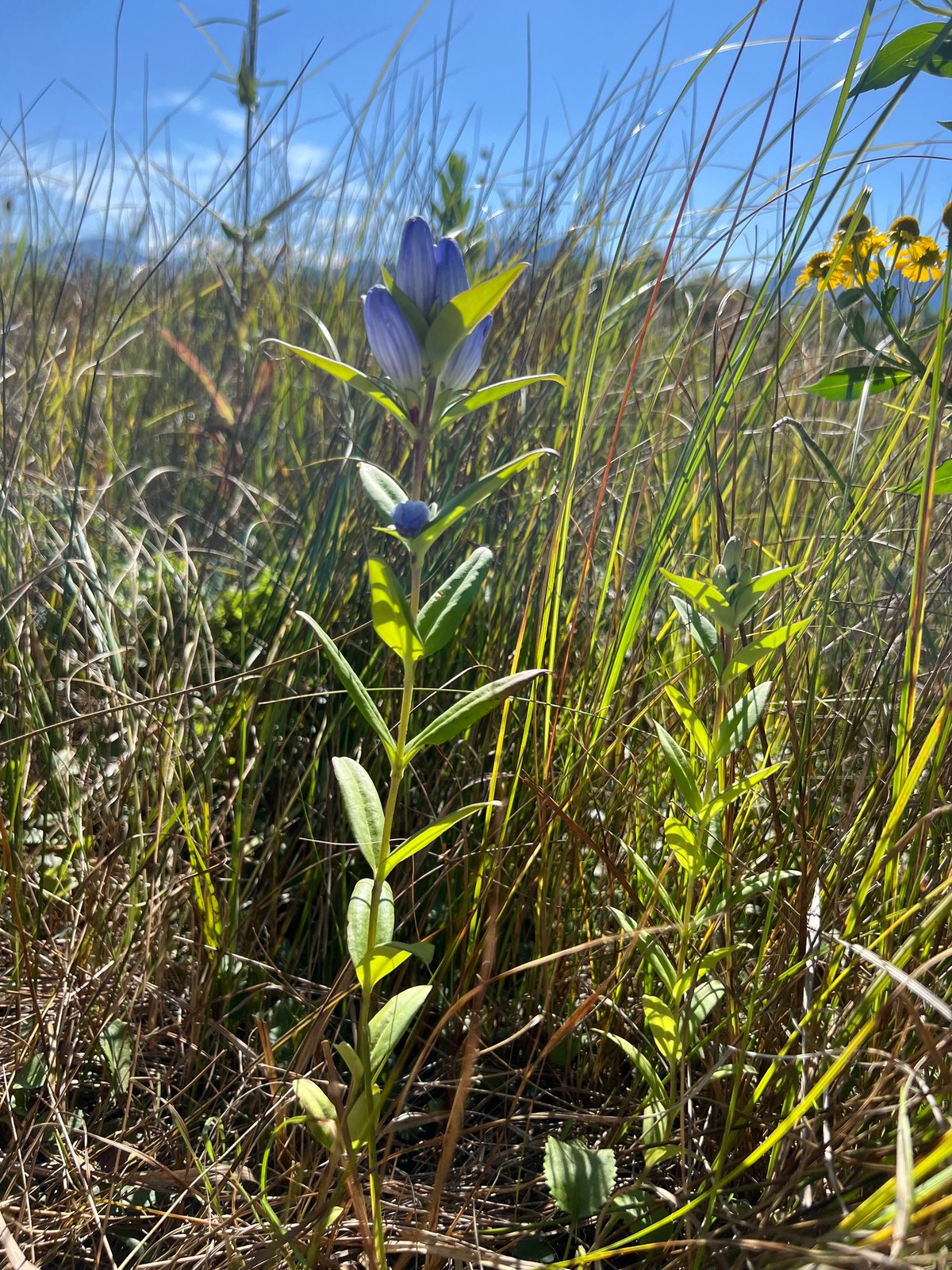
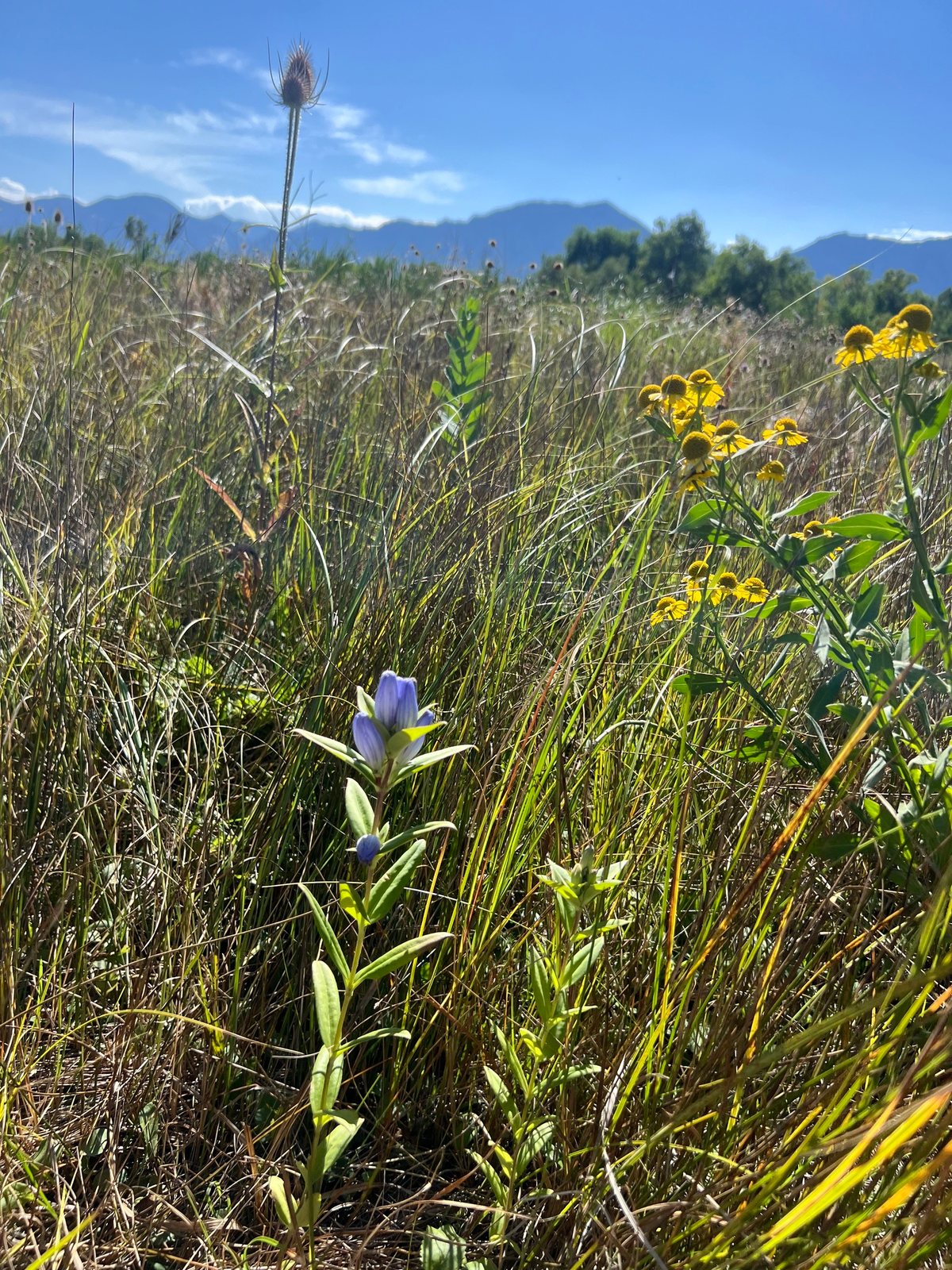
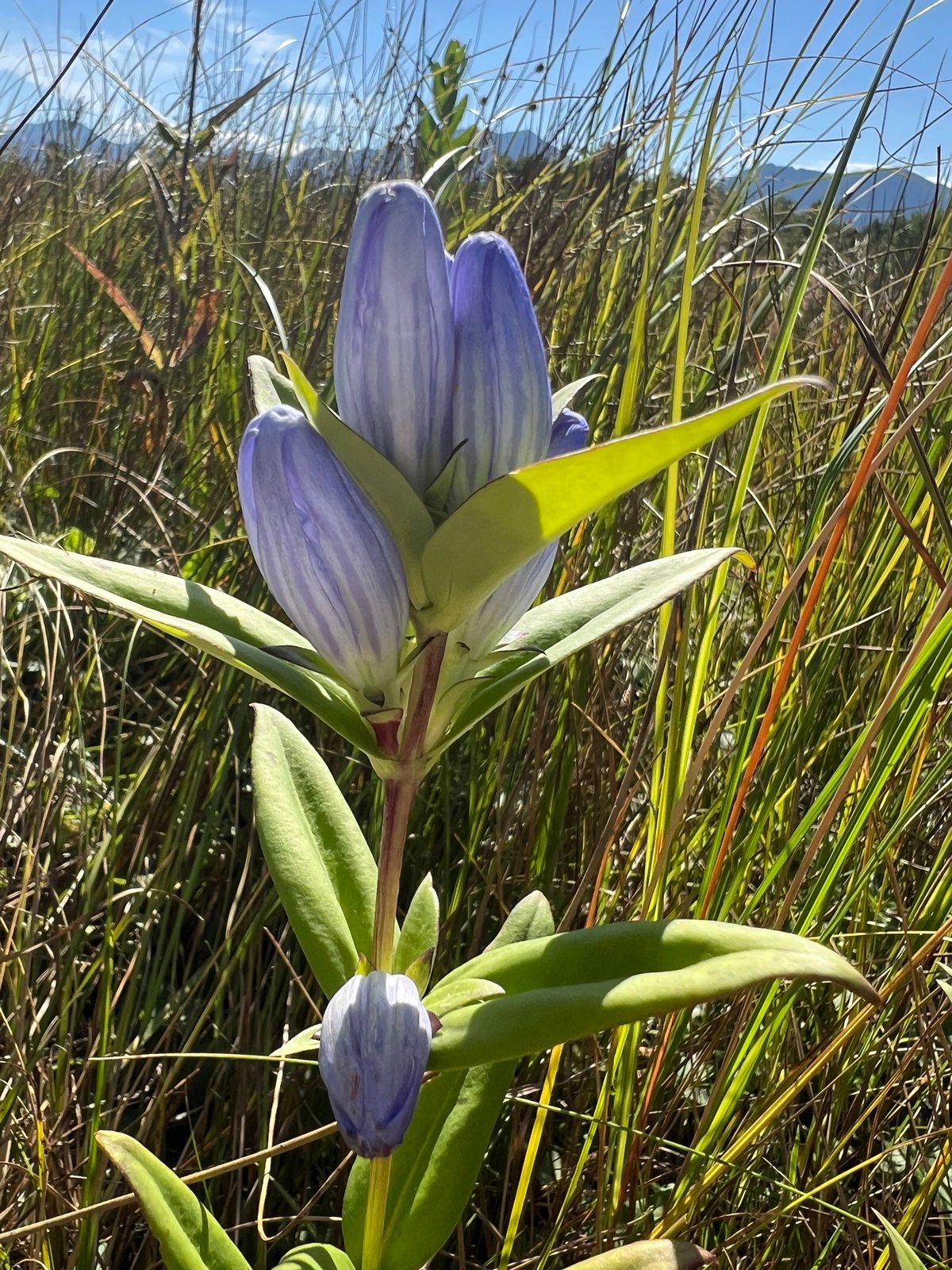
Bottle gentian is a clump-forming perennial native to central and eastern North America, grown for its blue-violet flowers that stay closed even when mature. It brings late-season colour to moist borders, meadow plantings and woodland edges, where strong bumblebees can force their way into the flowers.
At a glance
- Sun
- Full sun to partial shade; afternoon shade is helpful in warmer areas, especially if the soil might dry out.
- Water
- Keep the root zone consistently moist. Water deeply during dry spells; prolonged drought causes poor growth and scorched foliage.
- Soil
- Moist, humus-rich loam or clay that does not dry out. Tolerates periodically wet ground, but avoid stagnant, permanently submerged conditions.
- Height
- 1-2 ft (0.3-0.6 m)
- Spread
- 1-1.5 ft (0.3-0.45 m)
- Flowers
- Late summer to early autumn; blue to violet, bottle-shaped flowers clustered at stem tips and in upper leaf axils.
- Foliage
- Opposite pairs of dark green, lance-shaped leaves on upright stems; dies back in winter.
- Growth
- Slow to moderate; takes time to establish.
- Care needed
- Medium
The year at a glance
- Pollinators
- Deer resistant
- Cold hardy
- Low allergen
| J | F | M | A | M | J | J | A | S | O | N | D | |
|---|---|---|---|---|---|---|---|---|---|---|---|---|
| Flowers | ||||||||||||
| Fruit | ||||||||||||
| Plant |
Northern hemisphere months. In Australia, shift them by six.
- Difficulty
- Moderate
- Toughness
- Needs looking after
Will it suit your garden?
Pick your zone, country, light and whether you have pets.
Full sun is 6 or more hours of direct sun a day, part shade 3 to 6 hours, shade under 3.
How it grows
Planting day
1 ft (0.3 m)
After 1 year
1.1 ft (0.34 m)
After 2 years
1.2 ft (0.38 m)
After 3 years
1.4 ft (0.42 m)
After 5 years
1.5 ft (0.45 m)
full size
About 4 years to full size.
From a typical nursery size, at an average rate for this kind of plant. A rule of thumb, not a forecast.
Good to know
- Cats and dogs
- Safe
- Native to
- the US and Canada
- Growth rate
- Slow
Care
Jobs through the year
- WaterApr–May, Sep–Oct, every 7 days
- Check established plants and water unless rain keeps roots moist; new plants may need more frequent watering.
- WaterJun–Aug, every 3 days
- Check established plants and soak as needed to keep roots consistently moist; do not let soil dry out.
- MulchMar–Apr
- Apply a thin layer of leaf mould or compost, keeping the crown clear.
- PruneFeb–Mar
- Cut dead stems to ground level without damaging the crown.
- ProtectApr–May
- Mark late-emerging shoots and protect them from slugs by hand-picking or labelled bait.
- ProtectMay–Jul
- Thin vigorous neighbouring plants so they do not crowd the slow-growing clump.
- Plant in spring or early autumn while the soil is moist, keeping the crown at its original depth.
- Water during dry weather so the soil stays moist rather than drying between waterings.
- Apply a thin mulch of leaf mould or compost in spring, keeping it clear of the crown.
- Avoid heavy feeding; a light compost dressing is usually enough.
- Mark the planting position because shoots can emerge late in spring.
- Leave established clumps undisturbed rather than dividing them routinely.
Pruning. Cut dead stems to ground level in late winter or early spring before new shoots appear. Leave flower heads standing through autumn if you want seed.
Through the year
- Late winter
- Cut back last year's dead stems without damaging the crown.
- Spring
- Plant nursery-grown plants and add a thin mulch of leaf mould or compost.
- Late spring
- Check for emerging shoots before weeding or digging nearby; protect young growth from slugs.
- Summer
- Water during dry spells and prevent vigorous neighbouring plants from crowding the clump.
- Late summer
- Keep plants evenly moist while they flower.
- Autumn
- Collect seed as capsules turn brown and begin to split; sow promptly outdoors.
In the garden
- Plant small groups near the front or middle of a moist border, where the unusual closed flowers can be seen closely.
- Combine with cardinal flower and great blue lobelia beside a pond, above the permanently submerged zone.
- Use among sedges in a damp native meadow, with enough open space to prevent crowding.
- Place at a lightly shaded woodland edge for blue flowers after many spring woodland plants have finished.
Garden styles it suits: Native meadow, Woodland, Wildlife garden, Pollinator garden, Bog garden and Blues and silvers.
Plant it with: Cardinal flower, Great blue lobelia, Turtlehead, New England aster, Tussock sedge and Royal fern.
Wildlife: Bumblebees are its main pollinators; they push between the closed petals to reach nectar and pollen. It is generally less attractive to browsing deer than many border perennials, but it is not deer-proof.
Problems to watch for
- Slugs and snails can eat emerging shoots: check at dusk, remove pests and use an appropriate iron-phosphate bait if needed.
- Brown leaf edges, wilting or weak flowering often follow dry soil: water deeply and mulch to conserve moisture.
- Stems may lean in deep shade or overly rich soil: provide more light and avoid high-nitrogen fertilisers.
- Vigorous grasses and spreading perennials can overwhelm slow-establishing plants: keep nearby growth thinned until the clump is established.
Safety
Not known to be toxic to people, cats, dogs or horses, but species-specific safety information is limited. No particular part is established as poisonous; this is an ornamental plant, not a food plant, so do not eat it or allow pets to chew it.
Easily confused with
Soapwort gentian (Gentiana saponaria)
Its blue flowers usually open slightly at the tip, exposing short lobes; bottle gentian flowers remain closed. Intermediate-looking plants can be difficult to identify from a distance.
Yellow gentian (Gentiana flavida)
Has pale cream to yellowish-white flowers rather than the blue-violet flowers typical of bottle gentian.
Marsh gentian (Gentiana pneumonanthe)
Has narrower leaves and blue trumpets that open into distinct spreading lobes rather than remaining bottle-shaped and closed.
The name
The common name refers to the bottle-shaped flowers, which remain closed even when fully mature.
Propagation. Grow from fresh seed sown outdoors in autumn, allowing winter cold to break dormancy. Germination can be slow and uneven, and seedlings may take several years to flower. Division is possible in early spring but can set plants back; seed or nursery-grown plants are usually better choices.
Checked against open data
- Accepted botanical name
- Gentiana andrewsii
- In the US and Canada
- Native in Canada and the lower 48 states.
- Native range
- Connecticut, Delaware, Illinois, Indiana, Iowa, Kansas, Kentucky, Manitoba, Maryland, Michigan, Minnesota and Missouri.
- Measured
- Soil pH 5.8 to 7.2. Average height 58 cm.
Sources: GBIF (CC BY 4.0), USDA PLANTS and Trefle (CC BY 4.0). The care and design notes are LandscapeGPT's own.
See it in your own yard.
Upload a photo of your yard and see it redesigned with plants that suit your climate, each checked against your zone.