Cigar plant
Cuphea ignea. Family Lythraceae. Shrub.
Also called Cigar flower, Mexican cigar plant, Firecracker plant.
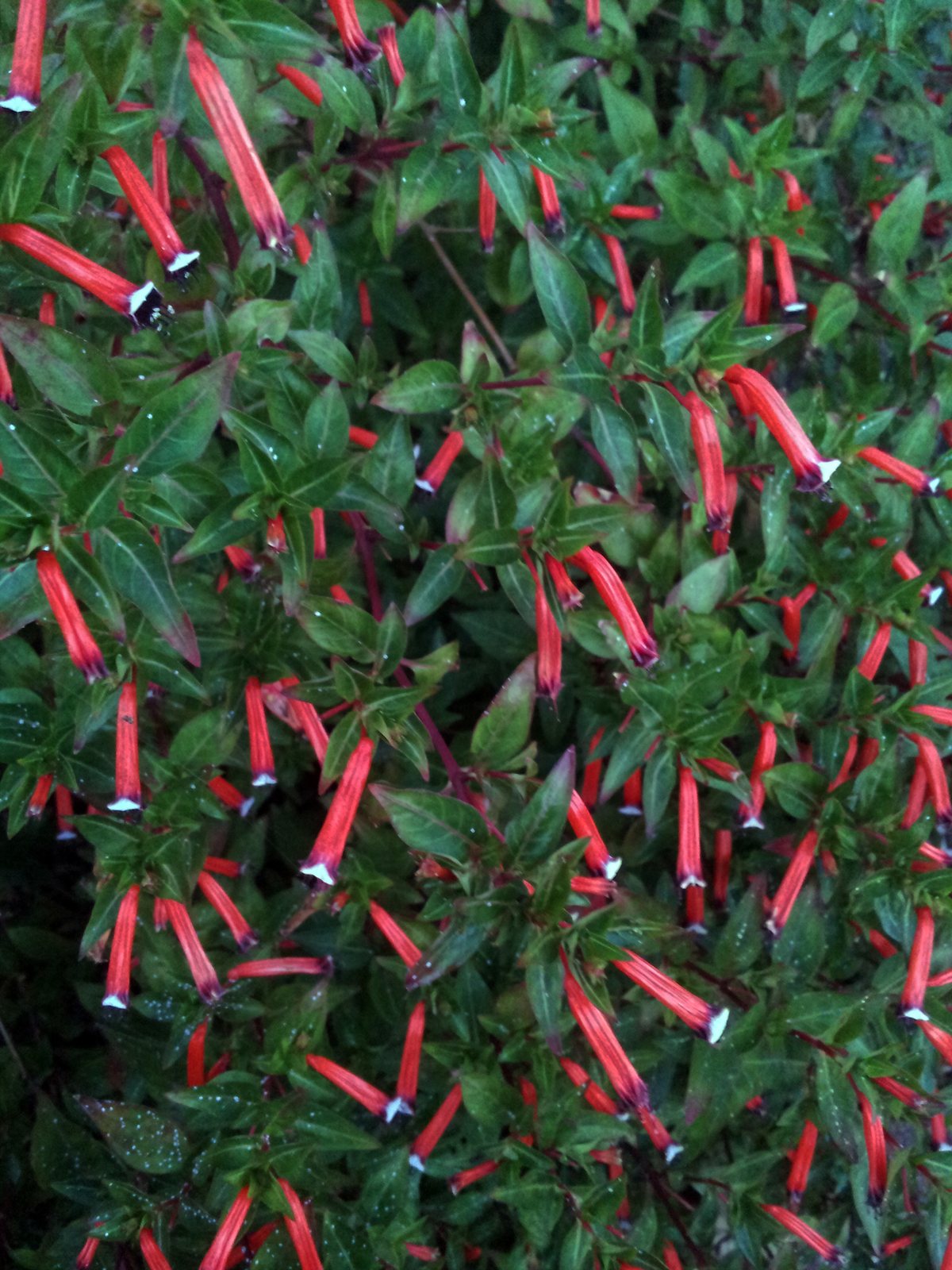
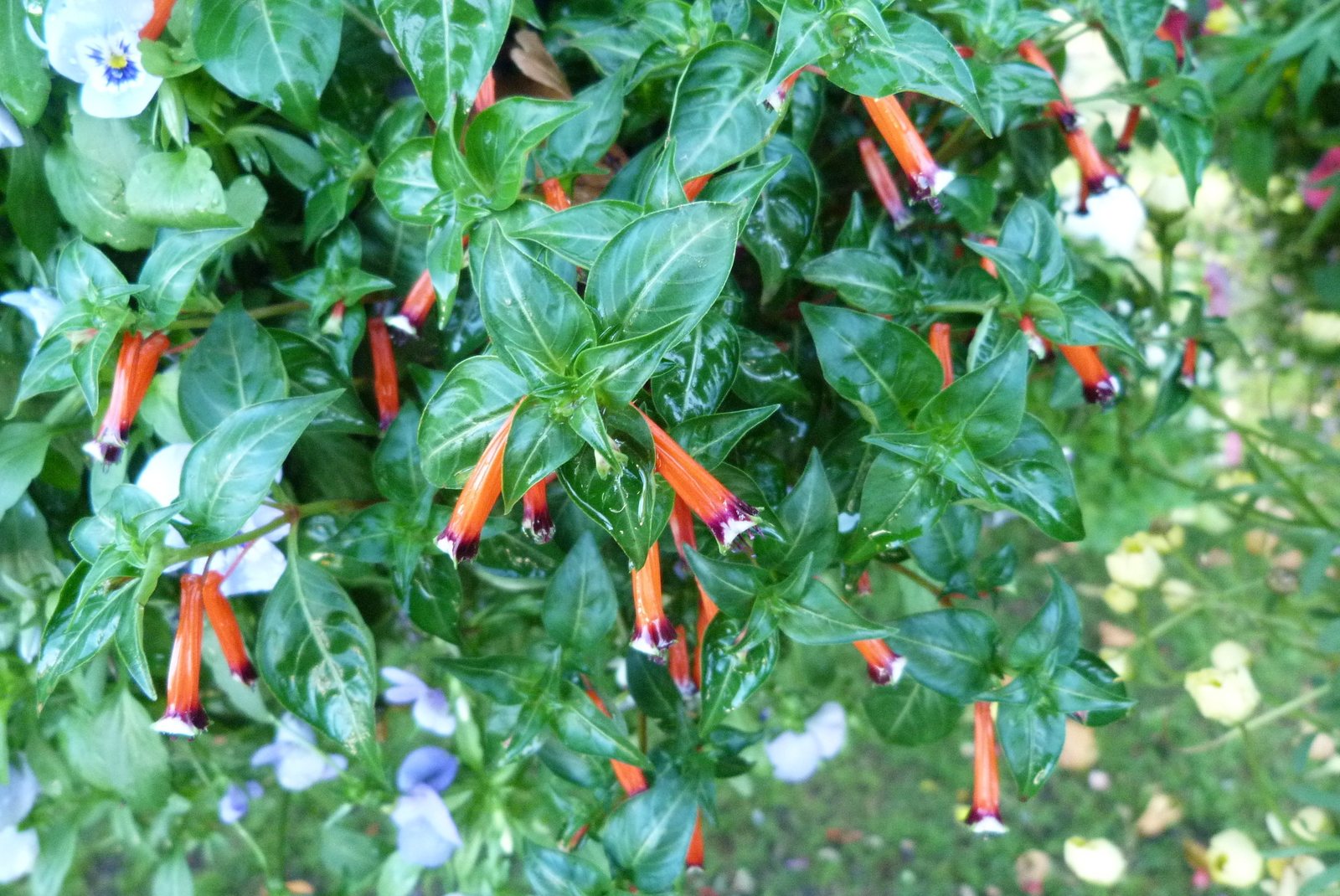
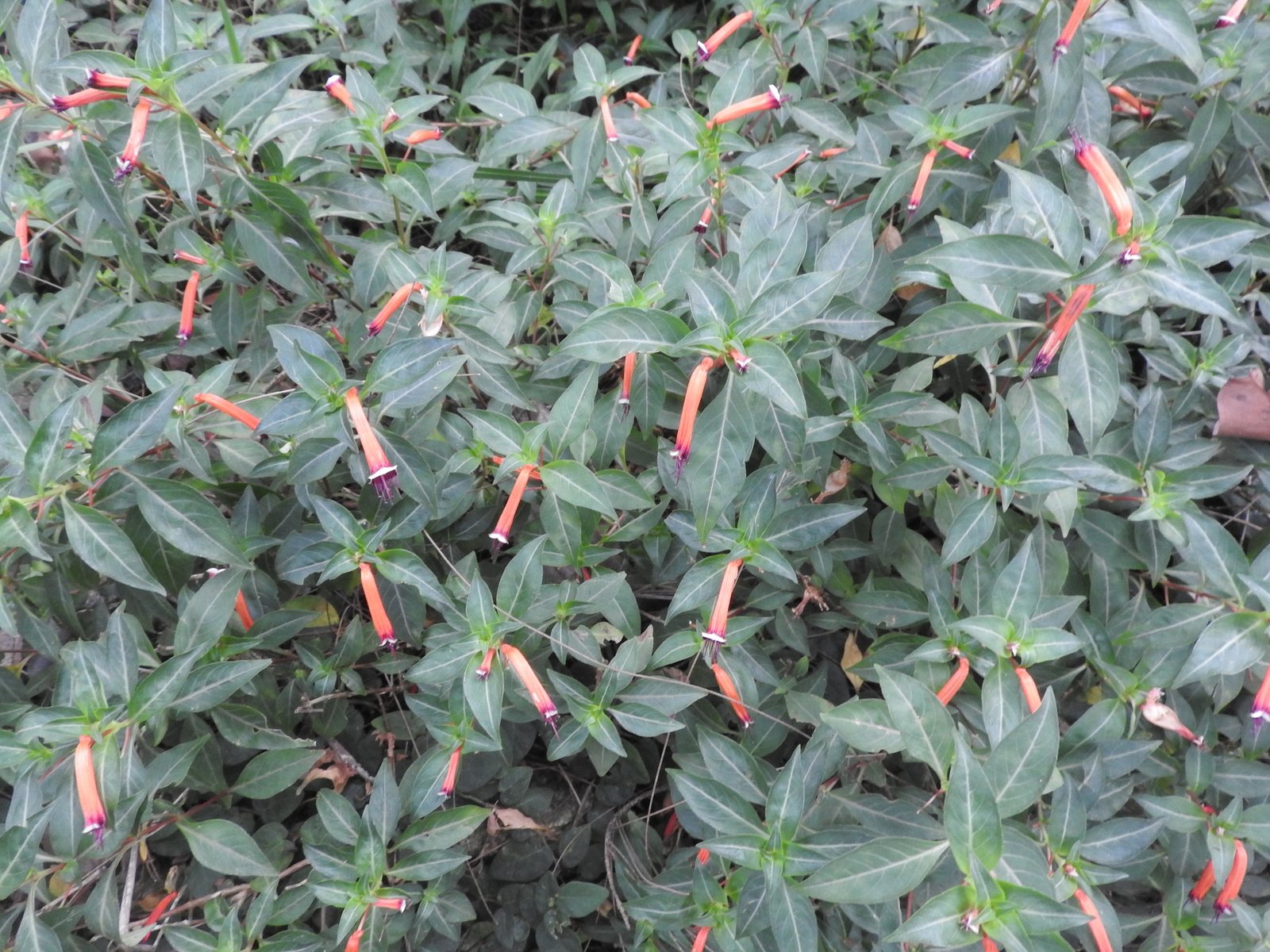
Cigar plant is a frost-tender evergreen shrub with small leaves and narrow orange-red flowers tipped with white and dark purple, like tiny glowing cigars. It flowers over a long warm season and is grown as an annual in colder climates, or kept in a pot and overwintered indoors.
At a glance
- Sun
- Full sun to partial shade; give afternoon shade in very hot, dry gardens.
- Water
- Water regularly during active growth, allowing the soil surface to dry slightly between waterings. Avoid both prolonged drought and waterlogged roots.
- Soil
- Well-drained soil enriched with compost; use a free-draining multipurpose potting mix in containers.
- Height
- 1-3 ft (0.3-0.9 m)
- Spread
- 1-3 ft (0.3-0.9 m)
- Flowers
- Orange-red tubular flowers with white and dark purple tips from late spring to autumn; flowering may continue much of the year in frost-free climates.
- Foliage
- Evergreen. Small, narrow, pointed, dark green leaves on slender, branching stems.
- Growth
- Fast in warm weather.
- Care needed
- Low
The year at a glance
- Pollinators
- Heat tolerant
- Low allergen
| J | F | M | A | M | J | J | A | S | O | N | D | |
|---|---|---|---|---|---|---|---|---|---|---|---|---|
| Flowers | ||||||||||||
| Plant |
Northern hemisphere months. In Australia, shift them by six.
- Difficulty
- Moderate
- Toughness
- Fairly tough
Will it suit your garden?
Pick your zone, country, light and whether you have pets.
Full sun is 6 or more hours of direct sun a day, part shade 3 to 6 hours, shade under 3.
How it grows
Planting day
1.6 ft (0.5 m)
After 1 year
1.7 ft (0.53 m)
After 2 years
1.8 ft (0.56 m)
After 3 years
1.9 ft (0.59 m)
After 5 years
2 ft (0.6 m)
full size
About 3 years to full size.
From a typical nursery size, at an average rate for this kind of plant. A rule of thumb, not a forecast.
Good to know
- Cats and dogs
- Safe
- Growth rate
- Fast
Care
Jobs through the year
- WaterMay, Sep, every 7 days
- Water established outdoor plants when the surface dries slightly; new plants and pots need closer checks.
- WaterJun–Aug, every 4 days
- Water established plants as the surface dries slightly; check containers daily in heat.
- WaterJan–Apr, Oct–Dec, every 14 days
- For plants overwintered frost-free indoors, water sparingly when partly dry without drying the root ball completely.
- FeedMay–Sep, every 21 days
- Feed container plants with balanced liquid fertilizer at the label rate; ground-grown plants rarely need routine feeding.
- MulchMay–Jun
- Lightly mulch outdoor plants, keeping stems clear.
- PruneMar–Apr
- Trim overwintered plants as new growth begins and pinch young tips for branching.
- PruneJun–Aug
- Lightly shorten leggy shoots only as needed; deadheading is unnecessary.
- ProtectMay–Jun
- Harden off indoor plants and plant outside only after frost risk has passed.
- ProtectSep–Oct
- Lift plants or bring pots into bright, frost-free shelter before the first frost, or treat them as annuals.
- ProtectJan–Apr, Oct–Dec, every 14 days
- Inspect sheltered plants for whiteflies, aphids and spider mites.
- Plant outside after frost risk has passed and the soil has warmed.
- Water thoroughly when the soil surface begins to dry; check containers daily during hot weather.
- Apply a balanced liquid feed to container plants every two to four weeks during active growth, following the label rate.
- Mulch garden plants lightly to conserve moisture, keeping mulch clear of the stems.
- Move pots into a bright, frost-free place before cold weather; water less in winter without letting the root ball dry completely.
Pruning. Pinch young shoot tips in spring to encourage branching, and lightly trim leggy growth during summer. Cut back overwintered plants in spring as new growth begins; routine deadheading is unnecessary.
Through the year
- Spring
- Trim overwintered plants, refresh container compost and gradually increase watering as growth resumes.
- Late spring
- Harden off indoor-grown plants and plant outside after the last frost.
- Summer
- Water consistently, feed container plants and pinch back straggling shoots.
- Late summer
- Take softwood or semi-ripe cuttings to keep young plants for the following year.
- Autumn
- In frosty regions, bring container plants indoors before the first frost or remove plants grown as annuals.
- Winter
- Keep protected plants in bright light, water sparingly and check for indoor pests.
In the garden
- Use in patio pots where the small, detailed flowers can be seen close up.
- Plant near the front of a warm-season border with salvias and lantanas for sustained flower colour.
- Repeat in groups along sunny paths to create a low, informal flowering edge.
- Combine with coleus and sweet potato vine in mixed containers for contrasting foliage and trailing growth.
Garden styles it suits: Cottage garden, Modern courtyard, Tropical, Hot border, Pollinator garden and Small-space.
Plant it with: Salvia, Lantana, Pentas, Coleus, Sweet potato vine and French marigold.
Wildlife: The tubular flowers provide nectar for hummingbirds where they occur, especially in the Americas. Butterflies may also visit.
Problems to watch for
- Aphids on soft new growth: rinse off with water or use insecticidal soap according to the label.
- Whiteflies, especially under cover: inspect leaf undersides, isolate affected pots and treat with insecticidal soap where labelled for use.
- Spider mites in hot, dry conditions: look for fine webbing and stippled leaves; rinse foliage thoroughly and prevent repeated drying out.
- Root rot in wet soil: improve drainage, empty pot saucers and let the soil surface dry slightly before watering again.
Safety
Not known to be toxic to people, cats, dogs or horses. Species-specific safety information is limited, and no part should be treated as edible.
Easily confused with
Bat-faced cuphea (Cuphea llavea)
Its flowers have a conspicuous dark purple face and two spreading red petals; cigar plant has narrow tubes without those prominent petals.
Mexican heather (Cuphea hyssopifolia)
It has tiny, open purple, pink or white flowers rather than long orange-red tubes.
Firecracker plant (Russelia equisetiformis)
It has long, arching, rush-like stems with very small leaves and plain red tubular flowers, rather than leafy stems and white-tipped flowers.
The name
The common name refers to the cigar-like flowers, while the species name ignea means fiery, referring to their colour.
Propagation. Take softwood cuttings in spring or early summer, or semi-ripe cuttings in late summer, and root them in a moist, free-draining medium with gentle warmth. Seed can also be sown in warm conditions in spring.
Checked against open data
- Accepted botanical name
- Cuphea ignea
- In the US and Canada
- Introduced in Hawaii.
- Native range
- Mexico Southeast and Mexico Southwest.
Sources: GBIF (CC BY 4.0), USDA PLANTS and Trefle (CC BY 4.0). The care and design notes are LandscapeGPT's own.
See it in your own yard.
Upload a photo of your yard and see it redesigned with plants that suit your climate, each checked against your zone.