Coast live oak
Quercus agrifolia. Family Fagaceae. Tree.
Also called California live oak, Encina.
A large evergreen oak native to coastal California and northern Baja California, with a broad crown, twisting limbs and small, leathery leaves. Grow it for lasting shade, strong structure and wildlife habitat where there is ample room and summers are relatively dry. It is unsuitable for small gardens or lawns that need frequent summer irrigation.
At a glance
- Sun
- Full sun; young trees tolerate partial shade.
- Water
- Water young trees deeply during dry spells while they establish. Established trees usually need little or no summer irrigation in coastal Mediterranean climates; frequent watering around the trunk can cause serious root disease.
- Soil
- Well-drained loam, clay or sandy soil; tolerates a range of soil pH. Avoid waterlogged ground, compacted soil and sites with a permanently wet root zone.
- Height
- 40-70 ft (12-21 m)
- Spread
- 40-80 ft (12-24 m)
- Flowers
- Spring; yellow-green male catkins and tiny, inconspicuous female flowers.
- Foliage
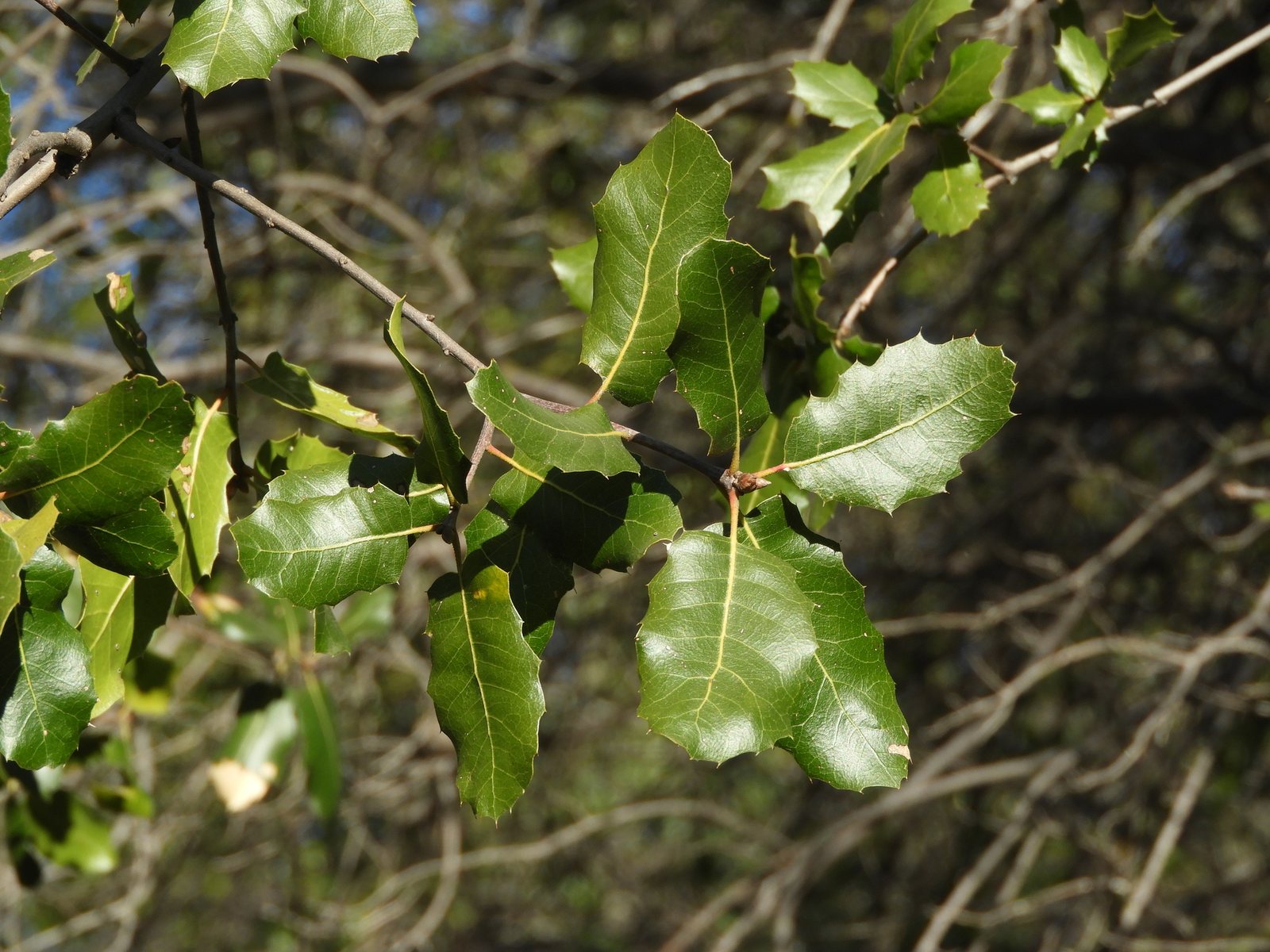
- Evergreen. Dark green, leathery, oval leaves with cupped edges and often spiny teeth. The undersides are paler, usually with small hair tufts where the veins meet; some older leaves drop in spring as new growth appears.
- Growth
- Moderate when young, slowing with age; growth depends strongly on soil depth and available moisture.
- Care needed
- Low
The year at a glance
- Drought tolerant
- Heat tolerant
- Wildlife
| J | F | M | A | M | J | J | A | S | O | N | D | |
|---|---|---|---|---|---|---|---|---|---|---|---|---|
| Flowers | ||||||||||||
| Fruit | ||||||||||||
| Plant |
Northern hemisphere months. In Australia, shift them by six.
- Difficulty
- Hard
- Toughness
- Fairly tough
Will it suit your garden?
Pick your zone, country, light and whether you have pets.
Full sun is 6 or more hours of direct sun a day, part shade 3 to 6 hours, shade under 3.
How it grows
Planting day
7 ft (2 m)
After 1 year
8 ft (2.6 m)
After 2 years
10 ft (3.1 m)
After 3 years
12 ft (3.7 m)
After 5 years
16 ft (4.8 m)
About 26 years to full size.
From a typical nursery size, at an average rate for this kind of plant. A rule of thumb, not a forecast.
Good to know
- Cats and dogs
- Toxic
- Native to
- the US
- Growth rate
- Slow
Care
Jobs through the year
- WaterMar–May, Sep–Oct, every 21 days
- Established ground-grown trees need water only in unusually dry soil; young or potted trees need closer checks.
- WaterJun–Aug, every 30 days
- Water established trees only in exceptional drought, well away from the trunk; never irrigate routinely.
- MulchApr
- Retain leaf litter or add shallow coarse mulch, keeping the trunk clear.
- PruneJul–Aug
- Make only necessary light cuts in dry weather; use an arborist for large limbs.
- ProtectJan–Mar, Oct–Dec
- Not reliably hardy in zones 6–7; grow young specimens in movable containers and overwinter frost-free.
- Plant during the cool, rainy season, leaving the root flare at soil level and allowing room for the mature crown.
- Water deeply through the first two or three dry seasons, letting the soil partly dry between waterings; gradually reduce irrigation as roots establish.
- Keep lawn sprinklers, thirsty plants and irrigation outlets away from the trunk and major roots.
- Retain fallen leaves or apply a shallow layer of coarse organic mulch, keeping it clear of the trunk.
- Do not routinely fertilize established trees, and avoid digging, paving or changing soil levels beneath the canopy.
Pruning. Train young trees with light pruning during dry summer weather, retaining well-spaced branches and removing weak competing leaders. On mature trees, limit pruning to necessary clearance and dead or hazardous limbs; use a qualified arborist for large branches and never top the crown.
Through the year
- Autumn
- Collect sound, freshly fallen acorns for propagation; do not let them dry out.
- Late autumn
- Plant young trees after seasonal rain begins, provided the soil drains freely.
- Winter
- Check drainage and keep runoff from collecting around the trunk.
- Spring
- Check new leaves for unusual dieback or heavy caterpillar damage; normal shedding of older leaves does not need treatment.
- Early summer
- Deep-water young trees as needed and check that mulch is not touching the trunk.
- Summer
- Carry out necessary light structural pruning in dry weather and keep routine irrigation away from established trees.
In the garden
- Use as a long-lived shade tree in a large garden, allowing its broad crown to develop without repeated size reduction.
- Retain existing specimens as the framework for a California native garden, with dry-shade planting toward the canopy edge.
- Combine with open gravel or leaf-litter ground beneath the crown for a Mediterranean landscape without an irrigated lawn.
- Plant in spacious wildlife gardens or naturalistic groves, leaving room for fallen leaves, acorns and spreading limbs.
Garden styles it suits: California native, Mediterranean, Woodland, Wildlife garden, Coastal and Desert / xeriscape.
Plant it with: Coffeeberry, Toyon, Hummingbird sage, California fescue and California polypody.
Wildlife: Acorns feed jays, woodpeckers, squirrels and other mammals. The canopy supports many native insects and provides nesting and shelter for birds; old trees may develop valuable cavities.
Problems to watch for
- Root and crown rot: often associated with summer irrigation or poor drainage. Redirect water away from the trunk, stop frequent shallow watering and have declining trees assessed by an arborist.
- Sudden oak death: Phytophthora ramorum can cause bleeding trunk cankers and canopy decline, especially in affected coastal California areas. Use inspected nursery stock, avoid moving potentially infected soil or plant material, and seek local diagnostic advice;
- California oakworm: caterpillars can strip foliage during outbreaks, but healthy trees commonly recover. Avoid routine spraying; seek advice if a young or stressed tree is repeatedly defoliated.
- Goldspotted oak borer: a serious threat in parts of southern California, causing branch dieback and bark injury. Do not move oak firewood, and have suspected infestations assessed promptly by a qualified arborist.
Safety
Acorns and leaves, particularly young leaves, contain tannins that can cause poisoning if eaten in quantity. Horses are especially at risk, with potentially fatal gut and kidney damage. Dogs can develop digestive upset or more serious poisoning, and swallowed acorns can cause obstruction. Keep cats from eating them too, although feline poisoning is less commonly reported. People should not eat raw acorns; traditional food preparation requires thorough tannin removal.
Easily confused with
Interior live oak (Quercus wislizeni)
Its leaves are generally flatter, with undersides nearly the same green as the upper surface. Coast live oak usually has more strongly cupped leaves and small hair tufts in the vein junctions underneath.
Canyon live oak (Quercus chrysolepis)
Young leaf undersides often have a yellowish or golden coating, and the acorn cups are thick with golden hairs. Coast live oak has thinner acorn cups without that golden coating.
Holm oak (Quercus ilex)
Leaf undersides usually have a more continuous grey or whitish felt. Coast live oak typically has greener undersides with localized hair tufts rather than an even felted covering.
The name
The common name refers to its coastal native range and its evergreen habit, with 'live oak' distinguishing it from oaks that lose all their leaves in winter.
Propagation. Grow from fresh acorns collected in autumn. Discard damaged acorns, sow promptly in deep containers protected from rodents, and keep the medium moist but not waterlogged. Plant out while young, before the developing roots become crowded or distorted.
Checked against open data
- Accepted botanical name
- Quercus agrifolia
- In the US and Canada
- Native in the lower 48 states.
- Native range
- California and Mexico Northwest.
- Measured
- Soil pH 5.5 to 7.5. Average height 2042 cm.
Sources: GBIF (CC BY 4.0), USDA PLANTS and Trefle (CC BY 4.0). The care and design notes are LandscapeGPT's own.
See it in your own yard.
Upload a photo of your yard and see it redesigned with plants that suit your climate, each checked against your zone.