Toyon
Heteromeles arbutifolia. Family Rosaceae. Shrub.
Also called California holly, Christmas berry.
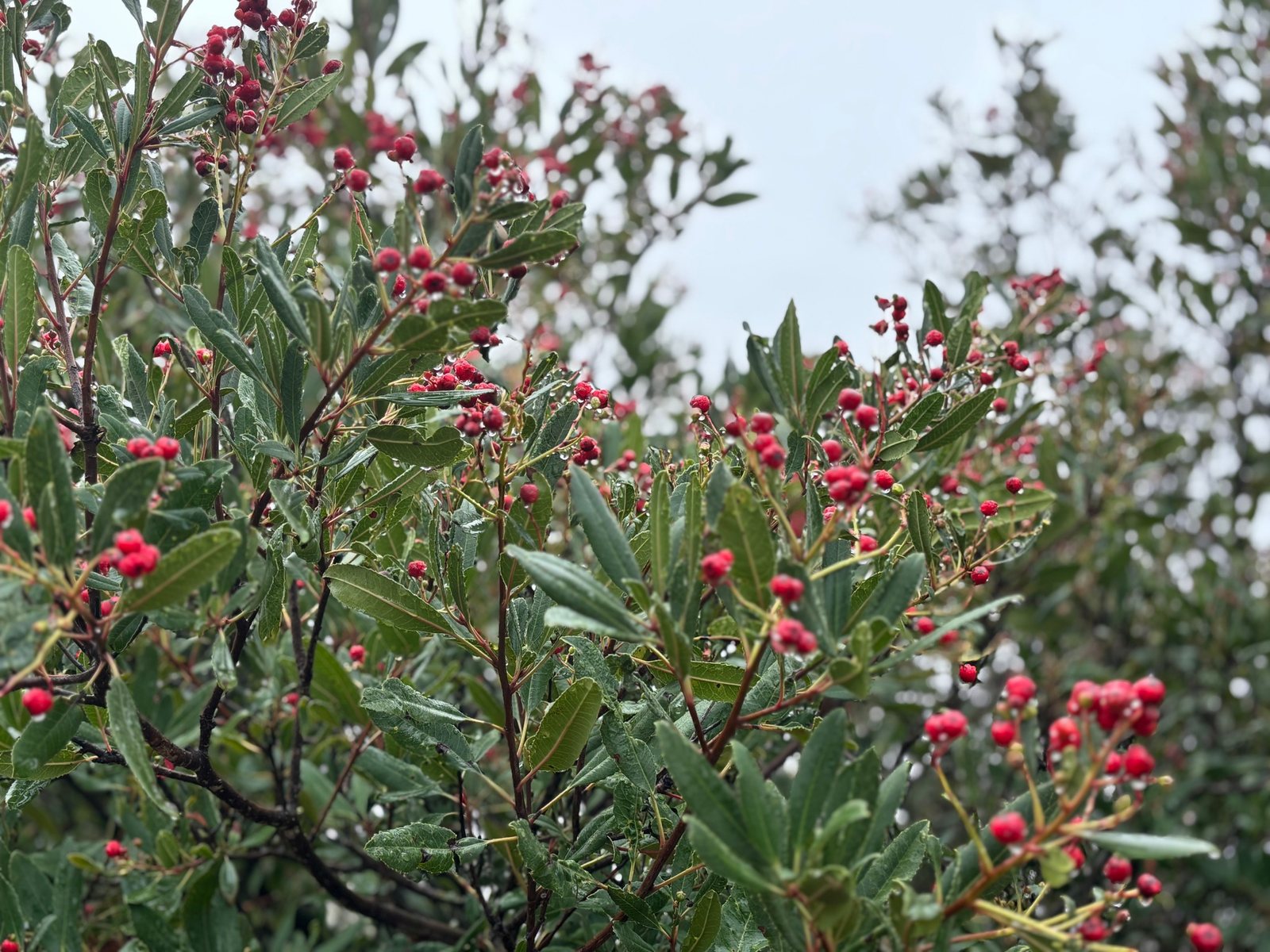
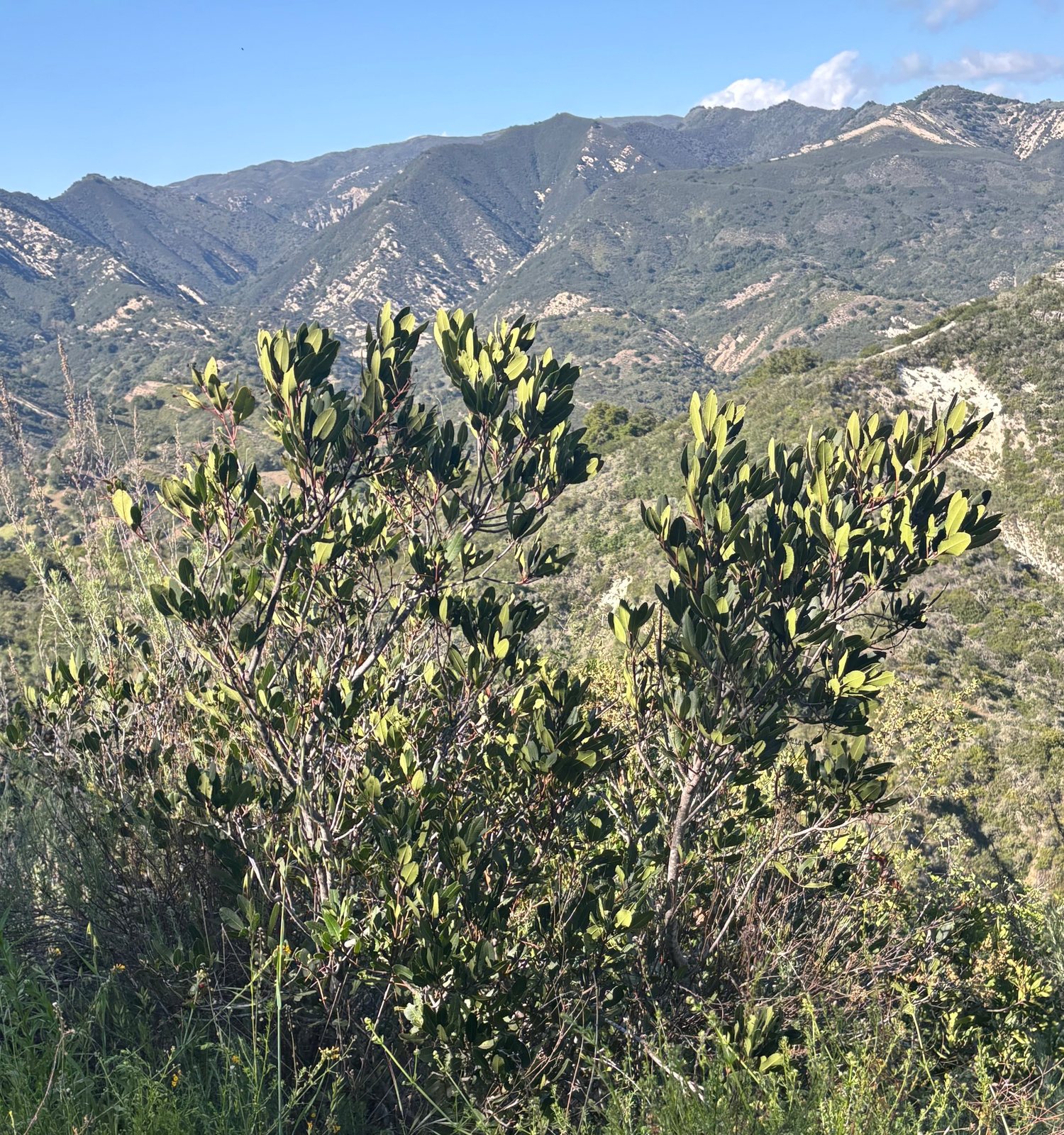
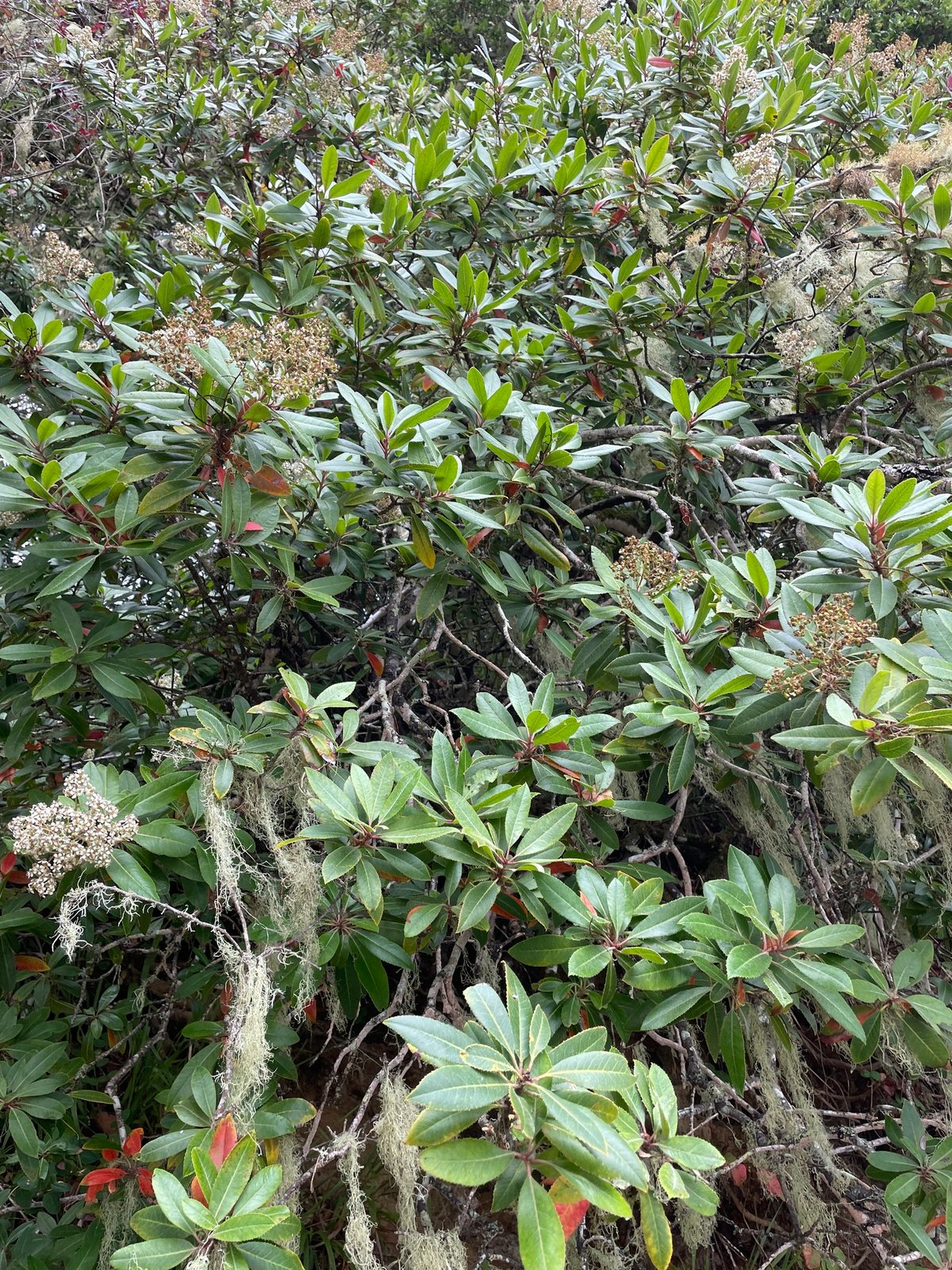
Toyon is a large evergreen shrub or small tree native to California and northern Baja California, grown for its leathery leaves, white summer flowers and red winter berries. It makes a useful wildlife screen in dry-summer gardens and needs little irrigation once established. In colder or wetter climates, give it a sheltered position with excellent drainage.
At a glance
- Sun
- Full sun to partial shade; flowering and berry production are usually best in sun.
- Water
- Low once established. Water deeply during establishment, then only occasionally during prolonged drought; avoid frequent summer irrigation.
- Soil
- Well-drained sandy, loamy or clay soil. Tolerates relatively poor soil, but not persistent waterlogging.
- Height
- 10-15 ft (3-4.6 m), occasionally 25 ft (7.6 m)
- Spread
- 8-15 ft (2.4-4.6 m)
- Flowers
- Clusters of small white flowers in late spring and summer, followed by red berries in autumn and winter.
- Foliage
- Evergreen. Dark green, leathery, oblong leaves with sharply toothed edges; foliage remains year-round.
- Growth
- Moderate; slower in dry conditions.
- Care needed
- Low
The year at a glance
- Pollinators
- Drought tolerant
- Heat tolerant
- Wildlife
- Low allergen
| J | F | M | A | M | J | J | A | S | O | N | D | |
|---|---|---|---|---|---|---|---|---|---|---|---|---|
| Flowers | ||||||||||||
| Fruit | ||||||||||||
| Plant |
Northern hemisphere months. In Australia, shift them by six.
- Difficulty
- Moderate
- Toughness
- Fairly tough
Will it suit your garden?
Pick your zone, country, light and whether you have pets.
Full sun is 6 or more hours of direct sun a day, part shade 3 to 6 hours, shade under 3.
How it grows
Planting day
1.6 ft (0.5 m)
After 1 year
3 ft (1 m)
After 2 years
5 ft (1.5 m)
After 3 years
7 ft (2 m)
After 5 years
10 ft (3 m)
About 7 years to full size.
From a typical nursery size, at an average rate for this kind of plant. A rule of thumb, not a forecast.
Good to know
- Cats and dogs
- Toxic
- Native to
- the US
- Growth rate
- Slow
Care
Jobs through the year
- WaterApr–May, Sep–Oct, every 21 days
- Water established ground plants only if dry; give young plants deeper, more frequent watering for two dry seasons.
- WaterJun–Aug, every 21 days
- Deep-water established ground plants only during prolonged drought; container plants need more frequent checks.
- PruneFeb–Mar
- Remove dead or crossing branches and shape lightly; avoid shearing away flowering wood.
- MulchApr
- Refresh organic mulch to 5–8 cm deep, keeping it clear of the trunk.
- ProtectJan–Apr, Oct–Dec
- Not reliably hardy in zones 6–7; grow in a movable container and overwinter in bright, frost-free shelter.
- Plant in autumn in mild climates, or in spring where winter cold is a concern.
- Water deeply through the first two dry seasons, allowing the soil to dry partly between soakings.
- Keep established plants away from frequently watered lawns and beds.
- Apply 2-3 in (5-8 cm) of organic mulch, keeping it clear of the trunk.
- Do not routinely fertilise; excessive feeding encourages soft growth.
Pruning. Prune lightly in late winter, removing dead, crossing or badly placed branches. To develop a small tree, remove lower branches gradually; avoid shearing, which spoils its natural form and reduces flowering and berries.
Through the year
- Late winter
- Remove dead or crossing branches and make any light shaping cuts.
- Spring
- Refresh mulch and check that it does not touch the trunk.
- Late spring
- Check new shoots for aphids and signs of fire blight.
- Summer
- Water young plants deeply during dry spells; avoid frequent watering around established roots.
- Autumn
- Plant in mild climates while the soil is still warm and seasonal rain is approaching.
- Winter
- Leave berries for birds and check drainage after prolonged rain.
In the garden
- Use as an informal evergreen screen along a spacious boundary.
- Combine with manzanitas and California lilacs in a dry, California-native planting.
- Train gradually as a multi-stemmed small tree to provide height without a dense canopy.
- Place behind grasses and low shrubs, where its dark foliage provides a backdrop and winter berries add colour.
Garden styles it suits: California native, Mediterranean, Wildlife garden, Low-maintenance, Desert / xeriscape and Winter interest.
Plant it with: California lilac, Manzanita, California coffeeberry, Deer grass, Cleveland sage and Western redbud.
Wildlife: Flowers attract bees and other insects. Berries feed many birds, while the dense evergreen branches provide shelter and nesting cover.
Problems to watch for
- Fire blight can blacken flowers and shoots: remove affected growth well below visible damage during dry weather, disinfect tools between cuts and avoid high-nitrogen feeding.
- Root and crown rot can develop in wet soil: improve drainage, keep mulch off the trunk and reduce irrigation.
- Aphids may gather on tender shoots: wash off small colonies with water and encourage natural predators.
- Leaf spots are more likely in damp, crowded conditions: avoid overhead watering, improve airflow and remove heavily affected fallen leaves.
Safety
Leaves and seeds contain cyanogenic compounds; raw fruit can also contain them, particularly when unripe. Treat the plant as potentially toxic to people, cats, dogs and horses if eaten in sufficient quantity. Significant ingestion can cause serious poisoning; do not offer berries as food or allow livestock to browse it.
Where it spreads. Has naturalised in parts of southern Australia, including South Australia and Victoria. Birds can spread its seed into nearby vegetation; check local weed guidance before planting near bushland.
Easily confused with
English holly (Ilex aquifolium)
Holly usually has broader, wavier leaves with large spines. Toyon has flatter, more elongated leaves with numerous smaller teeth and broad clusters of flowers and berries.
Firethorn (Pyracantha spp.)
Firethorn has conspicuous sharp thorns and generally smaller leaves. Toyon is thornless and develops larger, leathery leaves.
Red-tip photinia (Photinia × fraseri)
Red-tip photinia produces conspicuous bright red young leaves and generally larger, glossier foliage. Toyon's new growth is less vividly coloured, and its red winter fruit clusters are usually much more prominent.
The name
The species name arbutifolia means 'Arbutus-leaved', referring to its resemblance to the leaves of a strawberry tree.
Propagation. Sow cleaned seed from ripe berries promptly; germination can be irregular. Semi-ripe cuttings taken in late summer are another option, but rooting can be slow and unreliable.
Checked against open data
- Accepted botanical name
- Heteromeles arbutifolia
- In the US and Canada
- Native in the lower 48 states. Introduced in Hawaii.
- Native range
- California and Mexico Northwest.
- Measured
- Average height 518 cm.
Sources: GBIF (CC BY 4.0), USDA PLANTS and Trefle (CC BY 4.0). The care and design notes are LandscapeGPT's own.
See it in your own yard.
Upload a photo of your yard and see it redesigned with plants that suit your climate, each checked against your zone.