California coffeeberry
Frangula californica. Family Rhamnaceae. Shrub.
Also called Coffeeberry, California buckthorn, Rhamnus californica.
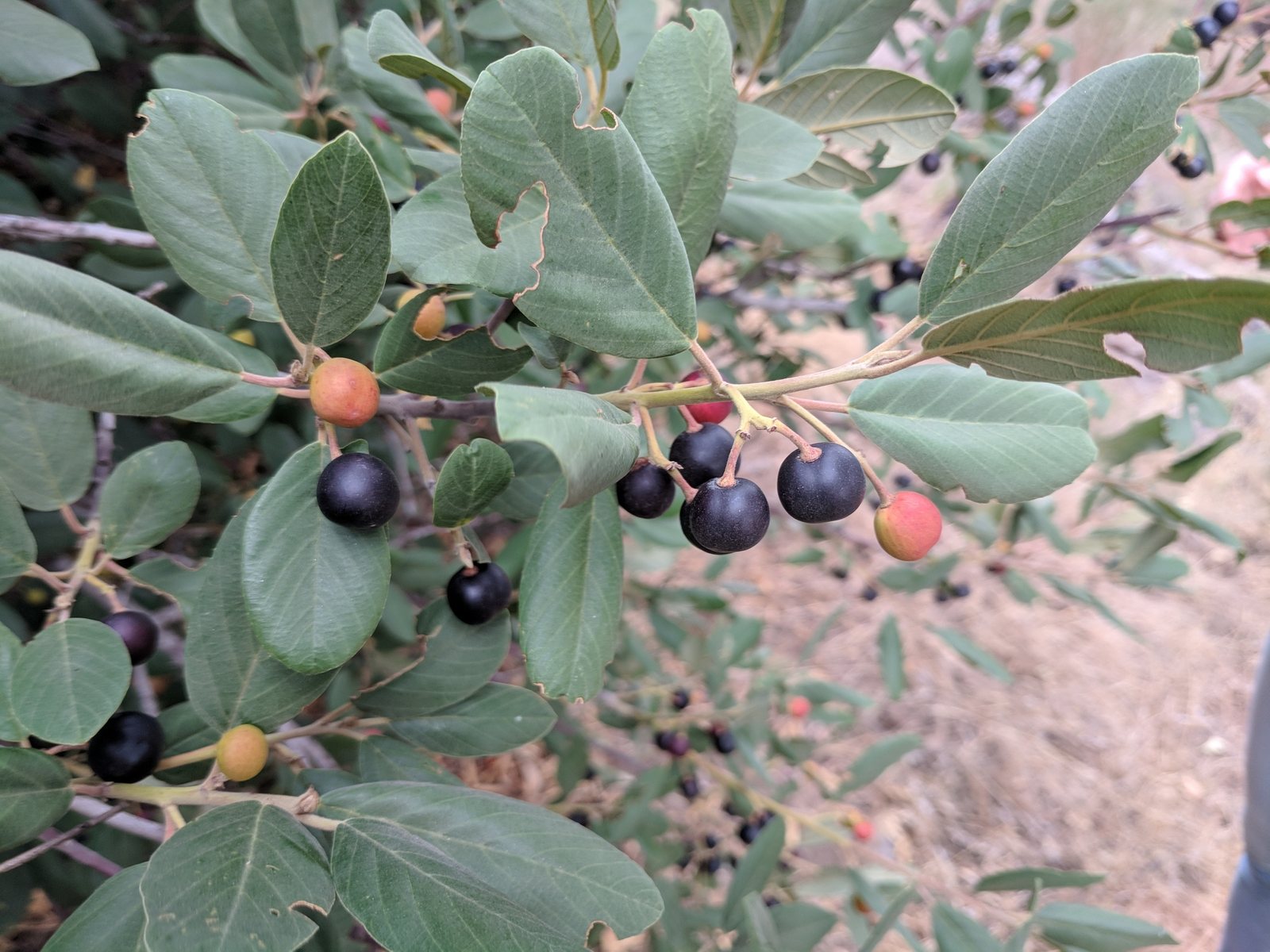
California coffeeberry is an evergreen shrub native to western North America, grown for its dense foliage, drought tolerance and value to wildlife. Small flowers attract insects, and berries ripen from green through red to black; despite the common name, they are not edible coffee beans.
At a glance
- Sun
- Full sun to partial shade; afternoon shade is helpful in hot inland gardens.
- Water
- Low once established; water regularly through the first one or two dry seasons. Established plants tolerate summer drought but accept occasional deep watering in well-drained soil.
- Soil
- Adaptable to sandy, loamy or clay soils with adequate drainage; avoid persistently waterlogged ground.
- Height
- 6-15 ft (1.8-4.6 m)
- Spread
- 6-12 ft (1.8-3.7 m)
- Flowers
- Spring to early summer; small, inconspicuous greenish-white flowers in clusters.
- Foliage
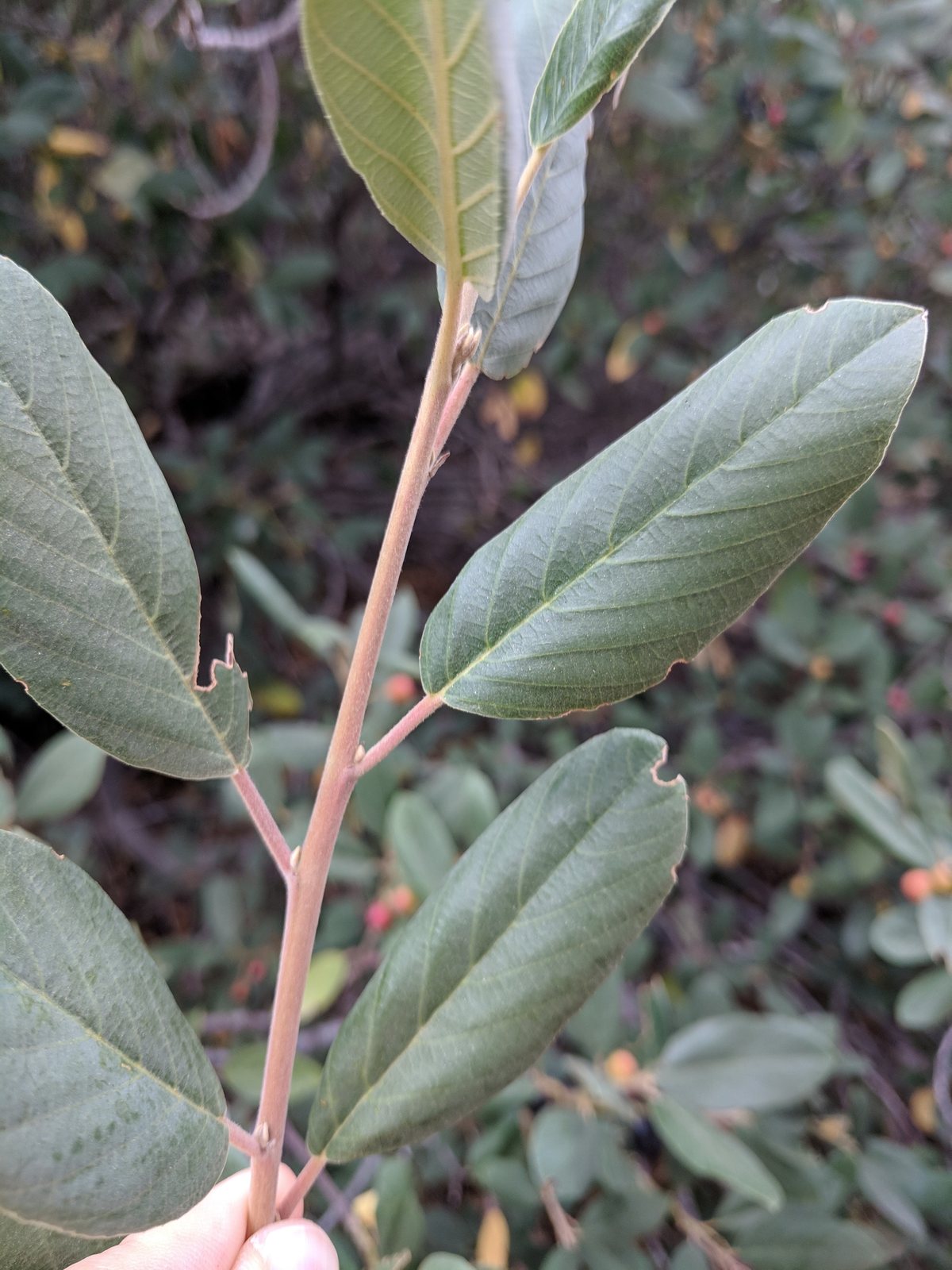
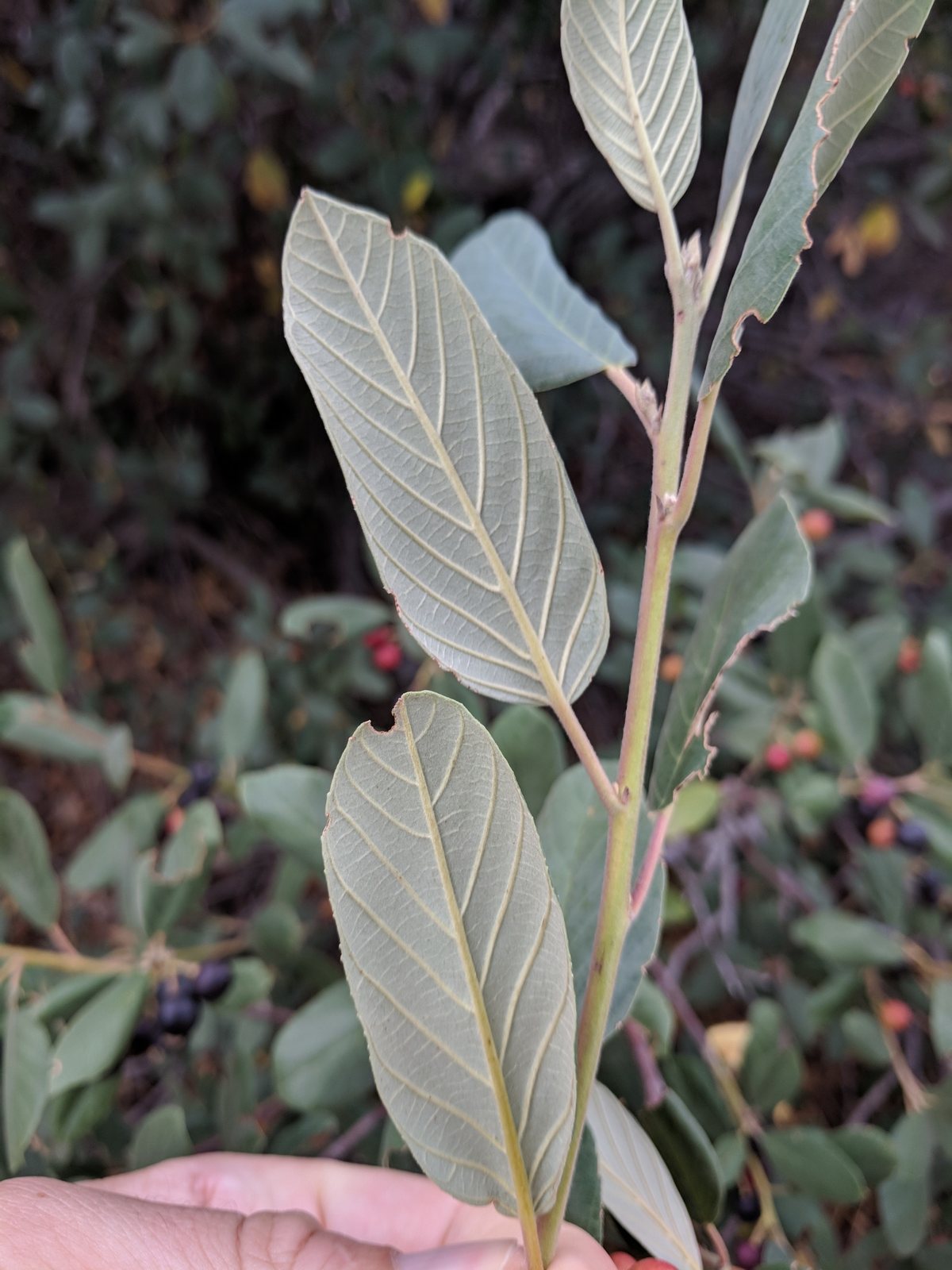
- Evergreen. Leathery, oval to oblong leaves, dark green above and paler beneath, with prominent veins; leaf size and shape vary among wild forms.
- Growth
- Moderate; slower in dry conditions.
- Care needed
- Low
The year at a glance
- Pollinators
- Drought tolerant
- Heat tolerant
- Wildlife
- Low allergen
| J | F | M | A | M | J | J | A | S | O | N | D | |
|---|---|---|---|---|---|---|---|---|---|---|---|---|
| Flowers | ||||||||||||
| Fruit | ||||||||||||
| Plant |
Northern hemisphere months. In Australia, shift them by six.
- Difficulty
- Moderate
- Toughness
- Fairly tough
Will it suit your garden?
Pick your zone, country, light and whether you have pets.
Full sun is 6 or more hours of direct sun a day, part shade 3 to 6 hours, shade under 3.
How it grows
Planting day
1.6 ft (0.5 m)
After 1 year
3 ft (0.92 m)
After 2 years
4 ft (1.3 m)
After 3 years
6 ft (1.7 m)
After 5 years
8 ft (2.6 m)
About 7 years to full size.
From a typical nursery size, at an average rate for this kind of plant. A rule of thumb, not a forecast.
Good to know
- Cats and dogs
- Mildly toxic: may upset a stomach
- Native to
- the US
- Growth rate
- Slow
Care
Jobs through the year
- WaterApr–May, Sep–Oct, every 21 days
- Water established shrubs only when dry; water more often during the first two growing seasons.
- WaterJun–Aug, every 21 days
- Give established shrubs an occasional deep soak during dry spells; avoid constantly wet soil.
- PruneFeb–Mar
- Lightly thin dead or crossing branches and shorten wayward shoots before new growth.
- MulchMay
- Maintain 5–8 cm of mulch over roots, keeping it away from stems.
- ProtectJan–Mar, Nov–Dec
- Use a sheltered site in zone 7; in zone 6, overwinter a container plant in bright, frost-free shelter.
- Plant in autumn where winters are mild, or in spring near its cold limit.
- Water deeply during establishment, allowing the soil surface to dry between waterings.
- Once established, reduce irrigation and avoid keeping the root zone constantly wet.
- Spread 2-3 in (5-8 cm) of mulch over the root area, keeping it clear of the stems.
- Do not routinely fertilize; rich feeding is usually unnecessary.
Pruning. Thin crowded branches and shorten wayward shoots in late winter or early spring, before new growth starts. Keep pruning light to preserve its natural shape and berry display; remove dead or damaged wood whenever needed.
Through the year
- Late winter
- Remove dead or crossing branches and lightly shape established shrubs.
- Spring
- Plant in colder districts and water new plants thoroughly.
- Late spring
- Check mulch depth and keep mulch away from the base of the stems.
- Summer
- Deep-water young shrubs when the root zone begins to dry; avoid frequent shallow irrigation.
- Late summer
- Leave ripening berries for birds and take semi-ripe cuttings if you want more plants.
- Autumn
- Plant in mild-winter areas while the soil is warm and seasonal rain can help establishment.
In the garden
- Use as an informal evergreen hedge or screen, allowing room for its naturally broad shape.
- Combine with manzanitas and California lilacs in a dry, California-native shrub border.
- Plant along a woodland edge with western sword fern where there is partial shade.
- Use on well-drained slopes for year-round cover and wildlife habitat.
- Set behind flowering perennials as a quiet, dark-green backdrop.
Garden styles it suits: California native, Wildlife garden, Low-maintenance, Mediterranean, Woodland and Native hedgerow.
Plant it with: Manzanita, California lilac, Toyon, California fuchsia, Deer grass and Western sword fern.
Wildlife: Flowers provide nectar and pollen for bees, flies and other insects. Birds eat the berries, and the dense evergreen branches provide shelter and nesting cover.
Problems to watch for
- Root rot in saturated soil: improve drainage before planting and reduce irrigation; do not plant in a winter-wet hollow.
- Scale insects: inspect stems and leaf undersides, prune out heavily infested shoots and use a labelled horticultural oil if needed.
- Aphids on soft new growth: wash them off with water and avoid excessive nitrogen feeding.
- Leaf scorch or leaf drop during establishment: check soil moisture and water deeply when dry; protect young plants from intense reflected heat.
Safety
Do not eat the berries, seeds, leaves or bark; ingestion can cause nausea, vomiting or diarrhoea in people. Keep cats and dogs from chewing the plant or eating fallen fruit because gastrointestinal upset is a concern. Horse-specific toxicity information is limited, so do not allow browsing or put prunings in paddocks.
Easily confused with
Cascara (Frangula purshiana)
Cascara is deciduous and usually develops into a small tree, with larger leaves showing strongly marked, nearly parallel side veins. Coffeeberry normally retains its smaller, leathery leaves.
Toyon (Heteromeles arbutifolia)
Toyon has conspicuously toothed leaves, larger clusters of white flowers and red fruits that remain red when ripe. Coffeeberry fruits ripen to black.
Redberry (Rhamnus crocea)
Redberry generally has much smaller leaves, often spine-tipped branchlets and ripe red berries rather than black ones.
The name
The common name refers to the seeds' resemblance to coffee beans, while californica means 'of California'.
Propagation. Grow from cleaned seed sown outdoors in autumn; germination can be slow and uneven, and cold stratification may help. Take semi-ripe cuttings in summer to reproduce a particular plant, although rooting success varies.
Checked against open data
- Accepted botanical name
- Frangula californica
- In the US and Canada
- Native in the lower 48 states. Introduced in Hawaii.
- Native range
- Arizona, California, Mexico Northeast, Mexico Northwest, Nevada, New Mexico and Oregon.
- Measured
- Average height 210 cm.
Sources: GBIF (CC BY 4.0), USDA PLANTS and Trefle (CC BY 4.0). The care and design notes are LandscapeGPT's own.
See it in your own yard.
Upload a photo of your yard and see it redesigned with plants that suit your climate, each checked against your zone.