California fuchsia
Epilobium canum. Family Onagraceae. Perennial.
Also called Hummingbird trumpet, Zauschneria.
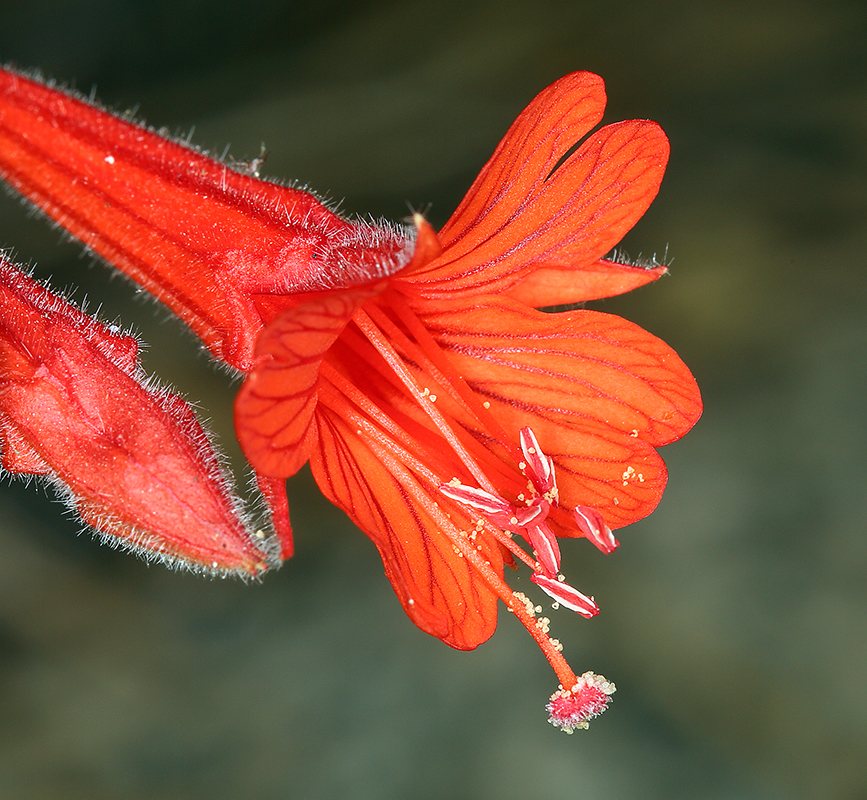
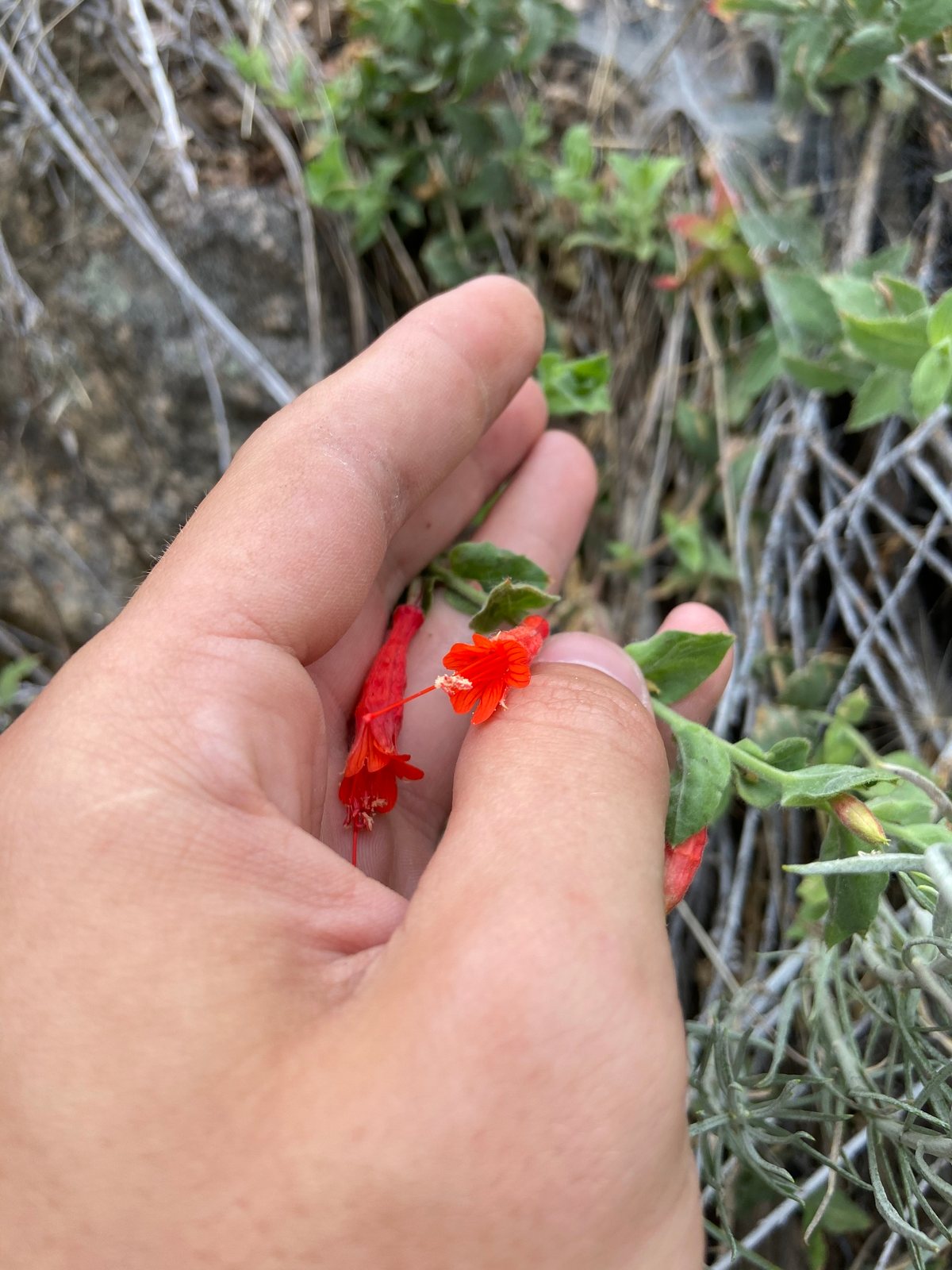
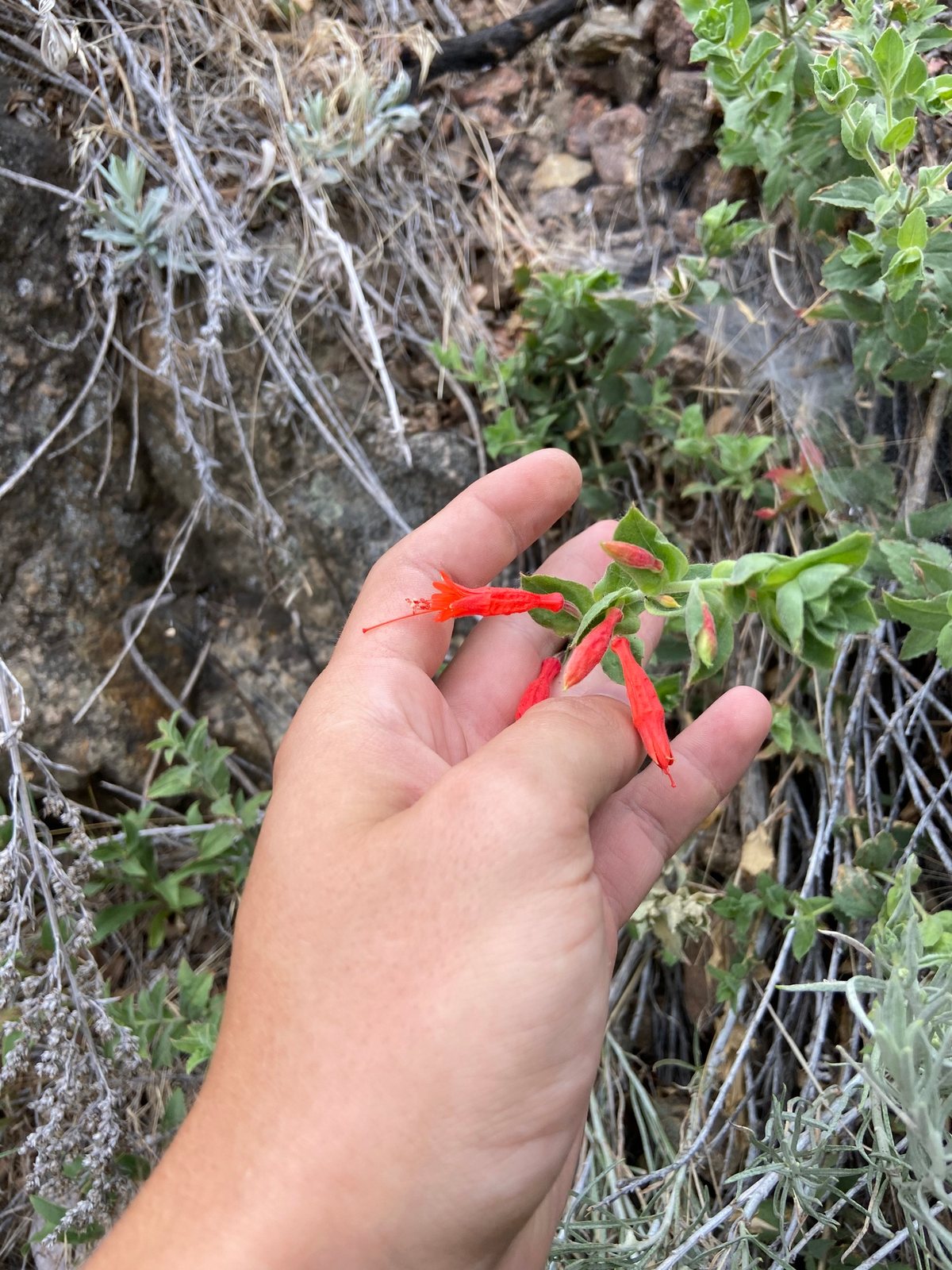
California fuchsia is a spreading, woody-based perennial native to western North America, grown for its grey-green foliage and scarlet tubular flowers in late summer and autumn. It suits sunny, dry gardens and provides valuable late-season nectar for hummingbirds where they occur; despite its common name, it is not a true fuchsia.
At a glance
- Sun
- Full sun; tolerates light afternoon shade in very hot inland gardens, but flowers less in shade.
- Water
- Low once established. Water regularly during establishment, then deeply but infrequently during prolonged dry weather; avoid persistently wet soil.
- Soil
- Well-drained sandy, gravelly or loamy soil. Tolerates poor soil, but struggles in wet clay and winter waterlogging.
- Height
- 1-3 ft (0.3-0.9 m)
- Spread
- 2-4 ft (0.6-1.2 m), potentially wider through underground stems
- Flowers
- Late summer through autumn; usually scarlet to orange-red tubular flowers.
- Foliage
- Small, narrow, grey-green to silvery leaves, often softly hairy. Usually loses its leaves in cold winters; may remain partly evergreen in mild climates.
- Growth
- Moderate to fast once established
- Care needed
- Low
The year at a glance
- Pollinators
- Deer resistant
- Drought tolerant
- Heat tolerant
- Wildlife
- Low allergen
| J | F | M | A | M | J | J | A | S | O | N | D | |
|---|---|---|---|---|---|---|---|---|---|---|---|---|
| Flowers | ||||||||||||
| Plant |
Northern hemisphere months. In Australia, shift them by six.
- Difficulty
- Moderate
- Toughness
- Fairly tough
Will it suit your garden?
Pick your zone, country, light and whether you have pets.
Full sun is 6 or more hours of direct sun a day, part shade 3 to 6 hours, shade under 3.
How it grows
Planting day
1 ft (0.3 m)
After 1 year
1.4 ft (0.42 m)
After 2 years
1.8 ft (0.55 m)
After 3 years
2 ft (0.6 m)
full size
About 2 years to full size.
From a typical nursery size, at an average rate for this kind of plant. A rule of thumb, not a forecast.
Good to know
- Cats and dogs
- Safe
- Native to
- the US
- In the garden
- Spreads vigorously: plan to contain it.
- Growth rate
- Fast
Care
Jobs through the year
- WaterApr–May, Oct, every 21 days
- Water established plants only when dry; newly planted clumps need more frequent checks.
- WaterJun–Sep, every 21 days
- During prolonged drought, soak deeply and let soil dry between waterings.
- PruneMar–Apr
- Cut old stems to 5–10 cm before strong new growth; leave stems standing through winter.
- PruneAug–Sep
- Dig out encroaching shoots with their underground stems to contain spread.
- ProtectJan–Mar, Oct–Dec
- Not reliably hardy in zones 6–7; overwinter a backup plant frost-free and keep outdoor crowns dry.
- Water new plants deeply whenever the root zone begins to dry during their first growing season.
- Once established, allow the soil to dry between waterings; occasional deep summer watering can extend flowering.
- Avoid routine feeding, especially high-nitrogen fertiliser, which encourages loose growth.
- Use a thin gravel mulch where useful, keeping the crown clear of damp organic mulch.
- Lift unwanted shoots with their underground stems to keep the clump within bounds.
Pruning. Cut old stems back to about 2-4 in (5-10 cm) in late winter or early spring, before strong new growth starts. In colder gardens, leave the old stems standing through winter and remove any frost-damaged growth in spring.
Through the year
- Late winter
- In mild areas, cut back old stems before new growth begins.
- Spring
- Plant after severe frost risk has passed, choosing full sun and freely draining soil.
- Late spring
- Take softwood cuttings from healthy, non-flowering shoots.
- Summer
- Water young plants as needed; give established plants an occasional deep soak during prolonged drought.
- Late summer
- Remove shoots spreading into neighbouring plants and enjoy the start of flowering.
- Autumn
- Keep fallen leaves from collecting over the crown and check that winter rain can drain away.
In the garden
- Plant along sunny gravel paths, allowing the flowering stems to soften the edges.
- Let it spill over a low retaining wall where its tubular flowers can be seen clearly.
- Combine with silver-leaved shrubs and drought-tolerant grasses for a dry border with late-season colour.
- Use in a California native planting to provide autumn nectar after many spring-flowering plants have finished.
Garden styles it suits: California native, Mediterranean, Desert / xeriscape, Dry gravel garden, Wildlife garden and Hot border.
Plant it with: California buckwheat, Cleveland sage, Deer grass, Yarrow, Lavender and Rockrose.
Wildlife: The flowers are especially attractive to hummingbirds in North America. Bees also visit, sometimes reaching nectar through holes near the flower bases.
Problems to watch for
- Root and crown rot in wet soil: improve drainage, reduce watering and move plants out of winter-wet sites.
- Sparse flowering or floppy stems: provide more sun, stop nitrogen feeding and reduce excessive watering.
- Unwanted spreading by underground stems: lift out encroaching shoots with their roots, or give the plant a contained planting area.
- Frost damage: leave old stems through winter, then cut back to healthy growth in spring; protect young plants during unusually severe cold.
Safety
Not known to be toxic to people, cats, dogs or horses. Species-specific safety information is limited, so do not treat it as edible or encourage pets or livestock to eat it.
Where it spreads. Can spread assertively by underground stems in California gardens and other mild, dry-summer regions, particularly with irrigation. This is usually a garden-containment issue rather than an invasive-species listing.
Easily confused with
Hardy fuchsia (Fuchsia magellanica)
A woody shrub with hanging flowers that usually have red sepals and a contrasting purple inner skirt; California fuchsia has narrow trumpet-shaped flowers and often grey, hairy foliage.
Fireweed (Chamaenerion angustifolium)
Usually much taller, with upright spikes of open, four-petalled pink-purple flowers rather than narrow scarlet tubes.
The name
The species name canum means grey or hoary, referring to the hairy foliage, while California fuchsia describes its familiar range and superficial resemblance to true fuchsias.
Propagation. Take softwood cuttings in late spring or early summer, or divide rooted shoots in spring. Seed can also be sown, but seedlings may differ from the parent; use cuttings or division to preserve a named cultivar.
Checked against open data
- Accepted botanical name
- Epilobium canum
- In the US and Canada
- Native in the lower 48 states.
- Native range
- Arizona, California, Idaho, Mexico Northeast, Mexico Northwest, Nevada, New Mexico, Oregon, Utah and Wyoming.
Sources: GBIF (CC BY 4.0), USDA PLANTS and Trefle (CC BY 4.0). The care and design notes are LandscapeGPT's own.
See it in your own yard.
Upload a photo of your yard and see it redesigned with plants that suit your climate, each checked against your zone.