Croton
Codiaeum variegatum. Family Euphorbiaceae. Shrub.
Also called Garden croton, Variegated croton, Joseph's coat.
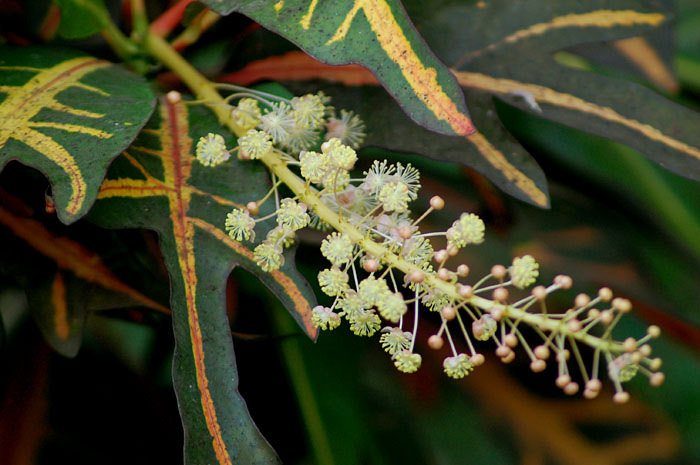
Croton (Codiaeum variegatum) is a tropical evergreen shrub grown for its leathery leaves patterned in yellow, orange, red, pink and green. It makes a colourful hedge or foliage accent in frost-free gardens; in most of the United States, the United Kingdom and Canada, grow it indoors or move a container outdoors for summer.

At a glance
- Sun
- Bright filtered light to partial sun; established plants can tolerate full sun in humid tropical climates. Introduce stronger sun gradually and provide afternoon shade in hot, dry areas.
- Water
- Keep evenly moist during active growth, allowing the surface to dry slightly between waterings. Water less in winter, but do not let the root ball dry completely or stand in water.
- Soil
- Fertile, well-drained soil with added organic matter; use a free-draining houseplant potting mix in containers.
- Height
- 6-10 ft (1.8-3 m) outdoors; usually 2-4 ft (0.6-1.2 m) indoors
- Spread
- 3-6 ft (0.9-1.8 m) outdoors
- Foliage
- Glossy, leathery evergreen leaves with contrasting veins, spots or patches. Leaf shapes range from broad and oval to narrow, lobed or twisted, depending on the cultivar.
- Growth
- Moderate in warm, humid conditions; slow indoors or in cool weather.
- Care needed
- Medium
The year at a glance
- Heat tolerant
- Low allergen
| J | F | M | A | M | J | J | A | S | O | N | D | |
|---|---|---|---|---|---|---|---|---|---|---|---|---|
| Plant |
Northern hemisphere months. In Australia, shift them by six.
- Difficulty
- Moderate
- Toughness
- Needs looking after
Will it suit your garden?
Pick your zone, country, light and whether you have pets.
Full sun is 6 or more hours of direct sun a day, part shade 3 to 6 hours, shade under 3.
How it grows
Planting day
1.6 ft (0.5 m)
After 1 year
2.6 ft (0.79 m)
After 2 years
4 ft (1.1 m)
After 3 years
5 ft (1.4 m)
After 5 years
6 ft (2 m)
About 7 years to full size.
From a typical nursery size, at an average rate for this kind of plant. A rule of thumb, not a forecast.
Good to know
- Cats and dogs
- Toxic
- Native to
- Australia
- Growth rate
- Slow
Care
Jobs through the year
- WaterMar–May, Sep–Oct, every 7 days
- Water when the surface begins to dry; in zones 6–7 keep in a movable, freely draining container.
- WaterJun–Aug, every 3 days
- Check container moisture and water thoroughly if the surface is drying; empty saucers.
- WaterJan–Feb, Nov–Dec, every 10 days
- Check indoor plants and water only as the surface dries; never let the root ball dry completely.
- FeedApr–Aug, every 30 days
- Apply balanced liquid fertilizer at half strength during active growth.
- PruneApr–Jun
- Shorten leggy stems above a leaf node; wear gloves and eye protection against irritating sap.
- ProtectJan–May, Sep–Dec
- Keep indoors whenever nights fall below 15°C; avoid draughts and acclimatize gradually to outdoor light.
- Water thoroughly when the soil surface begins to dry, then empty saucers and cachepots.
- Feed container plants with a balanced liquid fertiliser at half the label strength monthly in spring and summer.
- Keep indoor plants away from cold draughts, heaters and sudden changes in temperature or light.
- Move summer containers indoors before nights regularly fall below 15°C (59°F), checking for pests first.
- Mulch outdoor plants to conserve moisture, keeping mulch away from the stems.
Pruning. Prune in spring or early summer once active growth begins, cutting long stems just above a leaf node to encourage branching. Wear gloves and protect your eyes from the irritating milky sap.
Through the year
- Spring
- Repot only if roots fill the container, using a pot one size larger with drainage holes.
- Spring
- Shorten leggy stems and begin feeding when new growth appears.
- Late spring
- In cool climates, move plants outside only after nights stay above 15°C (59°F); start in sheltered shade.
- Summer
- Check soil moisture frequently and inspect leaf undersides for mites and other sap-feeding pests.
- Early autumn
- Bring summer containers indoors before cool nights arrive and reduce feeding as growth slows.
- Winter
- Provide the brightest suitable indoor position, maintain warmth and reduce watering without letting roots dry out.
In the garden
- Use as a bold container focal point beside a sheltered entrance or on a warm patio.
- Plant in groups beneath open-canopied tropical trees, where filtered light shows the leaf colours without harsh afternoon exposure.
- Combine with green-leaved palms, philodendrons and ferns to make the patterned foliage stand out.
- Use as an informal low hedge or mixed shrub border in frost-free gardens.
Garden styles it suits: Modern tropical, Tropical, Luxury resort, Modern courtyard, Caribbean and Balinese.
Plant it with: Cordyline, Philodendron, Bromeliads, Peace lily, Bird's nest fern and Areca palm.
Wildlife: Small flowers may attract insects in tropical gardens, but croton is mainly a foliage plant and is not a dependable wildlife food plant.
Problems to watch for
- Spider mites cause fine stippling and webbing, especially indoors: rinse leaf undersides and use insecticidal soap labelled for the plant, repeating as directed.
- Mealybugs and scale weaken growth and leave sticky honeydew: isolate affected pots, remove visible pests and treat with a suitable labelled horticultural oil or insecticidal soap.
- Sudden leaf drop follows chilling, draughts, drying out or abrupt moves: restore steady warmth, light and watering; recovery may be slow.
- Root rot develops in persistently wet soil: improve drainage, empty standing water and repot into fresh mix if roots are decaying.
Safety
Toxic to people, cats and dogs if chewed or swallowed. All parts, particularly the milky sap, can cause mouth irritation, drooling, vomiting or diarrhoea; sap can also irritate skin and eyes. Effects are usually irritant rather than life-threatening, but seek medical or veterinary advice after ingestion. Horse-specific toxicity information is limited; keep clippings and plants away from horses.
Easily confused with
Copperleaf (Acalypha wilkesiana)
Its leaves are usually softer, more thinly textured and distinctly toothed, rather than the thick, glossy, mostly smooth-edged leaves of croton.
Ti plant (Cordyline fruticosa)
Long, strap-shaped leaves cluster around upright cane-like stems and have parallel veins; croton leaves have branching veins and grow along woody shoots.
Gold dust plant (Aucuba japonica)
Leaves grow in opposite pairs and have coarse teeth along their edges. Croton leaves are alternate and generally lack those teeth.
The name
The species name variegatum refers to the varied leaf colouring, while the common name croton survives from the plant's former placement in the genus Croton.
Propagation. Take leafy stem cuttings in late spring or summer and root in a moist, free-draining medium with warmth and high humidity. Air layering is useful for larger, leggy plants. Wear gloves when handling cut stems.
Checked against open data
- Accepted botanical name
- Codiaeum variegatum
- In the US and Canada
- Introduced in Pacific Basin and Puerto Rico.
- Native range
- Bismarck Archipelago, Borneo, Fiji, Jawa, Lesser Sunda Is., Maluku, New Guinea, Philippines, Queensland, Santa Cruz Is., Solomon Is. and Sulawesi.
Sources: GBIF (CC BY 4.0), USDA PLANTS and Trefle (CC BY 4.0). The care and design notes are LandscapeGPT's own.
See it in your own yard.
Upload a photo of your yard and see it redesigned with plants that suit your climate, each checked against your zone.