Drumsticks
Isopogon anemonifolius. Family Proteaceae. Shrub.
Also called Broad-leaved drumsticks, Broad-leaf drumsticks.
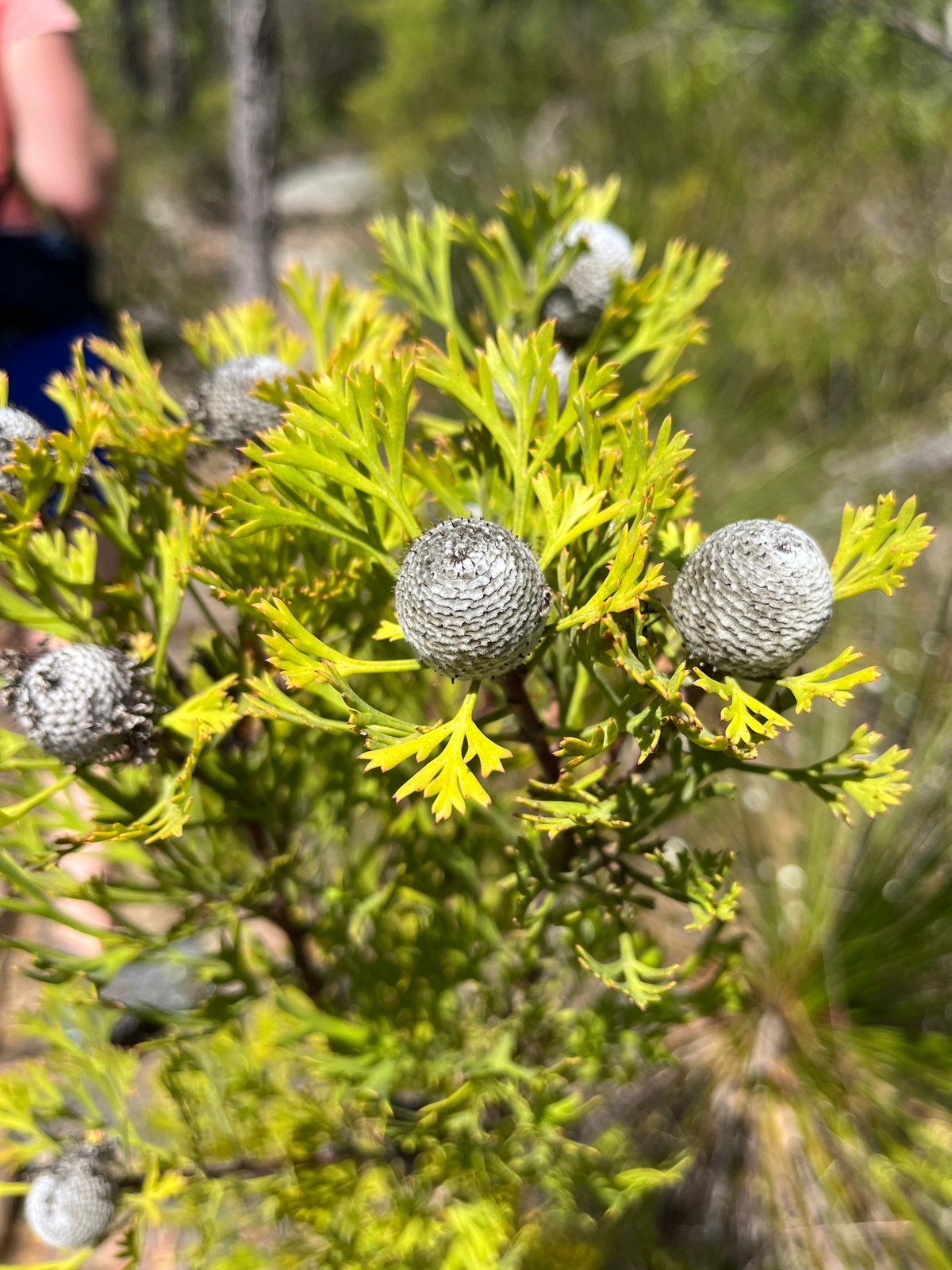
An evergreen shrub from eastern Australia, grown for its deeply divided leaves, rounded yellow flower heads and persistent woody seed heads. It suits sunny gardens with acidic, freely draining soil and mild winters; in most of Canada and colder parts of the United States and United Kingdom, grow it in a container under bright, frost-free winter cover.
At a glance
- Sun
- Full sun to light partial shade; flowering is best in sun.
- Water
- Water regularly while establishing, allowing the surface soil to dry between waterings. Established plants tolerate dry spells but benefit from occasional deep watering during prolonged drought.
- Soil
- Acidic to slightly acidic, nutrient-poor sand or sandy loam with excellent drainage. Avoid alkaline soil, heavy clay and sites that stay wet in winter.
- Height
- 3-6.5 ft (0.9-2 m)
- Spread
- 3-6.5 ft (0.9-2 m)
- Flowers
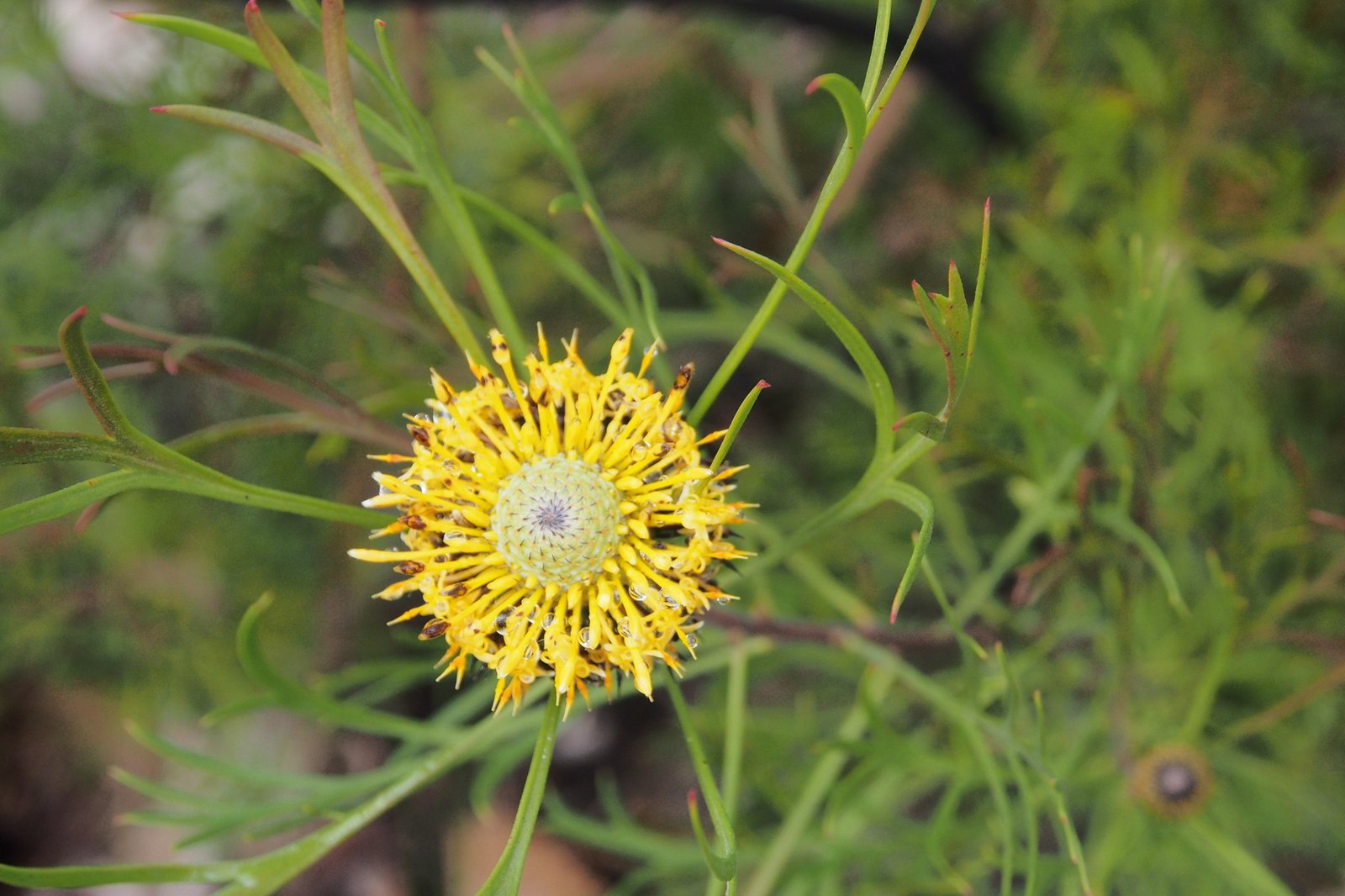
- Rounded pale to bright yellow flower heads in spring and early summer, typically September-December in Australia; timing varies with climate elsewhere.
- Foliage
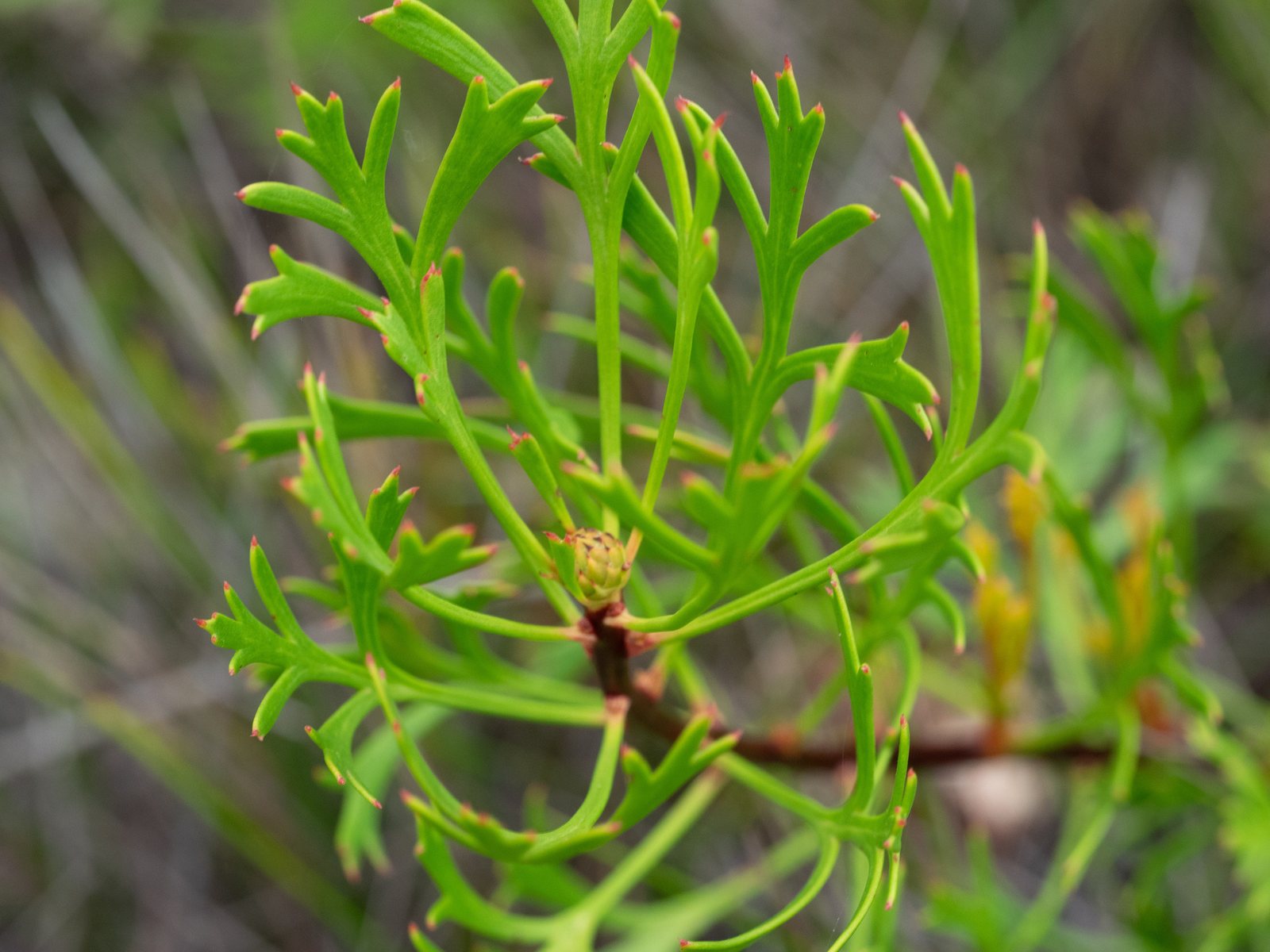
- Evergreen. Leathery green leaves deeply divided into flattened, narrow lobes, clustered along the stems.
- Growth
- Slow to moderate
- Care needed
- Medium
The year at a glance
- Pollinators
- Drought tolerant
- Heat tolerant
- Wildlife
- Low allergen
| J | F | M | A | M | J | J | A | S | O | N | D | |
|---|---|---|---|---|---|---|---|---|---|---|---|---|
| Flowers | ||||||||||||
| Fruit | ||||||||||||
| Plant |
Northern hemisphere months. In Australia, shift them by six.
- Difficulty
- Moderate
- Toughness
- Fairly tough
Will it suit your garden?
Pick your zone, country, light and whether you have pets.
Full sun is 6 or more hours of direct sun a day, part shade 3 to 6 hours, shade under 3.
How it grows
Planting day
1.6 ft (0.5 m)
After 1 year
2.1 ft (0.65 m)
After 2 years
2.6 ft (0.79 m)
After 3 years
3 ft (0.94 m)
After 5 years
4 ft (1.2 m)
About 7 years to full size.
From a typical nursery size, at an average rate for this kind of plant. A rule of thumb, not a forecast.
Good to know
- Cats and dogs
- Safe
- Native to
- Australia
- Growth rate
- Slow
Care
Jobs through the year
- WaterApr–May, Sep–Oct, every 14 days
- Water established ground plants only when dry; young plants and pots need closer checks.
- WaterJun–Aug, every 14 days
- During prolonged drought, water deeply and let the surface dry between soakings.
- WaterJan–Mar, Nov–Dec, every 21 days
- Under frost-free cover, water sparingly without letting the root ball dry completely.
- MulchApr–May
- Refresh a thin coarse mulch, keeping the stem base clear.
- FeedApr–May
- Usually leave unfed; use low-phosphorus native-plant fertilizer only for weak growth.
- PruneJun–Jul
- Tip-prune after flowering, retaining some persistent woody seed heads; avoid bare old wood.
- ProtectJan–Apr, Sep–Dec
- Overwinter in bright, frost-free shelter; use an acidic, freely draining container mix.
- Plant with the root ball level with the surrounding soil, keeping root disturbance to a minimum.
- Water deeply during the first growing season, but never leave the roots waterlogged.
- Usually leave unfed; if growth is weak, use a low-phosphorus fertiliser formulated for Australian native plants.
- Apply a thin layer of coarse mulch, keeping it clear of the stem base.
- Use a freely draining, low-phosphorus potting mix in containers and shelter pots from hard frost.
Pruning. Lightly trim shoot tips after flowering to encourage a compact shape, retaining some flower heads if you want the woody seed heads. Avoid severe cutting into old, leafless wood.
Through the year
- Spring
- Plant once the risk of damaging frost has passed, or check established plants for winter damage.
- Spring
- Refresh mulch without burying the stem base; feed only if needed with a low-phosphorus native-plant fertiliser.
- Early summer
- After flowering, lightly tip-prune to shape, leaving selected seed heads for display.
- Summer
- Check soil moisture during long dry spells and water deeply when needed, especially in containers.
- Autumn
- Clear blocked pot drainage holes and move container plants under cover before damaging frosts.
- Winter
- Keep sheltered plants in bright light and water sparingly without allowing the root ball to dry out completely.
In the garden
- Use as a specimen in an Australian native shrub border, where the divided leaves contrast with broad-leaved plants.
- Plant in an acidic gravel garden with other low-phosphorus, drought-tolerant shrubs.
- Grow in a large container on a sunny patio where winter shelter is available.
- Combine with kangaroo paws and native grasses for contrasting flower shapes and fine-textured foliage.
Garden styles it suits: Australian native, Dry gravel garden, Mediterranean, Wildlife garden, Architectural minimal and Modern courtyard.
Plant it with: Kangaroo paw, Geraldton wax, Heath banksia, Woolly grevillea and Spiny-headed mat-rush.
Wildlife: The flower heads provide pollen and nectar for visiting insects, including native bees. Dense branching can provide shelter for small birds.
Problems to watch for
- Root rot in wet soil: improve drainage before planting, avoid frequent shallow watering and discard badly affected plants.
- Phosphorus toxicity from general-purpose fertiliser: stop feeding and use only low-phosphorus products intended for sensitive Australian natives.
- Yellow leaves in alkaline soil: grow in an acidic, freely draining bed or container rather than repeatedly trying to correct unsuitable ground.
- Frost damage to shoots: choose a sheltered position and move container plants into bright, frost-free cover for winter.
Safety
Not known to be toxic to people, cats, dogs or horses, but species-specific safety information is limited. No particular part is established as poisonous; it is not an edible plant, so discourage chewing or eating it.
Easily confused with
Narrow-leaved drumsticks (Isopogon anethifolius)
Its finely divided leaf segments are slender and almost cylindrical; those of Isopogon anemonifolius are noticeably flatter and broader.
Conesticks (Petrophile pulchella)
It has much finer, needle-like divided foliage and elongated, conspicuously scaly woody cones rather than the rounded drumstick heads.
The name
Isopogon comes from Greek words meaning 'equal beard', referring to hairs on the fruits, while anemonifolius means 'anemone-leaved' and drumsticks describes the rounded heads held on stems.
Propagation. Raise from seed released from mature, dry woody heads, though germination can be slow and uneven. Semi-ripe cuttings taken in late summer are another option but may be difficult to root; use a very freely draining propagation mix.
Checked against open data
- Accepted botanical name
- Isopogon anemonifolius
- Native range
- New South Wales.
- Measured
- Average height 70 cm.
Sources: GBIF (CC BY 4.0) and Trefle (CC BY 4.0). The care and design notes are LandscapeGPT's own.
See it in your own yard.
Upload a photo of your yard and see it redesigned with plants that suit your climate, each checked against your zone.