Heath banksia
Banksia ericifolia. Family Proteaceae. Shrub.
Also called Heath-leaved banksia, Lantern banksia.
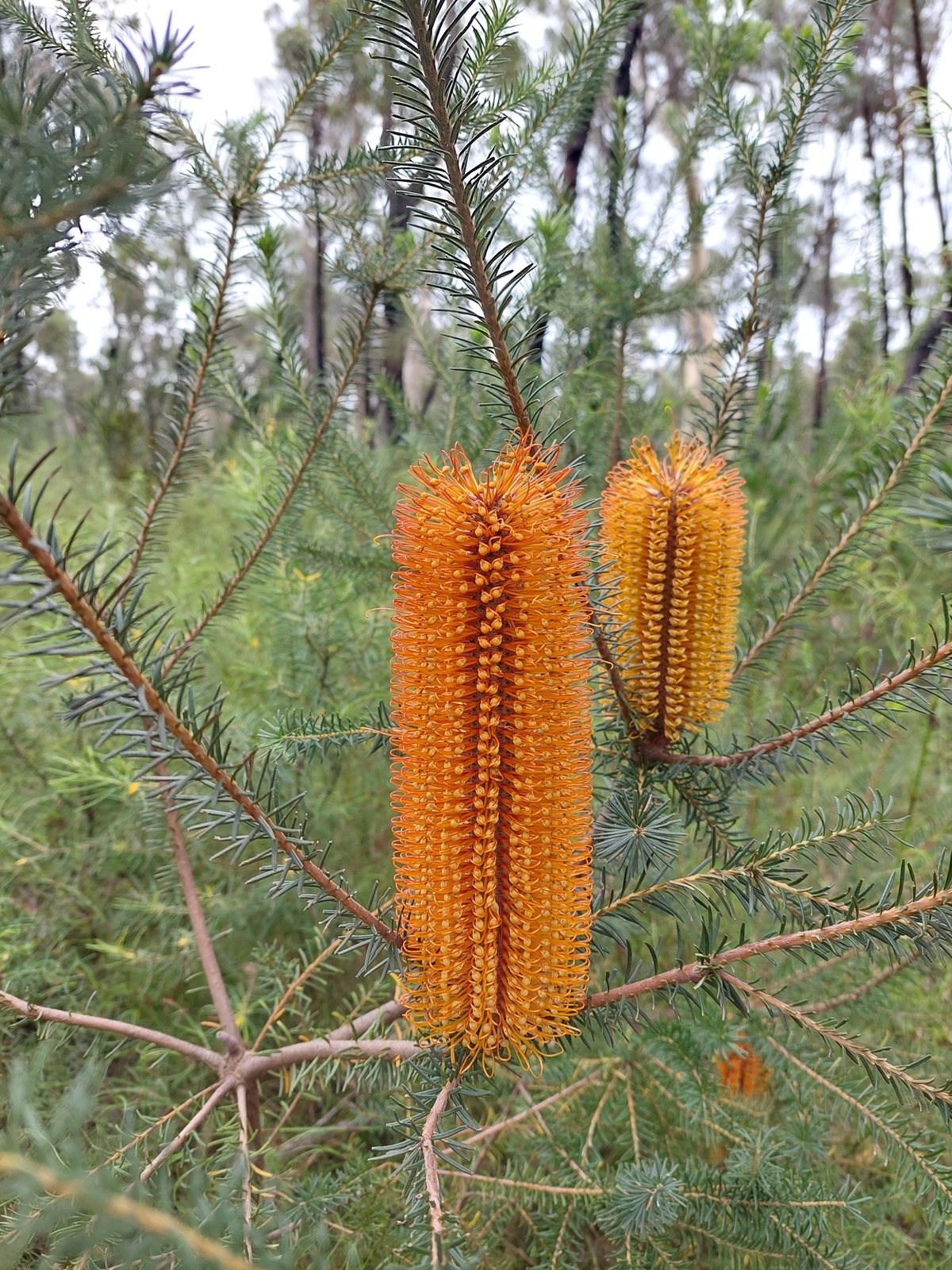
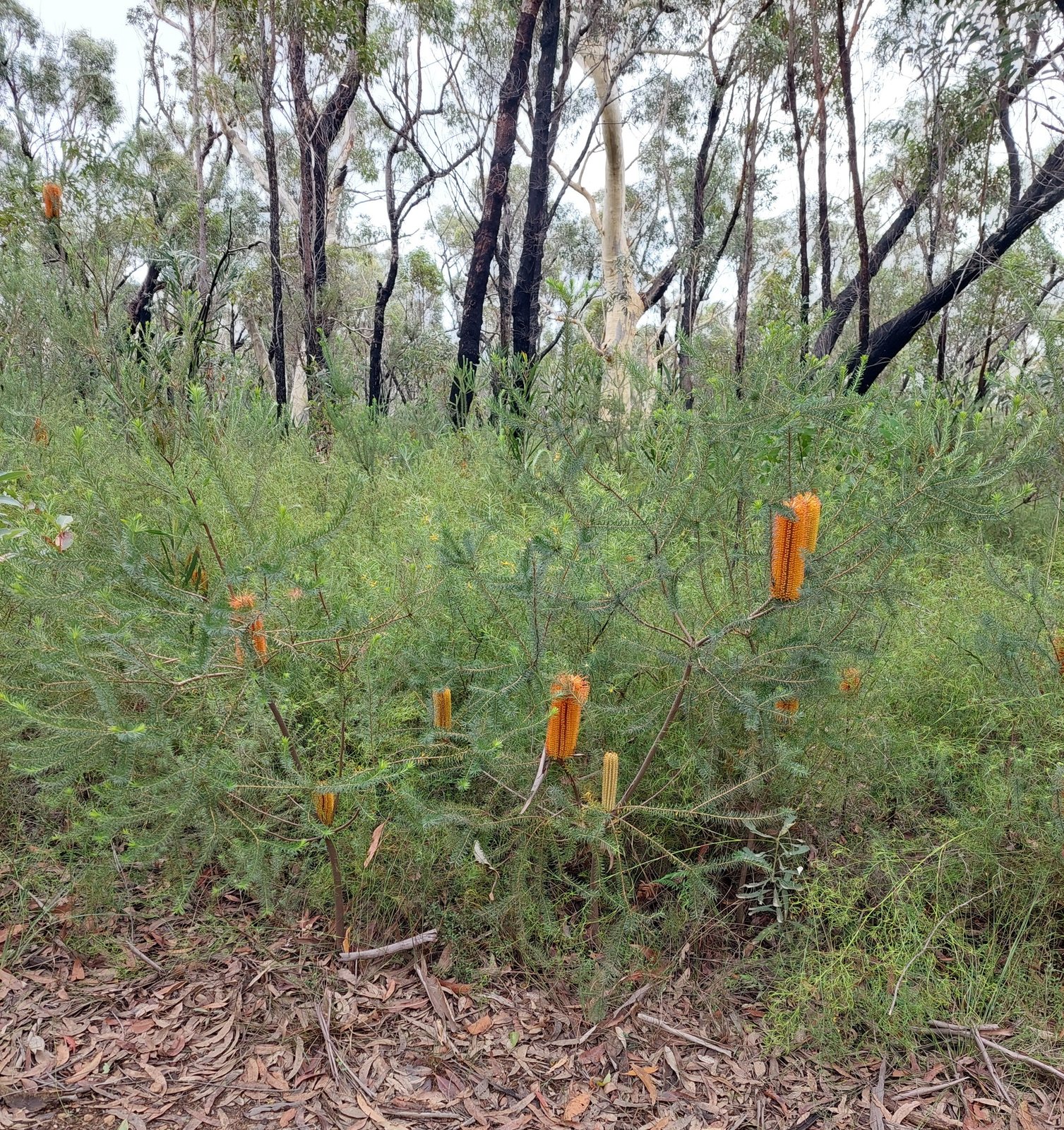
Heath banksia is a large evergreen Australian shrub with fine, heath-like foliage and orange flower spikes that attract nectar-feeding birds. It makes a substantial screen or specimen in mild gardens with acidic, freely draining soil, but dislikes hard frost, waterlogged roots and phosphorus-rich fertilisers.
At a glance
- Sun
- Full sun is best; tolerates light partial shade but flowers less heavily.
- Water
- Water regularly while establishing, then deeply during prolonged dry spells. Established plants tolerate some drought, but need more summer moisture than many dry-climate Australian shrubs.
- Soil
- Acidic, sandy or gravelly soil with excellent drainage and low phosphorus. Avoid chalk, limestone-rich soil and heavy, wet clay.
- Height
- 6-20 ft (1.8-6 m)
- Spread
- 6-13 ft (1.8-4 m)
- Flowers
- Mainly autumn through spring, with timing varying by climate; cylindrical golden-orange to deep orange spikes, often with darker red styles.
- Foliage
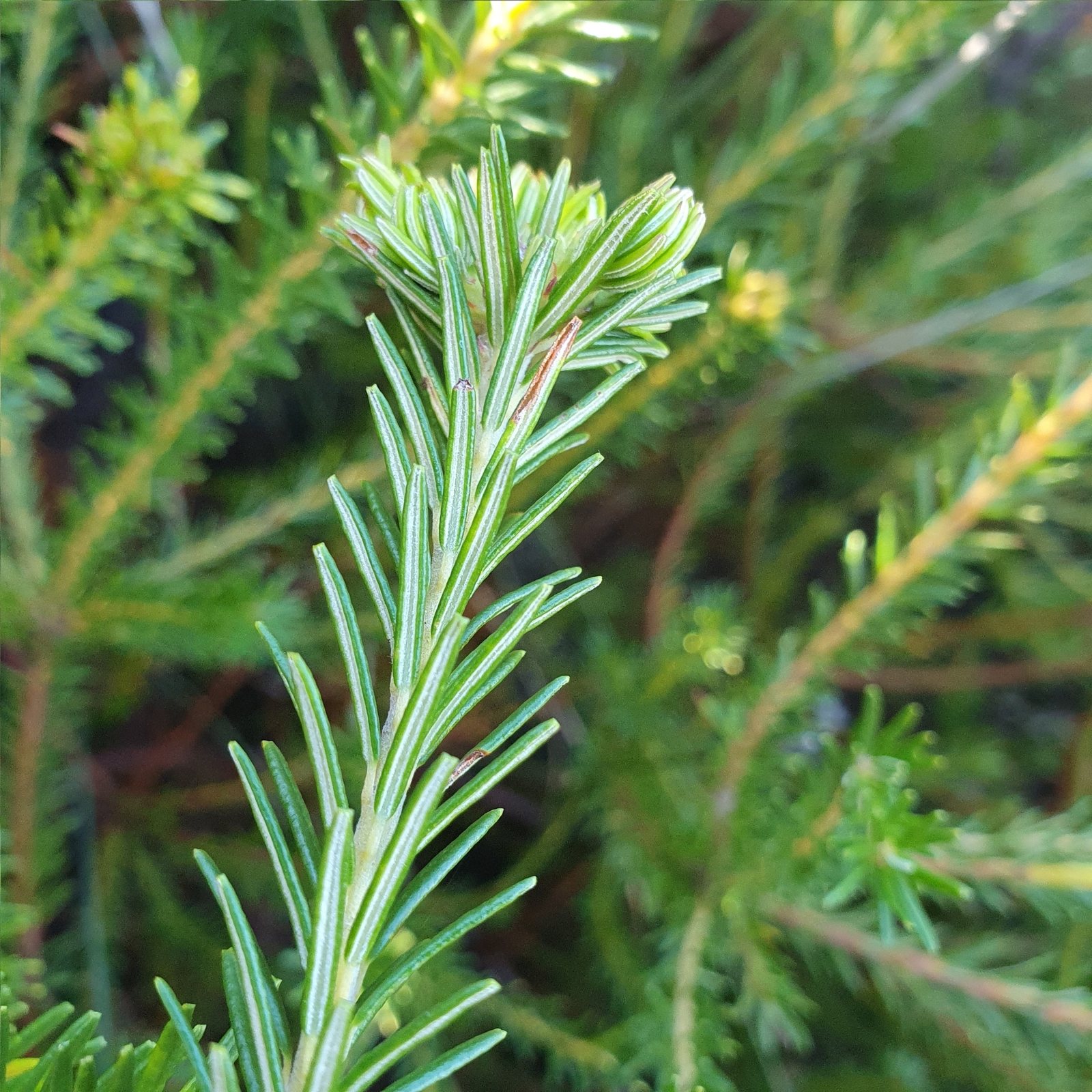
- Evergreen. Dense, narrow, dark green leaves resembling those of heaths; new growth is often paler and softly hairy.
- Growth
- Moderate; growth is faster with adequate moisture and a mild climate.
- Care needed
- Medium
The year at a glance
- Pollinators
- Drought tolerant
- Heat tolerant
- Wildlife
- Low allergen
| J | F | M | A | M | J | J | A | S | O | N | D | |
|---|---|---|---|---|---|---|---|---|---|---|---|---|
| Flowers | ||||||||||||
| Fruit | ||||||||||||
| Plant |
Northern hemisphere months. In Australia, shift them by six.
- Difficulty
- Hard
- Toughness
- Fairly tough
Will it suit your garden?
Pick your zone, country, light and whether you have pets.
Full sun is 6 or more hours of direct sun a day, part shade 3 to 6 hours, shade under 3.
How it grows
Planting day
1.6 ft (0.5 m)
After 1 year
4 ft (1.3 m)
After 2 years
7 ft (2.2 m)
After 3 years
10 ft (3.1 m)
After 5 years
13 ft (3.9 m)
full size
About 4 years to full size.
From a typical nursery size, at an average rate for this kind of plant. A rule of thumb, not a forecast.
Good to know
- Cats and dogs
- Safe
- Native to
- Australia
- Growth rate
- Fast
Care
Jobs through the year
- WaterApr–May, Sep–Oct, every 14 days
- Check established ground plants; water deeply only if dry, more often during the first two summers.
- WaterJun–Aug, every 7 days
- Water established ground plants deeply in dry weather; let the surface dry between soakings.
- FeedApr–May
- Feed only for weak growth, using a low-phosphorus fertiliser explicitly suitable for banksias.
- MulchMay
- Apply coarse bark, keeping the trunk clear and avoiding manure or rich compost.
- PruneMay–Jun
- After flowering, lightly trim leafy tips only; retain some spikes for persistent woody cones.
- ProtectJan–Apr, Oct–Dec
- Not winter-hardy in zones 6–7; grow in a movable pot and overwinter bright and frost-free.
- Water deeply through the first two summers, letting the surface soil dry between soakings.
- Use no fertiliser unless growth indicates a need; choose a low-phosphorus fertiliser formulated for Australian native plants.
- Mulch with coarse bark, keeping it clear of the trunk.
- Plant on a broad raised mound if drainage is marginal; do not leave the root ball sitting in a wet planting hole.
- Protect young plants from hard frost and cold, drying winds.
Pruning. Lightly tip-prune young plants after flowering to encourage branching, and remove damaged stems as needed. Avoid cutting hard into bare old wood, because regrowth is unreliable.
Through the year
- Spring
- Plant in frost-prone districts once hard frosts have passed, and water thoroughly.
- Spring
- Check foliage colour and growth; feed only if needed, using a low-phosphorus native-plant fertiliser.
- Summer
- Water young plants deeply during dry weather and check that mulch stays clear of the trunk.
- Early autumn
- Plant in mild, frost-free districts while the soil is warm and seasonal rain is approaching.
- After flowering
- Lightly trim leafy shoot tips if shaping is needed; retain some old flower spikes for their woody seed cones.
- Winter
- Check drainage after heavy rain and protect young plants when hard frost is forecast.
In the garden
- Use as an informal evergreen screen where its mature width can develop without repeated hard pruning.
- Place as a specimen against a plain wall or open lawn to show the orange flower spikes.
- Combine with kangaroo paws and low-growing Australian shrubs in a sunny, acidic gravel bed.
- Include in a wildlife border where nectar-feeding birds can reach the flowers and shelter in the dense foliage.
Garden styles it suits: Australian native, Wildlife garden, Coastal, Dry gravel garden, Architectural minimal and Winter interest.
Plant it with: Kangaroo paw, Geraldton wax, Woolly bush, Flannel flower and Grass tree.
Wildlife: Nectar-rich flowers feed honeyeaters in Australia and other nectar-feeding birds where these occur, as well as bees and other insects. Dense branches provide shelter for small birds.
Problems to watch for
- Phytophthora root rot can cause sudden wilting and dieback: prevent waterlogging, use clean nursery plants and avoid moving soil from affected areas; badly affected plants usually need removal.
- Phosphorus toxicity can cause yellowing, scorched leaf tips and decline: stop general-purpose feeding and avoid manure or phosphorus-rich compost around the roots.
- Yellow leaves with green veins can indicate iron deficiency in alkaline soil: check soil pH; persistent problems usually require a more suitable site or an acidic container mix.
- Hard frost can scorch foliage and kill young stems: choose a sheltered position and cover young plants during cold spells.
Safety
Not known to be toxic to people, cats, dogs or horses, although species-specific safety information is limited. No part is established as seriously poisonous; the leaves and woody cones are not food.
Where it spreads. Has escaped cultivation and become invasive in parts of South Africa, particularly the Western Cape, where it can threaten native fynbos.
Easily confused with
Hairpin banksia (Banksia spinulosa)
Its narrow leaves usually have rolled-under margins and often a few teeth near the tips; heath banksia has shorter, finer, generally untoothed leaves. Flowers alone can be difficult to distinguish.
Old man banksia (Banksia serrata)
Has much broader, strongly saw-toothed leaves, thick rough bark and usually cream-grey flower spikes rather than fine heath-like foliage and orange spikes.
The name
Banksia honours botanist Joseph Banks, while ericifolia means heath-leaved, referring to the foliage's resemblance to Erica.
Propagation. Sow seed released from mature woody cones into a freely draining, low-phosphorus seed mix, keeping it lightly moist rather than wet. Semi-ripe cuttings are possible but can be slow and unreliable; use cuttings to preserve named cultivar characteristics.
Checked against open data
- Accepted botanical name
- Banksia ericifolia
- Native range
- New South Wales.
- Measured
- Average height 98 cm.
Sources: GBIF (CC BY 4.0) and Trefle (CC BY 4.0). The care and design notes are LandscapeGPT's own.
See it in your own yard.
Upload a photo of your yard and see it redesigned with plants that suit your climate, each checked against your zone.