Firewood banksia
Banksia menziesii. Family Proteaceae. Tree.
Also called Menzies' banksia, Port wine banksia.
An evergreen small tree or large shrub from southwestern Australia, grown for its pink-red flower spikes, silvery buds and toothed leaves. It suits sunny, sandy gardens with dry summers and mild winters, but is unreliable in heavy soil, humid climates or prolonged frost. In most of the United Kingdom and Canada, it needs frost-free shelter rather than permanent outdoor planting.
At a glance
- Sun
- Full sun; allow space around the crown for good air circulation.
- Water
- Water regularly while establishing, allowing the soil to drain between waterings. Once established, water deeply only during extended dry spells; avoid frequent shallow watering.
- Soil
- Deep, freely draining sand or sandy loam, preferably slightly acidic to neutral. Avoid waterlogged ground, heavy clay and phosphorus-rich soil amendments.
- Height
- 16-33 ft (5-10 m), occasionally taller in favourable conditions
- Spread
- 10-20 ft (3-6 m)
- Flowers
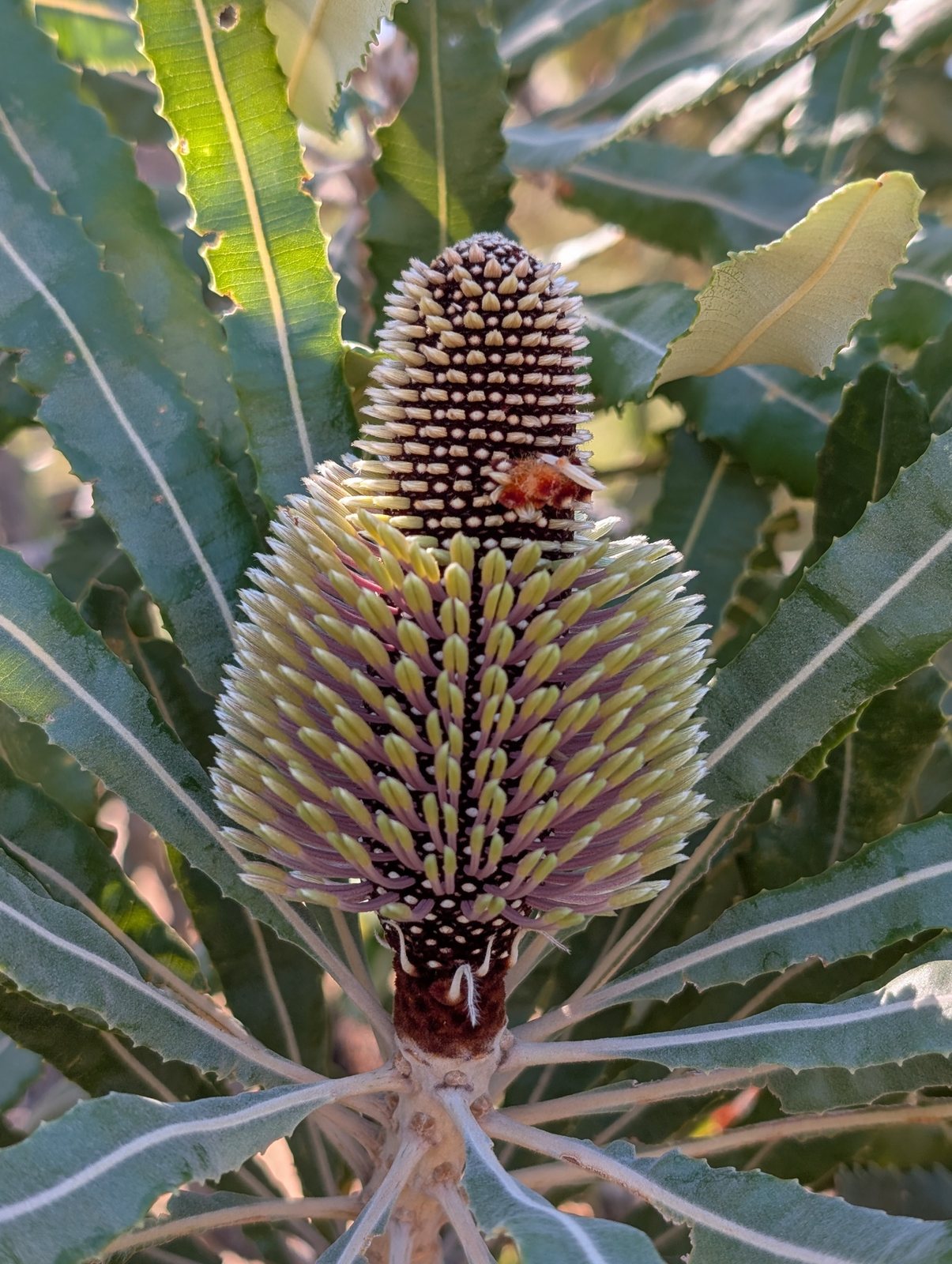
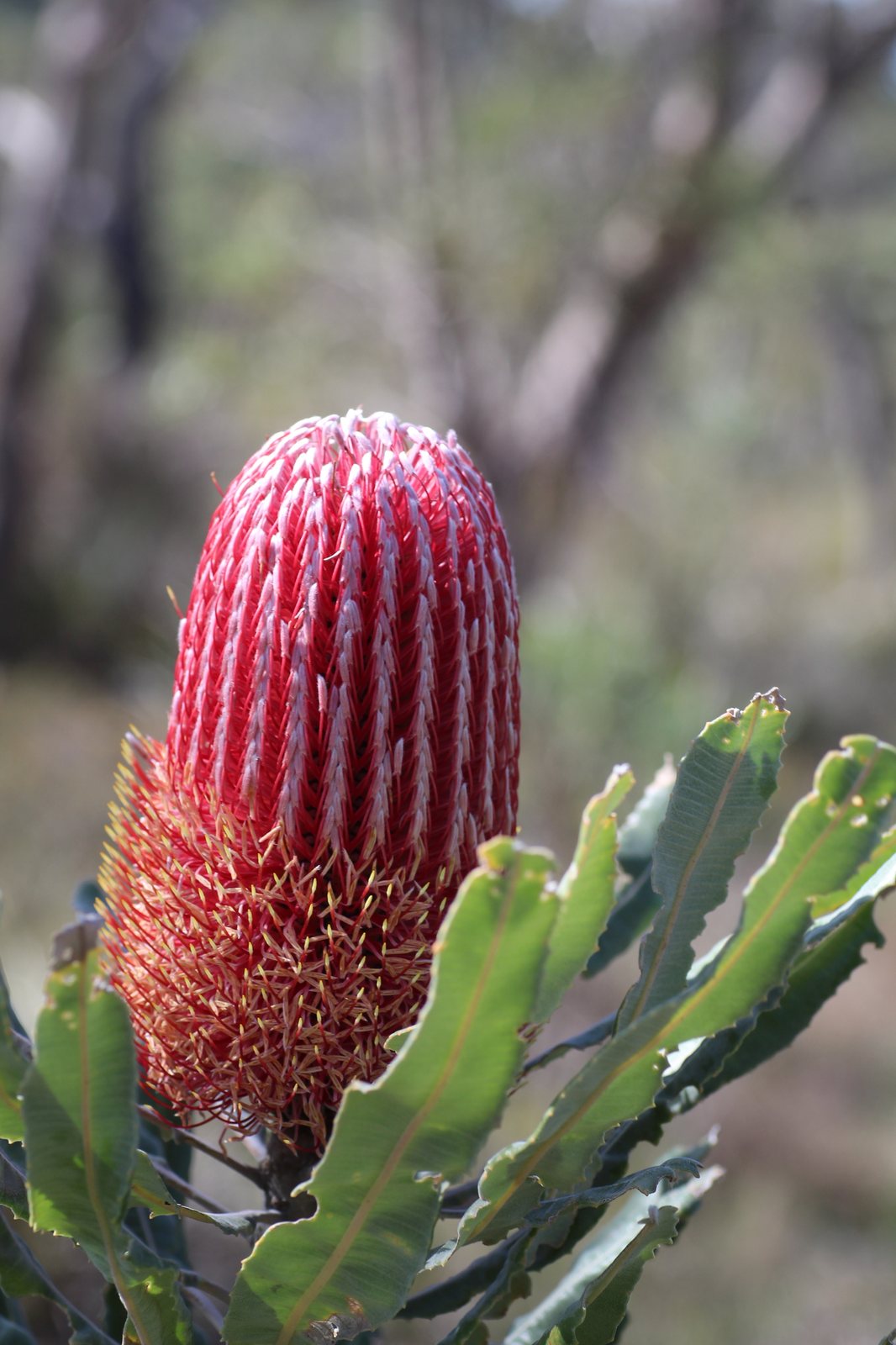
- Usually autumn to spring; in southwestern Australia, roughly February-October. Upright spikes open from silvery buds to pink or red flowers with cream or yellow tones; occasional plants have predominantly yellow flowers.
- Foliage
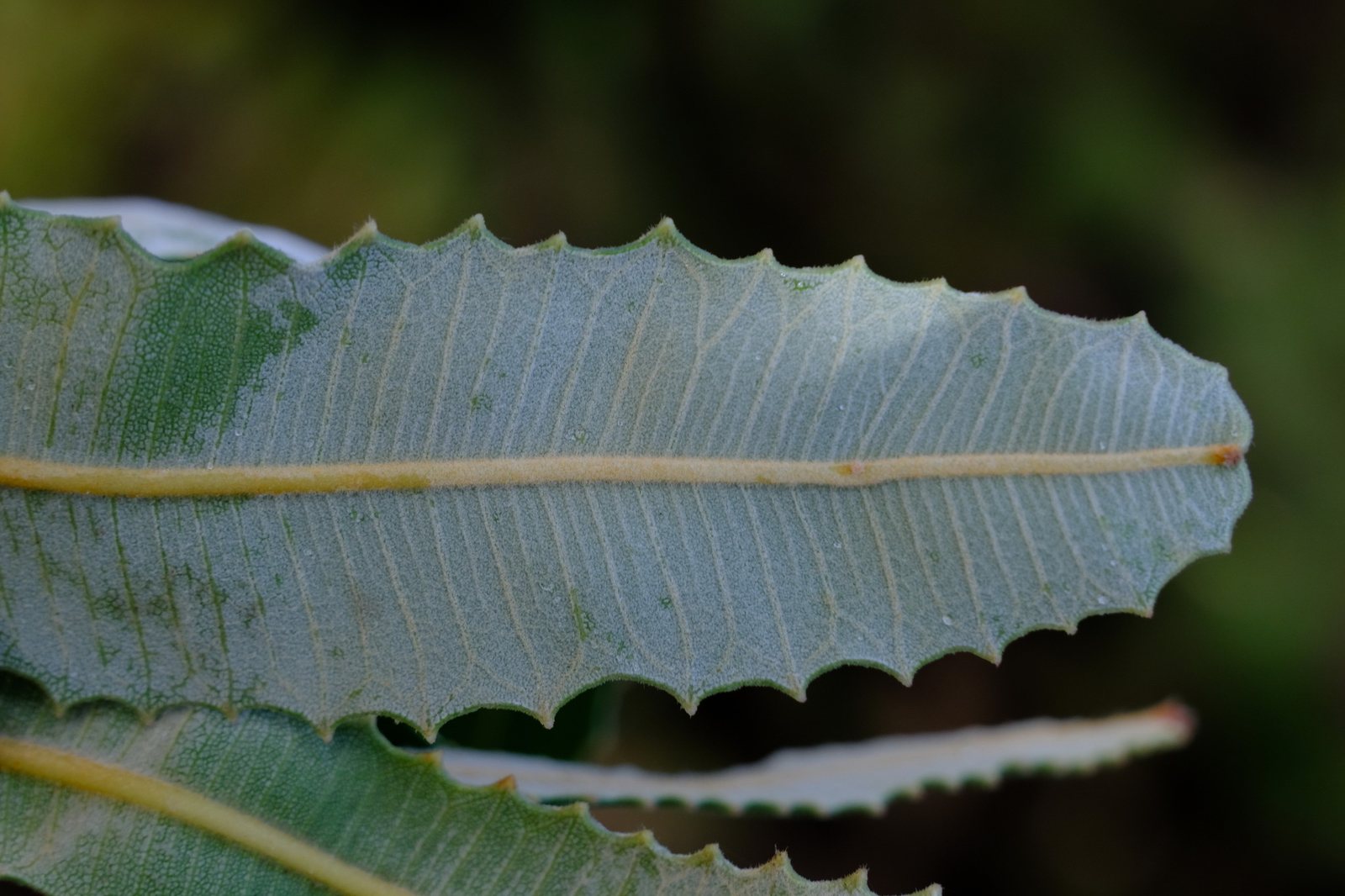
- Evergreen. Leathery, oblong leaves with conspicuous toothed edges, green above and paler beneath; new growth is often softly hairy.
- Growth
- Slow to moderate
- Care needed
- Medium
The year at a glance
- Pollinators
- Drought tolerant
- Heat tolerant
- Wildlife
- Low allergen
| J | F | M | A | M | J | J | A | S | O | N | D | |
|---|---|---|---|---|---|---|---|---|---|---|---|---|
| Flowers | ||||||||||||
| Fruit | ||||||||||||
| Plant |
Northern hemisphere months. In Australia, shift them by six.
- Difficulty
- Hard
- Toughness
- Needs looking after
Will it suit your garden?
Pick your zone, country, light and whether you have pets.
Full sun is 6 or more hours of direct sun a day, part shade 3 to 6 hours, shade under 3.
How it grows
Planting day
7 ft (2 m)
After 1 year
7 ft (2.2 m)
After 2 years
8 ft (2.4 m)
After 3 years
9 ft (2.6 m)
After 5 years
10 ft (3.1 m)
About 26 years to full size.
From a typical nursery size, at an average rate for this kind of plant. A rule of thumb, not a forecast.
Good to know
- Cats and dogs
- Safe
- Native to
- Australia
- Growth rate
- Slow
Care
Jobs through the year
- WaterApr–May, Sep–Oct, every 21 days
- For established ground-grown trees in suitable mild climates, water only if dry; young trees need more.
- WaterJun–Aug, every 14 days
- Deep-water established trees only in prolonged drought; check container moisture much more often.
- WaterJan–Mar, Nov–Dec, every 14 days
- For frost-free container culture, check moisture and water only as the mix dries; never leave standing in water.
- MulchJun
- Apply thin coarse mulch clear of the trunk; avoid manure and phosphorus-rich products.
- PruneMay
- After flowering, lightly shorten selected leafy shoots if needed; retain some woody seed cones.
- ProtectJan–Apr, Oct–Dec
- Cannot overwinter outdoors in zones 6–7; provide a bright frost-free greenhouse and excellent drainage.
- Plant in well-drained ground during mild weather; leave the root ball undisturbed as far as possible.
- Water deeply through the first two dry seasons, then reduce watering as roots establish.
- Do not use ordinary high-phosphorus fertilisers, manure or rich planting compost; use a low-phosphorus native-plant feed only if needed.
- Apply a thin layer of coarse mulch, keeping it clear of the trunk.
- Keep digging, paving and repeated foot traffic away from the root zone.
Pruning. After flowering, shorten selected leafy shoots lightly to encourage branching, leaving healthy foliage below each cut. Remove dead or damaged branches, but avoid routine hard pruning of mature trees.
Through the year
- Autumn
- In mild, winter-rainfall climates, plant once the soil is moist but not saturated.
- Winter
- Check drainage after heavy rain and protect young plants from frost.
- Spring
- In frost-prone areas, plant only after frost risk has passed; check new growth for yellowing or dieback.
- After flowering
- Lightly shape young plants if necessary; retain some old flower spikes for their woody seed cones.
- Early summer
- Renew coarse mulch without covering the trunk base.
- Summer
- Deep-water young plants during dry weather; water established trees only during prolonged drought.
In the garden
- Use as a specimen tree in a sunny, sandy garden, allowing room for its broad mature crown.
- Combine with kangaroo paws and grass trees for a layered Australian native planting.
- Place against a plain wall or open sky where the flower spikes and toothed foliage are easy to see.
- Include in a dry-climate wildlife garden, away from lawns that need frequent irrigation.
Garden styles it suits: Australian native, Wildlife garden, Mediterranean, Desert / xeriscape, Dry gravel garden and Architectural minimal.
Plant it with: Kangaroo paw, Geraldton wax, Woolly bush, Grass tree and Coastal rosemary.
Wildlife: Nectar attracts honeyeaters and other nectar-feeding birds in Australia, as well as insects. Cockatoos may open woody cones for seed, and a mature crown provides shelter for birds.
Problems to watch for
- Phytophthora root rot: decline and branch death are favoured by wet or contaminated soil. Prevent with excellent drainage, clean planting stock and careful watering; badly affected plants usually cannot be saved.
- Phosphorus toxicity: leaf-tip scorch and declining growth can follow unsuitable feeding. Stop phosphorus-rich fertilisers and manure, and seek soil testing before adding further nutrients.
- Iron chlorosis: young leaves may yellow in alkaline soil. Check soil pH and drainage; use an appropriate iron chelate if deficiency is confirmed.
- Frost damage: young shoots can blacken after freezing weather. Protect young plants and wait until spring growth begins before cutting back damaged wood.
Safety
Not known to be toxic to people, cats, dogs or horses. Species-specific information on ingestion is limited, so do not treat the leaves, flowers or seeds as food.
Easily confused with
Acorn banksia (Banksia prionotes)
Its flower spikes open cream and turn orange, often producing a sharply two-coloured, acorn-like appearance; its leaves are generally longer and narrower.
Baxter's banksia (Banksia baxteri)
It has broad leaves with much deeper triangular lobes and rounded greenish-yellow flower heads rather than the typical pink-red spikes.
Bull banksia (Banksia grandis)
It has much larger, deeply divided leaves and long yellow flower spikes, rather than shallowly toothed leaves and pink-red flowers.
The name
Banksia honours botanist Joseph Banks, menziesii honours naturalist Archibald Menzies, and the common name refers to the tree's historical use as firewood.
Propagation. Usually grown from seed released from mature woody cones. Sow in a clean, freely draining, low-phosphorus seed mix; smoke treatment is not normally necessary. Cuttings are possible but generally more difficult.
Checked against open data
- Accepted botanical name
- Banksia menziesii
- Native range
- Western Australia.
- Measured
- Average height 400 cm.
Sources: GBIF (CC BY 4.0) and Trefle (CC BY 4.0). The care and design notes are LandscapeGPT's own.
See it in your own yard.
Upload a photo of your yard and see it redesigned with plants that suit your climate, each checked against your zone.