Flame acanthus
Anisacanthus quadrifidus. Family Acanthaceae. Shrub.
Also called Hummingbird bush, Texas firecracker, Wright's desert honeysuckle.
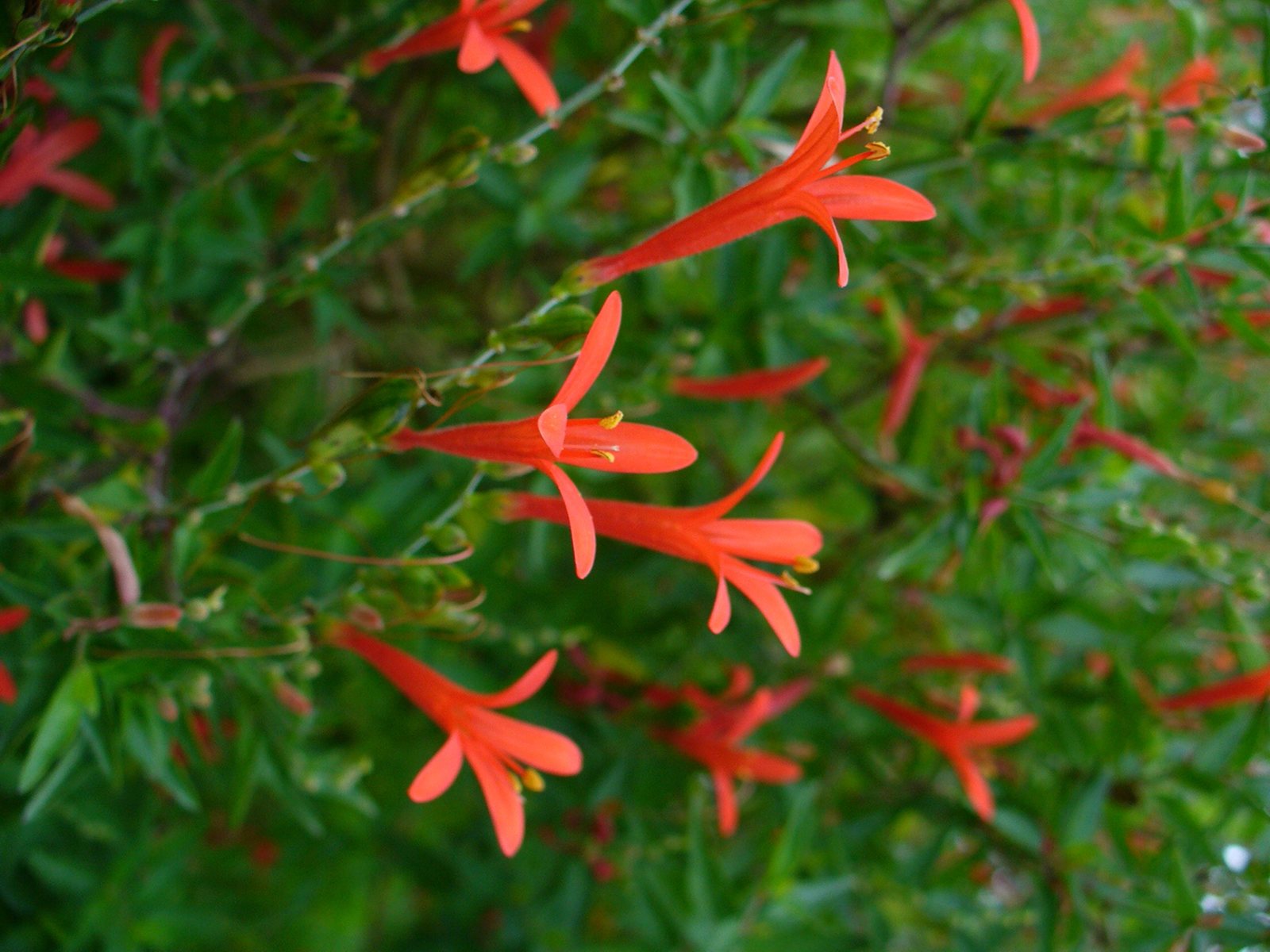
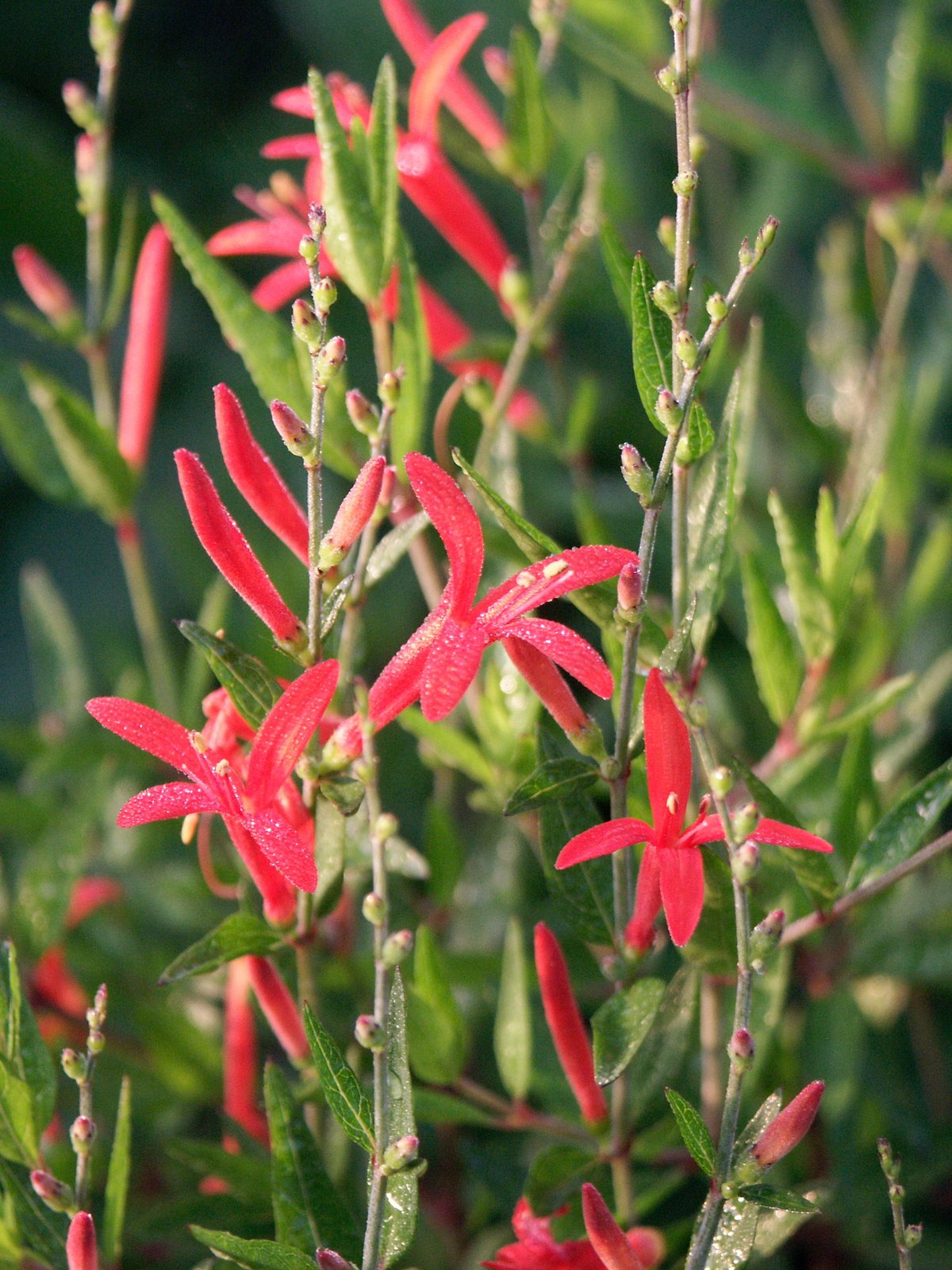
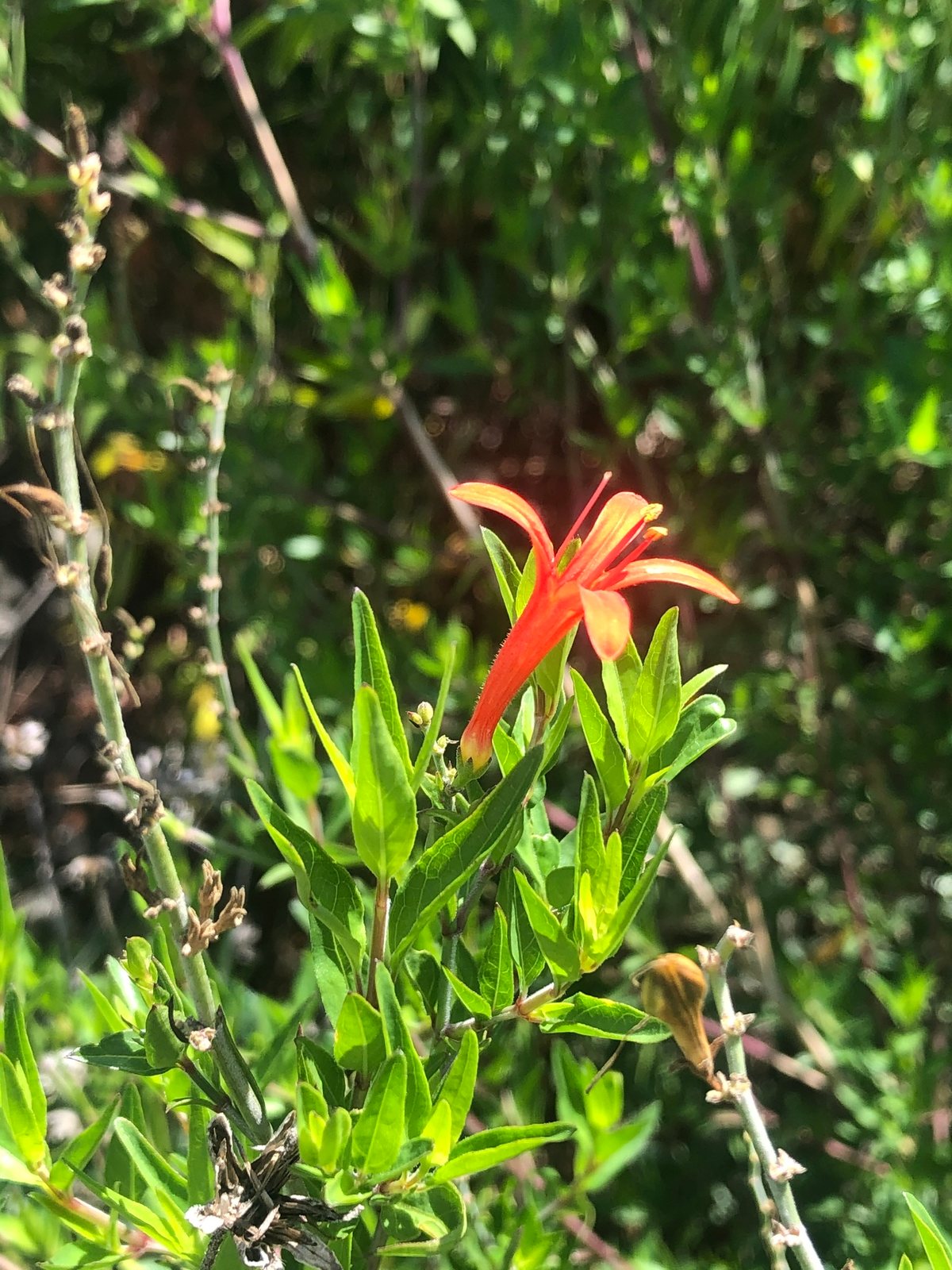
Flame acanthus is a loose, branching shrub grown for its narrow orange-red flowers, long summer display and tolerance of heat and drought. Native to Texas and Mexico, it attracts hummingbirds where they occur; the form most often sold for gardens is Anisacanthus quadrifidus var. wrightii. It loses its leaves in winter and may die back to the roots in colder parts of its range.
At a glance
- Sun
- Full sun for the strongest flowering; tolerates light partial shade.
- Water
- Low once established; water regularly during establishment, then deeply during prolonged dry spells.
- Soil
- Well-drained sandy, gravelly or loamy soil; tolerates limestone and clay provided water does not linger around the roots.
- Height
- 3-5 ft (0.9-1.5 m)
- Spread
- 3-4 ft (0.9-1.2 m)
- Flowers
- Summer through autumn, often until frost; narrow tubular flowers in orange to orange-red.
- Foliage
- Small, opposite, narrow green leaves on slender, twiggy stems; deciduous, sometimes dropping leaves during severe drought.
- Growth
- Moderate to fast in warm weather.
- Care needed
- Low
The year at a glance
- Pollinators
- Deer resistant
- Drought tolerant
- Heat tolerant
- Low allergen
| J | F | M | A | M | J | J | A | S | O | N | D | |
|---|---|---|---|---|---|---|---|---|---|---|---|---|
| Flowers | ||||||||||||
| Plant |
Northern hemisphere months. In Australia, shift them by six.
- Difficulty
- Moderate
- Toughness
- Fairly tough
Will it suit your garden?
Pick your zone, country, light and whether you have pets.
Full sun is 6 or more hours of direct sun a day, part shade 3 to 6 hours, shade under 3.
How it grows
Planting day
1.6 ft (0.5 m)
After 1 year
2.2 ft (0.68 m)
After 2 years
2.8 ft (0.85 m)
After 3 years
3 ft (1 m)
After 5 years
4 ft (1.2 m)
full size
About 4 years to full size.
From a typical nursery size, at an average rate for this kind of plant. A rule of thumb, not a forecast.
Good to know
- Cats and dogs
- Safe
- Native to
- the US
- Growth rate
- Fast
Care
Jobs through the year
- WaterMay, Sep, every 28 days
- Water established plants deeply only during prolonged drought; water new plants more often.
- WaterJun–Aug, every 21 days
- During prolonged dry spells, soak established roots to support flowering; skip if soil remains moist.
- PruneMar–Apr
- Remove dead wood before growth starts; cut frost-killed stems back to healthy basal growth.
- MulchMay
- Apply a light root-zone mulch, keeping the woody base clear.
- ProtectJan–Mar, Nov–Dec
- Protect the root zone from severe frost and winter wet; zone 6 gardens need a sheltered site or container overwintering.
- Plant after hard frosts have passed, allowing room for its spreading branches.
- Water deeply through the first growing season, letting the soil dry somewhat between waterings.
- Once established, give occasional deep water during extended drought to support flowering.
- Avoid rich feeding; most garden soils need no additional fertiliser.
- Apply a light mulch over the root zone, keeping it clear of the woody base.
Pruning. In late winter or early spring, remove dead wood and shorten live stems to maintain a compact framework. Where frost kills the top growth, cut dead stems close to the ground before new shoots develop; flowering occurs on new growth.
Through the year
- Late winter
- Inspect for winter damage and prune before new growth begins.
- Spring
- Plant after hard frosts and water new plants thoroughly.
- Late spring
- Check for shoots from the base before assuming a frost-damaged plant has died.
- Summer
- Water established plants deeply during prolonged dry weather rather than giving frequent light sprinklings.
- Autumn
- Remove unwanted seedlings and avoid heavy pruning before winter.
- Winter
- Keep the root zone free of standing water, especially near the colder limit of its range.
In the garden
- Plant in a sunny mixed border with ornamental grasses and salvias for a long season of warm colour.
- Use in gravel gardens with yuccas and other dryland plants, where its loose branches soften rigid forms.
- Group along a sunny fence or informal boundary as a low, flowering screen.
- Place near a seating area or window to watch hummingbirds in the Americas and visiting insects elsewhere.
Garden styles it suits: Desert / xeriscape, Southwestern, Texas Hill Country, Wildlife garden, Dry gravel garden and Hot border.
Plant it with: Autumn sage, Red yucca, Lindheimer's muhly, Blackfoot daisy, Purple coneflower and Butterfly weed.
Wildlife: Tubular flowers are especially attractive to hummingbirds in their range and are also visited by butterflies and other insects. Deer often leave it alone, though browsing is still possible.
Problems to watch for
- Root rot or winter loss in wet soil: improve drainage or move the plant to a raised, freely draining position.
- Winter dieback: leave the roots undisturbed and wait for warm-weather regrowth before removing the plant.
- Sparse flowering and floppy growth in shade: move to a sunnier position and avoid high-nitrogen feeding.
- Unwanted seedlings: pull them while small or remove developing seed capsules before they split.
Safety
Not known to be toxic to people, cats, dogs or horses, but species-specific safety information is limited. No particular plant part is established as poisonous; it is not an edible plant, so discourage ingestion.
Easily confused with
Chuparosa (Justicia californica)
Chuparosa has conspicuously green stems, generally broader leaves and red tubular flowers with a more obvious lower lip; it often flowers on nearly leafless branches.
Thurber's desert honeysuckle (Anisacanthus thurberi)
A close relative with generally longer, broader leaves and more muted orange to reddish flowers. Flowers overlap in appearance, so use a reliable nursery label or regional botanical key for a firm identification.
The name
The common name flame acanthus refers to its flame-coloured orange-red flowers.
Propagation. Sow ripe seed in spring in a warm, well-drained seed mix, or take softwood cuttings in late spring to early summer. Garden seedlings may appear near established plants.
Checked against open data
- Accepted botanical name
- Anisacanthus quadrifidus
- In the US and Canada
- Native in the lower 48 states.
- Native range
- Mexico Central, Mexico Gulf, Mexico Northeast, Mexico Southeast, Mexico Southwest and Texas.
Sources: GBIF (CC BY 4.0), USDA PLANTS and Trefle (CC BY 4.0). The care and design notes are LandscapeGPT's own.
See it in your own yard.
Upload a photo of your yard and see it redesigned with plants that suit your climate, each checked against your zone.