Foxglove penstemon
Penstemon cobaea. Family Plantaginaceae. Perennial.
Also called Prairie beardtongue, Cobaea beardtongue, Dewflower.
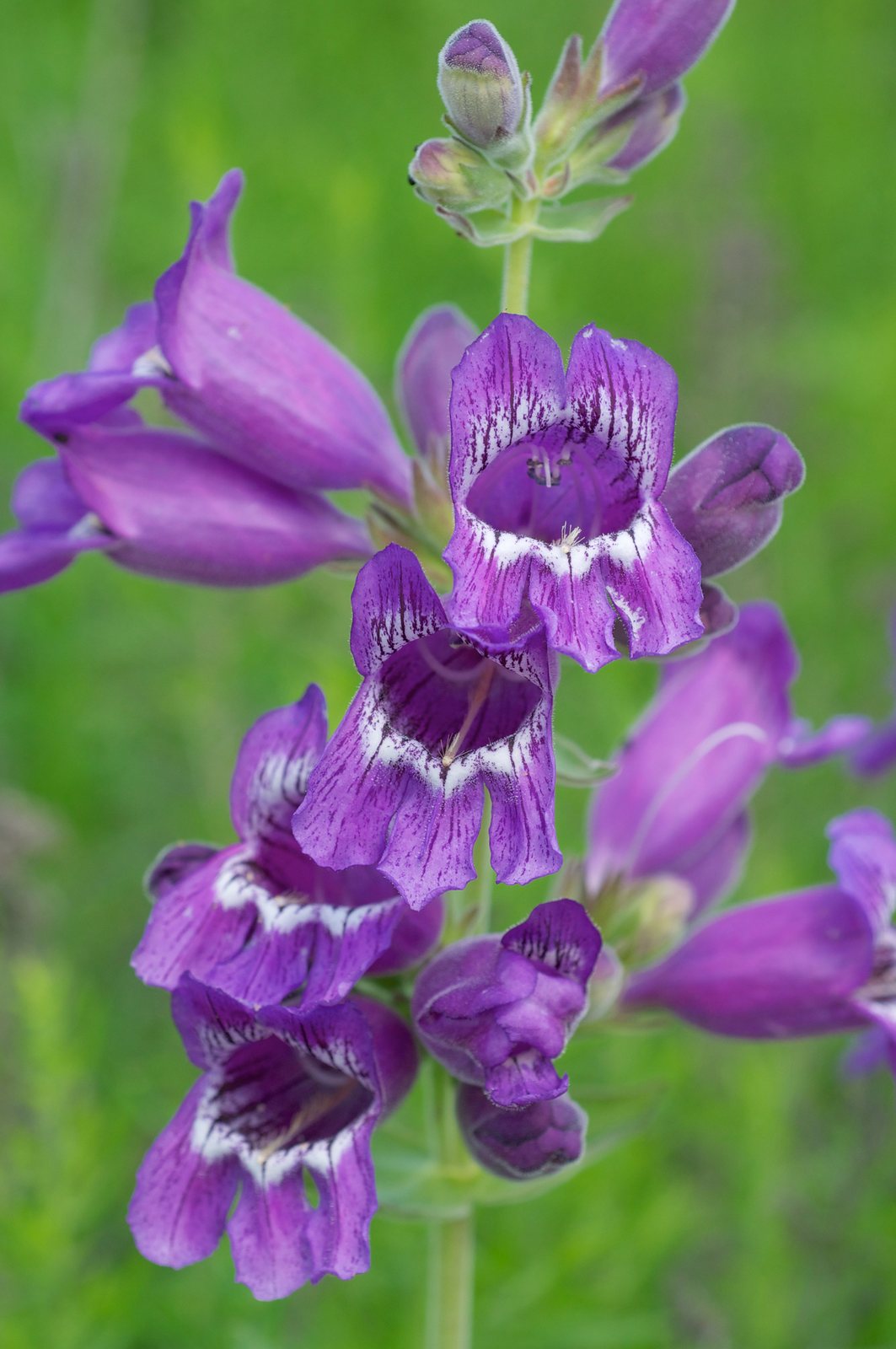
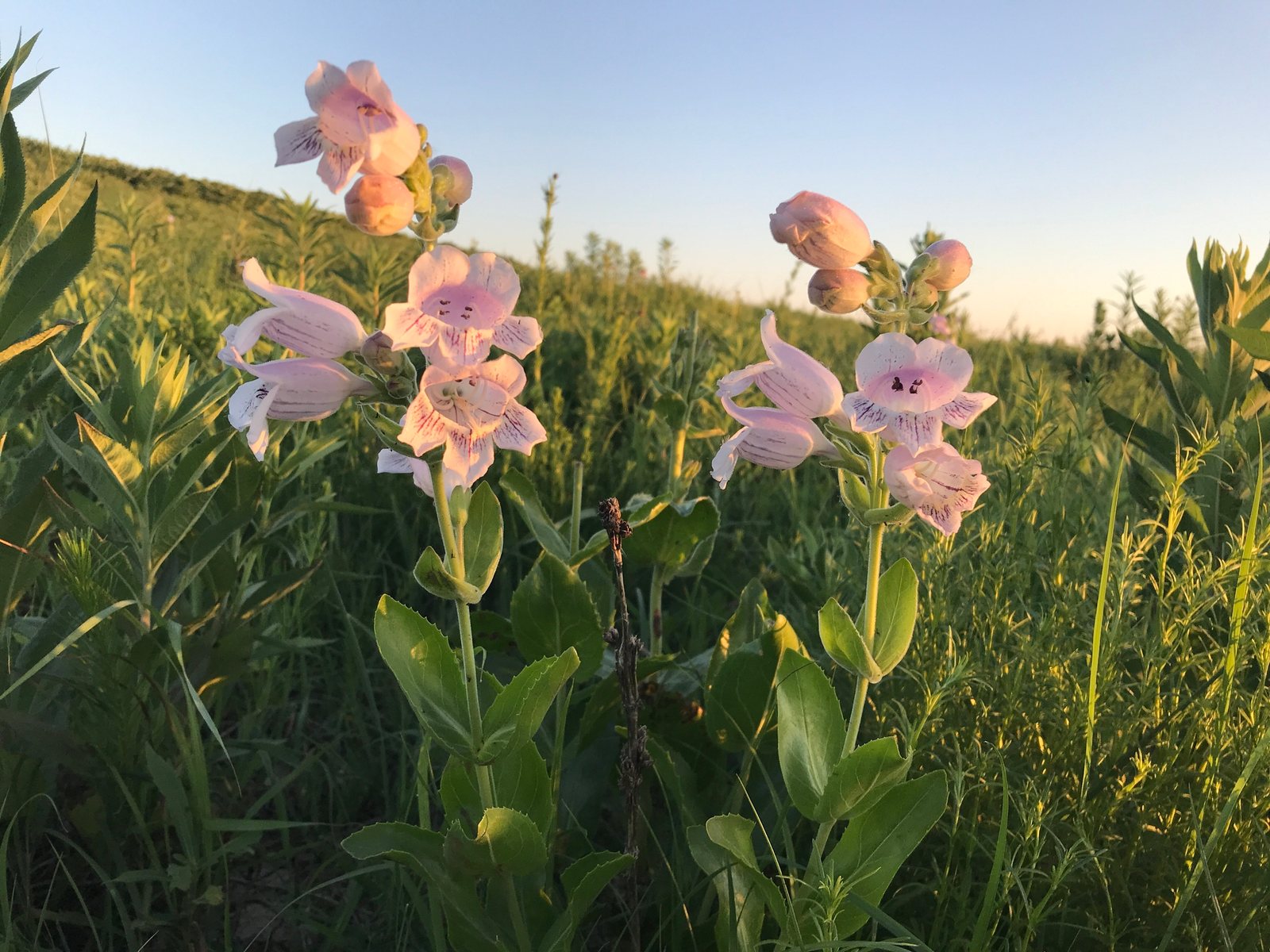
Foxglove penstemon is a clump-forming, often short-lived perennial native to the central and southern United States. Gardeners grow it for its unusually large, foxglove-like flowers, which attract bumblebees in late spring and early summer. It does best in sunny, freely draining ground and is less reliable where winters are persistently wet.
At a glance
- Sun
- Full sun; tolerates light afternoon shade, especially in hot climates.
- Water
- Water regularly while establishing; afterward, water during prolonged drought rather than keeping the soil consistently moist.
- Soil
- Well-drained sandy, gravelly or rocky soil of low to moderate fertility; tolerates limestone soils but dislikes waterlogged ground.
- Height
- 1-3 ft (0.3-0.9 m)
- Spread
- 1-2 ft (0.3-0.6 m)
- Flowers
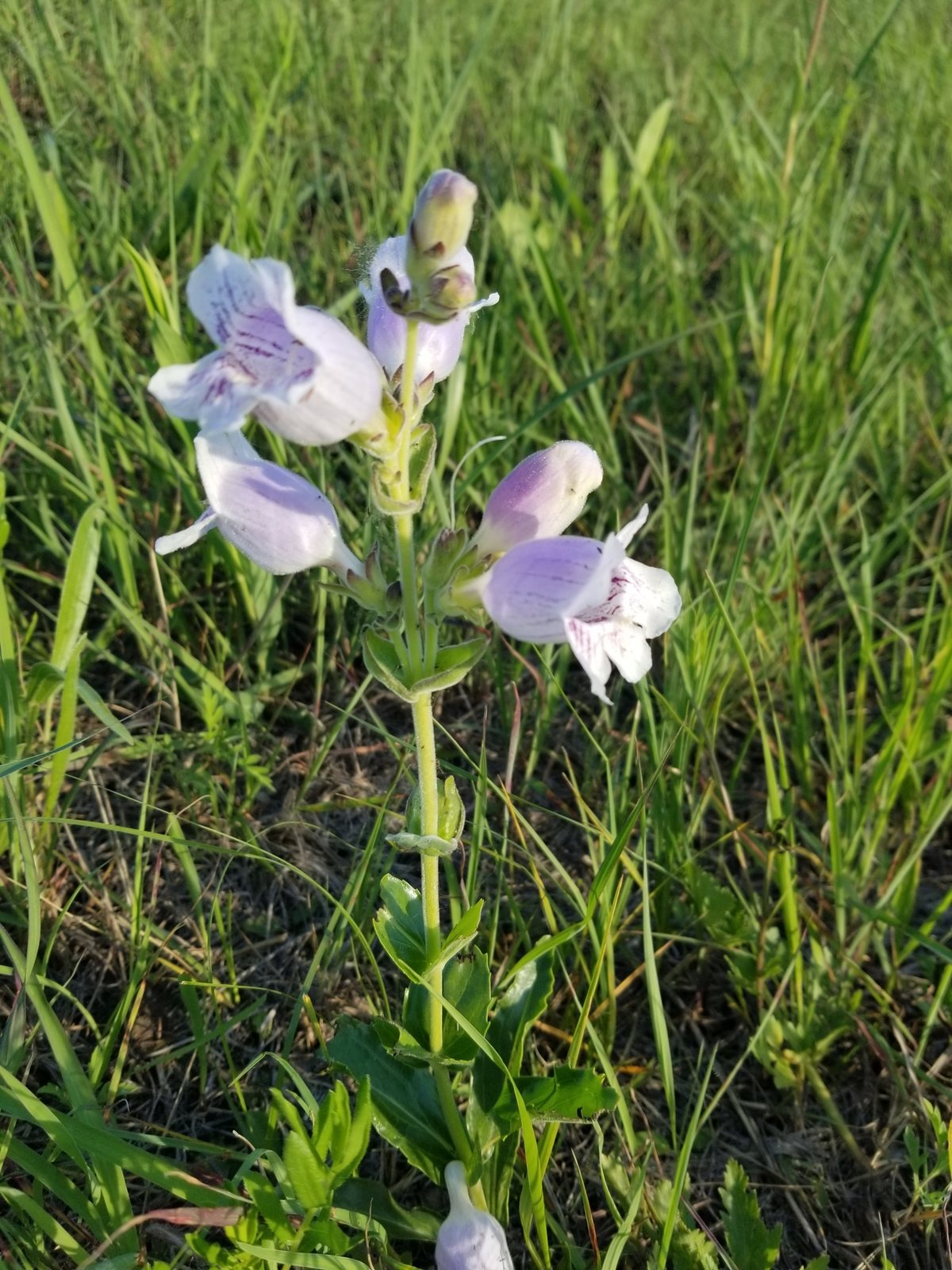
- Late spring to early summer; large white, pale pink, lavender or violet flowers, often with darker purple markings inside.
- Foliage
- Green, opposite, lance-shaped leaves with toothed edges; basal leaves may persist through mild winters.
- Growth
- Moderate
- Care needed
- Low
The year at a glance
- Pollinators
- Deer resistant
- Drought tolerant
- Low allergen
| J | F | M | A | M | J | J | A | S | O | N | D | |
|---|---|---|---|---|---|---|---|---|---|---|---|---|
| Flowers | ||||||||||||
| Fruit | ||||||||||||
| Plant |
Northern hemisphere months. In Australia, shift them by six.
- Difficulty
- Moderate
- Toughness
- Fairly tough
Will it suit your garden?
Pick your zone, country, light and whether you have pets.
Full sun is 6 or more hours of direct sun a day, part shade 3 to 6 hours, shade under 3.
How it grows
Planting day
1 ft (0.3 m)
After 1 year
1.3 ft (0.4 m)
After 2 years
1.6 ft (0.5 m)
After 3 years
2 ft (0.6 m)
full size
About 3 years to full size.
From a typical nursery size, at an average rate for this kind of plant. A rule of thumb, not a forecast.
Good to know
- Cats and dogs
- Safe
- Native to
- the US
- Growth rate
- Moderate
Care
Jobs through the year
- WaterApr–May, Sep, every 21 days
- Water established plants only during prolonged drought; water new plants more often.
- WaterJun–Aug, every 14 days
- Deep-water only if dry, allowing soil to dry between soakings.
- PruneMar
- Remove dead stems and damaged leaves without cutting into the crown.
- DeadheadJun–Jul
- Cut faded flower stalks to basal foliage, leaving a few to seed replacement plants.
- MulchApr
- Use a thin gravel mulch if needed; keep damp organic material away from the crown.
- ProtectOct–Nov
- Clear wet leaves from the crown and ensure winter drainage remains free.
- Plant with the crown at soil level in a sunny position with excellent drainage.
- Water deeply during establishment, allowing the surface soil to dry between waterings.
- Avoid rich manure and routine high-nitrogen feeding, which encourage weak, leafy growth.
- Keep damp organic mulch away from the crown; use a thin gravel mulch if needed.
- Leave a few seed stalks to ripen so seedlings can replace aging plants.
Pruning. After flowering, cut spent flower stalks back to the basal foliage unless you want seed. Remove dead stems and damaged leaves in early spring without cutting into the crown.
Through the year
- Late winter
- If sowing indoors, give seed a cold, moist treatment before moving it into warmth; germination can be uneven.
- Early spring
- Remove dead stems and check that winter moisture has not left the crown sitting in wet soil.
- Spring
- Plant young plants after the soil becomes workable, spacing them about 1-2 ft (0.3-0.6 m) apart.
- Late spring
- Water new plants during dry spells and watch for slugs around emerging growth.
- Early summer
- Remove faded flower stalks, or retain a few for seed.
- Autumn
- Collect dry seed capsules or sow seed outdoors so it receives natural winter chilling.
In the garden
- Plant in small groups near the front or middle of a sunny perennial border, where the large flowers can be seen closely.
- Combine with prairie grasses and other central US wildflowers for a loose, naturalistic planting.
- Use in a gravel garden or raised bed where sharp drainage protects the crown.
- Place beside paths in a pollinator garden to watch bumblebees entering the flowers.
Garden styles it suits: Native meadow, Midwest prairie, Texas Hill Country, Pollinator garden, Dry gravel garden and Cottage garden.
Plant it with: Little bluestem, Prairie dropseed, Butterfly weed, Lanceleaf coreopsis, Purple prairie clover and Winecup.
Wildlife: The large tubular flowers provide nectar and pollen for bumblebees and other bees. Bumblebees are particularly well suited to entering and pollinating the flowers.
Problems to watch for
- Crown and root rot in wet soil: improve drainage or move plants to a raised or gravelly bed; avoid frequent watering.
- Slugs and snails damaging young growth: inspect at dusk, remove hiding places and use suitable slug controls if necessary.
- Powdery mildew in crowded, poorly ventilated planting: increase spacing and avoid excessive nitrogen feeding.
- Plants disappearing after a few seasons: this species can be short-lived, so retain seedlings or raise replacements from seed.
Safety
Not known to be toxic to people, cats, dogs or horses, although species-specific toxicity information is limited. No part is recognized as a serious poisoning hazard, but it is not an edible plant. Despite its common name, it is not a true foxglove (Digitalis), which is highly poisonous.
Easily confused with
Common foxglove (Digitalis purpurea)
True foxglove has alternate leaves and usually taller spikes with flowers hanging mainly along one side. Foxglove penstemon has opposite stem leaves and a conspicuous sterile fifth stamen inside the flower.
Foxglove beardtongue (Penstemon digitalis)
This similarly named species has smaller, narrower, usually white flowers in more branched clusters; P. cobaea has much larger, broad-mouthed flowers.
Large-flowered beardtongue (Penstemon grandiflorus)
It has smooth, waxy blue-green leaves with largely untoothed edges and upper leaves that clasp the stem. P. cobaea has greener, toothed leaves and usually noticeably hairy stems.
The name
Foxglove penstemon refers to the resemblance of its large tubular flowers to those of true foxgloves, while beardtongue describes the hairy sterile stamen inside the flower.
Propagation. Grow from seed sown outdoors in autumn, or cold-moist stratify seed for about 4-8 weeks before spring sowing. Germination requirements vary between seed lots, and plants may not flower until their second year. Take softwood cuttings from healthy, nonflowering shoots in late spring or early summer.
Checked against open data
- Accepted botanical name
- Penstemon cobaea
- In the US and Canada
- Native in the lower 48 states.
- Native range
- Arkansas, Iowa, Kansas, Missouri, Nebraska, Oklahoma and Texas.
Sources: GBIF (CC BY 4.0), USDA PLANTS and Trefle (CC BY 4.0). The care and design notes are LandscapeGPT's own.
See it in your own yard.
Upload a photo of your yard and see it redesigned with plants that suit your climate, each checked against your zone.