Giant red paintbrush
Castilleja miniata. Family Orobanchaceae. Perennial.
Also called Scarlet paintbrush, Great red Indian paintbrush, Common red paintbrush.
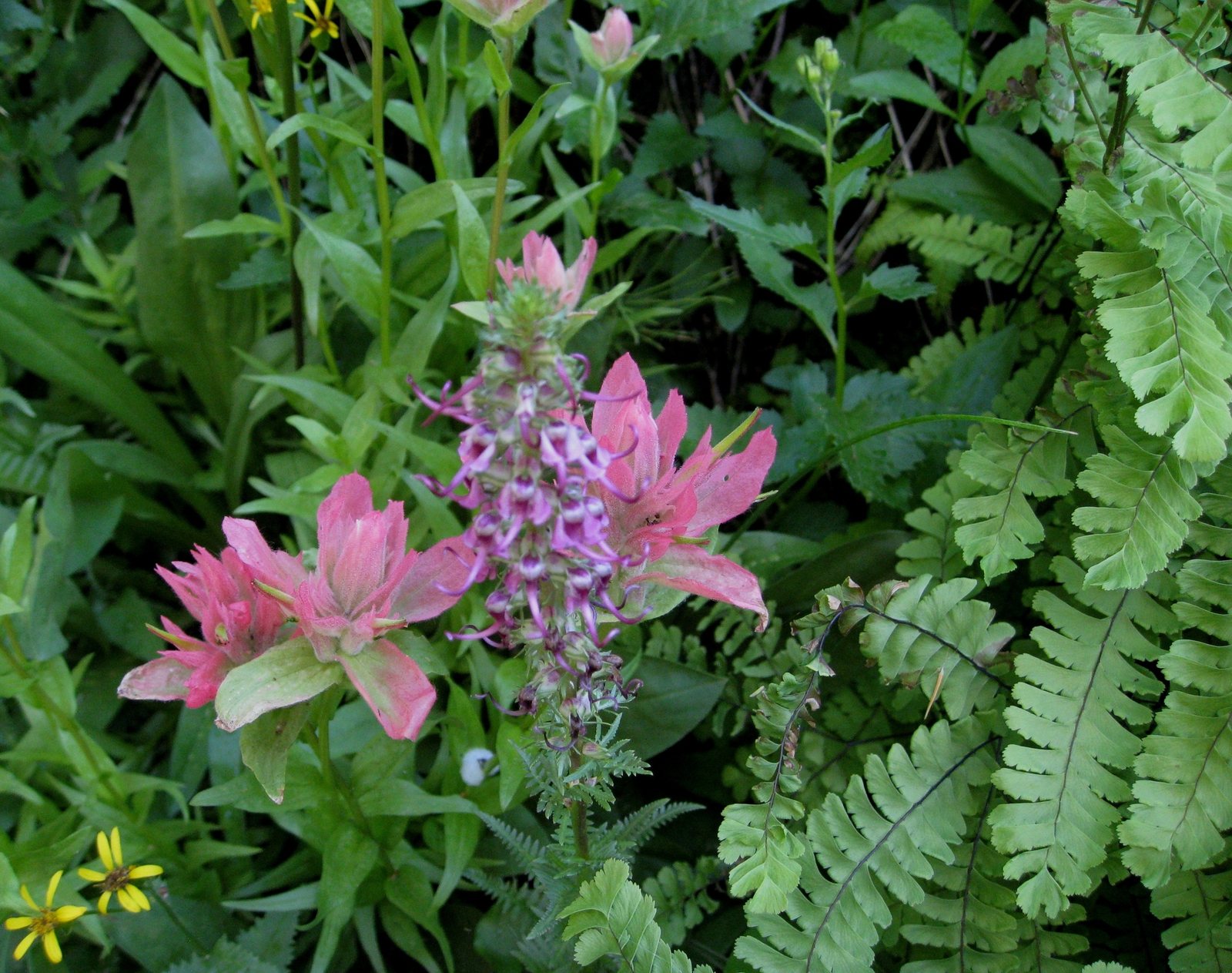
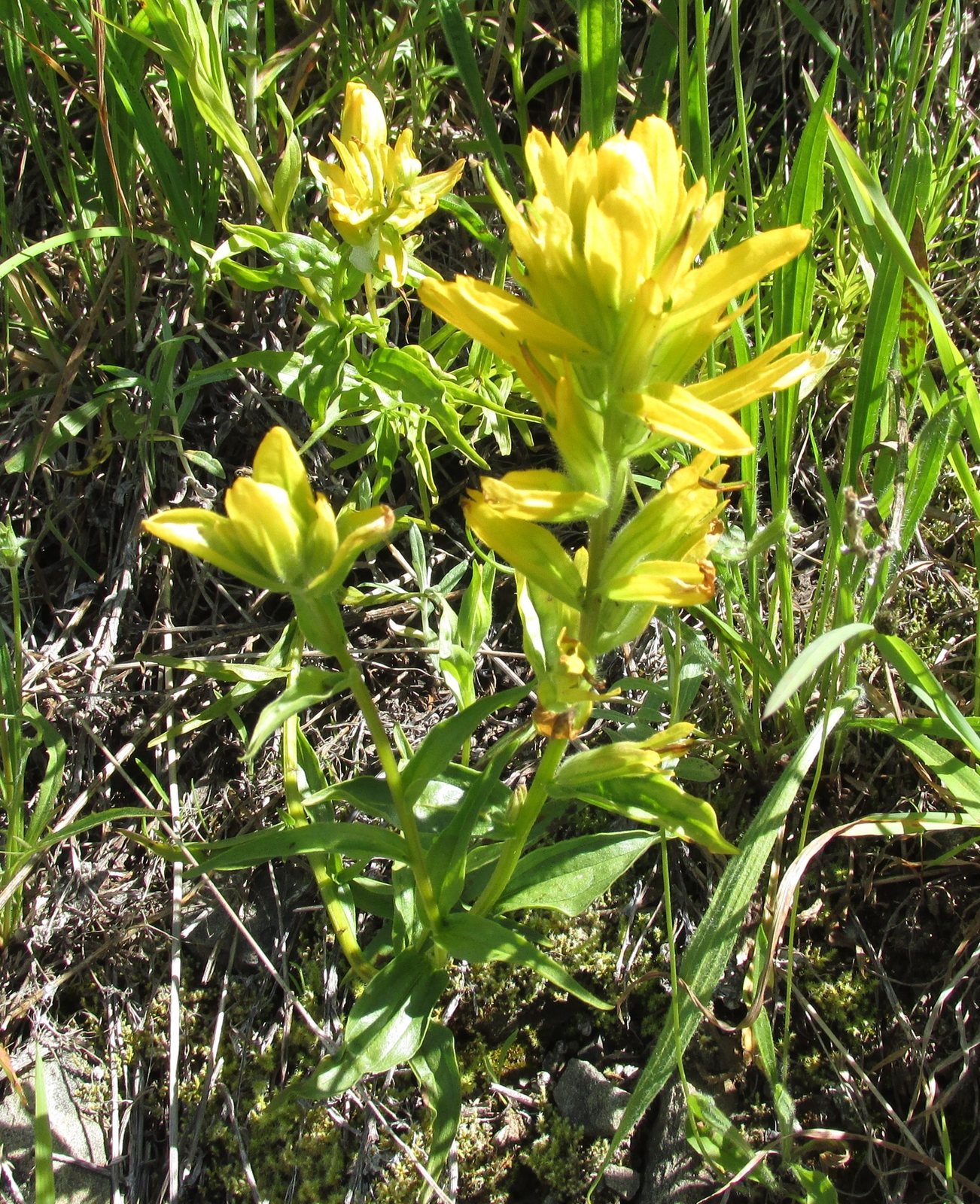
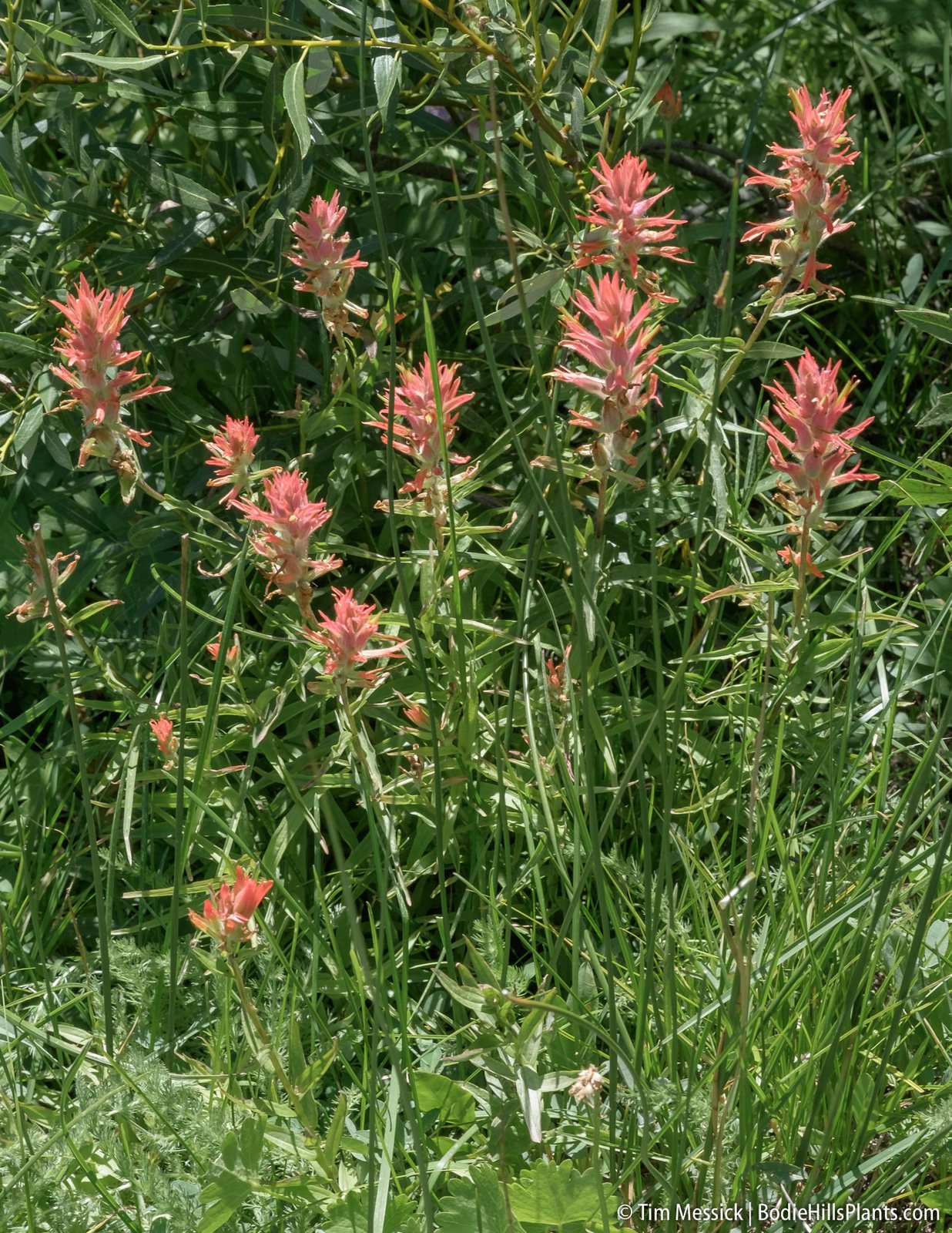
Giant red paintbrush is a western North American wildflower grown for upright spikes of scarlet bracts surrounding small, greenish flowers. It is a root hemiparasite: its green leaves make food, but its roots also draw water and nutrients from neighbouring plants. It is best suited to a cool, moist meadow planting with compatible grasses and wildflowers rather than a conventional border.
At a glance
- Sun
- Full sun to light partial shade; afternoon shade can help in warmer gardens.
- Water
- Moderate; keep the root zone moist during establishment and active spring growth, without waterlogging.
- Soil
- Well-drained sandy, loamy or gravelly soil with moderate moisture; avoid heavily fertilised soil and stagnant winter wet.
- Height
- 1-3 ft (0.3-0.9 m)
- Spread
- 0.5-1 ft (0.15-0.3 m)
- Flowers
- Late spring through summer, depending on elevation and climate; bright red to orange-red bracts surround inconspicuous greenish flowers.
- Foliage
- Upright stems carry narrow green leaves, mostly undivided below and sometimes lobed toward the flower spikes; stems and leaves may be hairy.
- Growth
- Moderate once established; establishment is often slow and unreliable.
- Care needed
- High
The year at a glance
- Pollinators
- Cold hardy
- Wildlife
- Low allergen
| J | F | M | A | M | J | J | A | S | O | N | D | |
|---|---|---|---|---|---|---|---|---|---|---|---|---|
| Flowers | ||||||||||||
| Fruit | ||||||||||||
| Plant |
Northern hemisphere months. In Australia, shift them by six.
- Difficulty
- Hard
- Toughness
- Needs looking after
Will it suit your garden?
Pick your zone, country, light and whether you have pets.
Full sun is 6 or more hours of direct sun a day, part shade 3 to 6 hours, shade under 3.
How it grows
Planting day
1 ft (0.3 m)
After 1 year
1.2 ft (0.38 m)
After 2 years
1.5 ft (0.45 m)
After 3 years
1.7 ft (0.53 m)
After 5 years
2 ft (0.6 m)
full size
About 4 years to full size.
From a typical nursery size, at an average rate for this kind of plant. A rule of thumb, not a forecast.
Good to know
- Cats and dogs
- Mildly toxic: may upset a stomach
- Native to
- Canada
- Growth rate
- Slow
Care
Jobs through the year
- WaterMar–May, every 7 days
- Check established plants and water if soil is drying; keep new plants consistently moist, not soggy.
- WaterJun–Aug, every 7 days
- Water established plants during dry spells; young plants need closer moisture checks.
- WaterSep–Oct, every 14 days
- Water only if soil is dry and plants remain actively growing.
- PruneFeb–Mar
- Cut dead stems near ground level without damaging emerging shoots or host roots.
- PruneApr–Jun
- Selectively trim crowding host growth without disturbing either plant's roots.
- MulchApr
- Use only a thin layer, keeping crowns and patches of soil uncovered.
- ProtectJan–Feb, Nov–Dec
- Protect outdoor seed pots from disturbance and waterlogging while allowing natural winter chilling.
- Grow beside compatible living hosts, such as locally suitable fescues, tufted hairgrass or yarrow.
- Water during dry spells in the first growing season, keeping soil moist but aerated.
- Avoid routine feeding; vigorous neighbouring plants can shade and crowd it out.
- Keep mulch thin and clear of the crown; leave small patches of open soil for seedlings.
- Avoid dividing or moving established plants, which can damage their roots and host connections.
Pruning. Leave flower spikes until the seed capsules ripen if you want seedlings. Cut dead stems near ground level in late winter or early spring, taking care not to damage emerging shoots.
Through the year
- Autumn
- Surface-sow fresh seed beside suitable host plants, pressing it onto the soil without burying it deeply.
- Winter
- Allow outdoor seed pots to receive natural cold, while protecting them from disturbance and waterlogging.
- Early spring
- Remove dead stems and check that nearby grasses are not smothering new growth.
- Spring
- Plant nursery-grown plants with their host roots intact; water carefully while they establish.
- Summer
- Water during prolonged dry spells and leave flowering spikes for pollinators and seed production.
- Late summer
- Collect seed when capsules turn brown and begin to split; store it dry until autumn sowing.
In the garden
- Thread through a moist native meadow with fine-textured grasses for scattered red accents.
- Plant in sunny woodland openings where the soil stays cool and neighbouring vegetation is not too dense.
- Use in a western North American wildflower planting with yarrow and locally appropriate native grasses.
- Place in a naturalistic mountain garden where drainage is good but summer moisture remains available.
Garden styles it suits: Native meadow, Wildflower, Wildlife garden, Pacific Northwest woodland, Mountain lodge and Rewilded.
Plant it with: Idaho fescue, Tufted hairgrass, Bluebunch wheatgrass, Common yarrow and Selfheal.
Wildlife: The flowers provide nectar for hummingbirds within their native range and are also visited by bees. Its relationships with neighbouring plants make it especially useful in a functioning native meadow community.
Problems to watch for
- Poor establishment without suitable hosts: sow or plant among compatible grasses and herbs rather than in an isolated pot or bare bed.
- Root or crown rot in wet soil: improve drainage and keep heavy mulch away from the crown.
- Crowding by vigorous neighbours: thin surrounding growth selectively without disturbing the paintbrush roots.
- Failure to germinate: use fresh seed and provide a prolonged cold, moist period; germination can be uneven.
Safety
Toxicity to cats, dogs and people is not well documented, so do not treat it as edible. Paintbrushes can accumulate selenium from selenium-rich soils; foliage may then poison grazing animals, including horses, if enough is eaten. Risk depends strongly on the soil and amount consumed.
Easily confused with
Harsh paintbrush (Castilleja hispida)
Usually has more deeply divided leaves and conspicuously stiff, spreading hairs; giant red paintbrush generally has mostly undivided lower leaves.
Scarlet Indian paintbrush (Castilleja coccinea)
An eastern North American annual or biennial, usually with conspicuously divided upper leaves; giant red paintbrush is a western perennial.
The name
Castilleja honours Spanish botanist Domingo Castillejo, while miniata means vermilion-coloured, referring to the red bracts.
Propagation. Usually grown from seed. Surface-sow fresh seed outdoors in autumn, or provide cold, moist stratification before spring sowing; requirements vary with seed origin. Raise seedlings alongside suitable host plants and transplant with minimal root disturbance. Division is unreliable.
Checked against open data
- Accepted botanical name
- Castilleja miniata
- Native range
- Alaska, Alberta, Arizona, British Columbia, California, Colorado, Idaho, Manitoba, Mexico Northwest, Montana, Nevada and New Mexico.
Sources: GBIF (CC BY 4.0) and Trefle (CC BY 4.0). The care and design notes are LandscapeGPT's own.
See it in your own yard.
Upload a photo of your yard and see it redesigned with plants that suit your climate, each checked against your zone.