Greater quaking grass
Briza maxima. Family Poaceae. Ornamental grass.
Also called Large quaking grass, Big quaking grass, Rattlesnake grass.
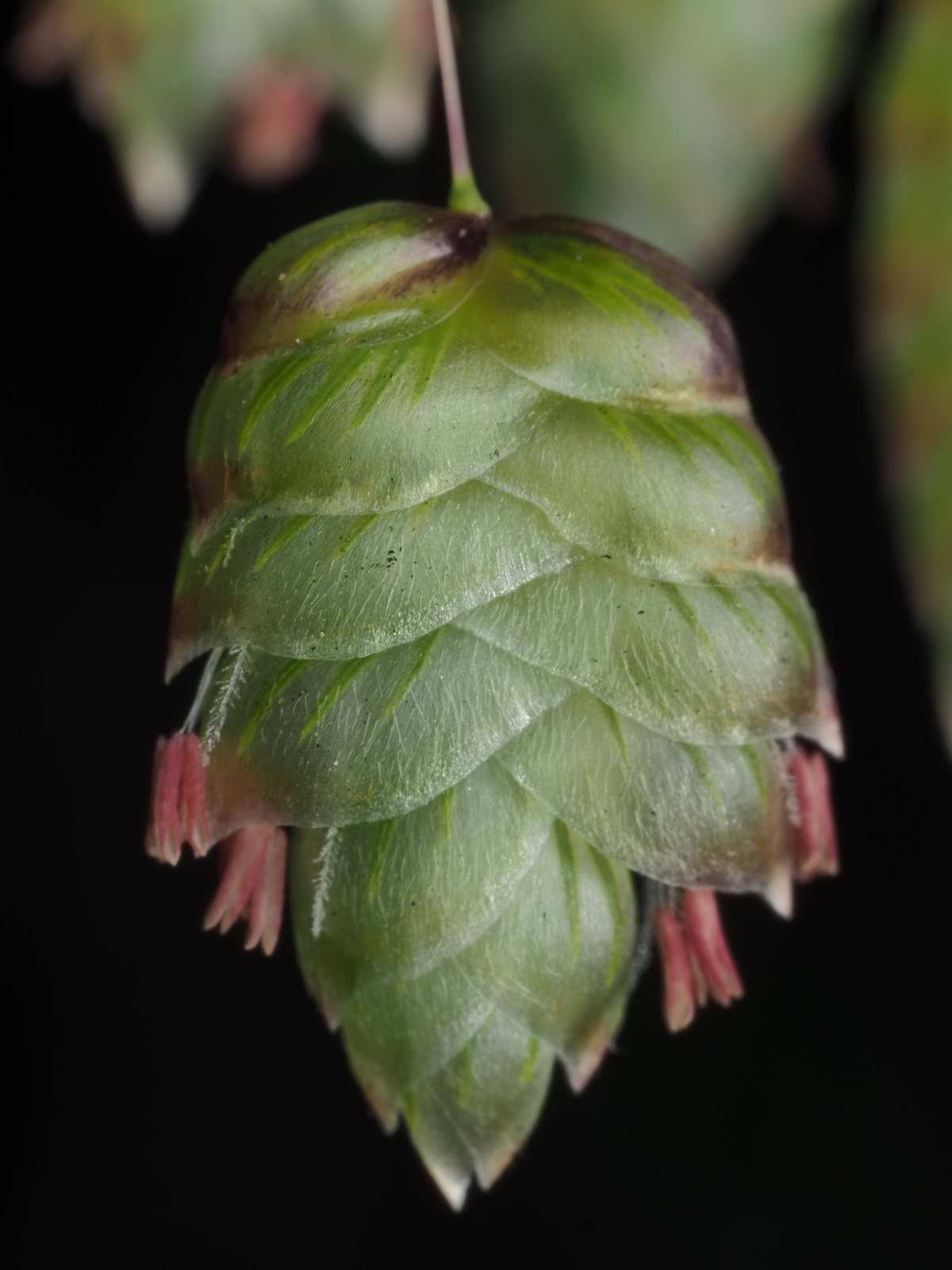
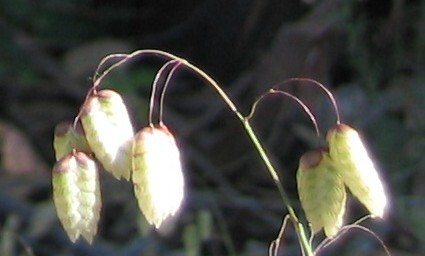
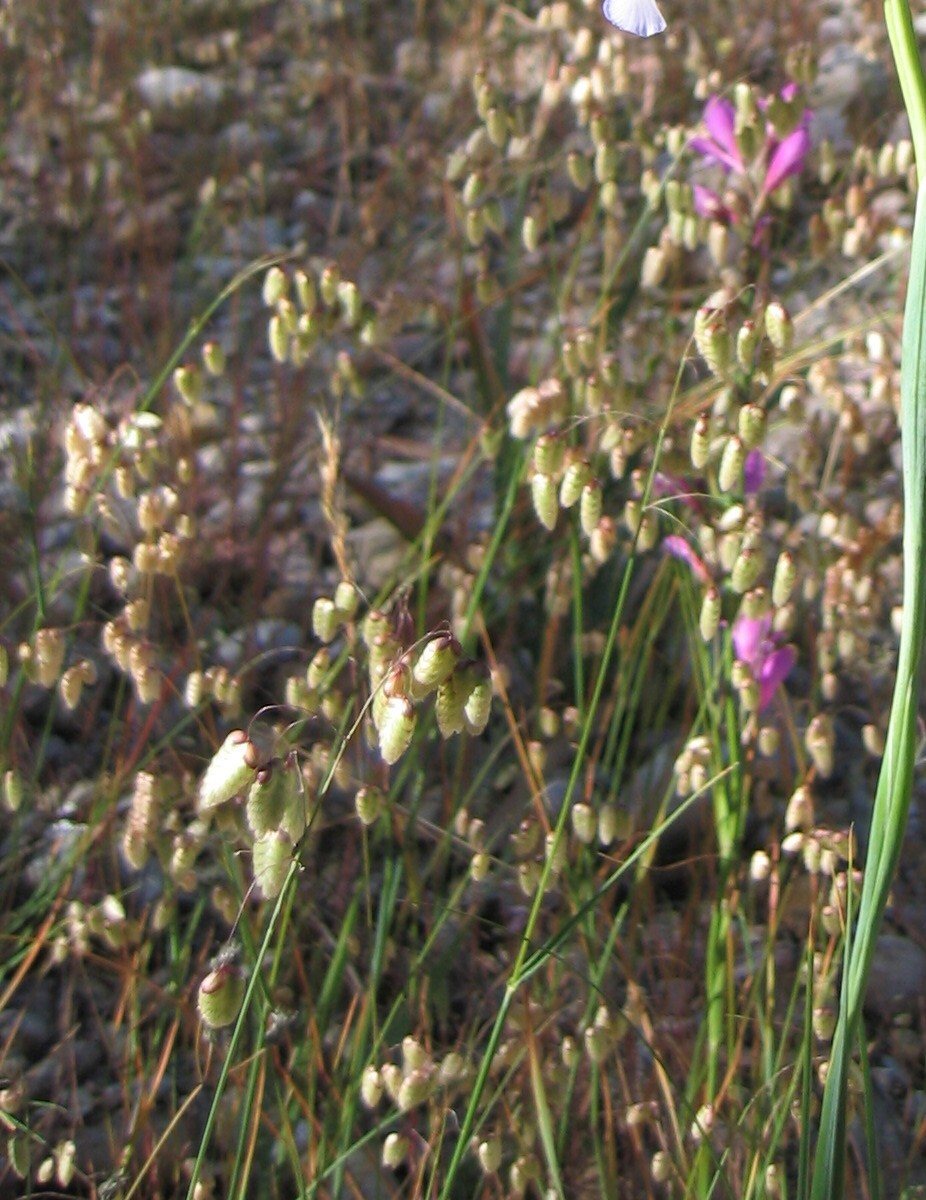
Greater quaking grass is grown as an annual for its loose sprays of large, dangling, heart-shaped flower heads, which tremble in a breeze and turn from green to straw-gold. It adds light movement to borders and makes useful dried stems, but it readily self-seeds and is an environmental weed in parts of Australia and California.
At a glance
- Sun
- Full sun for the strongest stems and best flowering; tolerates light shade.
- Water
- Water seedlings regularly until established, then water during prolonged dry spells. Avoid persistently wet soil.
- Soil
- Well-drained sandy, loamy or gravelly soil; tolerates relatively poor soil. Avoid waterlogged ground and heavily enriched beds.
- Height
- 1-2 ft (0.3-0.6 m)
- Spread
- 0.5-1 ft (0.15-0.3 m)
- Flowers
- Late spring to summer; small flowers are enclosed in conspicuous, dangling green spikelets that mature to straw-gold, sometimes with purple tints.
- Foliage
- Narrow, flat green leaves form a small, loose tuft beneath fine flowering stems.
- Growth
- Fast; flowers and sets seed within one growing season.
- Care needed
- Low
The year at a glance
- Deer resistant
- Drought tolerant
- Wildlife
| J | F | M | A | M | J | J | A | S | O | N | D | |
|---|---|---|---|---|---|---|---|---|---|---|---|---|
| Flowers | ||||||||||||
| Fruit | ||||||||||||
| Plant |
Northern hemisphere months. In Australia, shift them by six.
- Difficulty
- Easy
- Toughness
- Fairly tough
Will it suit your garden?
Pick your zone, country, light and whether you have pets.
Full sun is 6 or more hours of direct sun a day, part shade 3 to 6 hours, shade under 3.
How it grows
Planting day
1.1 ft (0.35 m)
After 1 year
1.4 ft (0.41 m)
After 2 years
1.5 ft (0.45 m)
full size
About 2 years to full size.
From a typical nursery size, at an average rate for this kind of plant. A rule of thumb, not a forecast.
Good to know
- Cats and dogs
- Safe
- Invasive in
- the US and Australia
- In the garden
- Spreads vigorously: plan to contain it.
- Growth rate
- Fast
Care
Jobs through the year
- WaterApr–May, every 14 days
- Water rooted plants if soil is dry; seedlings need watering whenever the surface dries.
- WaterJun–Aug, every 10 days
- Water established plants only during prolonged dry spells; avoid saturated soil.
- DeadheadJun–Aug
- Remove heads before seed sheds where self-seeding is unwanted.
- PruneJul–Sep
- Pull spent annual plants before remaining seeds scatter.
- Thin seedlings to about 6-12 in (15-30 cm) apart so each tuft has room to develop.
- Water young plants when the soil surface dries; reduce watering once roots are established.
- Usually give no fertiliser; rich feeding encourages floppy growth.
- Choose a sunny, sheltered position rather than staking individual stems.
- Remove flower heads before seed falls if you do not want seedlings nearby.
Pruning. No routine pruning is needed. Cut stems as they turn straw-coloured for indoor display, or remove the whole plant before seeds shed to limit spread.
Through the year
- Early spring
- Where the species is not invasive, sow seed thinly in well-drained soil as conditions begin to warm.
- Mid-spring
- Thin crowded seedlings and keep young plants watered during dry weather.
- Late spring
- Check developing stems for aphids and avoid feeding plants that are already growing well.
- Summer
- Cut selected stems as the heads turn straw-coloured, before they begin shedding seed.
- Late summer
- Pull spent plants and unwanted seedlings; remove seed heads rather than adding them to cool compost.
- Autumn
- In mild-winter areas where planting is appropriate, sow a small batch for earlier flowering the following year.
In the garden
- Plant small drifts near the front of a sunny border, where the dangling heads can be seen against darker foliage.
- Mix with cornflowers, annual poppies and pot marigolds for a loose cottage-garden planting.
- Use sparingly among low plants in a gravel garden to add fine texture and movement.
- Grow in a seasonal container with compact flowering annuals, removing heads before seed scatters.
Garden styles it suits: Cottage garden, Dry gravel garden, Mediterranean, Modern rustic, Sensory garden and Small-space.
Plant it with: Cornflower, Love-in-a-mist, Pot marigold, California poppy, Lavender and Catmint.
Wildlife: The wind-pollinated flowers offer little to bees. Seed-eating birds may take the seeds, but allowing seed to mature is unsuitable where the grass is invasive.
Problems to watch for
- Unwanted self-seeding: remove heads before they shed seed and pull seedlings while small.
- Floppy stems in shade or rich soil: move future sowings to full sun and omit fertiliser.
- Root rot in wet ground: improve drainage or grow in a container with free-draining compost.
- Aphids on young growth: dislodge small colonies with a gentle jet of water.
Safety
Not known to be toxic to people, cats, dogs or horses. No part is recognised as poisonous, but it is not a food plant.
Where it spreads. An introduced environmental weed in parts of southern and western Australia, including Western Australia, South Australia, Victoria, Tasmania and New South Wales. It is also invasive in parts of California, particularly coastal habitats. It spreads by seed; avoid planting near bushland, native grassland or other sensitive habitats in affected regions.
Easily confused with
Common quaking grass (Briza media)
A perennial with much smaller, often purple-tinged spikelets; greater quaking grass is annual and has larger, broader dangling heads.
Lesser quaking grass (Briza minor)
Also annual, but its numerous tiny, roughly triangular spikelets make a much finer spray than the large, heart-shaped heads of greater quaking grass.
Northern sea oats (Chasmanthium latifolium)
A taller perennial with broad, bamboo-like leaves and flat, oat-like seed heads, rather than narrow leaves and plump, heart-shaped spikelets.
The name
The epithet maxima means largest, referring to its unusually large spikelets, while quaking grass describes the way the dangling heads tremble in a breeze.
Propagation. Propagate by seed in spring, or in autumn where winters are mild. Sow shallowly in its final position or in modules for transplanting while young; do not propagate it where local weed guidance discourages planting.
Checked against open data
- Accepted botanical name
- Briza maxima
- In the US and Canada
- Introduced in Canada, Hawaii and the lower 48 states.
- Native range
- Albania, Algeria, Azores, Baleares, Bulgaria, Canary Is., Corse, Cyprus, East Aegean Is., France, Greece and Italy.
- Measured
- Average height 28 cm.
Sources: GBIF (CC BY 4.0), USDA PLANTS and Trefle (CC BY 4.0). The care and design notes are LandscapeGPT's own.
See it in your own yard.
Upload a photo of your yard and see it redesigned with plants that suit your climate, each checked against your zone.