Guava
Psidium guajava. Family Myrtaceae. Tree.
Also called Common guava, Tropical guava, Apple guava.
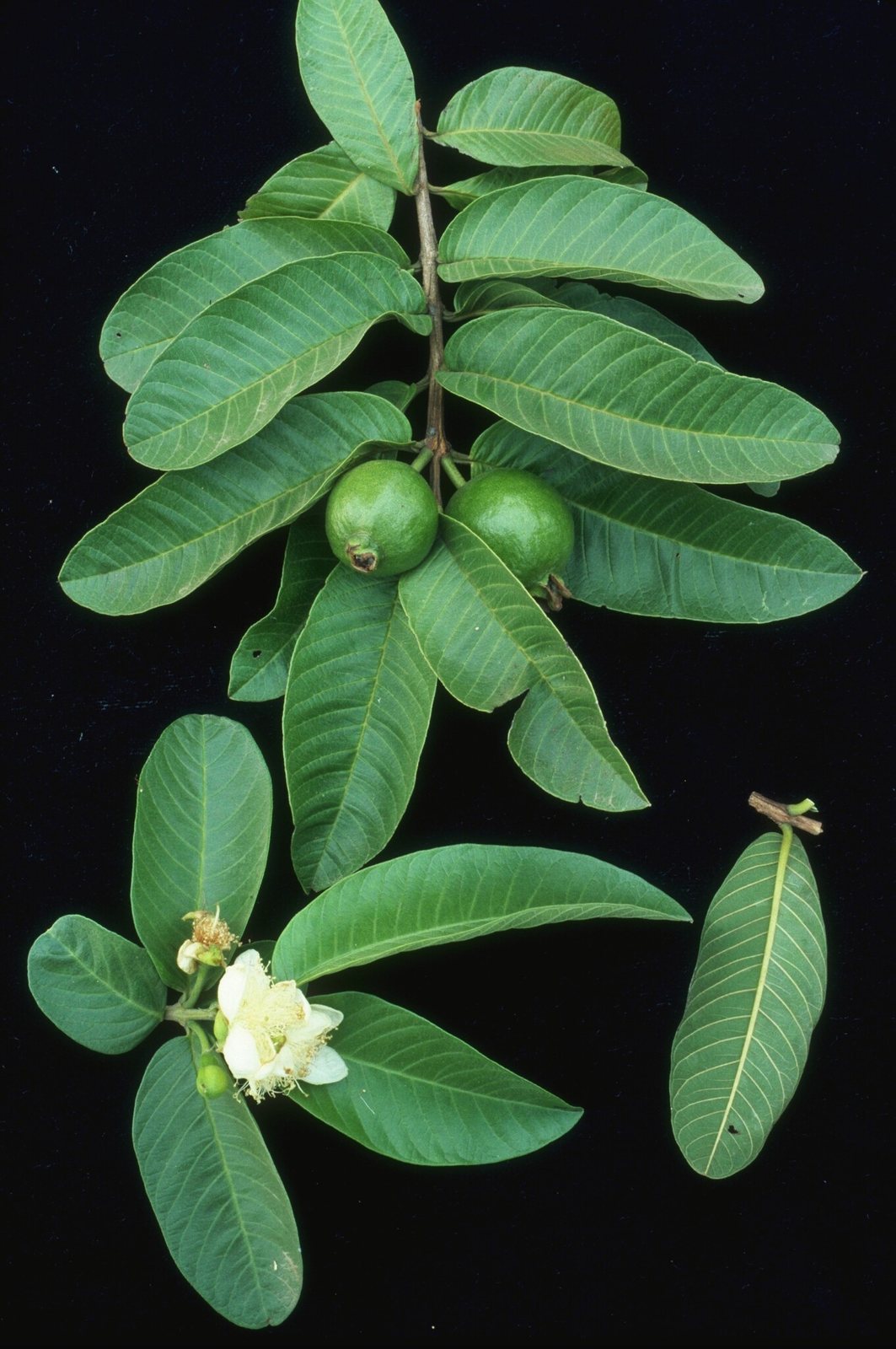
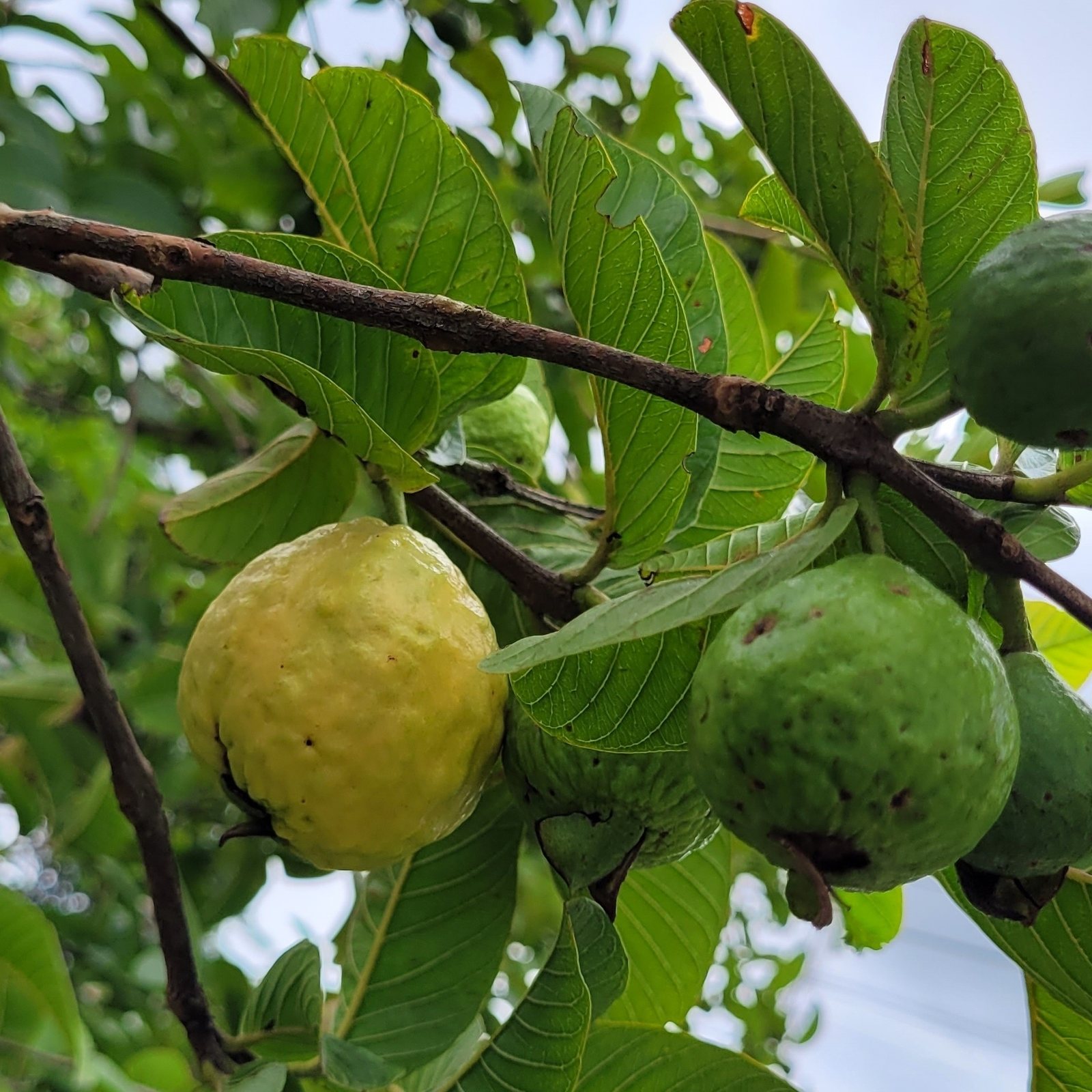
Guava is a small tropical evergreen tree grown for fragrant, sweet fruit with white, pink or red flesh, as well as attractive peeling bark. It needs a warm, sheltered position to crop well; in the United Kingdom, Canada and other frost-prone areas, grow it in a large container with bright, frost-free winter accommodation.
At a glance
- Sun
- Full sun; light shade is tolerated but usually reduces flowering and fruiting.
- Water
- Water regularly while establishing and during flowering and fruit development. Established trees tolerate short dry spells, but drought can reduce the crop.
- Soil
- Well-drained soil, preferably slightly acidic to neutral. Tolerates several soil types but struggles in waterlogged ground; alkaline soil can cause nutrient deficiencies.
- Height
- 10-20 ft (3-6 m)
- Spread
- 10-20 ft (3-6 m)
- Flowers
- White flowers with prominent stamens, mainly in spring and summer; flowering may recur in tropical climates.
- Foliage
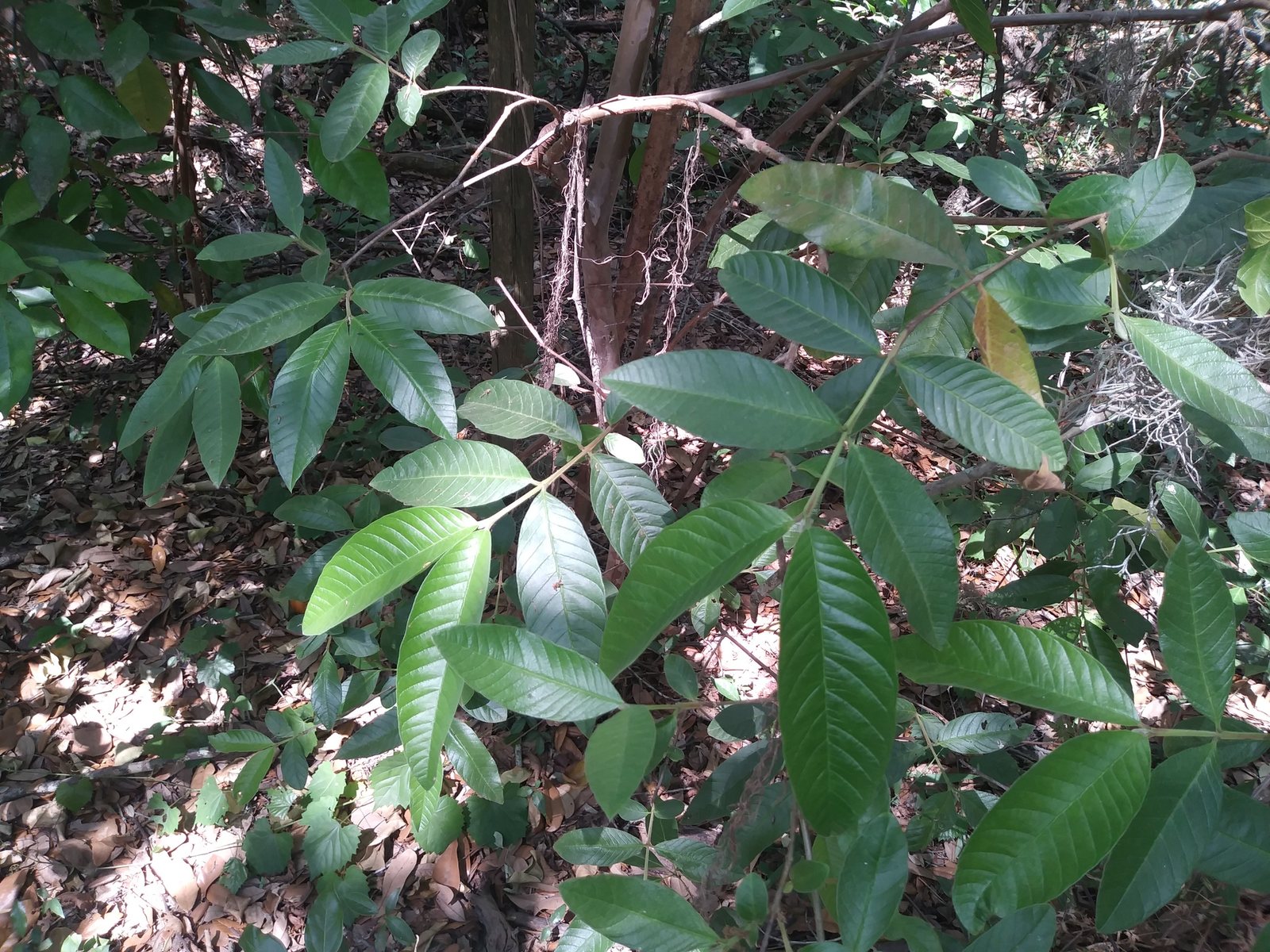
- Evergreen. Opposite, oval green leaves with conspicuous veins; young growth may be bronze-tinted.
- Growth
- Fast in warm conditions.
- Care needed
- Medium
The year at a glance
- Pollinators
- Heat tolerant
- Wildlife
- Low allergen
- Edible
| J | F | M | A | M | J | J | A | S | O | N | D | |
|---|---|---|---|---|---|---|---|---|---|---|---|---|
| Flowers | ||||||||||||
| Fruit | ||||||||||||
| Plant |
Northern hemisphere months. In Australia, shift them by six.
- Difficulty
- Hard
- Toughness
- Fairly tough
Will it suit your garden?
Pick your zone, country, light and whether you have pets.
Full sun is 6 or more hours of direct sun a day, part shade 3 to 6 hours, shade under 3.
How it grows
Planting day
7 ft (2 m)
After 1 year
7 ft (2.2 m)
After 2 years
8 ft (2.4 m)
After 3 years
8 ft (2.6 m)
After 5 years
10 ft (3 m)
About 13 years to full size.
From a typical nursery size, at an average rate for this kind of plant. A rule of thumb, not a forecast.
Good to know
- Cats and dogs
- Safe
- Invasive in
- the US and Australia
- In the garden
- Spreads vigorously: plan to contain it.
- Growth rate
- Fast
Care
Jobs through the year
- WaterJun–Aug, every 3 days
- Grow in a movable pot here; water when upper compost starts drying and drain freely.
- WaterMar–May, Sep–Oct, every 7 days
- Check compost and water as needed, maintaining moisture during fruit development.
- WaterJan–Feb, Nov–Dec, every 14 days
- Check sheltered pots; water sparingly without letting the root ball dry completely.
- FeedApr–Aug, every 30 days
- Use balanced fruit-tree fertiliser at the label rate; avoid excess nitrogen.
- MulchMay
- Refresh organic mulch while keeping the trunk clear.
- PruneApr–May
- Remove dead or crowded branches and shorten tall shoots; retain new flowering growth.
- ProtectJan–Apr, Oct–Dec
- Keep under bright frost-free cover, ideally above 5°C; protect earlier if frost threatens.
- ProtectMay–Jun
- Acclimatise outdoor pots gradually once nights are reliably warm.
- HarvestAug–Oct
- Pick fragrant, slightly yielding fruit; cropping needs a long warm season and is unreliable outdoors here.
- Water deeply when the upper soil begins to dry; do not leave container plants standing in water.
- Apply a balanced fruit-tree fertiliser during active growth, following the label; avoid heavy nitrogen feeding.
- Spread organic mulch over the root zone, keeping it clear of the trunk.
- Use a large container with drainage holes and a free-draining potting mix where winter protection is needed.
- Move container plants under bright cover before frost, ideally keeping winter temperatures above 5°C (41°F).
Pruning. Prune in spring once frost risk has passed, removing dead, crossing and crowded branches and shortening tall shoots to keep fruit within reach. Flowers form on new growth, so avoid repeated heavy trimming during the growing season.
Harvest
Pick fruit when its skin lightens, usually towards yellow, it smells fragrant and it yields slightly to gentle pressure; timing varies with climate and cultivar, often falling in summer or autumn. Clip or gently twist ripe fruit from the branch and use it promptly. Vegetatively propagated trees commonly give their first worthwhile crop about 2-3 years after planting, while seedlings often take 3-5 years or longer.
Through the year
- Early spring
- Check for cold damage and prune after the risk of frost has passed.
- Spring
- Plant in warm soil, refresh mulch and begin feeding as active growth starts.
- Late spring
- Move overwintered container plants outdoors gradually once nights are reliably warm.
- Summer
- Water consistently during fruit development and protect young fruit from fruit fly where present.
- Summer to autumn
- Check fruit frequently and harvest as it becomes fragrant and slightly soft.
- Autumn
- Bring container plants under cover before cold nights or frost.
- Winter
- Keep protected plants bright and frost-free; reduce watering but do not let the root ball dry completely.
In the garden
- Use as a small fruit tree in a sunny edible garden, keeping the canopy low for harvesting.
- Grow in a large courtyard container where its peeling bark and fruit can be seen close up.
- Combine with citrus and other warm-climate fruit trees in a sheltered orchard.
- Train as an informal evergreen screen where there is room for its spreading branches and access to collect fallen fruit.
Garden styles it suits: Tropical, Modern tropical, Modern courtyard, Edible landscape, Backyard orchard and Food forest.
Plant it with: Lemon, Mandarin, Pineapple, Sweet potato and Basil.
Wildlife: Flowers attract bees and other insects. Ripe fruit attracts birds and fruit bats where present; remove fallen fruit to reduce rodents and unwanted seedlings.
Problems to watch for
- Fruit flies: larvae spoil ripening fruit in affected regions. Bag young fruit with suitable exclusion bags and promptly collect and dispose of infested and fallen fruit according to local guidance.
- Anthracnose: dark spots and fruit rot are encouraged by wet, humid conditions. Remove affected fruit, open the canopy for airflow and avoid wetting foliage when watering.
- Scale insects and mealybugs: inspect stems and leaf undersides, manage ants and use a labelled horticultural oil when needed, avoiding hot weather.
- Poor cropping or yellow leaves: check for insufficient sun, cold, waterlogging or alkaline soil. Improve growing conditions and use an appropriate micronutrient treatment only where deficiency is indicated.
Safety
Guava is not known to be toxic to people, cats or dogs; ripe fruit is edible, although large amounts may cause digestive upset in pets. Toxicity information for horses is limited, so do not offer prunings or large quantities of fruit as feed.
Where it spreads. Spreads by seed carried by birds and mammals and can form dense stands. It is invasive in Hawaii, parts of Florida and tropical northeastern Australia, including parts of Queensland, as well as several tropical island regions. Check local guidance before planting and prevent fruit from spreading into nearby bushland or natural areas.
Easily confused with
Strawberry guava (Psidium cattleyanum)
Usually has smaller, glossier leaves with less conspicuous veins and smaller red or yellow fruit.
Pineapple guava (Acca sellowiana)
Has thick leaves with silvery undersides and flowers with fleshy white-pink petals and conspicuous red stamens.
The name
The name guava, reflected in the botanical epithet guajava, reached English through Spanish guayaba from an Indigenous Caribbean name.
Propagation. Named varieties are usually propagated by grafting, budding or air layering to preserve their fruit characteristics. Seeds germinate in warmth, but seedlings vary in fruit quality and usually take longer to crop.
Checked against open data
- Accepted botanical name
- Psidium guajava
- In the US and Canada
- Introduced in Hawaii, the lower 48 states, Pacific Basin, Puerto Rico and US Virgin Islands.
- Native range
- Peru.
- Measured
- Soil pH 5.5 to 7. Average height 590 cm.
Sources: GBIF (CC BY 4.0), USDA PLANTS and Trefle (CC BY 4.0). The care and design notes are LandscapeGPT's own.
See it in your own yard.
Upload a photo of your yard and see it redesigned with plants that suit your climate, each checked against your zone.