King's mantle
Thunbergia erecta. Family Acanthaceae. Shrub.
Also called Bush clock vine, Bush thunbergia.
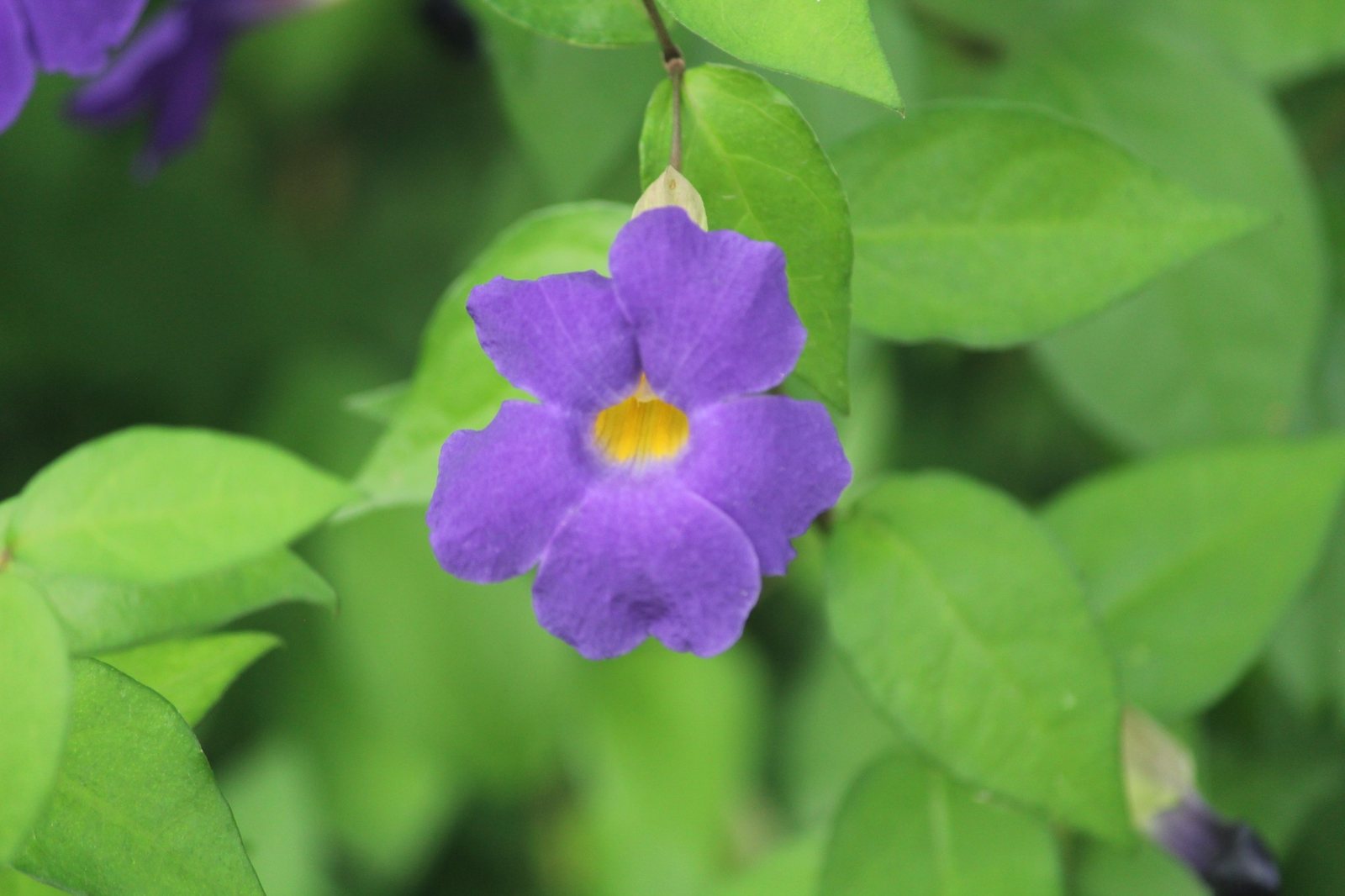
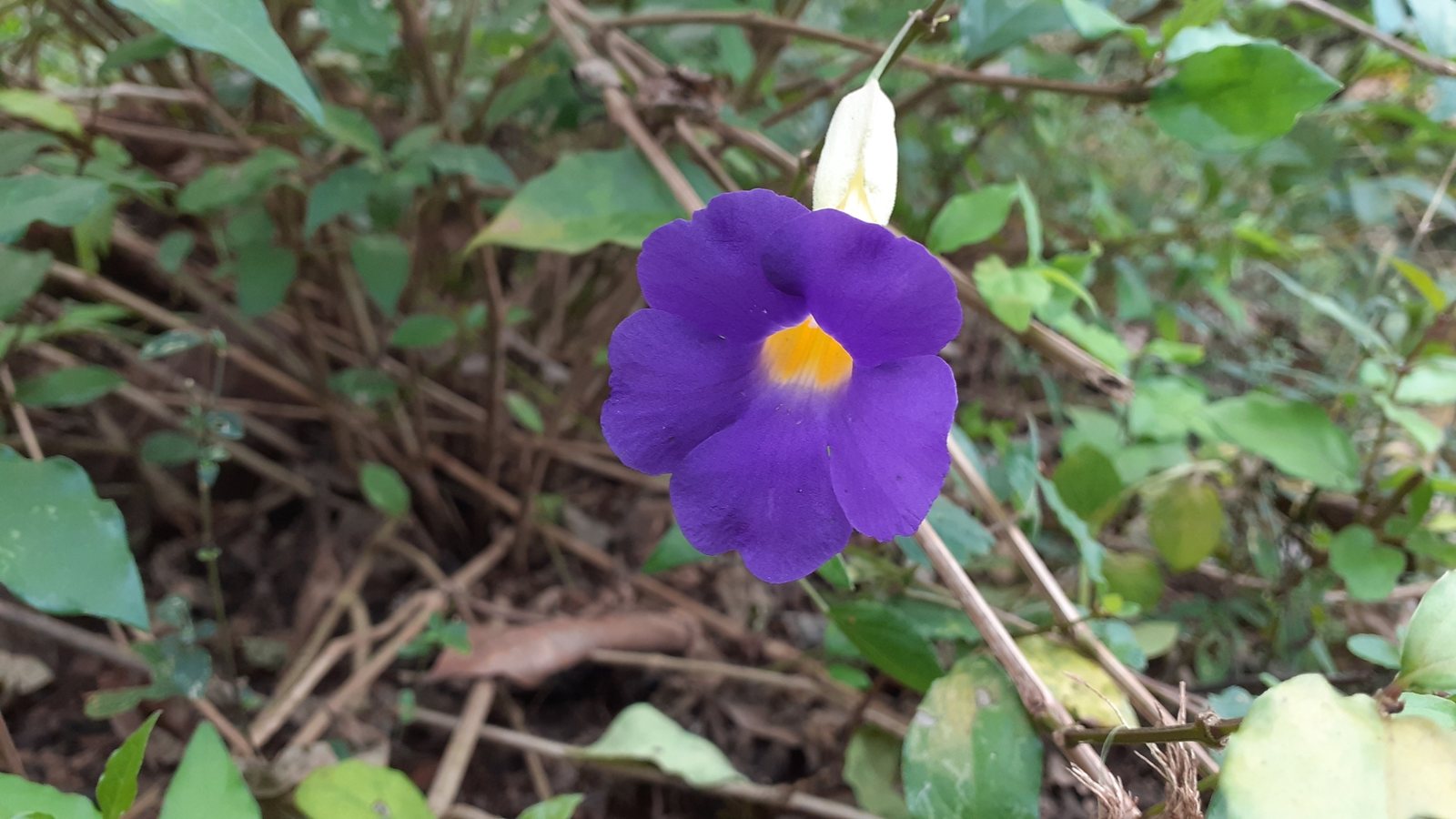
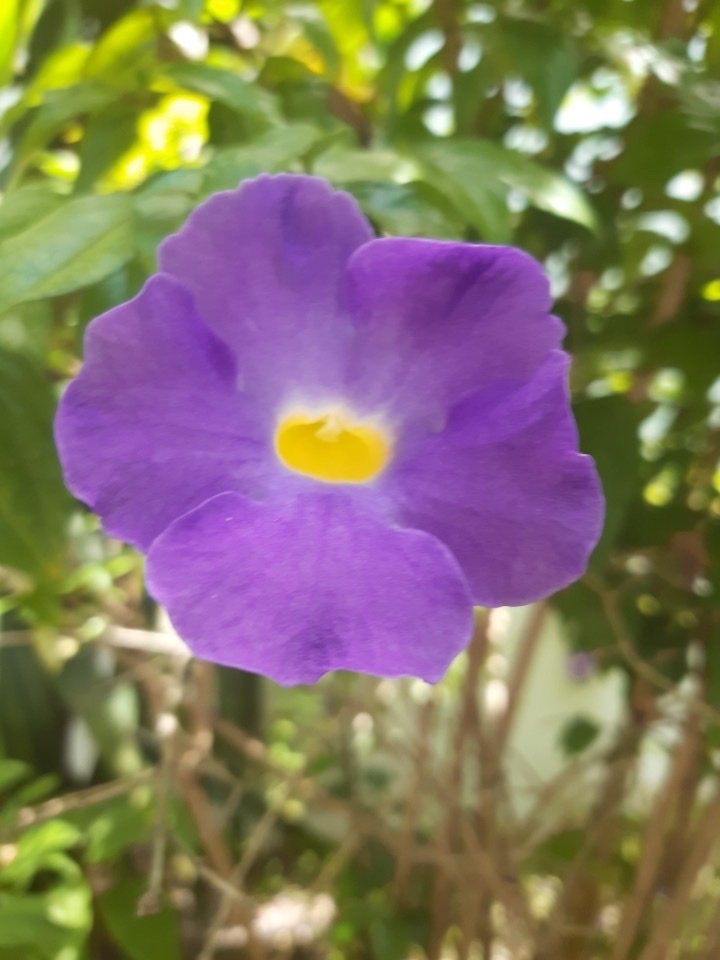
King's mantle is a tropical evergreen shrub grown for its violet-blue, trumpet-shaped flowers with yellow throats. Its arching branches make an informal hedge or flowering backdrop in frost-free gardens; in the United Kingdom, Canada and colder parts of the United States and Australia, grow it in a container and overwinter it indoors.
At a glance
- Sun
- Full sun to partial shade. Morning sun and light afternoon shade suit hot, dry locations; deep shade reduces flowering.
- Water
- Keep the root zone moderately moist while establishing. Once established, water during dry spells; container plants need watering whenever the surface of the compost begins to dry.
- Soil
- Fertile, well-drained soil enriched with compost. Avoid waterlogged ground and pots left standing in water.
- Height
- 4-8 ft (1.2-2.4 m)
- Spread
- 3-6 ft (0.9-1.8 m)
- Flowers
- Violet-blue to deep purple flowers with yellow throats, mainly from summer into autumn; flowering can continue through much of the year in consistently warm climates.
- Foliage
- Evergreen. Small, opposite, oval to narrowly oval, dark green leaves on slender, arching branches.
- Growth
- Moderate to fast in warm weather.
- Care needed
- Medium
The year at a glance
- Pollinators
- Heat tolerant
- Wildlife
- Low allergen
| J | F | M | A | M | J | J | A | S | O | N | D | |
|---|---|---|---|---|---|---|---|---|---|---|---|---|
| Flowers | ||||||||||||
| Plant |
Northern hemisphere months. In Australia, shift them by six.
- Difficulty
- Moderate
- Toughness
- Needs looking after
Will it suit your garden?
Pick your zone, country, light and whether you have pets.
Full sun is 6 or more hours of direct sun a day, part shade 3 to 6 hours, shade under 3.
How it grows
Planting day
1.6 ft (0.5 m)
After 1 year
2.7 ft (0.83 m)
After 2 years
4 ft (1.1 m)
After 3 years
5 ft (1.5 m)
After 5 years
6 ft (1.8 m)
full size
About 4 years to full size.
From a typical nursery size, at an average rate for this kind of plant. A rule of thumb, not a forecast.
Good to know
- Cats and dogs
- Safe
- Growth rate
- Fast
Care
Jobs through the year
- WaterApr–May, Sep, every 14 days
- For established summer bedding, water when dry; containers and new plants need more frequent watering.
- WaterJun–Aug, every 7 days
- Water established plants deeply during dry spells; check containers daily and water as the surface dries.
- WaterJan–Mar, Oct–Dec, every 14 days
- Check frost-free overwintering pots and water sparingly when needed; never let the root ball dry completely.
- FeedApr
- Apply balanced slow-release fertilizer at the label rate as growth resumes.
- MulchMay
- Mulch outdoor root zones with organic matter, keeping stems clear.
- PruneMar–Apr
- Remove dead or crossing branches and shorten straggly shoots as active growth begins.
- ProtectSep–Oct
- Not winter-hardy in zones 6–7: lift or move pots to bright, frost-free shelter before cold nights.
- ProtectMay–Jun
- Gradually acclimatise overwintered plants outdoors once frost risk has passed and nights are warm.
- Water deeply after planting and keep the soil evenly moist until roots establish.
- Apply a balanced slow-release fertiliser in spring at the label rate; avoid heavy nitrogen feeding.
- Spread organic mulch over the root zone, keeping it clear of the stems.
- Use a container with drainage holes and a free-draining potting mix.
- Move container plants into a bright, frost-free place before cold nights arrive; water less during winter without letting the root ball dry completely.
Pruning. Prune in early spring as active growth begins, removing dead or crossing branches and shortening long shoots to shape the shrub. Lightly trim after a flowering flush if needed; repeated close clipping removes flowering growth.
Through the year
- Early spring
- Remove damaged growth and shorten straggly branches as new growth begins.
- Spring
- Feed, refresh mulch and repot container plants if their roots have filled the pot.
- Late spring
- Plant outdoors or move pots outside once frost risk has passed and nights are reliably warm; acclimatise indoor plants gradually.
- Summer
- Check soil moisture regularly, especially in containers, and inspect tender shoots for pests.
- Late summer
- Take semi-ripe cuttings from healthy, non-flowering shoots.
- Autumn
- Bring container plants under cover before frost and reduce watering as growth slows.
- Winter
- Keep overwintering plants in bright, frost-free conditions and check for spider mites and whiteflies.
In the garden
- Grow as a loose flowering hedge in a frost-free garden rather than a tightly clipped boundary.
- Place behind lower plants in a tropical border, where its arching branches provide height and purple flowers.
- Use a large patio container to bring summer colour to gardens where it cannot overwinter outdoors.
- Combine with cream, yellow or lime-green foliage to contrast with the dark leaves and violet flowers.
Garden styles it suits: Tropical, Modern tropical, Modern courtyard, Luxury resort, Florida subtropical and Caribbean.
Plant it with: Tropical hibiscus, Ixora, Pentas, Coleus, Dwarf gardenia and Agapanthus.
Wildlife: Flowers attract bees and other nectar-feeding insects; hummingbirds may visit where they occur. The branching growth provides some shelter for small garden animals.
Problems to watch for
- Spider mites can cause pale, stippled leaves, particularly indoors in dry air. Rinse leaf undersides and treat persistent infestations with a labelled insecticidal soap.
- Whiteflies and scale insects can produce sticky honeydew and sooty mould. Inspect leaf undersides and stems, remove badly affected shoots and use a labelled horticultural oil if needed.
- Waterlogged soil can cause root rot and wilting. Improve drainage, empty saucers and allow the surface of container compost to begin drying between waterings.
- Cold can blacken leaves and kill shoots or the whole plant. Move pots under cover before frost and delay pruning damaged outdoor plants until new growth shows what has survived.
Safety
Not known to be toxic to people, cats, dogs or horses, but species-specific safety information is limited. No particular poisonous part is established; do not treat the leaves, flowers or seeds as edible.
Where it spreads. Has escaped cultivation in parts of tropical Queensland and on Pacific islands. Check local weed guidance before planting in tropical regions, and keep garden waste out of bushland.
Easily confused with
Black-eyed Susan vine (Thunbergia alata)
A twining climber rather than a woody shrub, usually with orange, yellow or white flowers surrounding a dark central eye.
Bengal clock vine (Thunbergia grandiflora)
A vigorous climbing vine with much larger, broad leaves and hanging clusters of pale blue flowers; King's mantle is a shrub with smaller leaves and flowers borne singly or in small groups.
The name
Thunbergia honours the Swedish botanist Carl Peter Thunberg, and erecta means upright, referring to its shrubby habit rather than the climbing growth of many related species.
Propagation. Take softwood cuttings in spring or semi-ripe cuttings in summer and root them in a moist, free-draining medium with warmth and protection from strong sun.
Checked against open data
- Accepted botanical name
- Thunbergia erecta
- In the US and Canada
- Introduced in the lower 48 states and Puerto Rico.
- Native range
- Cameroon, Central African Repu, Congo, Gabon, Ghana, Guinea, Guinea-Bissau, Ivory Coast, Liberia, Nigeria, Rwanda and Senegal.
Sources: GBIF (CC BY 4.0), USDA PLANTS and Trefle (CC BY 4.0). The care and design notes are LandscapeGPT's own.
See it in your own yard.
Upload a photo of your yard and see it redesigned with plants that suit your climate, each checked against your zone.