Large-flowered bellwort
Uvularia grandiflora. Family Colchicaceae. Perennial.
Also called Great merrybells, Large merrybells.
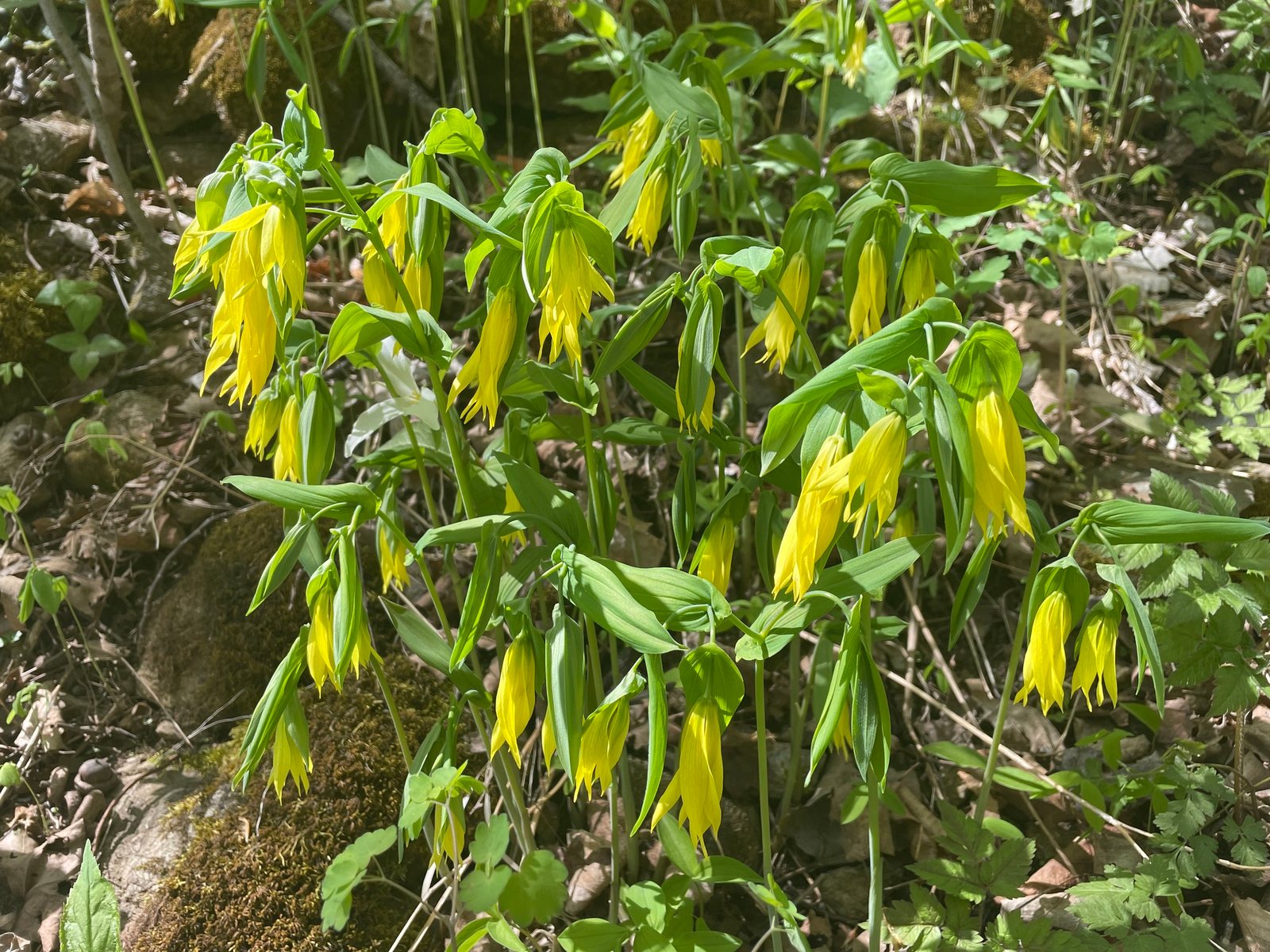
Large-flowered bellwort is a clump-forming woodland perennial native to eastern North America. Gardeners grow it for its dangling yellow spring flowers and softly arching stems, which fit naturally beneath deciduous trees and shrubs.
At a glance
- Sun
- Partial shade to full shade; spring sunshine beneath deciduous trees is suitable, but avoid hot afternoon sun.
- Water
- Keep the soil evenly moist during spring growth. Established plants tolerate some summer dryness, but prolonged drought can cause early dormancy.
- Soil
- Humus-rich, well-drained soil that retains moisture; neutral to mildly acidic or alkaline soil is suitable. Avoid waterlogged ground.
- Height
- 1-2 ft (0.3-0.6 m)
- Spread
- 1-1.5 ft (0.3-0.45 m), gradually widening by short rhizomes
- Flowers
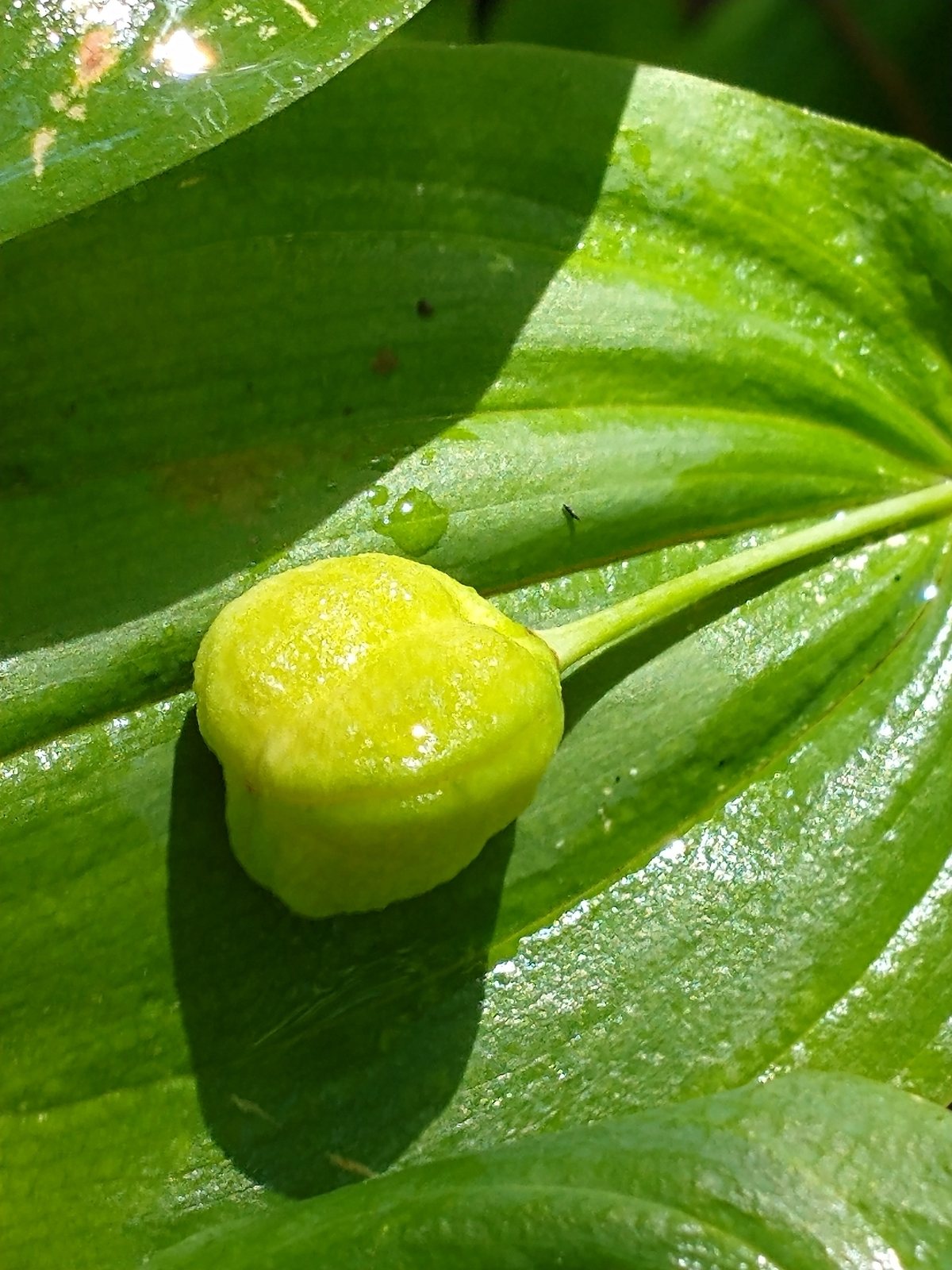
- Mid- to late spring; hanging, pale to clear yellow bells with long, slightly twisted petals.
- Foliage
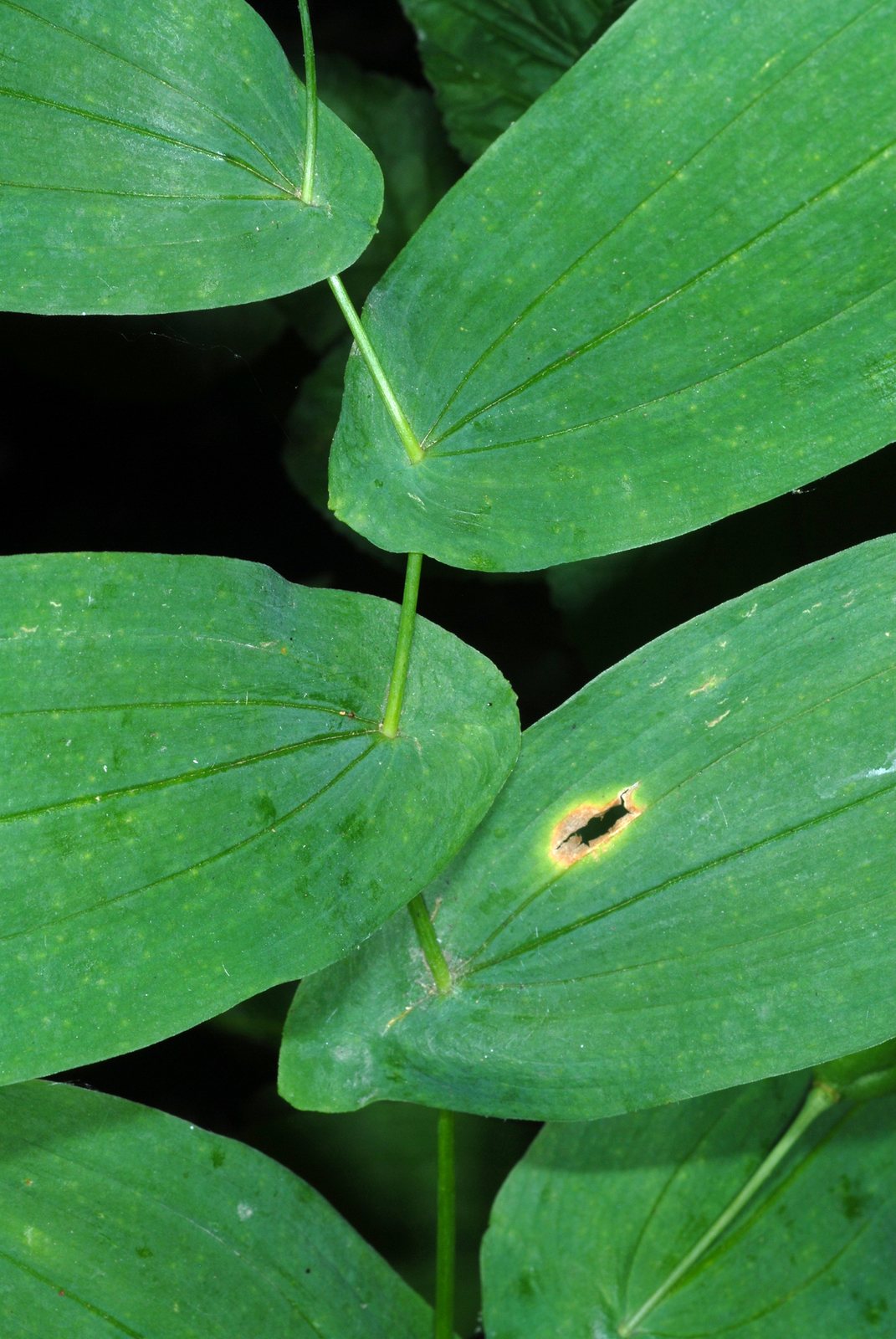
- Soft green, oval leaves clasp the stems so completely that the stems appear to pass through them. Young leaves and shoots have a characteristic drooping appearance; foliage may die back early in dry summers.
- Growth
- Slow to moderate
- Care needed
- Low
The year at a glance
- Pollinators
- Cold hardy
- Low allergen
| J | F | M | A | M | J | J | A | S | O | N | D | |
|---|---|---|---|---|---|---|---|---|---|---|---|---|
| Flowers | ||||||||||||
| Plant |
Northern hemisphere months. In Australia, shift them by six.
- Difficulty
- Easy
- Toughness
- Fairly tough
Will it suit your garden?
Pick your zone, country, light and whether you have pets.
Full sun is 6 or more hours of direct sun a day, part shade 3 to 6 hours, shade under 3.
How it grows
Planting day
1 ft (0.3 m)
After 1 year
1.1 ft (0.34 m)
After 2 years
1.2 ft (0.38 m)
After 3 years
1.4 ft (0.42 m)
After 5 years
1.5 ft (0.45 m)
full size
About 4 years to full size.
From a typical nursery size, at an average rate for this kind of plant. A rule of thumb, not a forecast.
Good to know
- Cats and dogs
- Safe
- Native to
- the US and Canada
- Growth rate
- Slow
Care
Jobs through the year
- WaterMar–May, every 7 days
- Water established clumps when rainfall does not keep actively growing roots evenly moist; check new plants more often.
- WaterJun–Sep, every 14 days
- Water during prolonged dry spells, especially beneath trees; avoid saturating dormant clumps.
- MulchOct–Nov
- Spread a light layer of leaf mould or well-rotted compost, keeping the crown clear.
- PruneFeb
- Carefully remove dead stems and leaves before new shoots emerge.
- DivideMar
- Divide only when necessary, before shoots extend, and replant promptly.
- ProtectMar–May, every 7 days
- Check shoots for slugs and snails; cover with fleece when a hard late frost is forecast.
- ProtectJul–Aug
- Mark any dormant clumps to prevent accidental digging.
- Plant in sheltered woodland shade, with the crown at its previous soil level.
- Water during dry spells while shoots, flowers and leaves are actively growing.
- Apply leaf mould or well-rotted compost each autumn, keeping it clear of the crown.
- Avoid digging around established clumps; the rhizomes and emerging shoots are easily damaged.
- Divide only when necessary, preferably in early spring before growth extends.
Pruning. No shaping is needed. Remove dead stems and leaves after they have yellowed completely, or leave them until late winter.
Through the year
- Late winter
- Clear away dead stems carefully before new shoots emerge.
- Early spring
- Plant dormant nursery-grown plants or divide established clumps if necessary.
- Spring
- Protect emerging shoots from slugs and snails, and water if the soil begins to dry.
- Late spring
- Leave green foliage intact after flowering so the rhizomes can replenish their reserves.
- Summer
- Water during prolonged drought and mark any clumps that become dormant to avoid accidental digging.
- Autumn
- Spread a light mulch of leaf mould or compost over the surrounding soil.
In the garden
- Plant small groups beneath deciduous trees for a quiet display before the canopy closes.
- Combine with ferns and hostas, whose expanding foliage fills gaps if bellwort becomes dormant.
- Use beside shaded paths where the hanging flowers can be seen at close range.
- Mix with other spring woodland flowers in informal drifts on moist, well-drained ground.
Garden styles it suits: Woodland, Wildlife garden, English country, Cottage garden, Secret garden and Low-maintenance.
Plant it with: Hostas, Christmas fern, Trilliums, Virginia bluebells, Solomon's seal and Wild ginger.
Wildlife: The spring flowers provide pollen and nectar for bees, including bumblebees. Deer may browse the foliage.
Problems to watch for
- Slugs and snails can eat emerging shoots: hand-pick them, reduce nearby hiding places and use labelled iron-phosphate bait if necessary.
- Dry soil can cause leaf browning and early dormancy: mulch and water during active growth, especially beneath thirsty trees.
- Waterlogged soil can rot the rhizomes: improve drainage or move the plant to a better-drained position.
- Late frost can damage emerging shoots: cover them with horticultural fleece when a hard frost is forecast.
Safety
Not known to be toxic to people, cats, dogs or horses, but species-specific safety information is limited. No particular poisonous part is established; do not assume the leaves, flowers or rhizomes are safe to eat.
Easily confused with
Perfoliate bellwort (Uvularia perfoliata)
Also has leaves pierced by the stems, but its flowers are generally smaller and paler, with a granular inner surface; large-flowered bellwort has smooth inner flower surfaces.
Sessile-leaved bellwort (Uvularia sessilifolia)
Usually smaller, with cream to pale yellow flowers and leaves attached at their bases rather than surrounding the stems.
The name
Uvularia refers to the hanging flowers' resemblance to a uvula, while grandiflora means large-flowered and bellwort describes the bell-shaped blooms.
Propagation. Divide established clumps carefully in early spring, retaining roots and growth buds on each piece. Fresh seed can be sown outdoors in a sheltered pot, but germination is slow and may take more than one seasonal cycle; seedlings take several years to flower.
Checked against open data
- Accepted botanical name
- Uvularia grandiflora
- In the US and Canada
- Native in Canada and the lower 48 states.
- Native range
- Alabama, Arkansas, Connecticut, Georgia, Illinois, Indiana, Iowa, Kansas, Kentucky, Manitoba, Maryland and Masachusettes.
- Measured
- Average height 34 cm.
Sources: GBIF (CC BY 4.0), USDA PLANTS and Trefle (CC BY 4.0). The care and design notes are LandscapeGPT's own.
See it in your own yard.
Upload a photo of your yard and see it redesigned with plants that suit your climate, each checked against your zone.