Meadow blazing star
Liatris ligulistylis. Family Asteraceae. Perennial.
Also called Rocky Mountain blazing star, Northern plains blazing star, Round-headed blazing star.
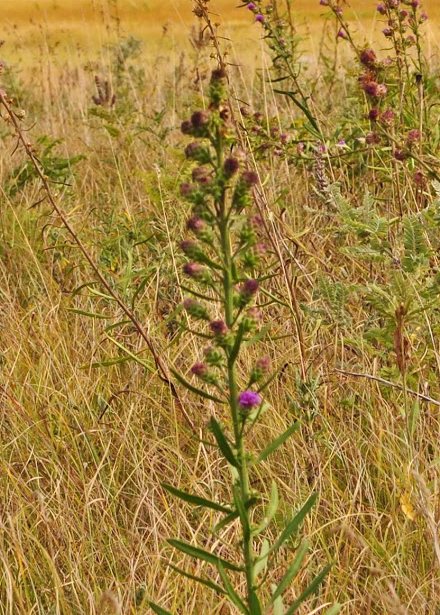
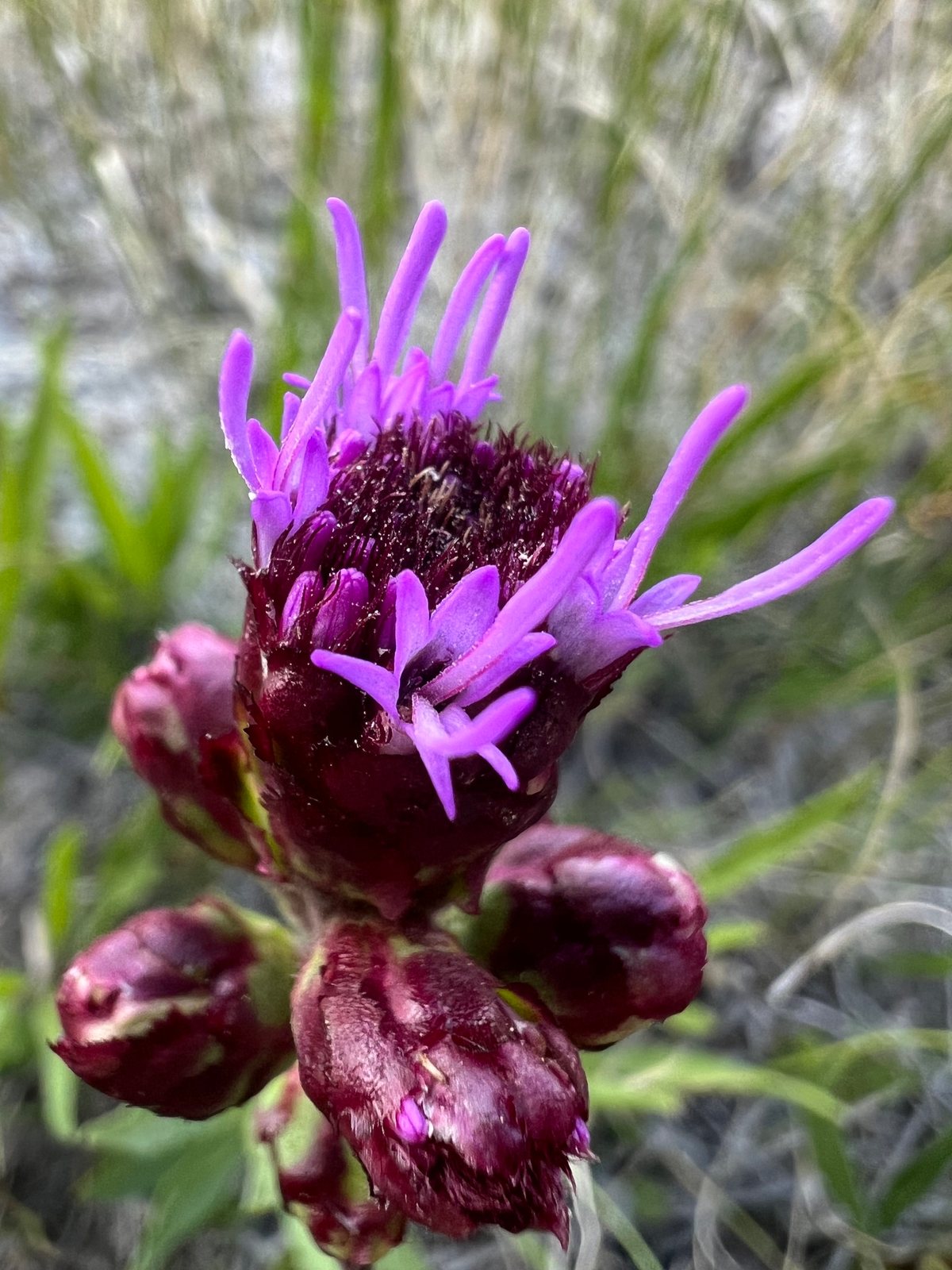
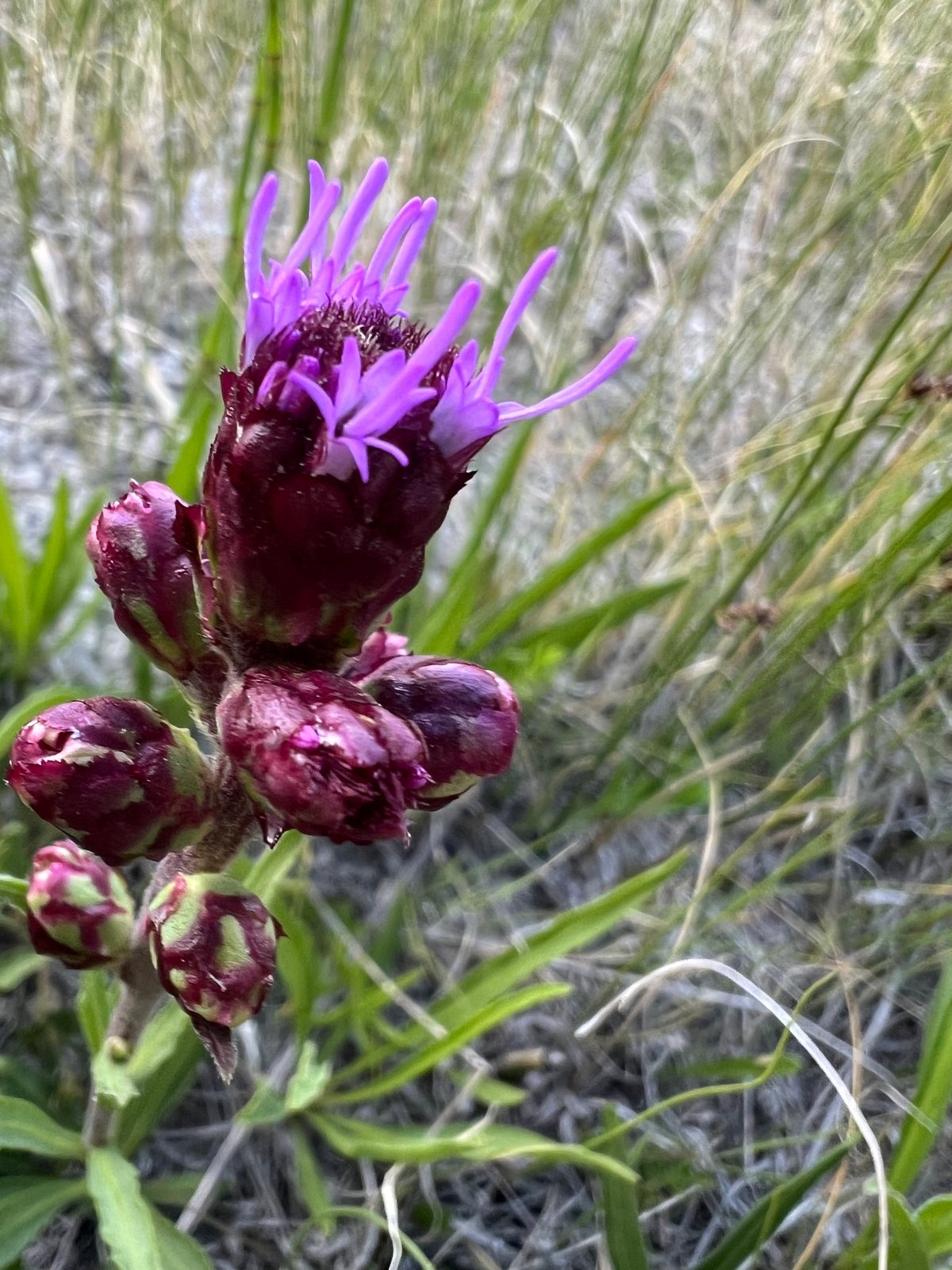
Meadow blazing star is a clump-forming perennial native to central North America, with tall stems bearing loose clusters of shaggy purple flower heads. Gardeners grow it for late-summer colour, its airy shape among grasses and its strong attraction to butterflies, especially monarchs.
At a glance
- Sun
- Full sun; tolerates light shade, but stems may lean and flowering is reduced.
- Water
- Moderate; water regularly while establishing, then during prolonged dry spells. Established plants tolerate some drought but flower best with occasional deep watering.
- Soil
- Well-drained sandy, loamy or clay soil with moderate fertility. Avoid waterlogged ground, particularly in winter.
- Height
- 3-5 ft (0.9-1.5 m)
- Spread
- 1-2 ft (0.3-0.6 m)
- Flowers
- Mid-summer to early autumn; rosy-purple to violet-purple flower heads open progressively from the upper part of each stem downward.
- Foliage
- Narrow green leaves, larger near the base and smaller along the flowering stems; dies back in winter.
- Growth
- Moderate; young plants may take two or three growing seasons to form substantial flowering clumps.
- Care needed
- Low
The year at a glance
- Pollinators
- Drought tolerant
- Cold hardy
- Wildlife
- Low allergen
| J | F | M | A | M | J | J | A | S | O | N | D | |
|---|---|---|---|---|---|---|---|---|---|---|---|---|
| Flowers | ||||||||||||
| Fruit | ||||||||||||
| Plant |
Northern hemisphere months. In Australia, shift them by six.
- Difficulty
- Easy
- Toughness
- Very tough
Will it suit your garden?
Pick your zone, country, light and whether you have pets.
Full sun is 6 or more hours of direct sun a day, part shade 3 to 6 hours, shade under 3.
How it grows
Planting day
1 ft (0.3 m)
After 1 year
2 ft (0.6 m)
After 2 years
3 ft (0.9 m)
After 3 years
4 ft (1.2 m)
full size
About 3 years to full size.
From a typical nursery size, at an average rate for this kind of plant. A rule of thumb, not a forecast.
Good to know
- Cats and dogs
- Safe
- Native to
- the US and Canada
- Growth rate
- Moderate
Care
Jobs through the year
- WaterApr–May, Sep, every 21 days
- Water established plants only if dry; check young plants more often during establishment.
- WaterJun–Aug, every 14 days
- Give established plants a deep watering during prolonged dry spells.
- FeedApr
- Add a light compost dressing only on poor soil; otherwise omit feeding.
- MulchApr
- Use a thin mulch layer and keep it away from the crown.
- DivideMar–Apr
- Divide crowded clumps only if flowering declines, retaining healthy buds and roots.
- ProtectMay–Jun
- Add discreet supports before tall stems lean, particularly in exposed gardens.
- DeadheadAug–Sep
- Remove faded stems only if seedlings are unwanted; otherwise leave seed heads for birds.
- PruneFeb–Mar
- Cut old stems near ground level; retain occupied hollow stems nearby until insects emerge.
- ProtectJan–Feb, Nov–Dec
- Cover outdoor seed pots with rodent-proof mesh while allowing natural winter chilling.
- Water deeply during the first growing season, letting the soil surface dry between waterings.
- Avoid rich feeding; apply a light dressing of compost in spring only if the soil is poor.
- Keep mulch thin and clear of the crown to discourage rot.
- Support tall stems early with twiggy stakes or grow them among sturdy grasses, especially in exposed gardens.
- Divide crowded clumps in spring if flowering declines; routine annual division is unnecessary.
Pruning. Leave spent stems standing through winter for seed-eating birds and structure, then cut them close to ground level in late winter or early spring before new shoots emerge. Remove individual faded flower stems earlier if you want to limit self-seeding.
Through the year
- Late winter
- Cut down old stems before new growth begins, leaving any occupied hollow stems nearby until insects have emerged.
- Spring
- Plant container-grown plants in a sunny, well-drained position and water thoroughly.
- Spring
- Divide established clumps if needed, keeping healthy buds and roots on each division.
- Early summer
- Add discreet supports before stems become tall enough to lean.
- Summer
- Water during prolonged dry spells and check that neighbouring plants are not shading the crown.
- Autumn
- Leave seed heads for birds, or collect ripe seed when the heads become dry and fluffy.
- Late autumn
- Sow seed outdoors in pots protected from rodents so winter cold can help break dormancy.
In the garden
- Plant in loose groups through prairie-style borders with little bluestem and switchgrass for tall purple accents.
- Place in the middle or back of a sunny mixed border, where lower plants can conceal the sparse lower stems.
- Combine with goldenrods and black-eyed Susans for contrasting purple and yellow late-season flowers.
- Use beside a sunny path or seating area where visiting butterflies can be watched closely.
Garden styles it suits: Native meadow, Midwest prairie, New perennial (prairie), Pollinator garden, Wildlife garden and Cottage garden.
Plant it with: Little bluestem, Prairie dropseed, Purple coneflower, Black-eyed Susan, Showy goldenrod and Aromatic aster.
Wildlife: The nectar-rich flowers attract monarchs, swallowtails and many other butterflies, as well as bees. Finches and other seed-eating birds may feed on the ripe seed heads.
Problems to watch for
- Crown or root rot in wet soil: improve drainage or move plants to higher ground; keep winter mulch away from the crown.
- Powdery mildew in crowded conditions: increase spacing and airflow, and water at soil level rather than wetting the leaves.
- Voles and other rodents eating the underground corms: reduce dense cover around affected plants and use buried wire-mesh protection where damage persists.
- Flopping stems in shade or over-rich soil: move to full sun, stop high-nitrogen feeding and provide discreet supports.
Safety
Not known to be toxic to cats, dogs, horses or people. Species-specific safety information is limited, and no part should be treated as food; discourage pets and children from eating it.
Easily confused with
Dense blazing star (Liatris spicata)
Its smaller flower heads are packed closely against the stem in a dense, wand-like spike; meadow blazing star has larger, more widely spaced heads on noticeable short stalks.
Prairie blazing star (Liatris pycnostachya)
It forms a densely packed, cylindrical flower spike rather than the loose arrangement of rounded, stalked heads found on meadow blazing star.
The name
The species name ligulistylis refers to its tongue- or strap-shaped styles, the slender structures projecting from the tiny flowers.
Propagation. Divide established clumps in early spring, retaining roots and at least one healthy growing point on each piece. Grow from seed sown outdoors in autumn, or give spring-sown seed about 8-12 weeks of cold, moist treatment; seedlings commonly need two or more growing seasons to flower.
Checked against open data
- Accepted botanical name
- Liatris ligulistylis
- In the US and Canada
- Native in Canada and the lower 48 states.
- Native range
- Alberta, Colorado, Iowa, Manitoba, Minnesota, Montana, New Mexico, North Dakota, Saskatchewan, South Dakota, Wisconsin and Wyoming.
Sources: GBIF (CC BY 4.0), USDA PLANTS and Trefle (CC BY 4.0). The care and design notes are LandscapeGPT's own.
See it in your own yard.
Upload a photo of your yard and see it redesigned with plants that suit your climate, each checked against your zone.