Singapore frangipani
Plumeria obtusa. Family Apocynaceae. Tree.
Also called Singapore plumeria, White frangipani, Evergreen frangipani.
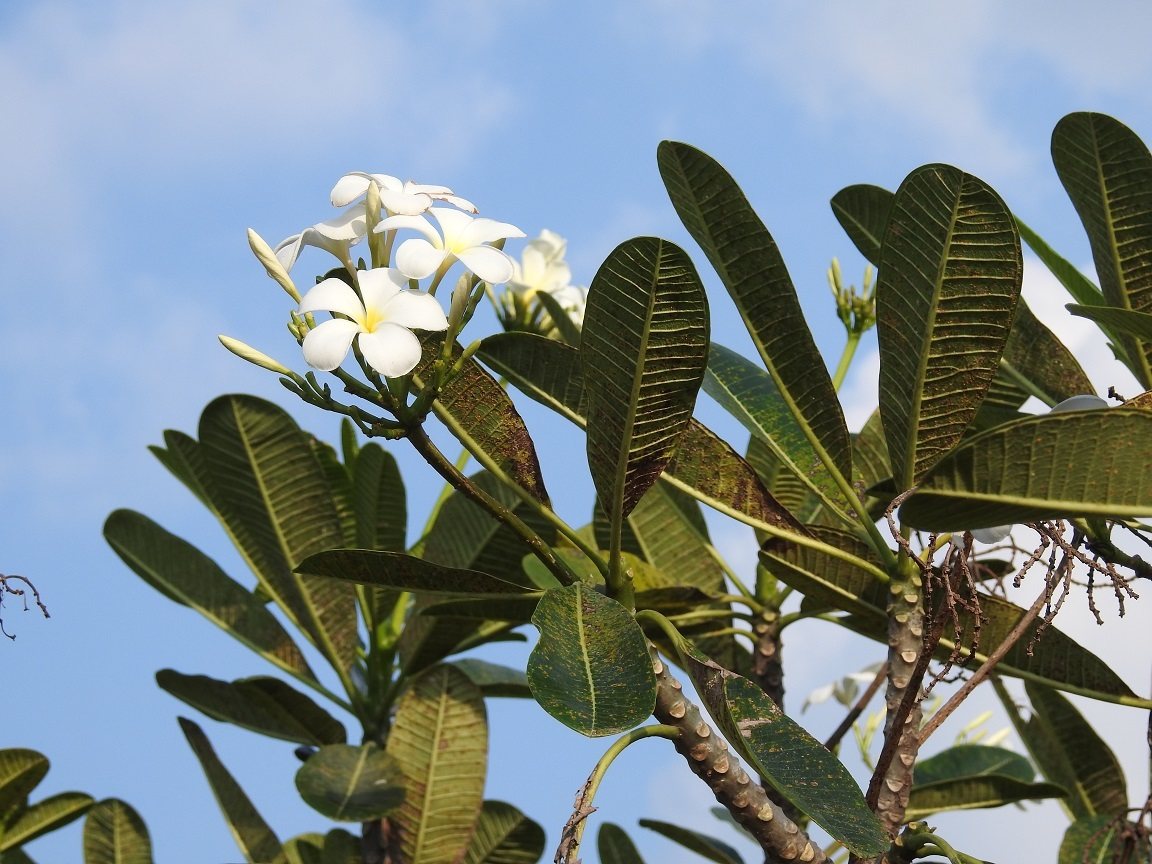
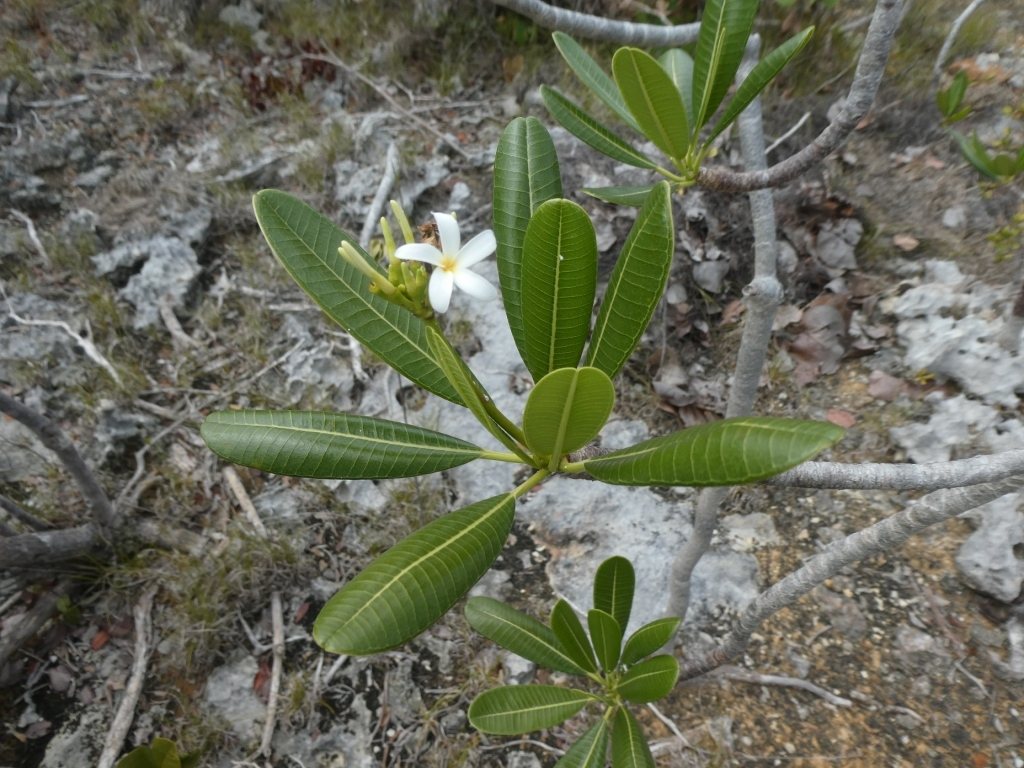
Singapore frangipani is a small tropical tree grown for its fragrant, white, yellow-centred flowers and glossy, rounded-tip leaves. It makes a spreading specimen near a warm patio or courtyard, but in most of the United States, the United Kingdom and Canada it needs a container and a frost-free winter home.
At a glance
- Sun
- Full sun gives the best flowering; light afternoon shade is acceptable in very hot climates.
- Water
- Water thoroughly during active growth, then let the upper soil dry before watering again. Water much less in cool weather, especially if leaves fall.
- Soil
- Well-drained sandy or loamy soil; avoid waterlogged ground. For containers, use a coarse potting mix amended with pumice, perlite or fine bark.
- Height
- 10-25 ft (3-7.6 m)
- Spread
- 10-20 ft (3-6 m)
- Flowers
- Clusters of fragrant white flowers with yellow centres, mainly from late spring through autumn; flowering can continue intermittently all year in tropical conditions.
- Foliage
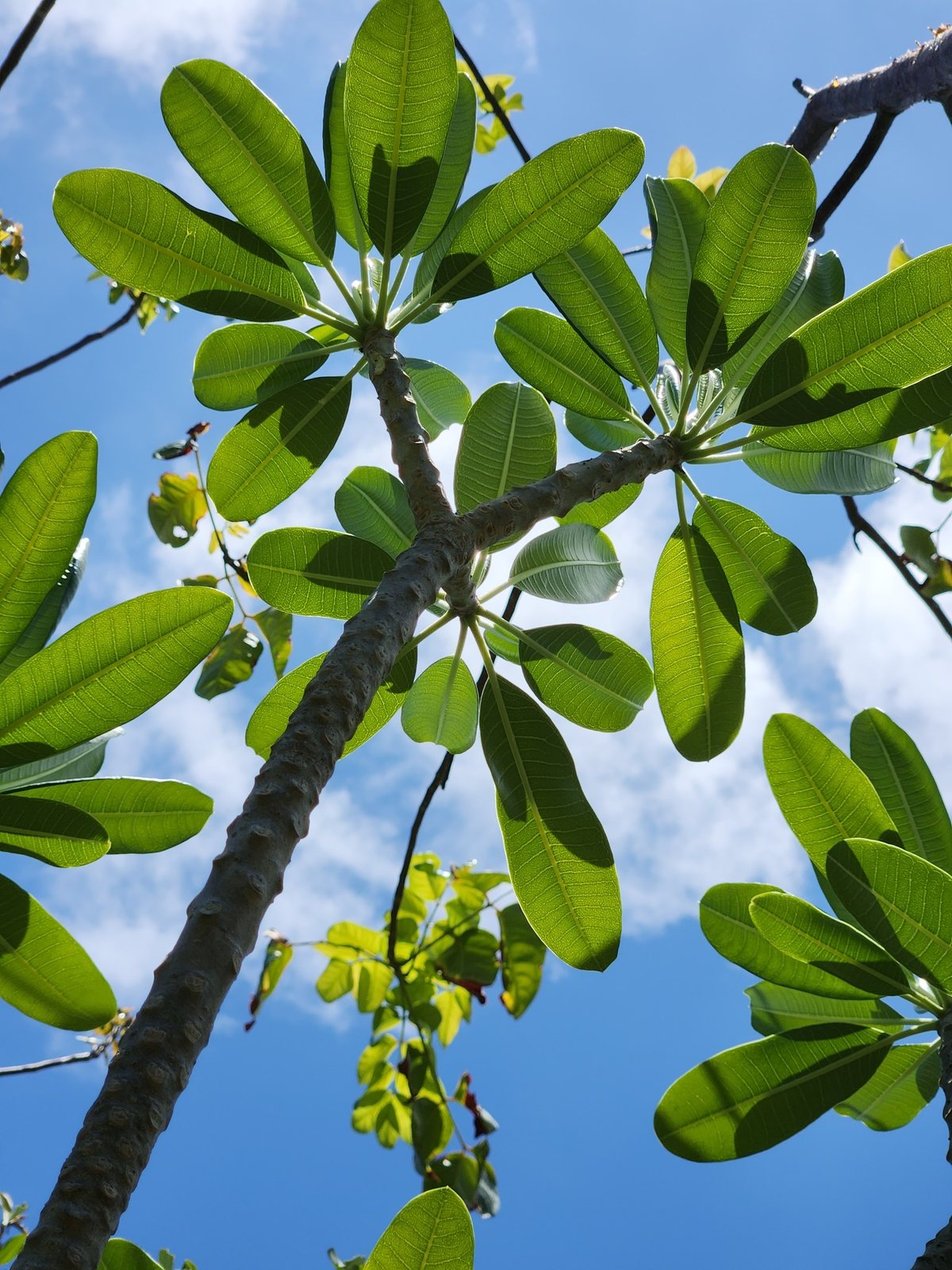
- Evergreen. Thick, glossy, dark green leaves with blunt or rounded tips, clustered towards the ends of fleshy branches. Leaves may drop during cool or dry weather.
- Growth
- Slow to moderate; faster in sustained tropical warmth.
- Care needed
- Medium
The year at a glance
- Drought tolerant
- Heat tolerant
- Low allergen
- Fragrant
| J | F | M | A | M | J | J | A | S | O | N | D | |
|---|---|---|---|---|---|---|---|---|---|---|---|---|
| Flowers | ||||||||||||
| Plant |
Northern hemisphere months. In Australia, shift them by six.
- Difficulty
- Moderate
- Toughness
- Fairly tough
Will it suit your garden?
Pick your zone, country, light and whether you have pets.
Full sun is 6 or more hours of direct sun a day, part shade 3 to 6 hours, shade under 3.
How it grows
Planting day
7 ft (2 m)
After 1 year
7 ft (2.2 m)
After 2 years
8 ft (2.3 m)
After 3 years
8 ft (2.5 m)
After 5 years
9 ft (2.8 m)
About 20 years to full size.
From a typical nursery size, at an average rate for this kind of plant. A rule of thumb, not a forecast.
Good to know
- Cats and dogs
- Toxic
- Native to
- the US
- Growth rate
- Moderate
Care
Jobs through the year
- WaterApr–May, Sep–Oct, every 14 days
- Water established ground plants when the upper soil dries; young plants and pots need closer monitoring.
- WaterJun–Aug, every 7 days
- Soak established ground plants during dry weather, allowing the upper soil to dry before watering again.
- WaterJan–Mar, Nov–Dec, every 21 days
- Check sheltered pots and water sparingly only as needed; reduce further if leaves fall.
- FeedMay–Aug, every 28 days
- Feed actively growing pots with balanced flowering-plant fertiliser at the label rate.
- MulchJun
- Apply a light mulch over outdoor roots, keeping the trunk clear.
- PruneApr–May
- Remove dead or crossing branches sparingly as growth resumes; retain flowering tips and wear gloves.
- ProtectJan–May, Sep–Dec
- Grow in a movable container here; bring into bright frost-free shelter before nights fall below 10°C.
- Plant in a sunny, sheltered position after the soil has warmed; protect from frost and cold winds.
- Water deeply during warm growth, allowing the upper soil to dry between waterings; never leave a pot standing in water.
- Feed container plants with a balanced flowering-plant fertiliser at the label rate during active growth; stop feeding in cool weather.
- Apply a light mulch over the root zone, keeping it clear of the trunk.
- In cool climates, move pots into a bright, frost-free space before nights regularly fall below 50°F (10°C), and reduce watering.
Pruning. Prune sparingly in spring as warmth returns, removing dead, damaged or crossing branches and shortening only those needed to control size. Cuts remove flowering tips and may delay bloom; wear gloves and avoid contact with the milky sap.
Through the year
- Early spring
- Check overwintered plants for pests and remove dead or rotted growth as temperatures rise.
- Spring
- Repot only when root-bound, using a free-draining mix; resume watering gradually as growth starts.
- Late spring
- Move container plants outside once nights are consistently warm, introducing direct sun gradually.
- Summer
- Water thoroughly between drying periods and feed container plants according to the fertiliser label.
- Late summer
- Inspect leaves for rust and spider mites, and remove fallen diseased leaves.
- Autumn
- In cool climates, bring pots under cover before cold nights arrive and reduce watering as growth slows.
- Winter
- Keep sheltered plants bright and frost-free, watering sparingly without allowing the root ball to remain wet.
In the garden
- Use as a small specimen tree beside a sunny patio, leaving space for its broad canopy.
- Grow in a large container in a warm courtyard where the flowers can be seen and smelled nearby.
- Pair with cycads and clumping ornamental grasses for contrasting leaf shapes in a tropical planting.
- Place against a dark wall or evergreen backdrop to highlight its white flowers and branching silhouette.
Garden styles it suits: Modern tropical, Luxury resort, Modern courtyard, Tropical, Sensory garden and White garden.
Plant it with: Sago palm, Bird of paradise, Lomandra, Agapanthus and Society garlic.
Wildlife: The fragrant flowers attract moths and other flower visitors. Like other plumerias, the flowers offer little or no nectar, so this is not a strong nectar plant for a pollinator garden.
Problems to watch for
- Frangipani rust causes yellow-orange powdery spots beneath leaves and premature leaf drop. Collect fallen leaves, improve airflow and avoid wetting foliage; use a locally approved fungicide only if repeated severe attacks justify treatment.
- Root and stem rot follow prolonged wetness, especially in cool weather. Improve drainage, reduce watering and remove soft, rotten tissue with clean tools.
- Spider mites cause fine stippling, webbing and dull leaves, particularly indoors. Rinse leaf undersides and treat persistent infestations with insecticidal soap labelled for the plant.
- Cold damage causes blackened tips, leaf loss and soft stems. Move pots under cover before cold weather and wait until spring growth reveals the damage before pruning back to firm tissue.
Safety
Treat all parts as toxic if eaten, especially the milky sap. In people, cats and dogs, chewing or swallowing plant material can cause mouth irritation, vomiting or diarrhoea; sap can irritate skin and eyes. Serious poisoning is uncommon, but species-specific information for horses is limited, so keep it away from grazing animals.
Easily confused with
Red frangipani (Plumeria rubra)
Usually has longer, pointed leaves and is more consistently deciduous. Its flowers may be white, yellow, pink, red or mixed, so flower colour alone is not reliable.
Bridal bouquet (Plumeria pudica)
Has distinctive spoon- or fiddle-shaped leaves with a narrowed middle, rather than the broad, rounded-tip leaves of Singapore frangipani; its white flowers are usually little scented.
The name
Plumeria honours the French botanist Charles Plumier, and obtusa means blunt, referring to the rounded leaf tips.
Propagation. Take healthy stem cuttings in warm weather, let the cut ends dry and callus, then root them in a very free-draining medium with warmth and restrained watering. This species can be slower and less reliable to root than some other frangipanis. Seed is another option, but seedlings may differ from the parent.
Checked against open data
- Accepted botanical name
- Plumeria obtusa
- In the US and Canada
- Native in the lower 48 states, Puerto Rico and US Virgin Islands. Introduced in Pacific Basin.
- Native range
- Bahamas, Belize, Cayman Is., Cuba, Dominican Republic, Guatemala, Haiti, Jamaica, Mexico Southeast, Puerto Rico, Southwest Caribbean and Turks-Caicos Is..
- Measured
- Average height 890 cm.
Sources: GBIF (CC BY 4.0), USDA PLANTS and Trefle (CC BY 4.0). The care and design notes are LandscapeGPT's own.
See it in your own yard.
Upload a photo of your yard and see it redesigned with plants that suit your climate, each checked against your zone.