Texas olive
Cordia boissieri. Family Cordiaceae. Tree.
Also called Mexican olive, Anacahuita, White cordia.
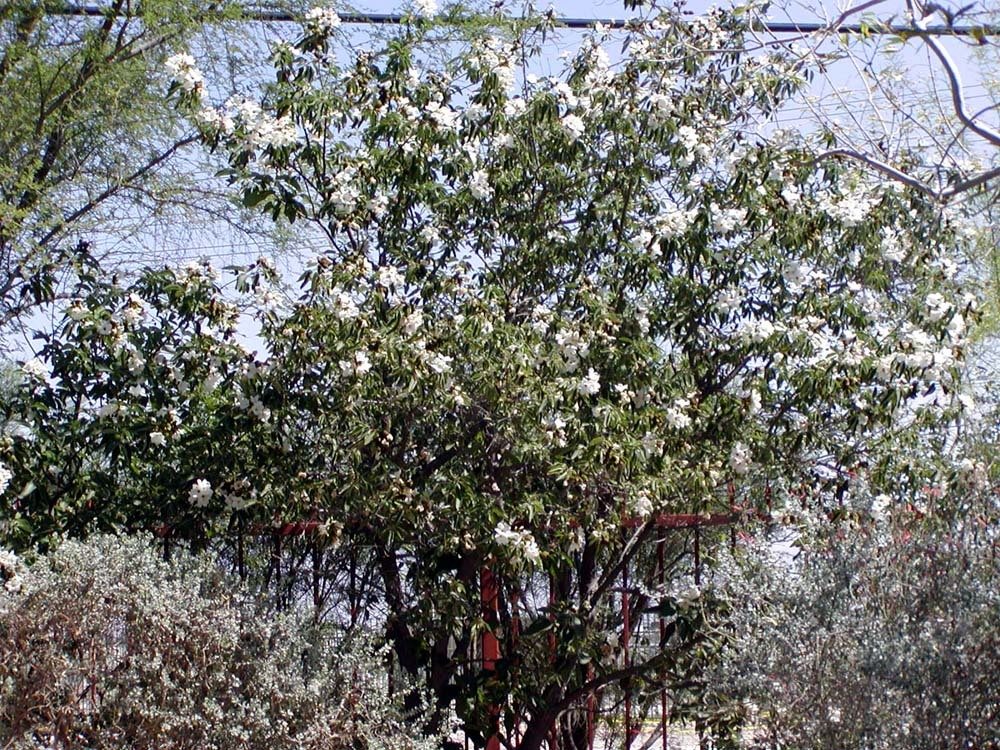
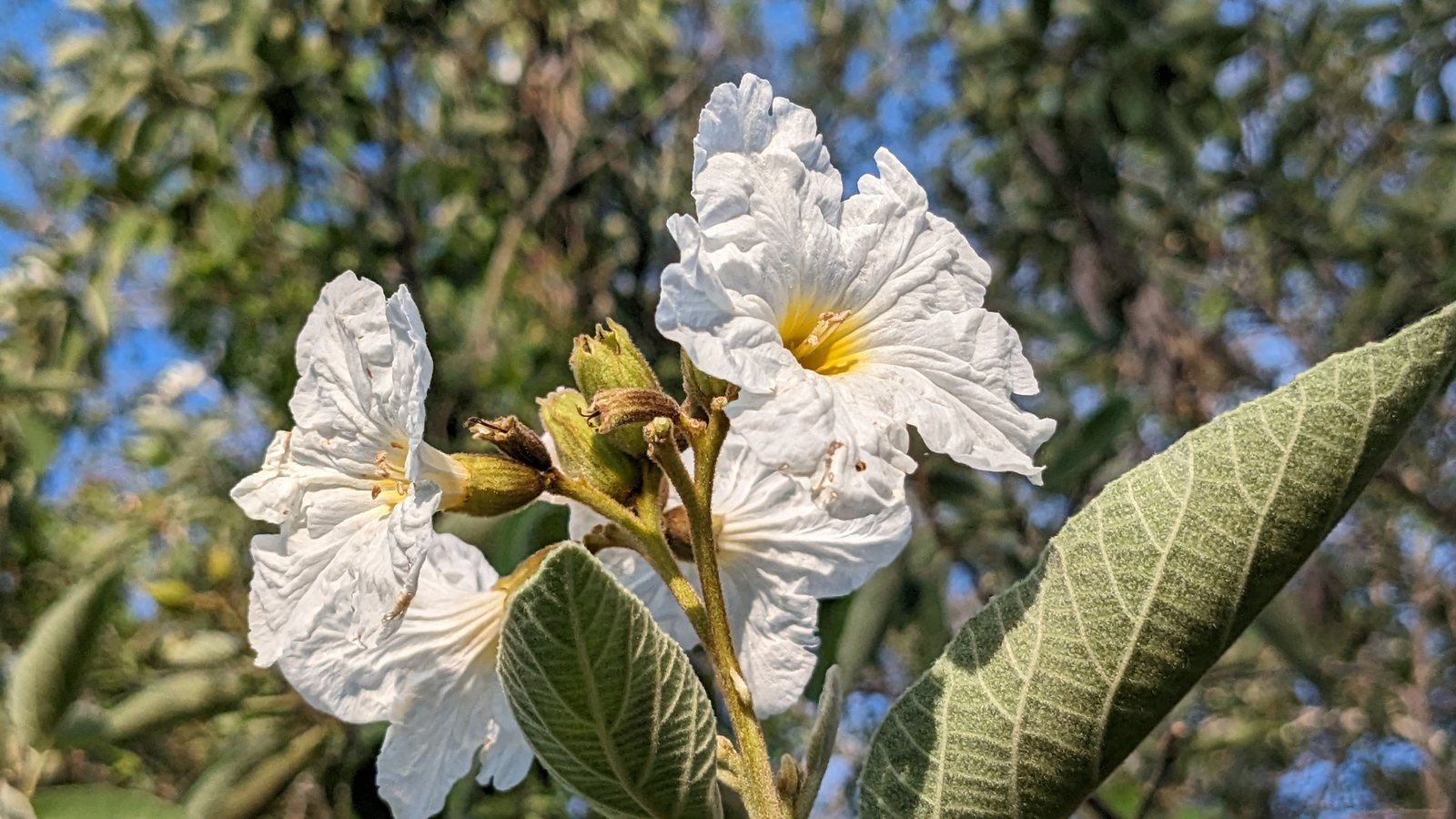
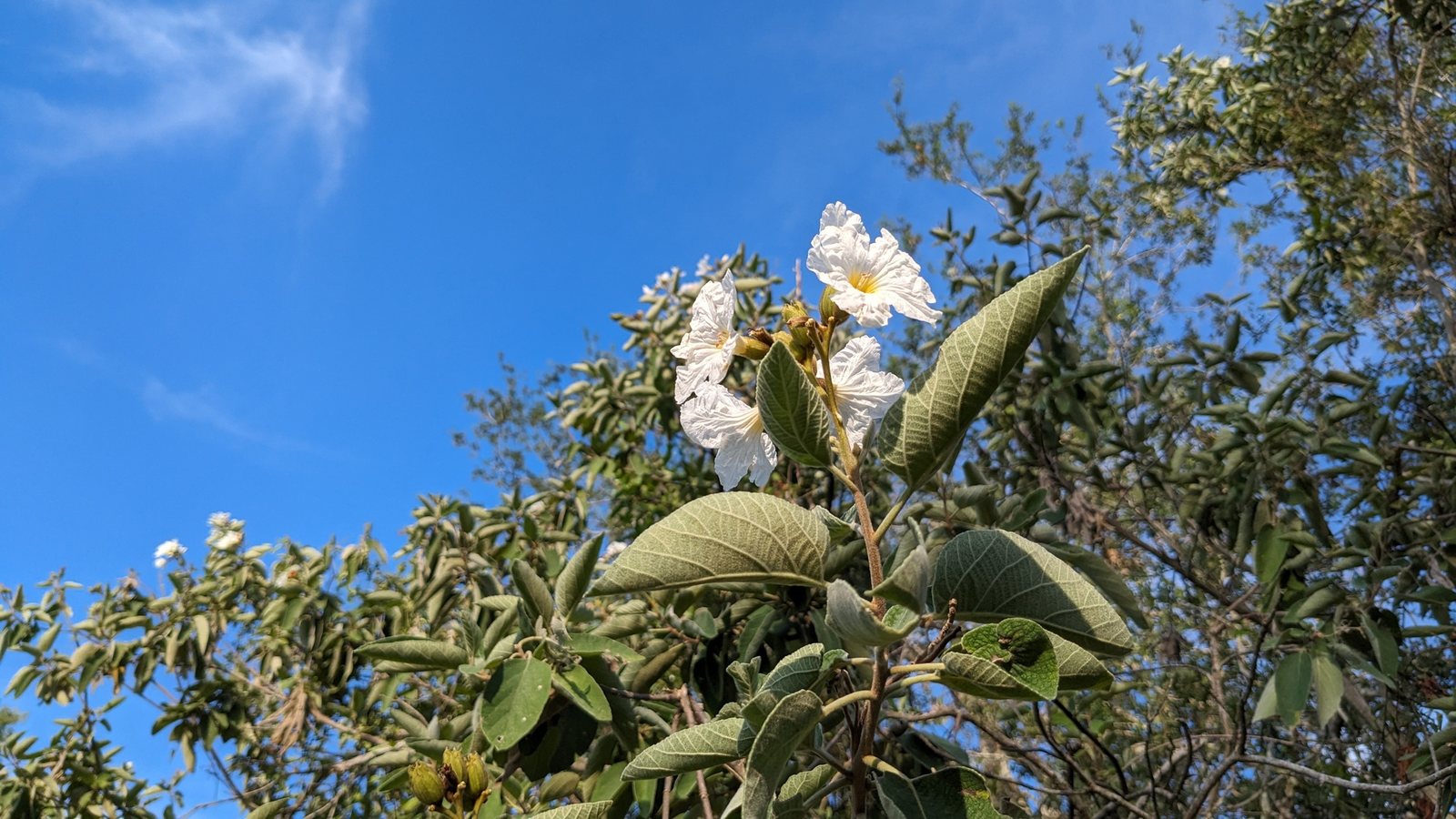
Texas olive is a small flowering tree native to southern Texas and northeastern Mexico, grown for its white, yellow-throated flowers and broad, grey-green leaves. It tolerates heat, drought and alkaline soil once established, but needs protection from hard freezes. Despite its common name and olive-like fruit, it is not a true olive.
At a glance
- Sun
- Full sun for the best flowering; tolerates light partial shade.
- Water
- Water regularly while establishing, then deeply during prolonged dry spells. Let the soil dry between waterings.
- Soil
- Well-drained sandy, loamy or rocky soil, including alkaline limestone soils; avoid persistently wet ground.
- Height
- 15-25 ft (4.6-7.6 m)
- Spread
- 10-20 ft (3-6.1 m)
- Flowers
- White, funnel-shaped flowers with yellow throats, produced in clusters from spring through autumn; flowering can continue intermittently through mild winters.
- Foliage
- Broad, oval, grey-green leaves with a rough, hairy surface. Evergreen in frost-free conditions, but may lose leaves in cold weather or severe drought.
- Growth
- Moderate
- Care needed
- Low
The year at a glance
- Pollinators
- Drought tolerant
- Heat tolerant
- Wildlife
- Low allergen
| J | F | M | A | M | J | J | A | S | O | N | D | |
|---|---|---|---|---|---|---|---|---|---|---|---|---|
| Flowers | ||||||||||||
| Fruit | ||||||||||||
| Plant |
Northern hemisphere months. In Australia, shift them by six.
- Difficulty
- Hard
- Toughness
- Fairly tough
Will it suit your garden?
Pick your zone, country, light and whether you have pets.
Full sun is 6 or more hours of direct sun a day, part shade 3 to 6 hours, shade under 3.
How it grows
Planting day
7 ft (2 m)
After 1 year
7 ft (2.2 m)
After 2 years
8 ft (2.4 m)
After 3 years
9 ft (2.6 m)
After 5 years
10 ft (3 m)
About 20 years to full size.
From a typical nursery size, at an average rate for this kind of plant. A rule of thumb, not a forecast.
Good to know
- Cats and dogs
- Mildly toxic: may upset a stomach
- Native to
- the US
- Growth rate
- Moderate
Care
Jobs through the year
- WaterMay, Sep–Oct, every 21 days
- For established ground plants, water deeply only during prolonged drought; young and potted trees need more frequent checks.
- WaterJun–Aug, every 14 days
- Water established ground plants deeply during prolonged drought, letting soil dry between soakings.
- MulchMay
- Spread 5–8 cm of organic mulch over roots, keeping the trunk clear.
- FeedApr–May
- Apply a modest balanced feed only if growth is weak.
- PruneMay
- After frost risk passes, remove dead or crossing branches; preserve the natural crown.
- ProtectJan–Apr, Oct–Dec
- Not reliably hardy in zones 6–7 or the UK; grow in a movable container and keep bright and frost-free.
- WaterJan–Apr, Nov–Dec, every 14 days
- Check sheltered container soil; water sparingly when partly dry, never leaving roots saturated.
- Plant after frost danger has passed, in a sunny position sheltered from cold winds.
- Water the root ball and surrounding soil deeply during establishment, allowing the surface to dry between waterings.
- Once established, water during extended drought rather than giving frequent light sprinklings.
- Spread 2-3 in (5-8 cm) of mulch over the root area, keeping it clear of the trunk.
- Avoid heavy feeding; use a modest application of balanced fertiliser in spring only if growth is weak.
- Protect young trees from frost with horticultural fleece, and keep container-grown plants frost-free.
Pruning. Prune lightly in late winter or early spring after the risk of hard frost has passed, removing dead, crossing or poorly placed branches. Train young plants gradually into a small tree or multi-stemmed shrub; avoid topping.
Through the year
- Late winter
- Check for cold damage, but leave final pruning until hard frosts are unlikely.
- Spring
- Plant new trees after frost danger has passed and begin deep establishment watering.
- Late spring
- Refresh mulch and remove unwanted shoots if training a clear trunk.
- Summer
- Water during prolonged drought and check leaves and stems for scale insects.
- Autumn
- Clear fallen fruit from paving and reduce watering as temperatures fall.
- Winter
- Protect young plants during freezes; move containers to a bright, frost-free shelter.
In the garden
- Use as a small specimen tree in a sunny courtyard where its flowers can be seen closely.
- Combine with agaves, yuccas and gravel for a drought-tolerant planting with contrasting leaf shapes.
- Plant in a loose mixed screen with other heat-tolerant shrubs, allowing room for its rounded crown.
- Use as a flowering focal point in a white garden, away from paving where fallen fruit could be a nuisance.
Garden styles it suits: Southwestern, Desert / xeriscape, Desert modern, Modern courtyard, White garden and Pollinator garden.
Plant it with: Red yucca, Texas sage, Autumn sage, Blackfoot daisy, Damianita and Gulf muhly.
Wildlife: Flowers attract bees and butterflies. Birds and other wildlife eat the fruit, and the branching crown provides cover.
Problems to watch for
- Freeze damage: leaves and young stems can die back in hard freezes. Use a sheltered site, protect young trees and wait for new growth before removing damaged wood.
- Root rot in wet soil: avoid low spots and frequent irrigation; improve drainage or replant on a broad raised mound.
- Scale insects: inspect stems and leaf undersides; treat significant infestations with horticultural oil according to the label, avoiding hot weather.
- Poor flowering in shade: provide full sun and avoid excessive nitrogen fertiliser.
Safety
The fruit is reported to cause stomach upset and dizziness when eaten raw, so do not treat it as an edible olive. Reliable information on toxicity to cats, dogs and horses is limited; keep pets and livestock from eating the fruit. Wildlife eating it does not establish that it is safe for people or pets.
Easily confused with
Wild olive (Cordia myxa)
Has much smaller, cream-coloured flowers and generally smoother, greener leaves; Texas olive has large, showy white flowers with yellow throats.
Geiger tree (Cordia sebestena)
Has vivid orange flowers rather than white ones and is more sensitive to cold.
Olive (Olea europaea)
Has narrow leaves arranged in opposite pairs and tiny flowers; Texas olive has broad, rough leaves arranged alternately and large trumpet-shaped flowers.
The name
The common name refers to its Texas range and olive-like fruit, although it is unrelated to the edible olive.
Propagation. Propagate from seed cleaned of its fleshy covering; germination can be slow and uneven. Semi-ripe cuttings taken during the growing season may root with warmth and rooting hormone.
Checked against open data
- Accepted botanical name
- Cordia boissieri
- In the US and Canada
- Native in the lower 48 states.
- Native range
- El Salvador, Mexico Central, Mexico Gulf, Mexico Northeast, Mexico Northwest, Mexico Southwest, New Mexico and Texas.
Sources: GBIF (CC BY 4.0), USDA PLANTS and Trefle (CC BY 4.0). The care and design notes are LandscapeGPT's own.
See it in your own yard.
Upload a photo of your yard and see it redesigned with plants that suit your climate, each checked against your zone.