Texas persimmon
Diospyros texana. Family Ebenaceae. Tree.
Also called Mexican persimmon, Black persimmon, Chapote.
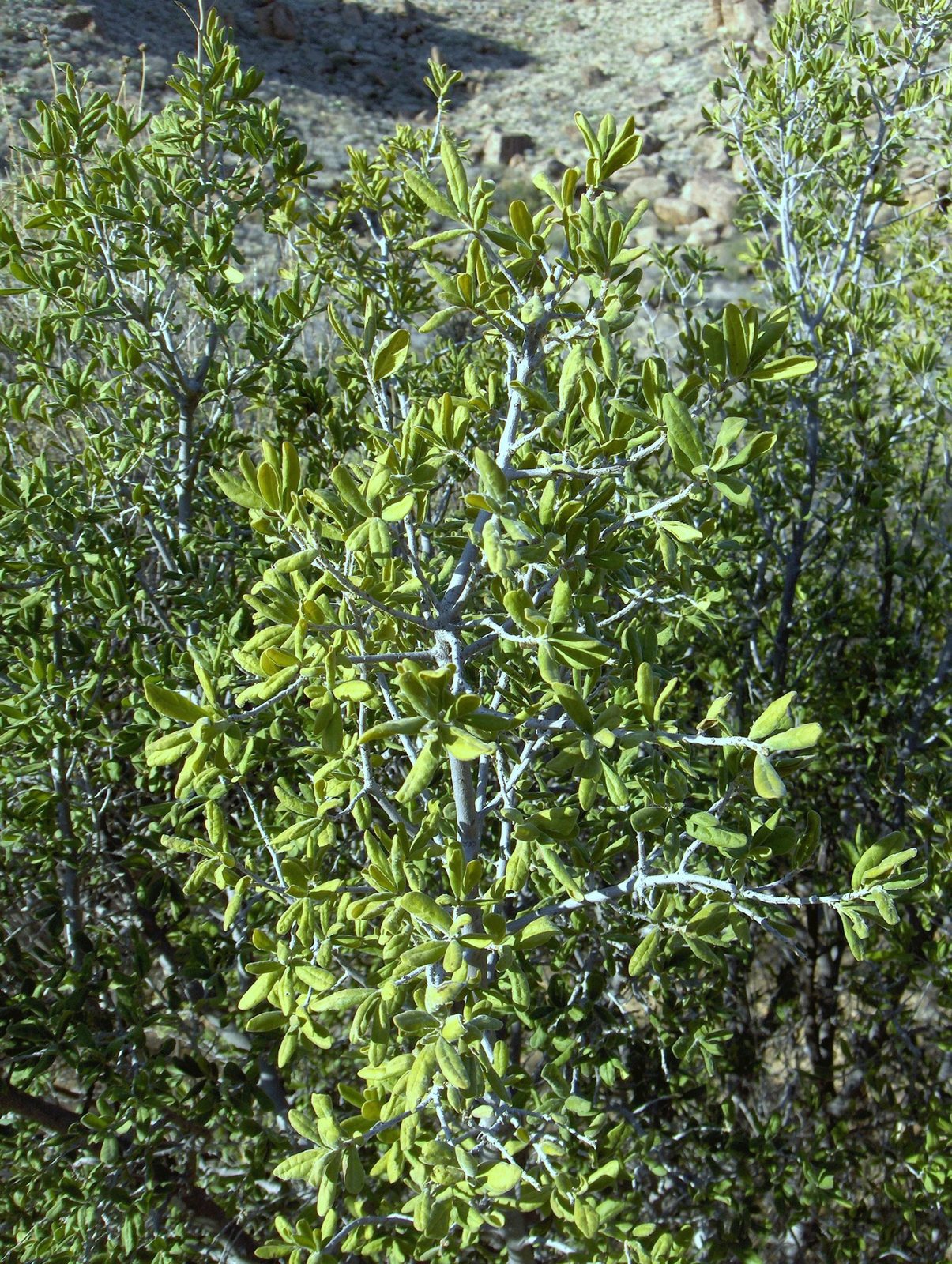
Texas persimmon is a slow-growing small tree native to Texas and northeastern Mexico, valued for its smooth, peeling bark, sculptural branches and edible black fruit. It suits hot, dry gardens with freely draining soil; male and female flowers usually grow on separate trees, so fruit production normally requires both sexes nearby. It is deciduous in colder conditions and may retain much of its foliage in mild winters.
At a glance
- Sun
- Full sun to partial shade; flowering and fruiting are usually best in full sun.
- Water
- Low once established; water regularly during establishment, then deeply during prolonged drought.
- Soil
- Well-drained sandy, gravelly or rocky soil; particularly well suited to limestone and alkaline ground. Avoid persistently wet soil.
- Height
- 10-20 ft (3-6 m)
- Spread
- 10-15 ft (3-4.6 m)
- Flowers
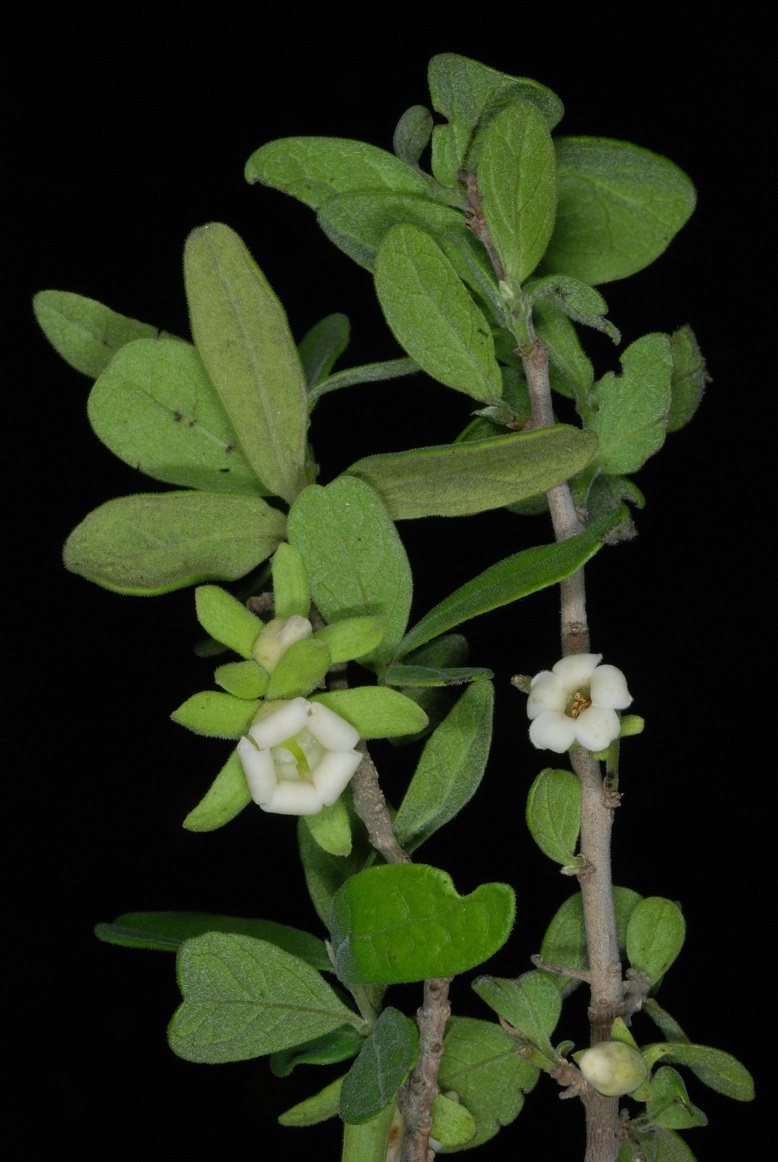
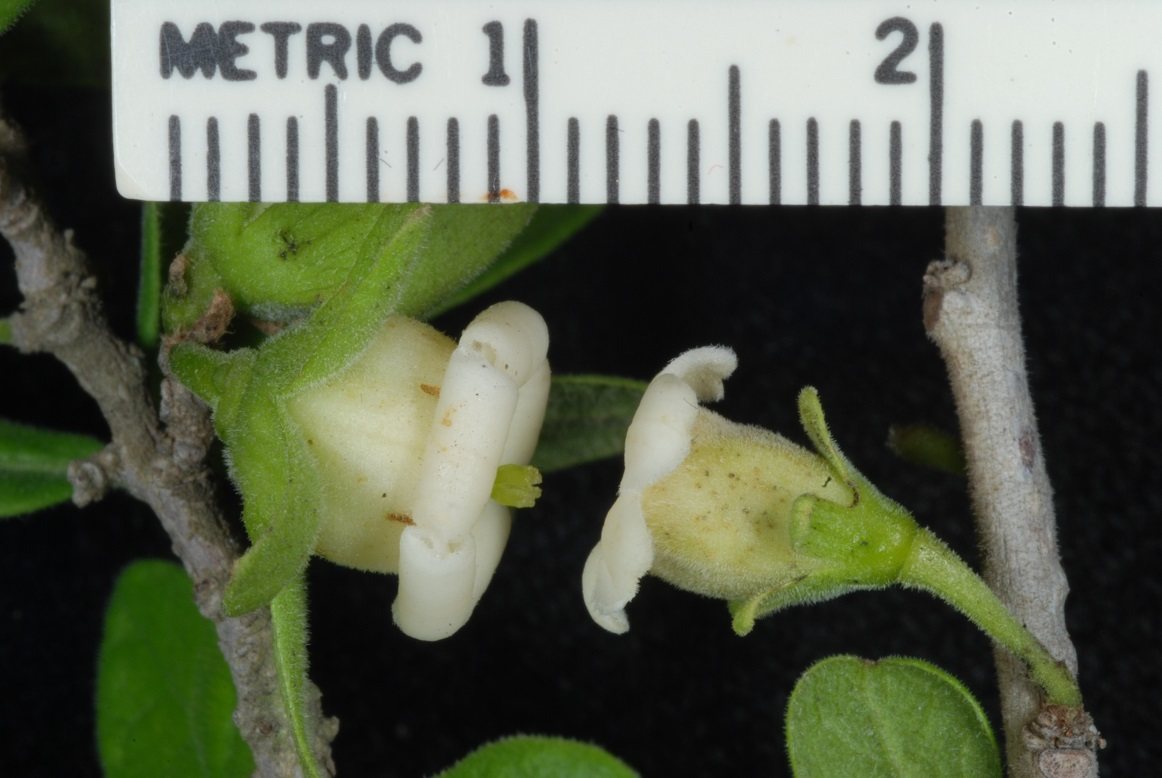
- Spring; small, bell-shaped, creamy-white to greenish-white flowers, often lightly fragrant.
- Foliage
- Small, leathery, oval leaves, dark green above and paler beneath; deciduous to semi-evergreen depending on winter conditions.
- Growth
- Slow
- Care needed
- Low
The year at a glance
- Pollinators
- Drought tolerant
- Heat tolerant
- Wildlife
- Edible
| J | F | M | A | M | J | J | A | S | O | N | D | |
|---|---|---|---|---|---|---|---|---|---|---|---|---|
| Flowers | ||||||||||||
| Fruit | ||||||||||||
| Plant |
Northern hemisphere months. In Australia, shift them by six.
- Difficulty
- Hard
- Toughness
- Needs looking after
Will it suit your garden?
Pick your zone, country, light and whether you have pets.
Full sun is 6 or more hours of direct sun a day, part shade 3 to 6 hours, shade under 3.
How it grows
Planting day
7 ft (2 m)
After 1 year
7 ft (2.1 m)
After 2 years
7 ft (2.2 m)
After 3 years
7 ft (2.2 m)
After 5 years
8 ft (2.4 m)
About 32 years to full size.
From a typical nursery size, at an average rate for this kind of plant. A rule of thumb, not a forecast.
Good to know
- Cats and dogs
- Safe
- Native to
- the US
- Growth rate
- Slow
Care
Jobs through the year
- WaterApr–May, Sep–Oct, every 30 days
- For established in-ground trees, water only if unusually dry; young trees need regular deep watering.
- WaterJun–Aug, every 21 days
- Deep-water established in-ground trees only during prolonged drought, allowing soil to dry between waterings.
- MulchMay
- Maintain an organic mulch layer over the roots without covering the trunk base.
- PruneFeb–Mar
- Remove dead or crossing branches and make light formative cuts; avoid heavy pruning.
- ProtectJan–Mar, Nov–Dec
- Not reliably hardy in zones 6–7; grow in a movable container and overwinter in bright, frost-free shelter.
- HarvestJul–Sep
- Pick only fully black, soft fruit that releases easily; cropping requires a female and nearby male.
- Water deeply through the first two growing seasons, allowing the soil to dry between waterings.
- Once established, give occasional deep watering during extended drought rather than frequent light irrigation.
- Keep a mulch layer over the root zone, leaving the trunk base clear.
- Do not fertilize routinely; feed only if poor growth is linked to a confirmed nutrient deficiency.
- For fruit, obtain a known female and provide a male nearby unless a suitable pollinator already grows locally.
Pruning. Prune in late winter before new growth, removing dead, crossing or poorly placed branches. Train young plants as a small single-trunk tree or retain several trunks to show off the bark; avoid heavy cutting into mature wood.
Harvest
Pick fruit in summer to early autumn when it is fully black, soft and releases easily; firm fruit can be strongly astringent, and the juice stains. Eat the ripe flesh or use it for preserves, removing the large seeds. Allow roughly 4-8 years after planting a young tree for a useful crop, with substantial variation according to plant age, growing conditions and pollination.
Through the year
- Late winter
- Remove dead or crossing branches and make light formative cuts.
- Spring
- Check flowers to establish whether trees are male or female if fruit production is a goal.
- Late spring
- Renew mulch without piling it against the trunk.
- Summer
- Water young trees deeply during dry spells; give established trees extra water only during prolonged drought.
- Summer to early autumn
- Harvest fully black, soft fruit and remove fallen fruit from paving.
- Autumn
- Plant in mild-winter areas while the soil is still warm; use spring planting near the colder edge of its range.
In the garden
- Use as a small specimen tree beside a gravel terrace, where its peeling grey and cream bark is easy to see.
- Combine with drought-tolerant grasses, yuccas and salvias in a dry, naturalistic planting.
- Retain multiple trunks to create a sculptural focal point in a courtyard with ample rooting space.
- Include female trees in a wildlife or edible garden, away from paving that falling fruit could stain.
Garden styles it suits: Texas Hill Country, Southwestern, Desert / xeriscape, Dry gravel garden, Wildlife garden and Edible landscape.
Plant it with: Red yucca, Autumn sage, Texas sage, Lindheimer's muhly, Little bluestem and Prickly pear.
Wildlife: Flowers attract visiting insects, and ripe fruit feeds birds and mammals. Dense branching provides cover for small birds.
Problems to watch for
- Poor growth or root decline in wet soil: improve drainage before planting and keep lawn irrigation away from the root zone.
- No fruit: the tree may be male, too young or an unpollinated female; check flower sex and provide a male if needed.
- Cold damage near its hardiness limit: choose a sheltered, sunny site and protect young plants during unusually severe freezes.
- Scale insects: inspect stems and leaf undersides; prune small infestations or use a labelled horticultural oil when conditions are suitable.
Safety
Ripe fruit flesh is edible for people and is not known to be toxic. Species-specific toxicity information for cats, dogs and horses is limited; do not treat this as confirmation that every part is safe. Remove the large seeds before eating, and prevent pets or livestock from eating large quantities of fruit, since persimmon seeds and fibrous material can cause digestive obstruction.
Easily confused with
American persimmon (Diospyros virginiana)
Usually a much larger tree with larger leaves, orange ripe fruit and dark bark divided into blocky plates, rather than the smooth, peeling bark and black fruit of Texas persimmon.
Black sapote (Diospyros digyna)
A frost-tender tropical tree with much larger, glossy leaves and large fruit that remains green-skinned as its flesh darkens; Texas persimmon has small leaves and small, black-skinned ripe fruit.
The name
Diospyros comes from Greek words commonly interpreted as 'divine fruit', while texana means 'of Texas'.
Propagation. Usually grown from seed cleaned from fully ripe fruit and sown fresh in a freely draining medium. Seedlings vary and cannot be reliably sexed until they flower; transplant while young and avoid disturbing the roots.
Checked against open data
- Accepted botanical name
- Diospyros texana
- In the US and Canada
- Native in the lower 48 states.
- Native range
- Mexico Northeast and Texas.
- Measured
- Average height 900 cm.
Sources: GBIF (CC BY 4.0), USDA PLANTS and Trefle (CC BY 4.0). The care and design notes are LandscapeGPT's own.
See it in your own yard.
Upload a photo of your yard and see it redesigned with plants that suit your climate, each checked against your zone.