Torch ginger
Etlingera elatior. Family Zingiberaceae. Perennial.
Also called Torch lily, Red ginger lily, Philippine wax flower, Bunga kantan.
Torch ginger is a large, clump-forming tropical perennial with tall leafy stems and waxy, torch-shaped flower heads on separate stalks. Gardeners grow it for bold foliage, striking cut flowers and edible flower buds used in Southeast Asian cooking. It needs year-round warmth: in most of the United Kingdom, Canada and cooler parts of the United States and Australia, it requires a heated greenhouse.
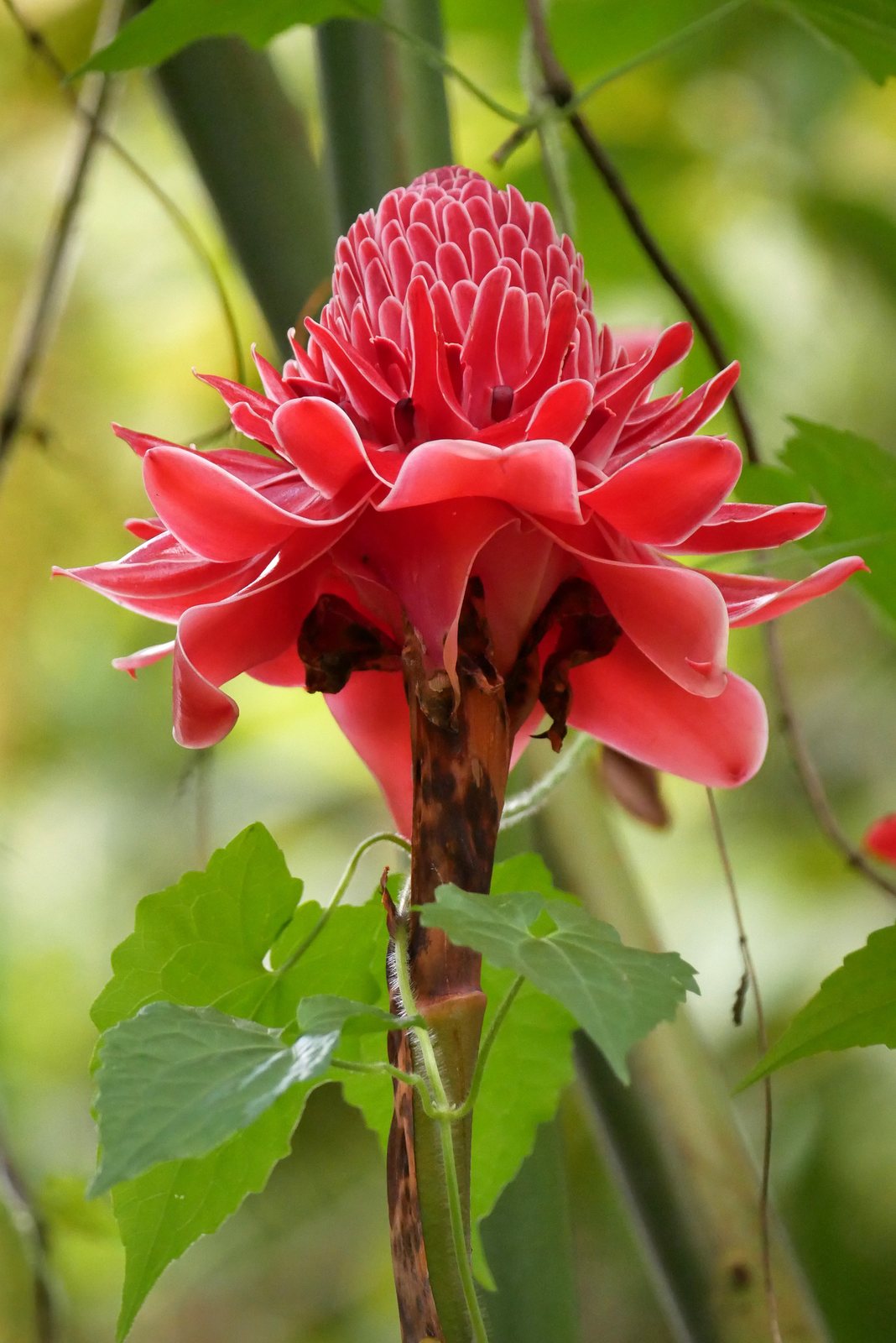
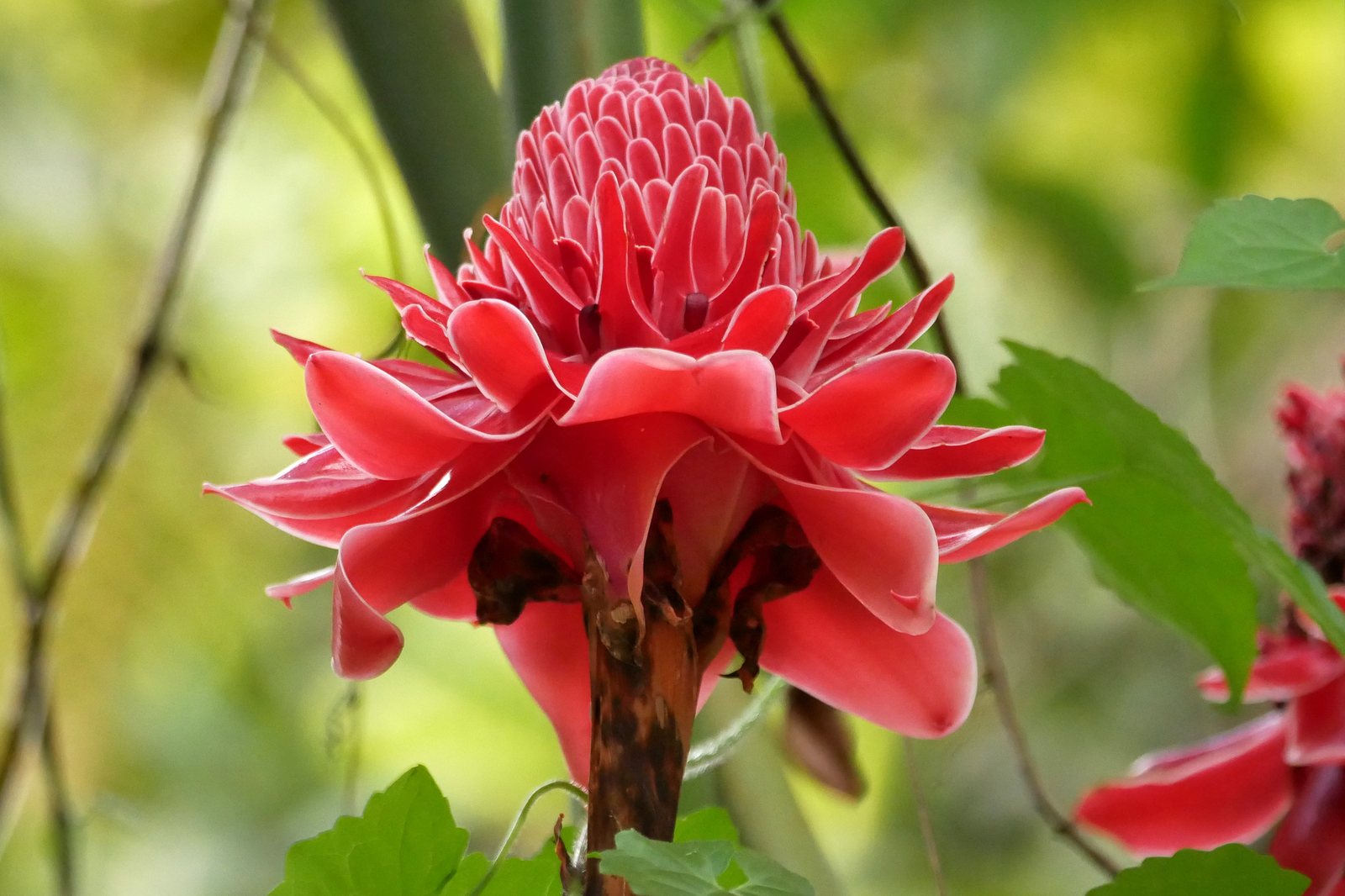
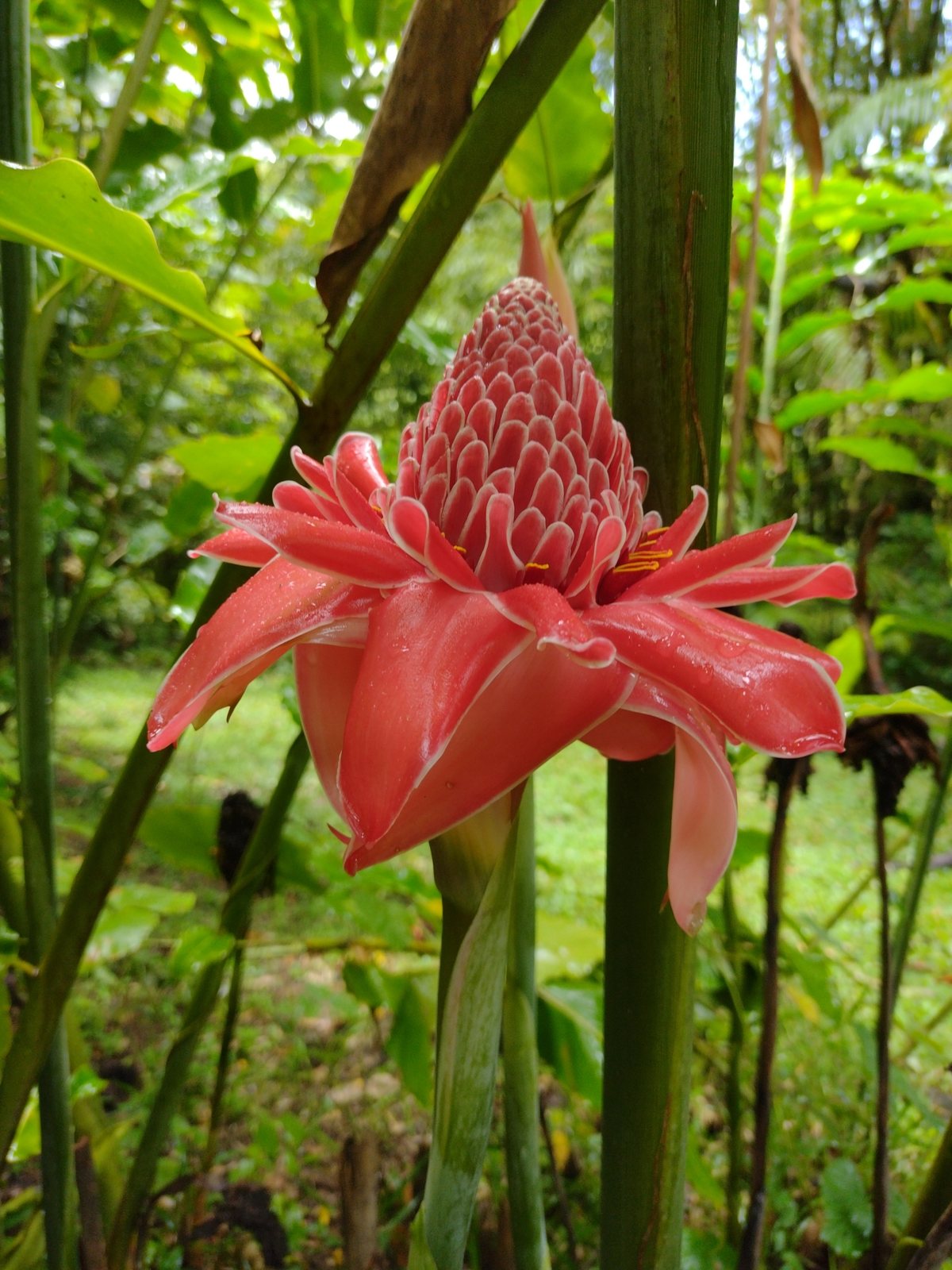
At a glance
- Sun
- Partial shade or filtered sun; tolerates full sun in humid climates if the soil stays moist. Shelter from strong winds.
- Water
- Keep consistently moist during active growth, without leaving the roots waterlogged. Water less in cooler weather, but do not let the root ball dry out completely.
- Soil
- Deep, fertile, humus-rich soil that holds moisture but drains freely; slightly acidic to neutral soil is suitable.
- Height
- 10-20 ft (3-6 m)
- Spread
- 6-10 ft (1.8-3 m), expanding further over time
- Flowers
- Mainly spring through autumn, potentially year-round in the humid tropics; red or pink waxy bracts surround small flowers. White-bracted forms also occur.
- Foliage
- Evergreen. Large, elongated green leaves arranged along tall, upright, cane-like stems; leaves can tear in strong winds.
- Growth
- Fast in warm, humid conditions
- Care needed
- High
The year at a glance
- Heat tolerant
- Wildlife
- Low allergen
- Edible
| J | F | M | A | M | J | J | A | S | O | N | D | |
|---|---|---|---|---|---|---|---|---|---|---|---|---|
| Flowers | ||||||||||||
| Fruit | ||||||||||||
| Plant |
Northern hemisphere months. In Australia, shift them by six.
- Difficulty
- Hard
- Toughness
- Needs looking after
Will it suit your garden?
Pick your zone, country, light and whether you have pets.
Full sun is 6 or more hours of direct sun a day, part shade 3 to 6 hours, shade under 3.
How it grows
Planting day
1.8 ft (0.54 m)
After 1 year
8 ft (2.6 m)
After 2 years
15 ft (4.5 m)
full size
About 2 years to full size.
From a typical nursery size, at an average rate for this kind of plant. A rule of thumb, not a forecast.
Good to know
- Cats and dogs
- Safe
- In the garden
- Spreads vigorously: plan to contain it.
- Growth rate
- Fast
Care
Jobs through the year
- WaterApr–May, Sep–Oct, every 5 days
- Keep established roots consistently moist; young plants and pots need more frequent checks.
- WaterJun–Aug, every 3 days
- Water established plants deeply as the surface begins drying; avoid stagnant, saturated soil.
- WaterJan–Mar, Nov–Dec, every 10 days
- In heated shelter, reduce watering but never let roots dry completely.
- FeedMay–Aug, every 14 days
- Apply balanced fertiliser suitable for edible crops at the label rate during active growth.
- MulchJun
- Maintain generous organic mulch, keeping stem bases clear.
- DivideMay–Jun
- Divide congested clumps in sustained warmth, retaining healthy roots, rhizomes and shoots.
- HarvestMay–Sep, every 7 days
- Cut firm unopened flower buds for cooking; use only correctly identified plants treated safely for food.
- PruneJun–Oct, every 14 days
- Remove spent flower stalks and dead leafy stems at ground level; retain healthy stems.
- ProtectSep
- Move into a spacious, bright, heated greenhouse before cold nights; flowering requires sustained warmth.
- ProtectJun
- Use outdoors only during reliably warm weather, sheltered from wind and harsh afternoon sun.
- Water deeply whenever the soil surface begins to dry during warm weather.
- Apply a balanced fertiliser during active growth, following the product rate.
- Maintain a generous organic mulch, keeping it clear of the stem bases.
- Protect from frost and cold winds; move container plants into a warm, bright greenhouse before temperatures fall.
- Divide congested clumps in spring or at the start of the warm rainy season.
Pruning. Cut spent flower stalks and dead or damaged leafy stems down to ground level as needed. Thin overcrowded stems during warm weather rather than cutting the whole clump back annually.
Harvest
Pick firm, unopened flower buds before the bracts begin to spread, cutting the stalk with a clean knife or secateurs. The tender buds can be finely sliced for cooking; harvest only from correctly identified plants that have not been treated with pesticides unsuitable for edible crops.
Through the year
- Spring
- Divide crowded clumps once steady warmth returns, retaining healthy rhizomes, roots and shoots.
- Late spring
- Plant out only in frost-free climates once the soil is warm; refresh mulch around established clumps.
- Summer
- Water regularly and feed during strong growth; check container plants frequently for drying.
- Summer
- Harvest unopened edible buds or cut flower heads, and remove spent flower stalks.
- Autumn
- Bring container plants under warm cover before cold nights; reduce feeding as growth slows.
- Winter
- Keep protected plants warm and bright, water cautiously and inspect for spider mites and mealybugs.
In the garden
- Use as a tall backdrop to a sheltered tropical border, with lower foliage plants hiding the stem bases.
- Plant beside a warm courtyard or pool for large-scale foliage, leaving room for the clump to expand.
- Combine with heliconias, elephant ears and ferns for layered planting in humid shade.
- Grow in a very large container in a heated conservatory, allowing generous overhead space.
Garden styles it suits: Tropical, Modern tropical, Luxury resort, Balinese, Architectural minimal and Edible landscape.
Plant it with: Heliconias, Elephant ears, Bird of paradise, Shell ginger, Bird's nest fern and Philodendrons.
Wildlife: Flowers provide nectar for birds and insects in tropical climates. Visiting species vary by region; dense clumps also provide shelter for small animals.
Problems to watch for
- Cold damage: foliage blackens and rhizomes may rot after frost; grow under heated cover outside reliably frost-free areas.
- Rhizome rot: avoid stagnant, waterlogged soil and improve drainage before replanting healthy divisions.
- Spider mites and mealybugs under cover: inspect leaf undersides and stem joints, wash off small infestations and use a labelled insecticidal soap where appropriate.
- Poor flowering: provide sustained warmth, bright filtered light, adequate water and enough root space; young divisions may take time to establish.
Safety
Not known to be toxic to people; the flower buds are eaten as food. It is not known to be toxic to cats, dogs or horses, but species-specific safety information for these animals is limited, so discourage grazing or chewing.
Where it spreads. Can spread aggressively by rhizomes in humid, frost-free gardens, including Hawaii and tropical northern Australia. Allow space, control the clump edges and never dump unwanted rhizomes in natural areas.
Easily confused with
Red ginger (Alpinia purpurata)
Its narrower red or pink flower spikes sit at the tips of leafy stems; torch ginger produces broad, torch-shaped heads on separate, leafless stalks.
Shampoo ginger (Zingiber zerumbet)
Its separate flower stalks carry compact, pinecone-shaped heads that turn red, rather than the broad, spreading bracts of torch ginger.
Shell ginger (Alpinia zerumbet)
It bears hanging clusters of pale, shell-like flowers at the ends of leafy stems, not upright torch-shaped heads rising separately from the ground.
The name
Etlingera honours the botanist Andreas Ernst Etlinger, elatior means taller, and torch ginger refers to the shape of the flower heads.
Propagation. Divide established rhizomes during warm weather, keeping healthy roots and at least one growing shoot on each section. Seed can be sown fresh in warm, humid conditions, but seedlings are slower to reach flowering size and may vary.
Checked against open data
- Accepted botanical name
- Etlingera elatior
- In the US and Canada
- Introduced in Pacific Basin and Puerto Rico.
- Native range
- Borneo, Jawa, Lesser Sunda Is., Malaya, Sumatera and Thailand.
Sources: GBIF (CC BY 4.0), USDA PLANTS and Trefle (CC BY 4.0). The care and design notes are LandscapeGPT's own.
See it in your own yard.
Upload a photo of your yard and see it redesigned with plants that suit your climate, each checked against your zone.