Valley oak
Quercus lobata. Family Fagaceae. Tree.
Also called California white oak, Roble.
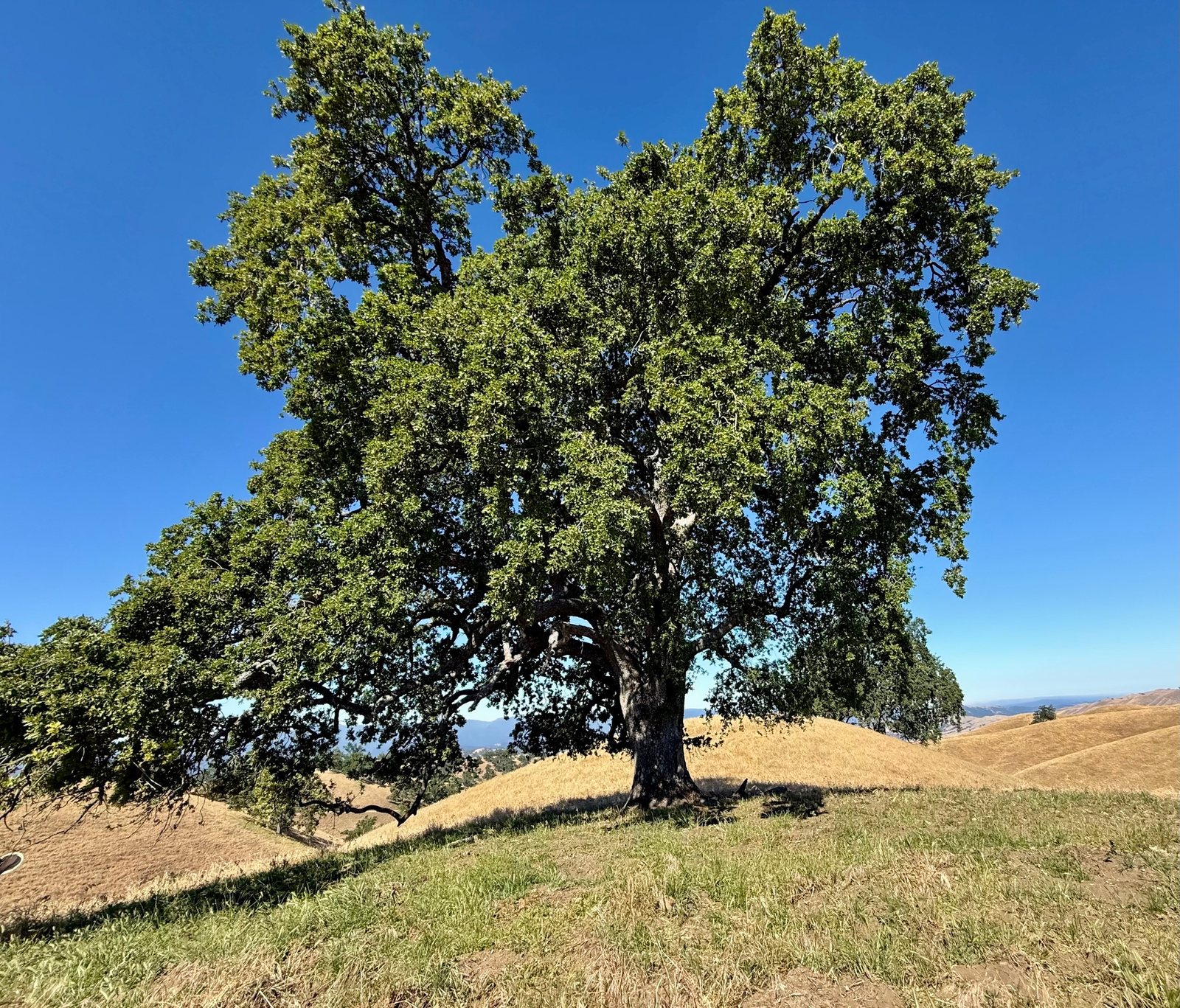
A large, deciduous oak native to California, with a broad crown, deeply lobed leaves and massive, spreading limbs. Grow it for long-lived shade, wildlife habitat and its sculptural winter outline, but only where there is room for a very large tree. It performs best with warm summers and deep soil; cold Canadian winters and cool, exposed sites elsewhere limit its suitability.
At a glance
- Sun
- Full sun; young trees tolerate light shade.
- Water
- Water young trees deeply during dry weather. Established trees usually need little summer irrigation where roots can reach deep moisture; avoid frequent watering around the trunk.
- Soil
- Deep loam or clay with access to subsoil moisture; tolerates alkaline soil and seasonal flooding, but not permanently waterlogged ground.
- Height
- 60-100 ft (18-30 m)
- Spread
- 50-80 ft (15-24 m)
- Flowers
- Spring: yellow-green male catkins and tiny, inconspicuous female flowers.
- Foliage
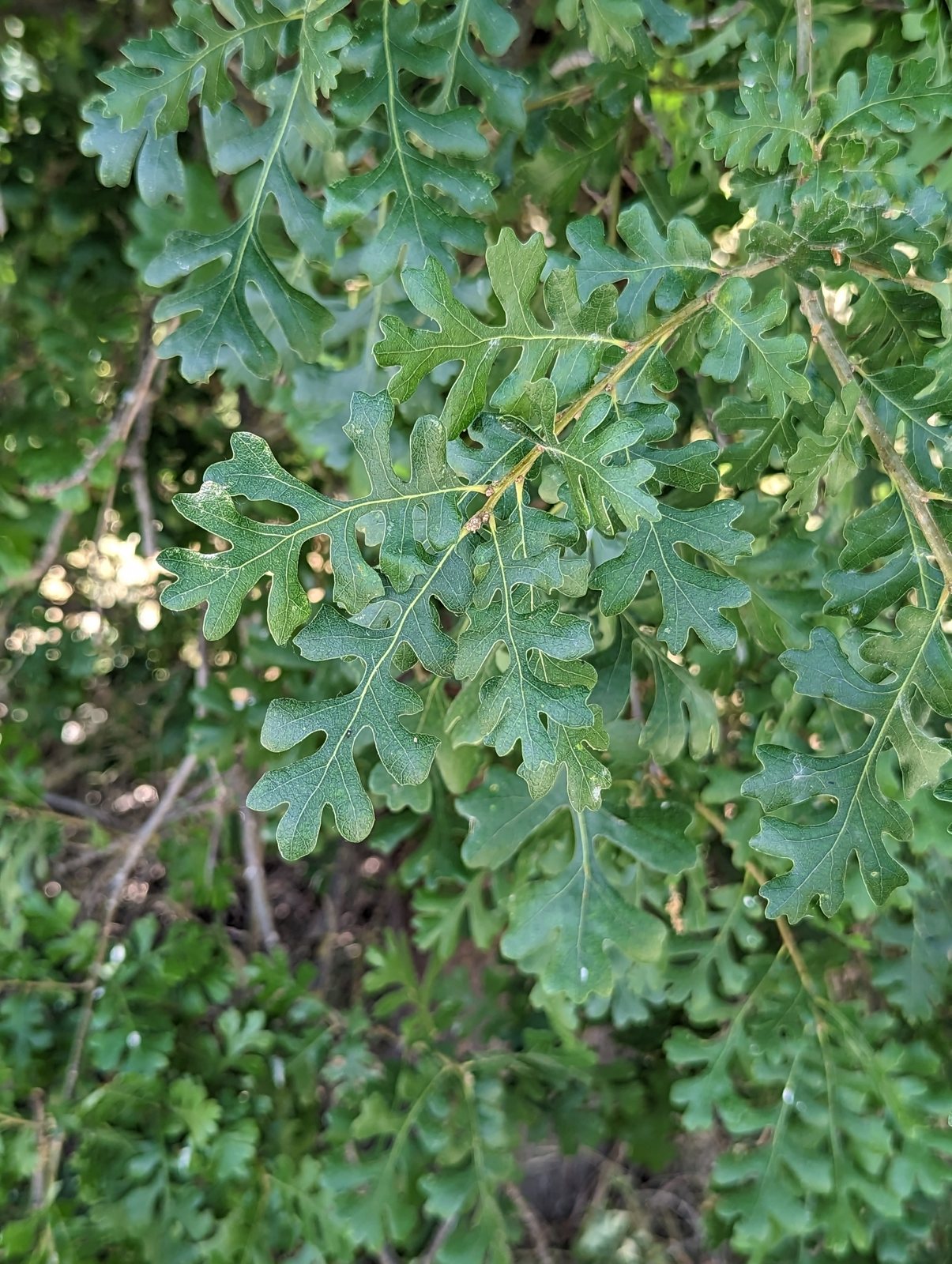
- Rounded, deeply lobed green leaves with softly hairy undersides; autumn colour is usually yellow to brown.
- Growth
- Moderate to fast when young with adequate moisture; slower on dry or restricted sites.
- Care needed
- Medium
The year at a glance
- Drought tolerant
- Heat tolerant
- Wildlife
| J | F | M | A | M | J | J | A | S | O | N | D | |
|---|---|---|---|---|---|---|---|---|---|---|---|---|
| Flowers | ||||||||||||
| Fruit | ||||||||||||
| Plant |
Northern hemisphere months. In Australia, shift them by six.
- Difficulty
- Moderate
- Toughness
- Very tough
Will it suit your garden?
Pick your zone, country, light and whether you have pets.
Full sun is 6 or more hours of direct sun a day, part shade 3 to 6 hours, shade under 3.
How it grows
Planting day
9 ft (2.9 m)
After 1 year
13 ft (3.9 m)
After 2 years
16 ft (5 m)
After 3 years
20 ft (6 m)
After 5 years
27 ft (8.2 m)
About 20 years to full size.
From a typical nursery size, at an average rate for this kind of plant. A rule of thumb, not a forecast.
Good to know
- Cats and dogs
- Toxic
- Native to
- the US
- Growth rate
- Moderate
Care
Jobs through the year
- WaterApr–May, Sep, every 30 days
- Water established trees only during exceptional drought if deep soil is dry; young trees need more frequent deep watering.
- WaterJun–Aug, every 30 days
- Deep-water only if drought exhausts deep moisture; established trees usually need none, and the trunk must stay dry.
- MulchMar–Apr
- Maintain organic mulch over the root area, leaving the trunk and root collar uncovered.
- PruneJan–Feb
- Train young trees with small formative cuts; leave mature-tree work to a qualified arborist.
- ProtectMar, Sep
- Check young-tree ties and remove supports once anchored; prevent digging, compaction and lawn irrigation over roots.
- Choose a permanent site well away from buildings, overhead wires and paving; allow for the full mature crown.
- Water deeply through the first few dry seasons, letting the surface soil dry between soakings.
- Spread organic mulch over the root area, keeping it clear of the trunk.
- Avoid lawn irrigation, soil compaction, digging and changes in soil level beneath established trees.
- Do not fertilise routinely; feed only if a soil test or diagnosed deficiency indicates a need.
- Stake only if the young tree cannot stand securely, and remove supports once it is anchored.
Pruning. Train young trees during the dormant season, retaining a strong central framework and removing competing leaders while cuts are small. Have a qualified arborist assess mature limbs; avoid topping and unnecessary large cuts.
Through the year
- Autumn
- Plant after reliable rain begins, while the soil is still workable.
- Late autumn
- Collect freshly fallen, sound acorns for immediate sowing in deep containers protected from rodents.
- Winter
- Check the branch structure and carry out light formative pruning on young trees.
- Spring
- Refresh mulch and check that tree ties are not rubbing or constricting the trunk.
- Summer
- Deep-water young trees during prolonged dry spells; keep irrigation away from the trunk.
- Late summer
- Inspect for dead branches, cracks or fungal growth and arrange an arborist assessment if needed.
In the garden
- Use as a single specimen in a large garden or park, with space to appreciate its spreading crown.
- Anchor a California native meadow, keeping planting and soil disturbance light beneath the canopy.
- Create broad summer shade over an informal seating area, with regular professional inspection of mature branches.
- Restore oak savanna character on large properties with widely spaced trees and native grasses.
Garden styles it suits: California native, Grand estate, Native meadow, Wildlife garden, Mediterranean and Rewilded.
Plant it with: Deer grass, Purple needle grass, California fescue, California poppy and Western redbud.
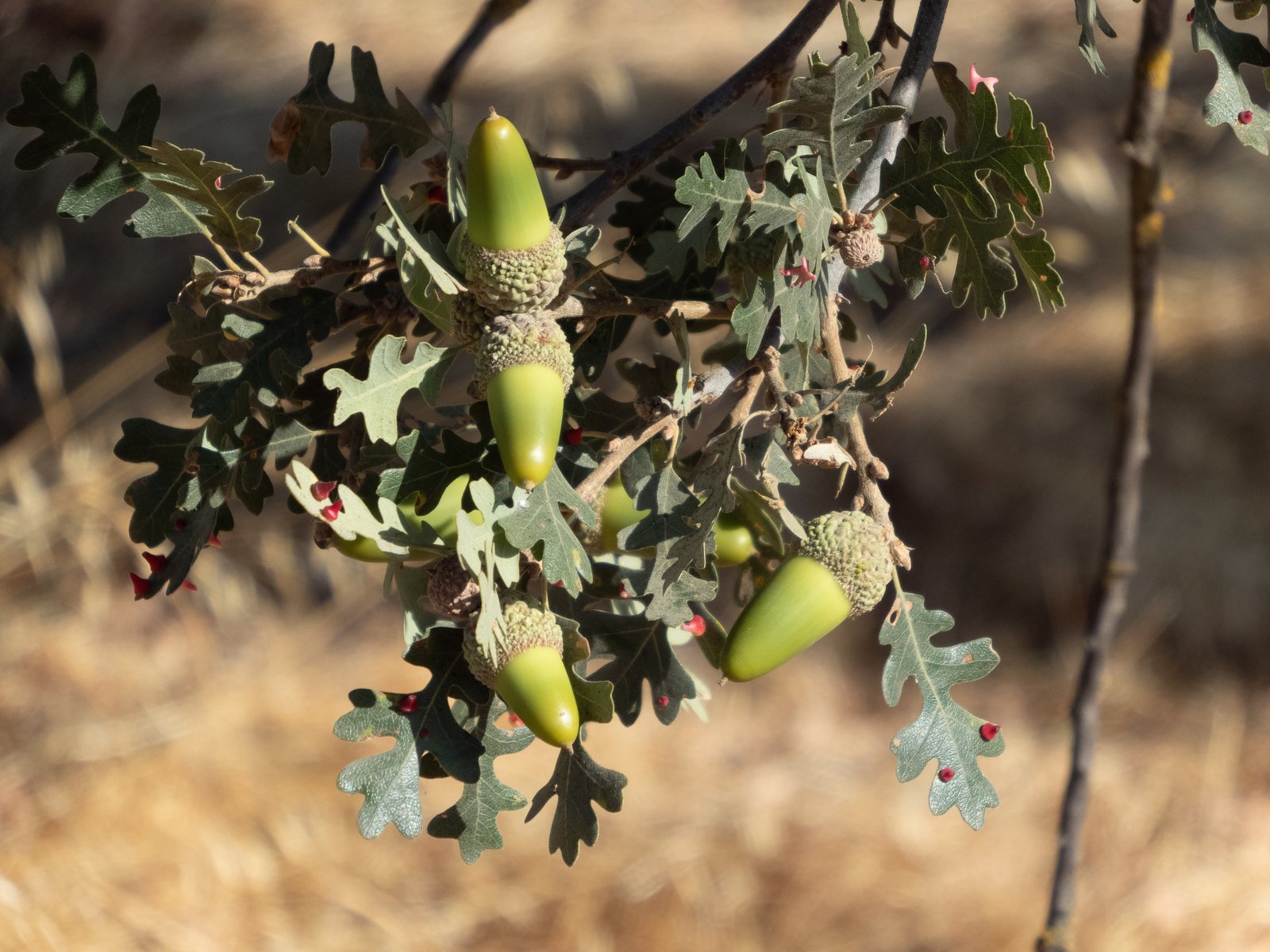
Wildlife: Acorns feed jays, woodpeckers, squirrels and other mammals. The foliage supports many insects, including moth and butterfly larvae, while large old trees provide nesting sites and cavities.
Problems to watch for
- Root and crown rot: frequent summer irrigation and wet soil around the trunk encourage decay; keep the root collar dry and seek an arborist's advice if the canopy declines.
- Oak galls: unusual swellings on leaves or twigs are usually harmless; avoid routine insecticide treatment.
- Leaf-eating caterpillars: established trees usually recover from occasional defoliation; identify the insect before considering treatment.
- Large-limb failure: mature trees can shed heavy branches, sometimes without obvious warning; arrange professional inspections and avoid placing vulnerable structures beneath major limbs.
Safety
Acorns, buds and leaves contain tannins and can poison dogs, cats and horses if eaten in quantity; horses are particularly vulnerable to serious digestive and kidney damage. Raw acorns are not suitable for people to eat without proper processing to remove tannins. Seek veterinary advice promptly after substantial ingestion.
Easily confused with
Blue oak (Quercus douglasii)
Usually a smaller tree with blue-grey leaves and shallower, less pronounced lobes; valley oak has greener, more deeply lobed leaves.
Oregon white oak (Quercus garryana)
Its leaves generally have broader, more regularly arranged lobes; valley oak often has deeper, narrower sinuses. Leaf shape overlaps, so use acorns and local range as additional clues.
English oak (Quercus robur)
English oak has very short leaf stalks, small ear-like lobes at the leaf base and acorns on long stalks; valley oak has longer leaf stalks and acorns that are nearly stalkless.
The name
The species name lobata refers to its lobed leaves, while valley oak describes its characteristic habitat in California's valleys.
Propagation. Grow from fresh acorns collected in autumn; do not let them dry out. Sow promptly in deep containers or in their final position, protect from rodents, and plant container-grown seedlings while young to avoid restricting the developing taproot.
Checked against open data
- Accepted botanical name
- Quercus lobata
- In the US and Canada
- Native in the lower 48 states.
- Native range
- Alabama, Arkansas, Delaware, Florida, Georgia, Illinois, Indiana, Kentucky, Louisiana, Maryland, Mississippi and Missouri.
- Measured
- Soil pH 4.5 to 7.5. Average height 1845 cm.
Sources: GBIF (CC BY 4.0), USDA PLANTS and Trefle (CC BY 4.0). The care and design notes are LandscapeGPT's own.
See it in your own yard.
Upload a photo of your yard and see it redesigned with plants that suit your climate, each checked against your zone.