Wayfaring tree
Viburnum lantana. Family Viburnaceae. Shrub.
Also called Wayfaring-tree viburnum.
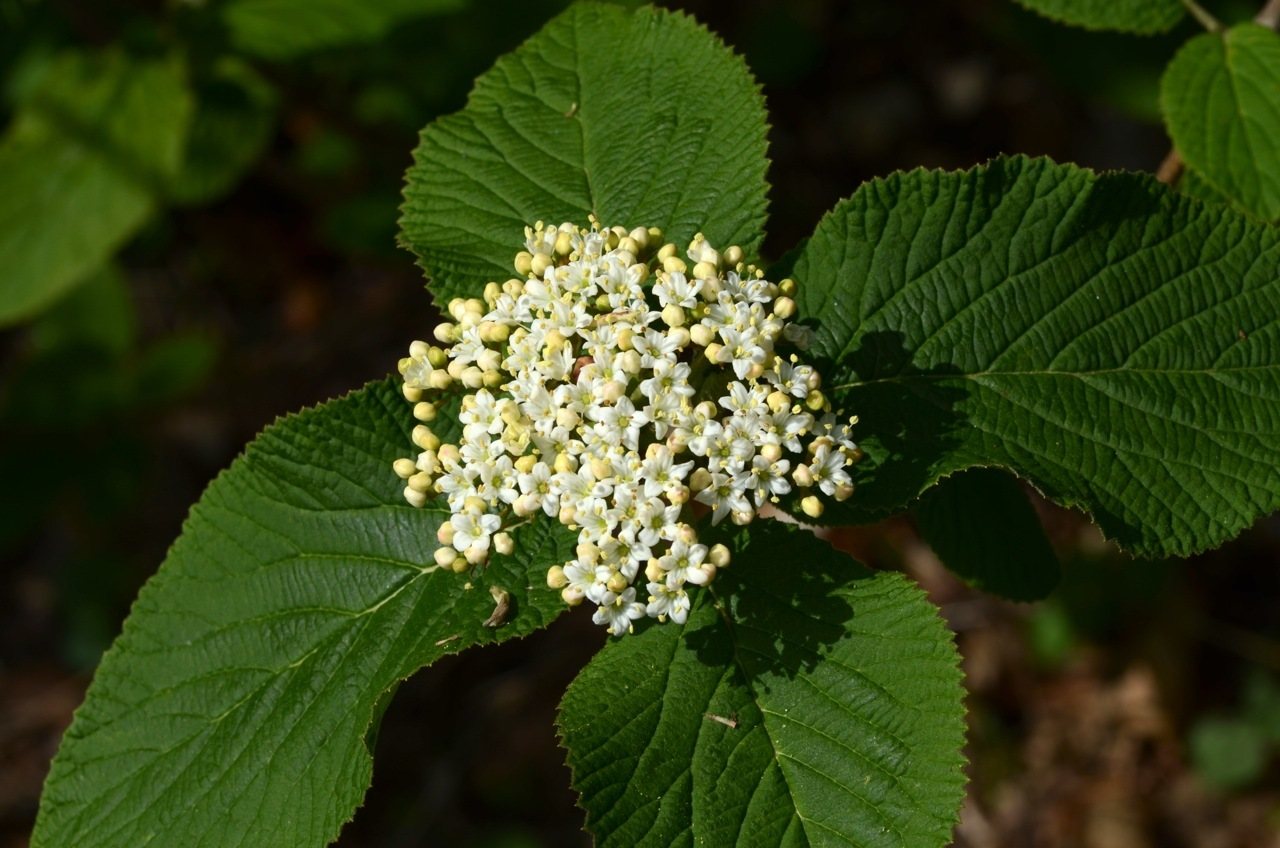
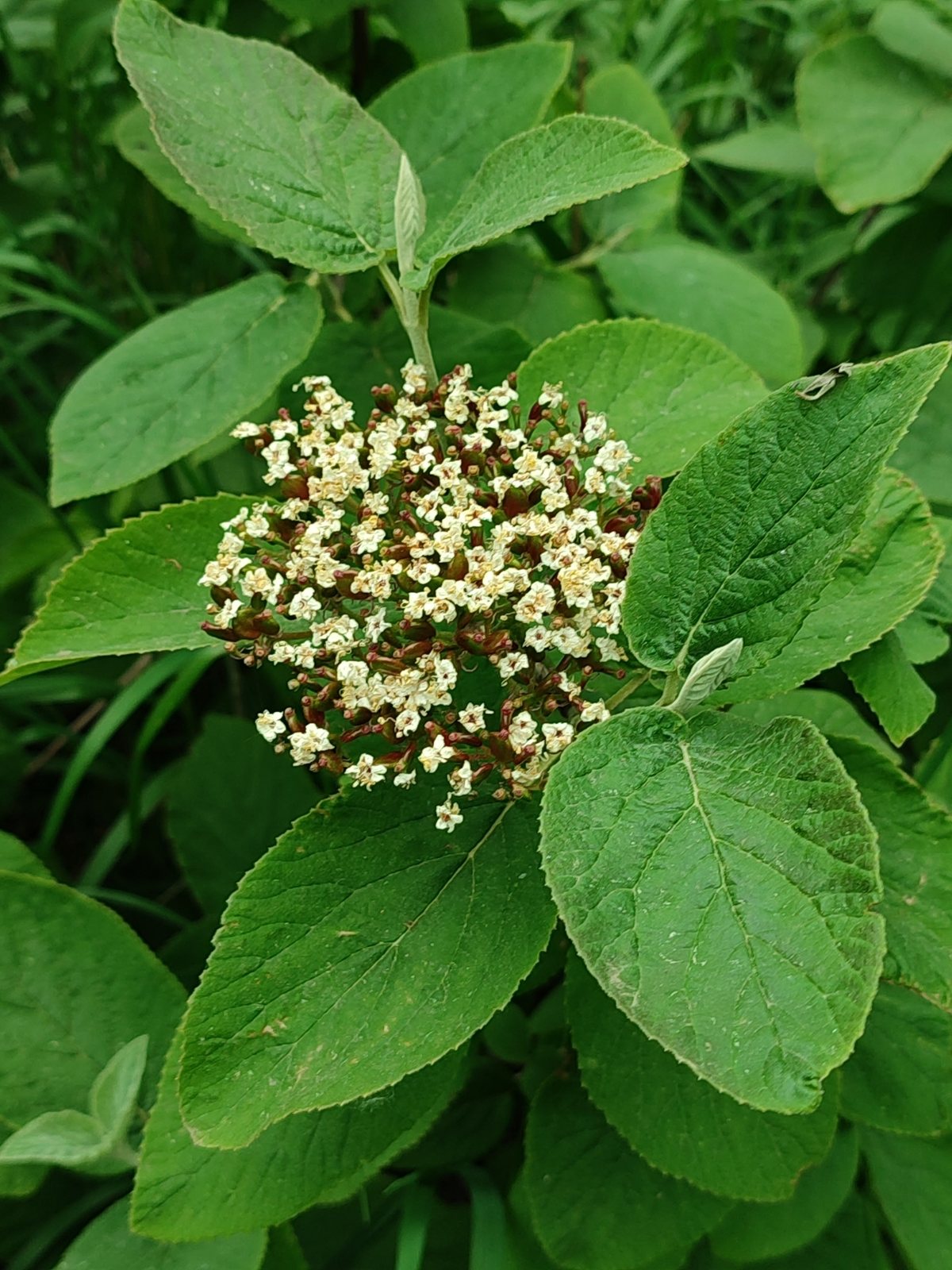
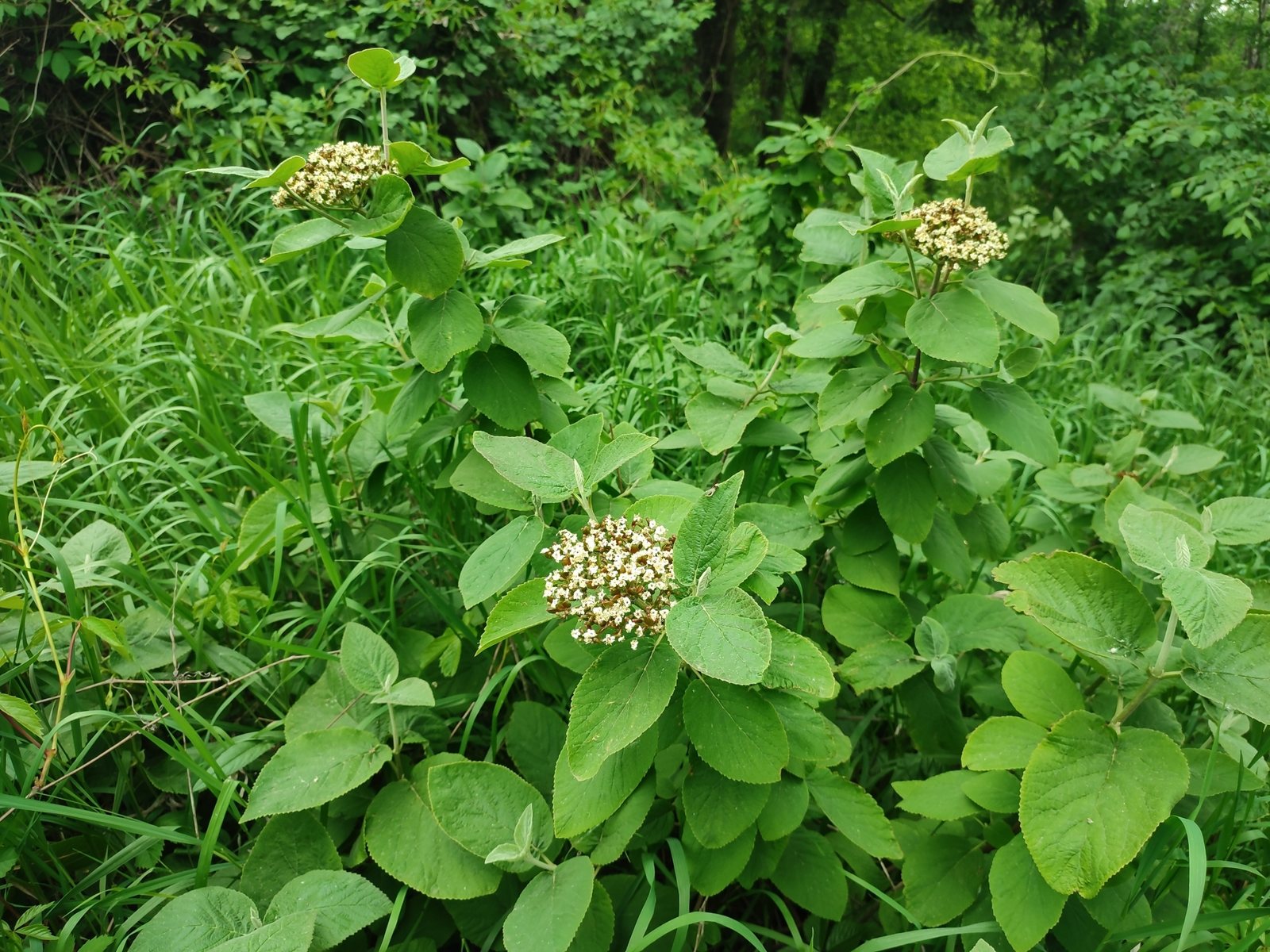
Wayfaring tree is a large deciduous shrub with creamy-white spring flowers, felted leaves and clusters of berries that change from red to black. Gardeners grow it for informal hedges, wildlife cover and autumn colour, particularly on chalky soil, but it can escape cultivation in parts of North America.
At a glance
- Sun
- Full sun to partial shade; flowering and fruiting are best with several hours of direct sun.
- Water
- Moderate while establishing; tolerates dry spells once established.
- Soil
- Well-drained loam, clay or chalky soil; tolerates a broad pH range and does particularly well in neutral to alkaline ground. Avoid waterlogged sites.
- Height
- 10-15 ft (3-4.5 m)
- Spread
- 8-15 ft (2.4-4.5 m)
- Flowers
- Late spring to early summer; small creamy-white flowers in broad, flat-topped clusters.
- Foliage
- Opposite, oval leaves with toothed edges, deeply impressed veins and softly hairy grey undersides; autumn colour ranges from muted yellow to reddish purple.
- Growth
- Moderate
- Care needed
- Low
The year at a glance
- Pollinators
- Drought tolerant
- Cold hardy
- Wildlife
- Low allergen
| J | F | M | A | M | J | J | A | S | O | N | D | |
|---|---|---|---|---|---|---|---|---|---|---|---|---|
| Flowers | ||||||||||||
| Fruit | ||||||||||||
| Plant |
Northern hemisphere months. In Australia, shift them by six.
- Difficulty
- Easy
- Toughness
- Very tough
Will it suit your garden?
Pick your zone, country, light and whether you have pets.
Full sun is 6 or more hours of direct sun a day, part shade 3 to 6 hours, shade under 3.
How it grows
Planting day
1.6 ft (0.5 m)
After 1 year
4 ft (1.2 m)
After 2 years
6 ft (1.8 m)
After 3 years
8 ft (2.5 m)
After 5 years
12 ft (3.8 m)
full size
About 5 years to full size.
From a typical nursery size, at an average rate for this kind of plant. A rule of thumb, not a forecast.
Good to know
- Cats and dogs
- Mildly toxic: may upset a stomach
- Native to
- the UK
- Invasive in
- the US and Canada
- In the garden
- Spreads vigorously: plan to contain it.
- Growth rate
- Moderate
Care
Jobs through the year
- WaterApr–May, Sep–Oct, every 21 days
- Water established shrubs only during prolonged dry spells; young shrubs need more frequent watering.
- WaterJun–Aug, every 14 days
- Water established shrubs deeply during prolonged drought; water regularly for the first two seasons.
- MulchMar
- Maintain 5–8 cm of organic mulch, leaving the stems clear.
- PruneJun
- Thin only as needed after flowering; retain flowered shoots if berries are wanted.
- PruneJan–Feb
- Remove and dispose of twig tips bearing viburnum leaf beetle egg pits.
- ProtectApr–May
- Inspect emerging leaves for leaf beetle larvae and remove small infestations promptly.
- ProtectJun, Sep–Oct
- Remove unwanted seedlings and rooted branches; check local invasive-plant guidance outside its native range.
- Water deeply during dry spells for the first two growing seasons.
- Apply 2-3 in (5-8 cm) of organic mulch, keeping it clear of the stems.
- Allow room for its broad mature shape rather than relying on regular clipping.
- Feed only if growth is weak or the soil is poor; avoid routine high-nitrogen fertiliser.
- Remove unwanted seedlings and rooted low branches, especially near natural areas.
Pruning. Prune just after flowering, removing damaged or crossing branches and, if needed, a few of the oldest stems at ground level. Keep pruning light if you want berries, since cutting off flowered shoots removes the developing fruit.
Through the year
- Early spring
- Plant while dormant if the soil is workable, and mulch established plants.
- Spring
- Inspect emerging leaves for viburnum leaf beetle larvae and remove small infestations promptly.
- Late spring
- After flowering, thin crowded branches only where necessary.
- Summer
- Water young shrubs deeply during dry weather and check for seedlings around mature plants.
- Autumn
- Plant in mild regions while the soil is moist; remove unwanted seedlings before they become established.
- Winter
- Inspect bare twigs for rows of viburnum leaf beetle egg pits; prune out affected tips and dispose of them.
In the garden
- Use in a broad, informal mixed hedge with hawthorn and hazel for seasonal flowers, berries and dense cover.
- Place at a sunny woodland edge with dogwoods and spring bulbs, allowing space for its spreading branches.
- Use as a substantial background shrub behind hardy geraniums and other informal border plants.
- Plant on well-drained chalky ground where a tough, large shrub is needed without frequent watering.
Garden styles it suits: English country, Woodland, Wildlife garden, Native hedgerow, Low-maintenance and Autumn colour.
Plant it with: Hawthorn, Hazel, Common dogwood, Field maple, Hardy geranium and Snowdrop.
Wildlife: Flowers provide food for visiting insects, and birds eat the ripe berries. Dense branching offers shelter and nesting cover. Outside its native range, these benefits do not outweigh the risk of spreading into natural habitats.
Problems to watch for
- Viburnum leaf beetle can skeletonise leaves: inspect in spring, remove larvae from small shrubs, and prune out egg-bearing twig tips in winter.
- Aphids can curl young shoots: wash them off with water and encourage ladybirds and other predators.
- Powdery mildew may develop in crowded, dry conditions: improve air circulation and water the root zone during prolonged drought.
- Poor flowering or fruiting can follow heavy shade or repeated clipping: provide more light and prune lightly after flowering; another genetically distinct plant nearby can improve fruit set.
Safety
The berries are not a food crop and may cause stomach upset, vomiting or diarrhoea in people if eaten, especially in quantity. Serious poisoning is not typical. Toxicity to cats, dogs and horses is not well established for this species; prevent pets and livestock from eating substantial amounts of fruit or foliage.
Where it spreads. Naturalized and locally invasive in parts of the northeastern and midwestern United States, including Wisconsin, and in southern Ontario, Canada. Birds spread its seeds into woodland edges and other natural areas. Check local invasive-plant guidance before planting in North America.
Easily confused with
Laurustinus (Viburnum tinus)
Laurustinus is evergreen, with smoother, darker leaves and flowers mainly from winter into spring; wayfaring tree loses its leaves and has conspicuously felted leaf undersides.
Leatherleaf viburnum (Viburnum rhytidophyllum)
Leatherleaf viburnum has much longer, narrower, strongly wrinkled leaves that usually remain through winter; wayfaring tree has broader, shorter deciduous leaves.
Guelder rose (Viburnum opulus)
Guelder rose has three-lobed leaves and usually bright red ripe berries; wayfaring tree has unlobed oval leaves and berries that ripen black.
The name
The common name, traditionally attributed to herbalist John Gerard, reflects the shrub's occurrence beside roads and along travellers' routes.
Propagation. Take softwood cuttings in late spring or early summer, or semi-ripe cuttings in summer. Low branches can be layered. Seed germination is slow and irregular, often requiring successive warm and cold periods.
Checked against open data
- Accepted botanical name
- Viburnum lantana
- In the US and Canada
- Introduced in Canada and the lower 48 states.
- Native range
- Albania, Algeria, Austria, Belgium, Bulgaria, Czechoslovakia, France, Germany, Great Britain, Greece, Hungary and Iran.
- Measured
- Soil pH 5.5 to 7.5. Average height 274 cm.
Sources: GBIF (CC BY 4.0), USDA PLANTS and Trefle (CC BY 4.0). The care and design notes are LandscapeGPT's own.
See it in your own yard.
Upload a photo of your yard and see it redesigned with plants that suit your climate, each checked against your zone.