Yaupon holly
Ilex vomitoria. Family Aquifoliaceae. Shrub.
Also called Yaupon, Cassina.
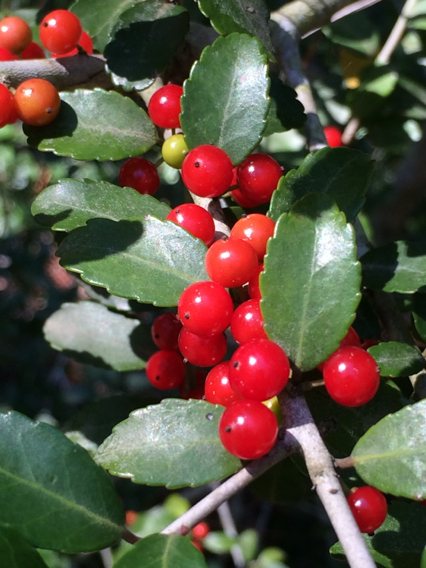
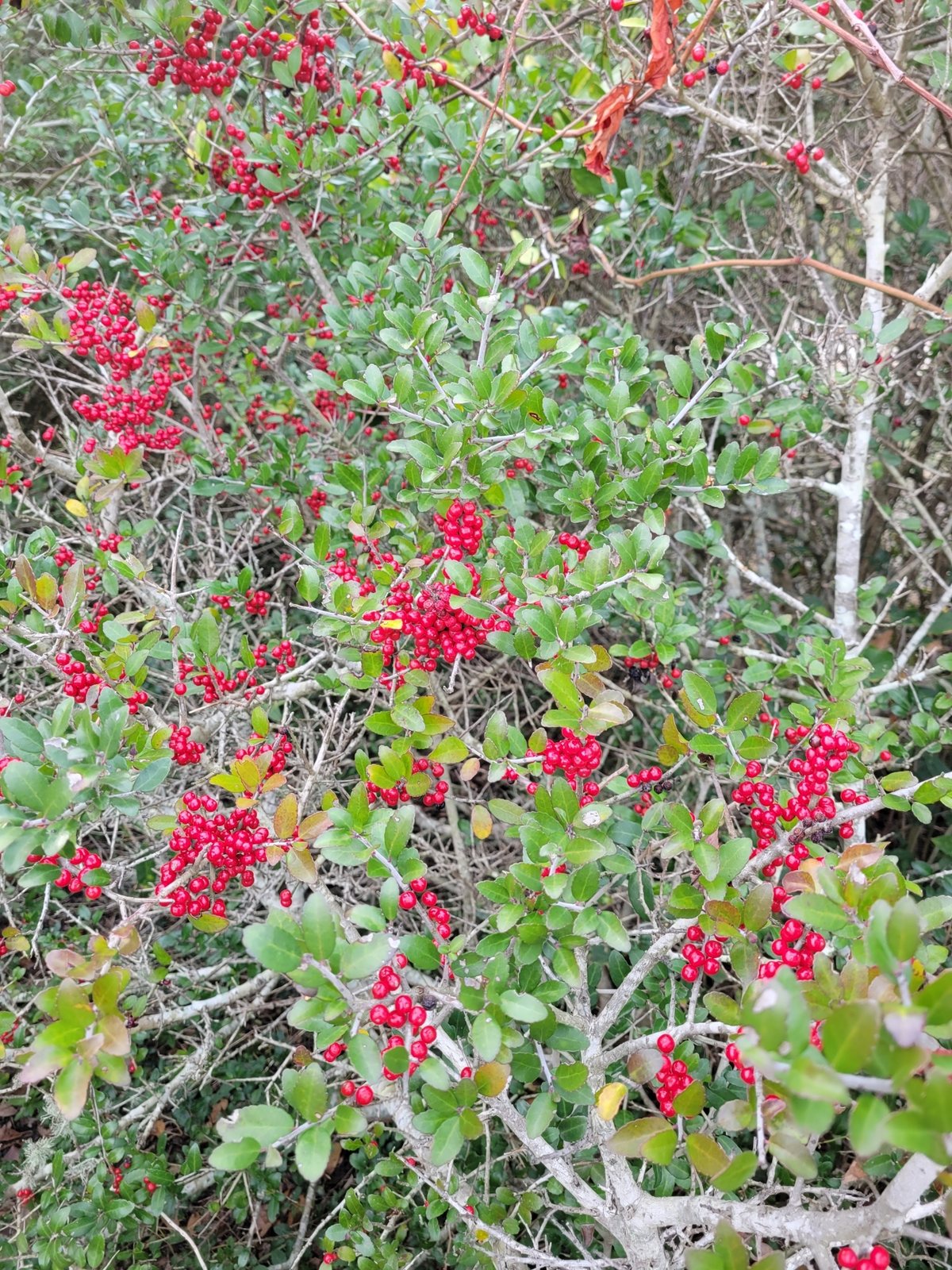
Yaupon holly is an evergreen shrub or small tree native to the southeastern United States, grown for its small leaves, dense branching and persistent red berries. It tolerates heat, coastal conditions and drought once established, and can be clipped into hedges or trained as a multistemmed tree. Only female plants bear berries, and they need a male yaupon nearby for pollination.
At a glance
- Sun
- Full sun to partial shade; growth is denser and fruiting usually better in full sun.
- Water
- Water regularly while establishing; established plants tolerate drought and occasional wet soil.
- Soil
- Adaptable to sandy, loamy or clay soils, from acidic to mildly alkaline; avoid permanently waterlogged ground.
- Height
- 10-20 ft (3-6 m); dwarf cultivars remain much smaller.
- Spread
- 8-12 ft (2.4-3.7 m)
- Flowers
- Small white flowers in spring, carried on separate male and female plants.
- Foliage
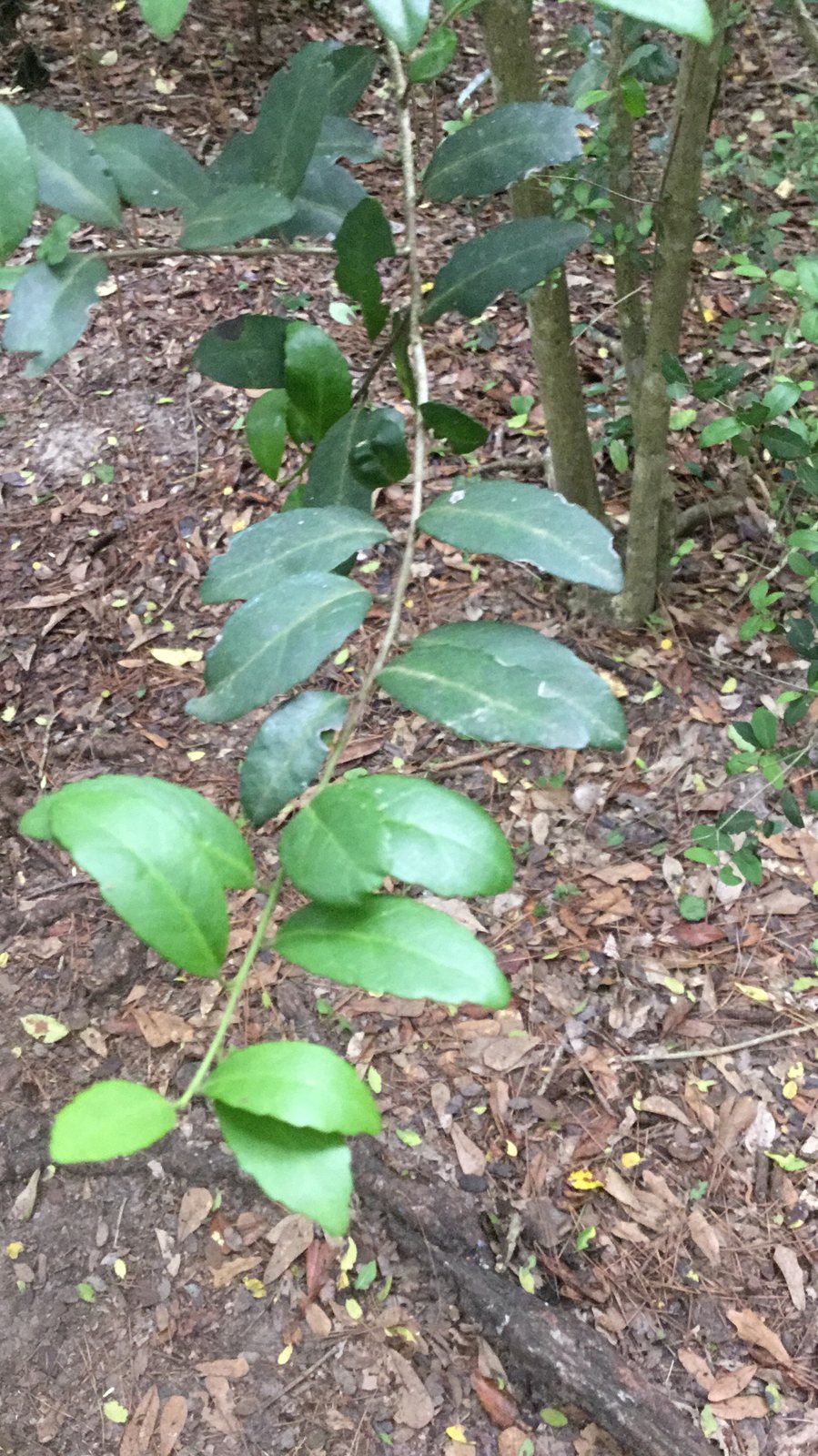
- Evergreen. Small, leathery, oval green leaves with rounded teeth and no sharp spines.
- Growth
- Moderate; faster in warm conditions with adequate moisture.
- Care needed
- Low
The year at a glance
- Pollinators
- Drought tolerant
- Heat tolerant
- Wildlife
- Low allergen
| J | F | M | A | M | J | J | A | S | O | N | D | |
|---|---|---|---|---|---|---|---|---|---|---|---|---|
| Flowers | ||||||||||||
| Fruit | ||||||||||||
| Plant |
Northern hemisphere months. In Australia, shift them by six.
- Difficulty
- Easy
- Toughness
- Very tough
Will it suit your garden?
Pick your zone, country, light and whether you have pets.
Full sun is 6 or more hours of direct sun a day, part shade 3 to 6 hours, shade under 3.
How it grows
Planting day
1.8 ft (0.54 m)
After 1 year
5 ft (1.5 m)
After 2 years
8 ft (2.5 m)
After 3 years
12 ft (3.5 m)
After 5 years
15 ft (4.5 m)
full size
About 4 years to full size.
From a typical nursery size, at an average rate for this kind of plant. A rule of thumb, not a forecast.
Good to know
- Cats and dogs
- Toxic
- Native to
- the US
- In the garden
- Spreads vigorously: plan to contain it.
- Growth rate
- Fast
Care
Jobs through the year
- PruneFeb–Mar
- Remove damaged or crossing branches and shape lightly; heavy clipping reduces flowers and berries.
- PruneMay–Aug
- Remove unwanted root suckers at their origin; stop heavy trimming by late summer.
- MulchApr
- Maintain 5-8 cm of mulch over the root zone, keeping it away from stems.
- WaterApr–May, Sep–Oct, every 21 days
- Water established plants only in extended dry spells; water first-year plants whenever the root zone starts drying.
- WaterJun–Aug, every 14 days
- Water established plants deeply during prolonged drought; skip when rainfall is adequate.
- ProtectJan–Mar, Nov–Dec
- In marginal zone 7 sites, shelter young plants from severe frost and drying winds; not reliably hardy in zone 6.
- Water deeply through the first growing season whenever the root zone begins to dry.
- Apply 2-3 in (5-8 cm) of mulch, keeping it away from the trunk and stems.
- Feed lightly in spring only if growth is weak or a soil test indicates a need.
- For berries, plant a known female and include a male yaupon that flowers at the same time.
- Remove unwanted root suckers at their point of origin before they form a thicket.
Pruning. Prune in late winter or early spring to remove damaged branches and shape the plant; gradually remove lower branches if training it as a small tree. Lightly trim hedges during active growth, but frequent shearing reduces flowers and berries.
Through the year
- Late winter
- Remove dead or crossing branches and carry out structural pruning before new growth.
- Spring
- Plant new specimens, water thoroughly and mulch the root zone.
- Spring
- Check that male and female plants flower together if berry production is a priority.
- Summer
- Water young plants during dry spells and remove unwanted suckers.
- Late summer
- Stop heavy trimming so new growth can mature before cold weather.
- Autumn
- Leave berries for birds and water young plants during prolonged dry weather.
In the garden
- Clip into evergreen hedges or screens for boundaries and sheltered seating areas.
- Train as a multistemmed small tree beside a terrace, leaving room for its mature crown.
- Combine with beautyberry and muhly grass for contrasting fruit, foliage and seasonal texture.
- Use in coastal gardens where salt spray and sandy soil limit less tolerant shrubs.
- Plant in mixed native borders to provide year-round cover and winter fruit for birds.
Garden styles it suits: Southern, Coastal, Wildlife garden, Formal, Topiary garden and Low-maintenance.
Plant it with: American beautyberry, Wax myrtle, Pink muhly grass, Switchgrass and Dwarf palmetto.
Wildlife: Spring flowers provide nectar and pollen for bees and other insects. Birds eat the berries, and dense evergreen branches provide shelter and nesting cover.
Problems to watch for
- Scale insects can cause sticky honeydew and black sooty mould; prune heavily infested shoots and use a labelled horticultural oil when conditions are suitable.
- Leaf miners leave pale trails or blotches; minor damage needs no treatment, and badly affected leaves can be removed.
- Root rot can develop in persistently saturated soil; improve drainage or move the plant to a better-drained position.
- Few or no berries usually means a male plant, no compatible male nearby, or excessive clipping; check plant sex and allow flowering shoots to develop.
Safety
Treat the berries and leaves as toxic to people, cats, dogs and horses. Berries contain saponins and can cause vomiting, diarrhoea and abdominal discomfort; leaves contain caffeine, which can also poison animals. Small berry ingestions usually cause gastrointestinal illness rather than severe poisoning, but seek medical or veterinary advice after ingestion, especially if symptoms develop.
Where it spreads. Can spread aggressively by root suckers and form dense thickets in its native range, particularly in Texas pastures and other southeastern US landscapes where fire or grazing patterns have changed. This is native woody encroachment rather than an introduced invasive population.
Easily confused with
Japanese holly (Ilex crenata)
Has similar small, rounded-toothed leaves but normally bears black fruit rather than red.
Inkberry (Ilex glabra)
Usually has larger, more elongated leaves with teeth concentrated near their tips, and black fruit.
Boxwood (Buxus sempervirens)
Leaves grow in opposite pairs and have smooth margins; yaupon leaves alternate along the stems and have rounded teeth.
The name
The epithet vomitoria refers to vomiting associated with historical ceremonial drinks made using yaupon, rather than proving that yaupon leaf tea itself is emetic.
Propagation. Take semi-ripe cuttings in summer to preserve the sex and characteristics of a selected plant. Seed germination is slow and irregular, and seedlings vary in sex and habit.
Checked against open data
- Accepted botanical name
- Ilex vomitoria
- In the US and Canada
- Native in the lower 48 states.
- Native range
- Alabama, Arkansas, Cuba, Florida, Georgia, Louisiana, Mexico Southeast, Mississippi, North Carolina, Oklahoma, South Carolina and Texas.
- Measured
- Soil pH 4.5 to 7. Average height 415 cm.
Sources: GBIF (CC BY 4.0), USDA PLANTS and Trefle (CC BY 4.0). The care and design notes are LandscapeGPT's own.
See it in your own yard.
Upload a photo of your yard and see it redesigned with plants that suit your climate, each checked against your zone.