Yellow flag iris
Iris pseudacorus. Family Iridaceae. Perennial.
Also called Yellow flag, Water flag, Yellow iris.
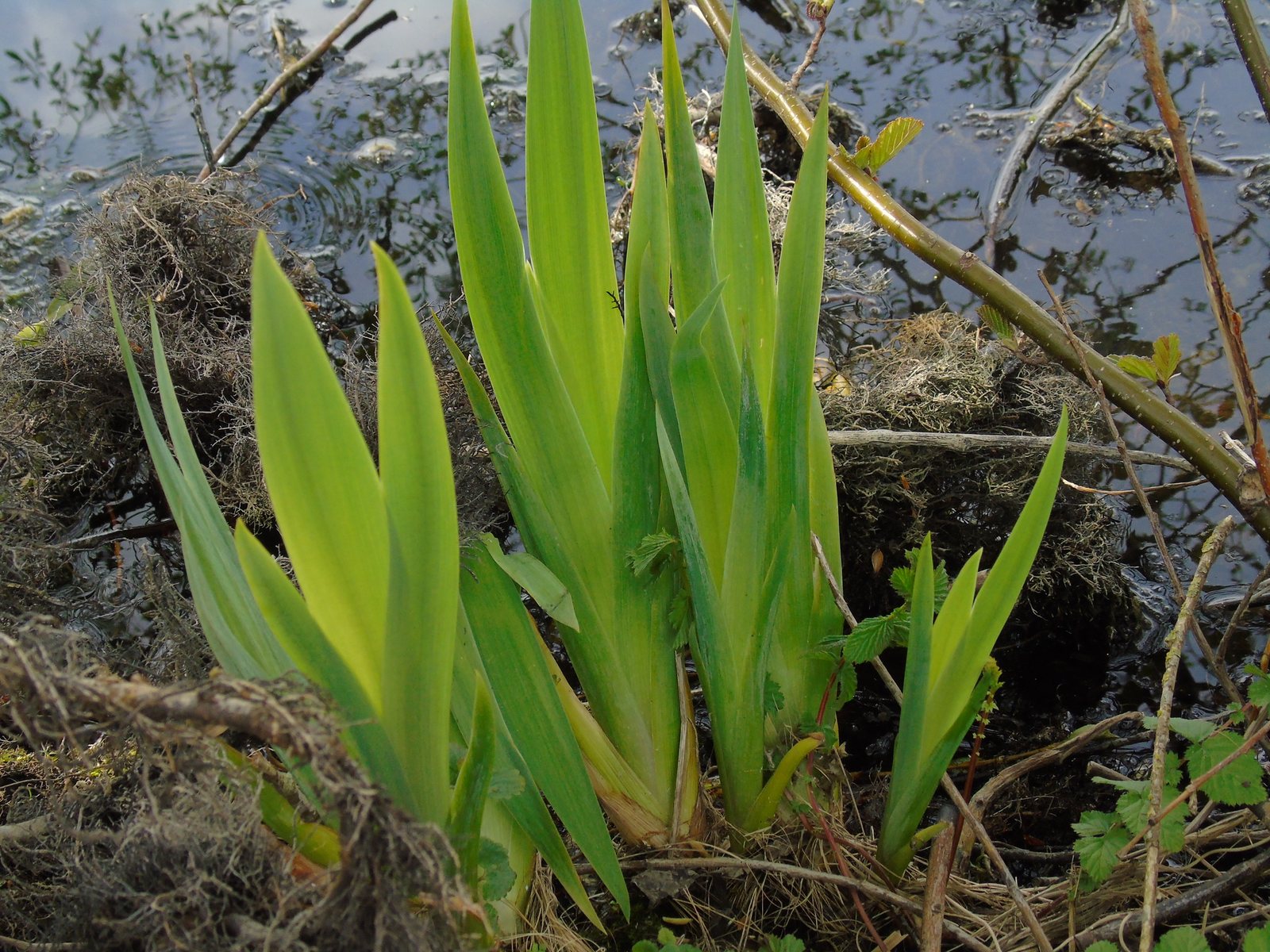
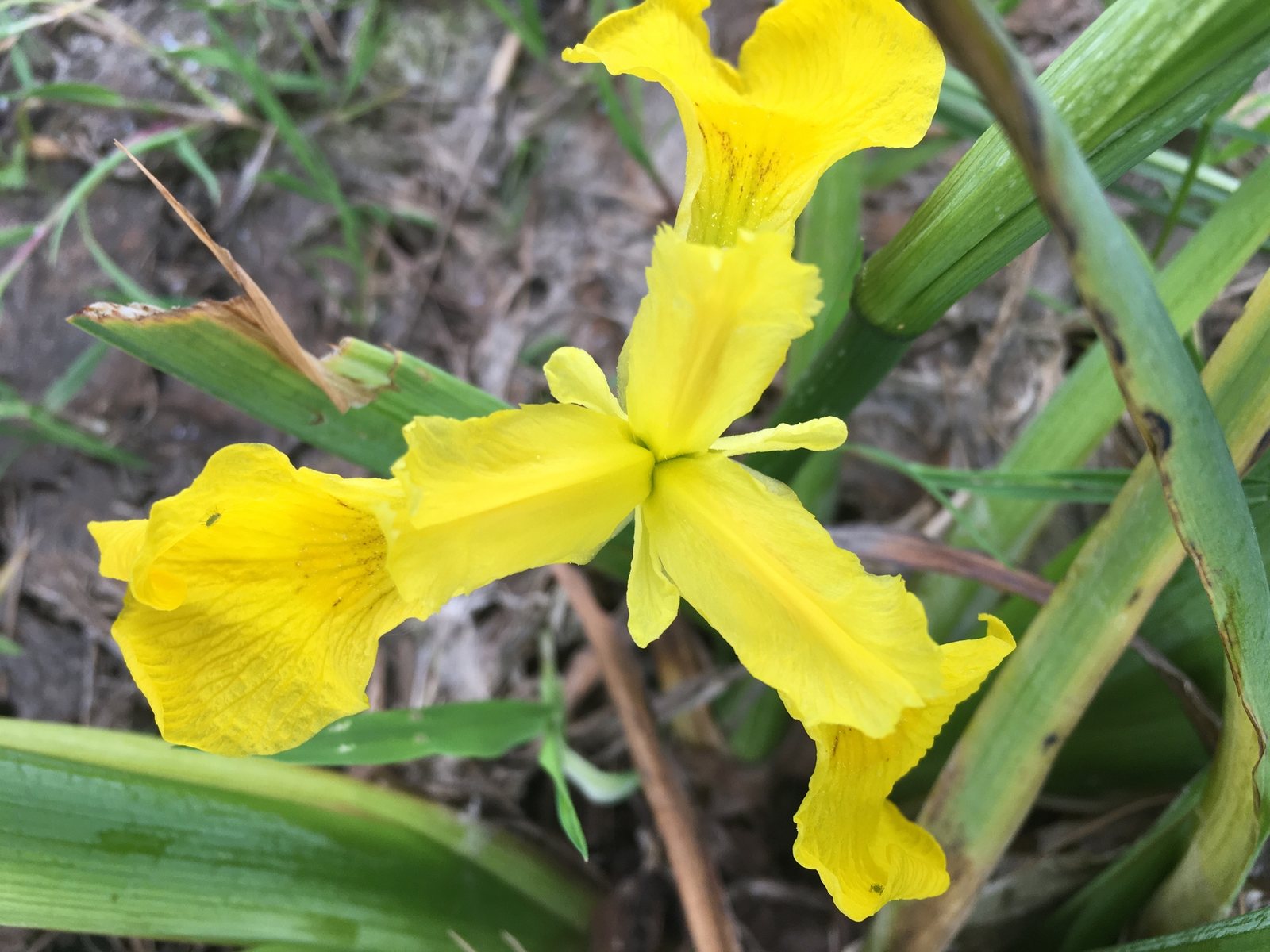
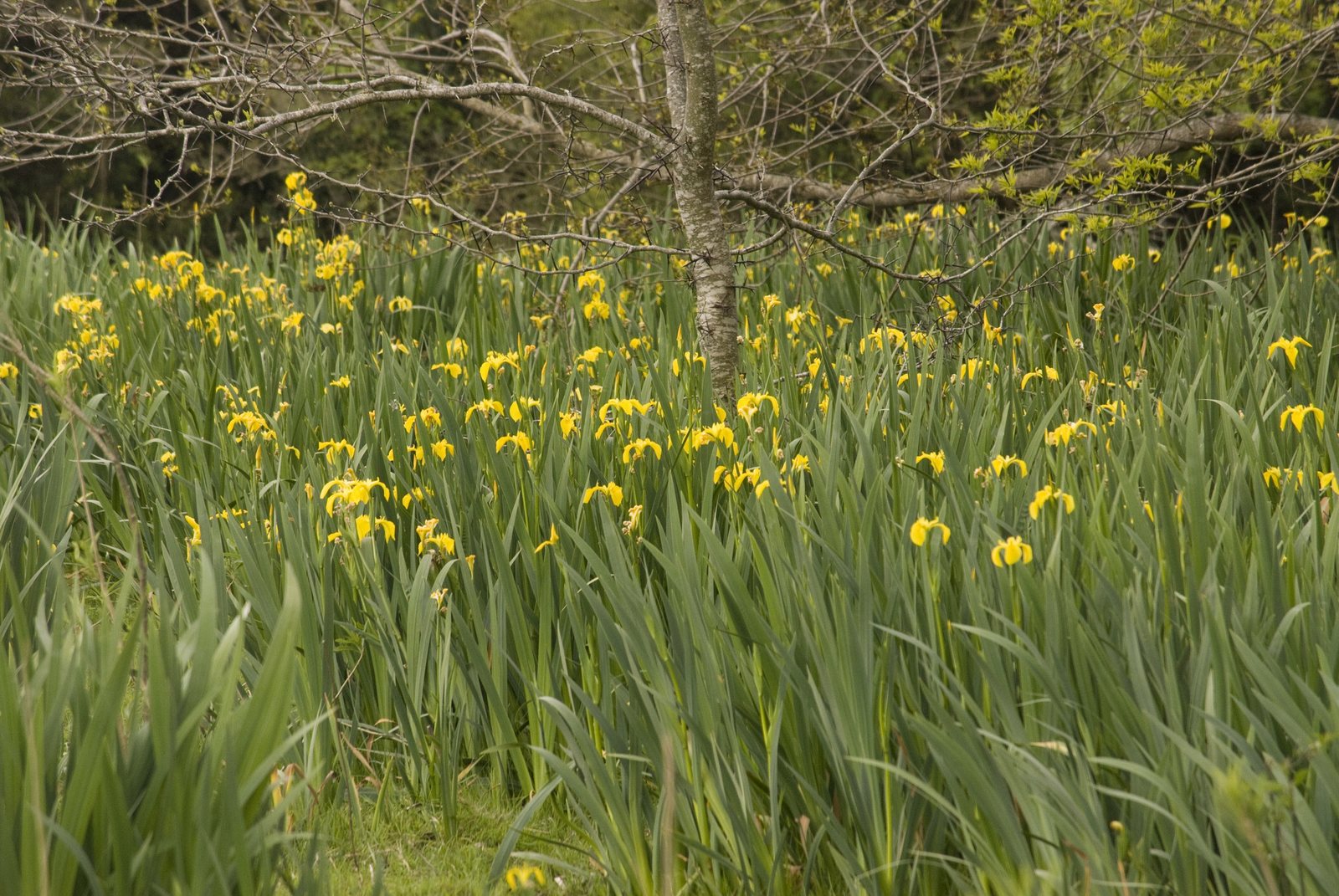
Yellow flag iris is a vigorous wetland perennial with upright, sword-shaped leaves and yellow flowers in late spring and early summer. Gardeners grow it for pond-edge colour and strong vertical foliage, but it can overwhelm small ponds and is invasive in much of North America and parts of Australia. Outside its native range, choose a locally native wetland plant instead.
At a glance
- Sun
- Full sun to partial shade; flowers best in full sun.
- Water
- Prefers consistently wet soil or shallow standing water. Established plants tolerate occasional drying, but do not need deep water.
- Soil
- Moisture-retentive loam or clay, including muddy pond margins; tolerates a wide range of soil pH.
- Height
- 3-5 ft (0.9-1.5 m)
- Spread
- 2-3 ft (0.6-0.9 m) initially; spreading rhizomes can form much larger colonies.
- Flowers
- Late spring to early summer; yellow flowers with darker markings on the lower petals.
- Foliage
- Broad, upright, sword-shaped green to grey-green leaves in dense fans; usually die back in winter.
- Growth
- Fast
- Care needed
- High
The year at a glance
- Pollinators
- Deer resistant
- Heat tolerant
- Low allergen
| J | F | M | A | M | J | J | A | S | O | N | D | |
|---|---|---|---|---|---|---|---|---|---|---|---|---|
| Flowers | ||||||||||||
| Fruit | ||||||||||||
| Plant |
Northern hemisphere months. In Australia, shift them by six.
- Difficulty
- Hard
- Toughness
- Very tough
Will it suit your garden?
Pick your zone, country, light and whether you have pets.
Full sun is 6 or more hours of direct sun a day, part shade 3 to 6 hours, shade under 3.
How it grows
Planting day
1 ft (0.3 m)
After 1 year
2.5 ft (0.76 m)
After 2 years
4 ft (1.2 m)
full size
About 2 years to full size.
From a typical nursery size, at an average rate for this kind of plant. A rule of thumb, not a forecast.
Good to know
- Cats and dogs
- Toxic
- Native to
- the UK
- Invasive in
- the US, Canada and Australia
- In the garden
- Spreads vigorously: plan to contain it.
- Growth rate
- Fast
Care
Jobs through the year
- ProtectMar–May, Jul–Aug
- Before planting or dividing, check local restrictions; do not grow where invasive or able to escape into waterways.
- WaterMar–May, Sep–Oct, every 7 days
- For established plants, maintain wet soil or shallow water; add water only if levels fall.
- WaterJun–Aug, every 3 days
- Check established plants and top up as needed to keep roots wet; new plants must not dry out.
- DeadheadJun–Jul, every 7 days
- Wearing gloves, cut spent flower stems to the base before capsules form; retained capsules would ripen in summer.
- PruneFeb, Nov–Dec
- Remove dead foliage wearing gloves; sap can irritate skin.
- DivideMar–Apr, Jul–Aug
- Where legal and appropriate, divide congested clumps in spring or after flowering, collecting every rhizome fragment.
- ProtectApr–Oct, every 14 days
- Remove escaped shoots and seedlings; dispose of fragments under local invasive-plant guidance, never in waterways.
- ProtectMay–Jun, every 7 days
- Inspect leaves for iris sawfly larvae and hand-pick if damage is substantial.
- Check local restrictions before planting; avoid it where it is invasive or could escape into waterways.
- Where appropriate to grow, keep the roots in wet soil or shallow water, with the crown close to the water surface.
- Do not routinely feed plants in pond margins; extra nutrients encourage excessive growth and algae.
- Remove flower stems before seed capsules develop, and inspect nearby ground for seedlings.
- Lift and divide congested clumps in spring or after flowering, wearing gloves; collect every rhizome fragment.
Pruning. Cut flower stems down to the base immediately after flowering to prevent seed production. Remove dead leaves in late autumn or winter, wearing gloves because the sap can irritate skin.
Through the year
- Late winter
- Remove remaining dead foliage and check that clumps have not spread beyond their intended area.
- Spring
- Where growing it is appropriate and legal, divide overcrowded clumps and remove unwanted rhizomes completely.
- Late spring
- Check leaves for sawfly larvae and remove them by hand if feeding damage is substantial.
- Early summer
- Cut off spent flower stems before seed capsules form.
- Summer
- Maintain wet soil during dry weather and remove seedlings or escaped shoots promptly.
- Autumn
- Collect loose rhizome fragments and seed heads; dispose of them according to local invasive-plant guidance, never in waterways.
In the garden
- In its native range, use small, managed groups at a large pond margin for upright foliage and yellow spring flowers.
- Pair with lower-growing wetland plants to contrast broad vertical leaves with softer ground-level growth.
- Use in a managed bog garden as a strong vertical accent, allowing access for regular thinning.
- In suitable native-range gardens, repeat clumps along a damp boundary to create a seasonal ribbon of colour.
Garden styles it suits: Bog garden, Cottage garden, English country and Architectural minimal.
Plant it with: Marsh marigold, Meadowsweet and Water avens.
Wildlife: Flowers provide pollen and nectar for visiting insects, including bees. Dense invasive stands can displace native wetland plants and reduce habitat diversity.
Problems to watch for
- Uncontrolled spread: rhizomes and floating seeds can establish dense colonies. Remove seed heads and escaped growth; pond baskets do not reliably prevent escape.
- Iris sawfly: larvae, particularly in the UK, chew leaf edges and may strip foliage. Hand-pick larvae when practical.
- Leaf spot: brown or streaked patches develop on leaves. Remove affected dead foliage and thin crowded clumps to improve airflow.
- Poor flowering: deep shade or severe crowding reduces bloom. Move to a sunnier position or divide the clump where continued cultivation is appropriate.
Safety
Toxic to people, cats, dogs and horses if eaten. All parts are potentially harmful, especially the rhizomes; ingestion can cause mouth irritation, drooling, vomiting, abdominal pain and diarrhoea. Sap can irritate skin. Seek medical or veterinary advice after ingestion.
Where it spreads. Spreads aggressively by rhizomes and waterborne seed. It is invasive across much of the United States, including the Pacific Northwest, California, the Northeast and Great Lakes region; in parts of Canada, including British Columbia, Ontario and Quebec; and in southeastern Australia, including parts of New South Wales, Victoria and Tasmania. Sale or planting is restricted in some jurisdictions.
Easily confused with
Northern blue flag (Iris versicolor)
Has violet-blue flowers with yellow-and-white markings rather than wholly yellow flowers; foliage alone can be difficult to distinguish.
Southern blue flag (Iris virginica)
Usually has violet-blue flowers with yellow signals; yellow flag has yellow flowers and typically forms especially robust, dense clumps.
Sweet flag (Acorus calamus)
Has aromatic leaves and a small, greenish, finger-like flower spike rather than showy iris flowers.
The name
The species name pseudacorus means 'false Acorus', referring to the resemblance of its leaves to those of sweet flag.
Propagation. Usually propagated by dividing rhizomes in spring or after flowering, but do not propagate where invasive or restricted. Seed also germinates readily and is a major route of escape; remove seed heads rather than allowing self-sowing.
Checked against open data
- Accepted botanical name
- Iris pseudacorus
- In the US and Canada
- Introduced in Canada and the lower 48 states.
- Native range
- Albania, Algeria, Austria, Baleares, Baltic States, Belarus, Belgium, Bulgaria, Central European Rus, Corse, Czechoslovakia and Denmark.
- Measured
- Soil pH 7 to 7.5. Average height 66 cm.
Sources: GBIF (CC BY 4.0), USDA PLANTS and Trefle (CC BY 4.0). The care and design notes are LandscapeGPT's own.
See it in your own yard.
Upload a photo of your yard and see it redesigned with plants that suit your climate, each checked against your zone.