Bird cherry
Prunus padus. Family Rosaceae. Tree.
Also called European bird cherry, Hackberry, Mayday tree.
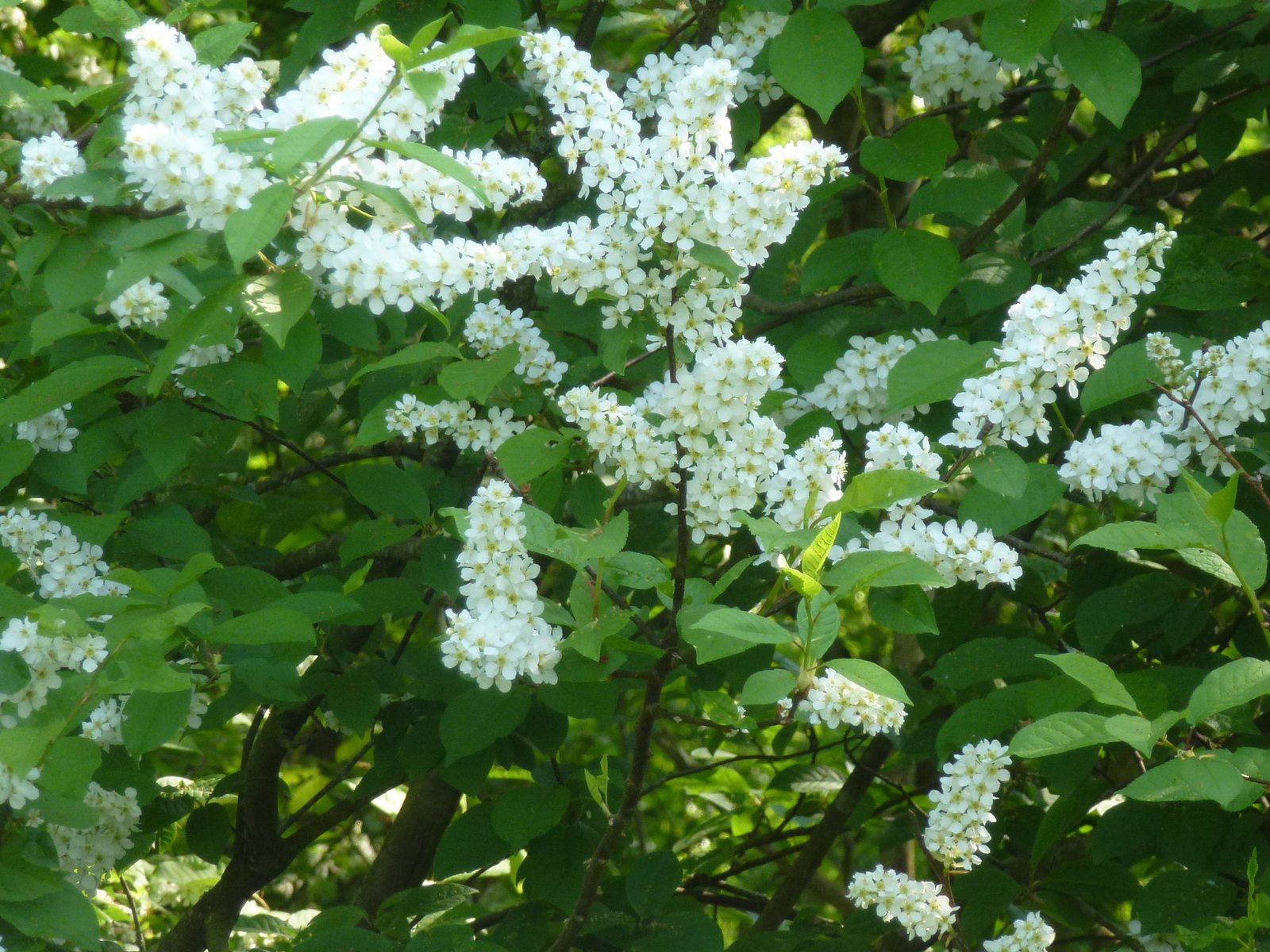
Bird cherry is a deciduous tree native to Europe and northern Asia, grown for its fragrant white flower sprays, dark fruits and yellow autumn leaves. It suits cool-climate gardens with room for a spreading crown, especially woodland edges and wildlife plantings. It can sucker and self-seed, and should not be planted where it is invasive.
At a glance
- Sun
- Full sun or partial shade; flowers most freely in sun.
- Water
- Prefers consistently moist soil; water deeply during dry spells while establishing. Avoid sites that become very dry in summer.
- Soil
- Moist, fertile soil with reasonable drainage; tolerates clay and a broad range of soil pH.
- Height
- 30-50 ft (9-15 m)
- Spread
- 20-40 ft (6-12 m)
- Flowers
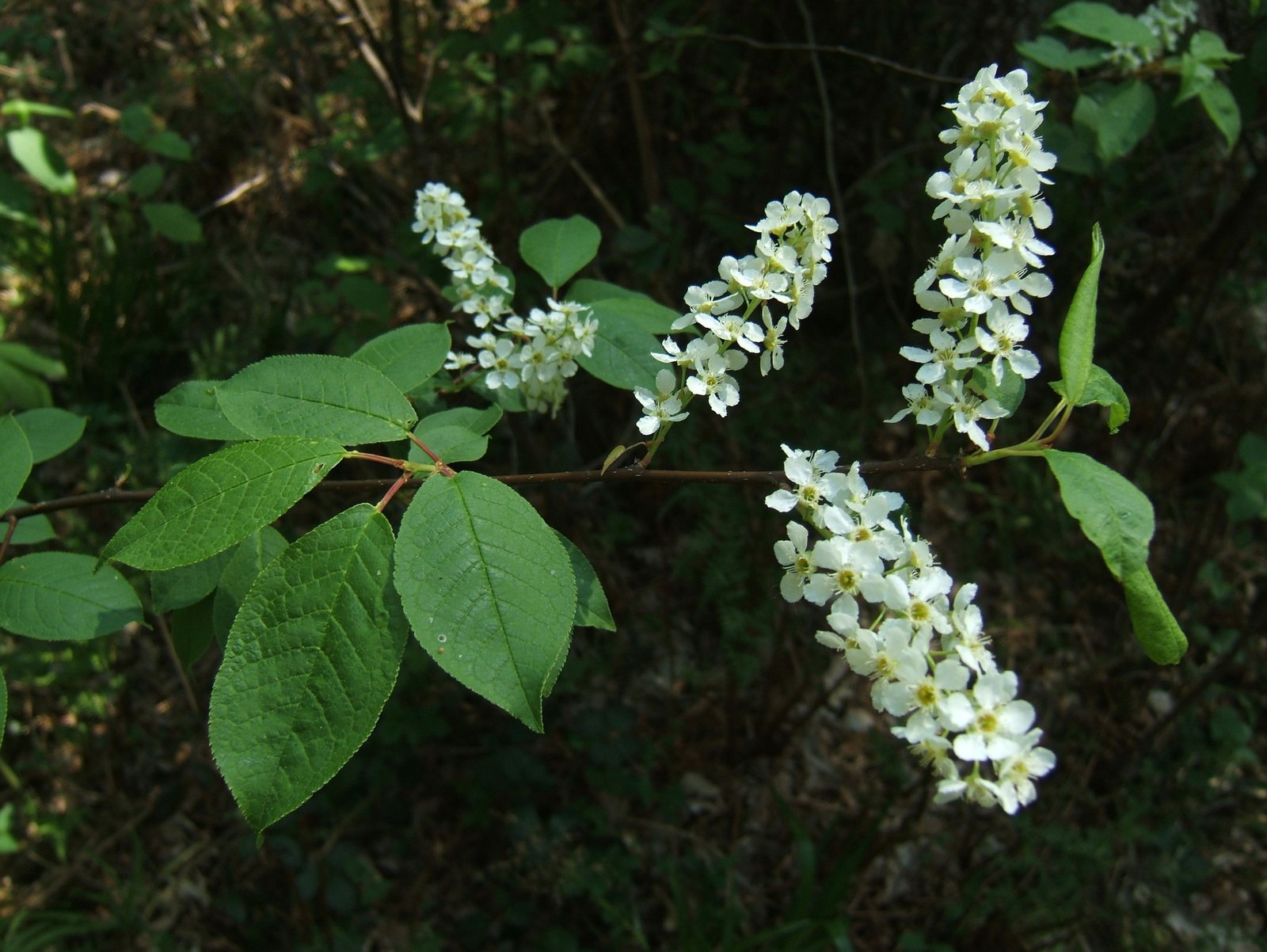
- Mid- to late spring; fragrant white flowers in long, drooping sprays as the leaves unfold.
- Foliage
- Oval, pointed, finely toothed green leaves, turning yellow in autumn.
- Growth
- Moderate to fast when young, especially in moist soil.
- Care needed
- Medium
The year at a glance
- Pollinators
- Cold hardy
- Wildlife
- Low allergen
- Fragrant
| J | F | M | A | M | J | J | A | S | O | N | D | |
|---|---|---|---|---|---|---|---|---|---|---|---|---|
| Flowers | ||||||||||||
| Fruit | ||||||||||||
| Plant |
Northern hemisphere months. In Australia, shift them by six.
- Difficulty
- Moderate
- Toughness
- Fairly tough
Will it suit your garden?
Pick your zone, country, light and whether you have pets.
Full sun is 6 or more hours of direct sun a day, part shade 3 to 6 hours, shade under 3.
How it grows
Planting day
7 ft (2 m)
After 1 year
9 ft (2.6 m)
After 2 years
11 ft (3.3 m)
After 3 years
13 ft (3.9 m)
After 5 years
17 ft (5.1 m)
About 16 years to full size.
From a typical nursery size, at an average rate for this kind of plant. A rule of thumb, not a forecast.
Good to know
- Cats and dogs
- Toxic
- Native to
- the UK
- Invasive in
- the US
- In the garden
- Spreads vigorously: plan to contain it.
- Growth rate
- Fast
Care
Jobs through the year
- WaterApr–May, Sep–Oct, every 14 days
- Water established trees deeply when soil begins drying; young trees need more frequent watering.
- WaterJun–Aug, every 7 days
- Water deeply in dry weather to maintain moist soil; do not let young rootballs dry out.
- MulchMar–Apr
- Apply 5–8 cm of organic mulch, keeping it away from the trunk.
- FeedMar–Apr
- Feed modestly only when poor growth and a soil test indicate a deficiency.
- PruneJun–Aug
- Prune only as needed in dry summer weather to reduce silver leaf risk.
- PruneMay–Sep, every 30 days
- Check for and remove unwanted suckers; pull seedlings before they establish.
- Plant during the dormant season when the ground is workable, keeping the root flare at soil level.
- Water deeply through the first two growing seasons whenever the root zone begins to dry.
- Apply 2-3 in (5-8 cm) of organic mulch, keeping it clear of the trunk.
- Do not feed routinely; use a modest spring feed only if growth is poor and a soil test indicates a deficiency.
- Remove unwanted suckers and seedlings promptly.
- Stake only on exposed sites or where the root ball moves; remove the support once the roots hold firmly.
Pruning. Establish a sound framework while young, then prune only when necessary in dry summer weather to reduce the risk of silver leaf infection. Remove crossing, damaged or diseased branches without cutting into the branch collar.
Through the year
- Winter
- Plant dormant trees when the ground is neither frozen nor waterlogged.
- Early spring
- Refresh mulch and check that ties are not rubbing or constricting the trunk.
- Late spring
- Check new growth for aphids and webbing caterpillars; avoid spraying flowers visited by insects.
- Summer
- Water young trees during dry spells and carry out any necessary pruning in dry weather.
- Late summer
- Remove unwanted seedlings and suckers, especially near natural areas.
- Autumn
- Check available space beneath the expanding crown and move sun-loving plants if they are becoming shaded.
In the garden
- Use as a flowering canopy tree at a woodland edge, underplanted with shade-tolerant perennials.
- Include in a broad mixed hedgerow where its mature size and suckering habit can be accommodated.
- Plant as a loose, informal specimen in a large lawn, allowing room for its spreading branches.
- Use in moist, naturalistic planting with dogwoods, ferns and sedges, where locally appropriate.
Garden styles it suits: Woodland, Wildlife garden, Native hedgerow, English country, Grand estate and Rewilded.
Plant it with: Hazel, Guelder rose, Red-twig dogwood, Male fern, Wood anemone and Primrose.
Wildlife: Flowers provide pollen and nectar for insects, and birds eat the small black fruits. Leaves support several moth caterpillars within its native range. These benefits do not justify planting it in regions where it invades native habitat.
Problems to watch for
- Bird cherry ermine moth: caterpillars can cover branches in silk and strip leaves. Established trees usually recover; remove small webs by hand on young trees.
- Aphids: colonies curl young leaves and leave sticky honeydew. Encourage predators and wash accessible colonies off with water rather than routinely spraying.
- Black knot: hard, black swellings develop on twigs, particularly in North America. Prune infected branches at least 6-8 in (15-20 cm) below the swelling in dry weather and dispose of them.
- Silver leaf: silvery foliage and branch dieback can follow infection through wounds. Avoid winter pruning, remove affected branches in dry summer weather and disinfect tools between cuts.
Safety
Leaves, bark, twigs and fruit stones contain cyanogenic compounds and can poison people, cats, dogs and horses if eaten, especially when leaves are wilted or stones are chewed. Substantial ingestion can be fatal; keep prunings away from livestock. Ripe fruit flesh is not generally considered poisonous, but the bitter fruits contain toxic stones and are unsuitable for casual eating by children.
Where it spreads. Invasive in Alaska, especially around Anchorage and in parts of the Fairbanks area, where it spreads into native woodland and along waterways. It also escapes cultivation in parts of the northern contiguous United States and Canada; check local guidance before planting near natural habitat.
Easily confused with
Chokecherry (Prunus virginiana)
Another cherry with elongated flower clusters, but usually with shorter clusters and leaves whose teeth tend to be sharper and more outward-pointing.
Black cherry (Prunus serotina)
Usually has narrower, glossier leaves, often with rusty hairs beside the midrib underneath near the leaf base. Older trees develop distinctive dark, scaly bark.
Wild cherry (Prunus avium)
Flowers appear in small bunches rather than long, drooping sprays, and the fruits are larger. Its bark usually has conspicuous horizontal markings.
The name
The common name refers to the birds that readily eat its small fruits.
Propagation. Sow cleaned seed outdoors in autumn; germination may take more than one seasonal cycle. Root softwood cuttings in early summer or semi-ripe cuttings later in summer; use vegetative propagation to preserve named cultivars.
Checked against open data
- Accepted botanical name
- Prunus padus
- In the US and Canada
- Introduced in Alaska, Canada and the lower 48 states.
- Native range
- Albania, Altay, Amur, Austria, Baltic States, Belarus, Belgium, Bulgaria, Buryatiya, Central European Rus, China North-Central and China Southeast.
- Measured
- Soil pH 5 to 7. Average height 800 cm.
Sources: GBIF (CC BY 4.0), USDA PLANTS and Trefle (CC BY 4.0). The care and design notes are LandscapeGPT's own.
See it in your own yard.
Upload a photo of your yard and see it redesigned with plants that suit your climate, each checked against your zone.