Black she-oak
Allocasuarina littoralis. Family Casuarinaceae. Tree.
Also called Black sheoak, River black-oak.
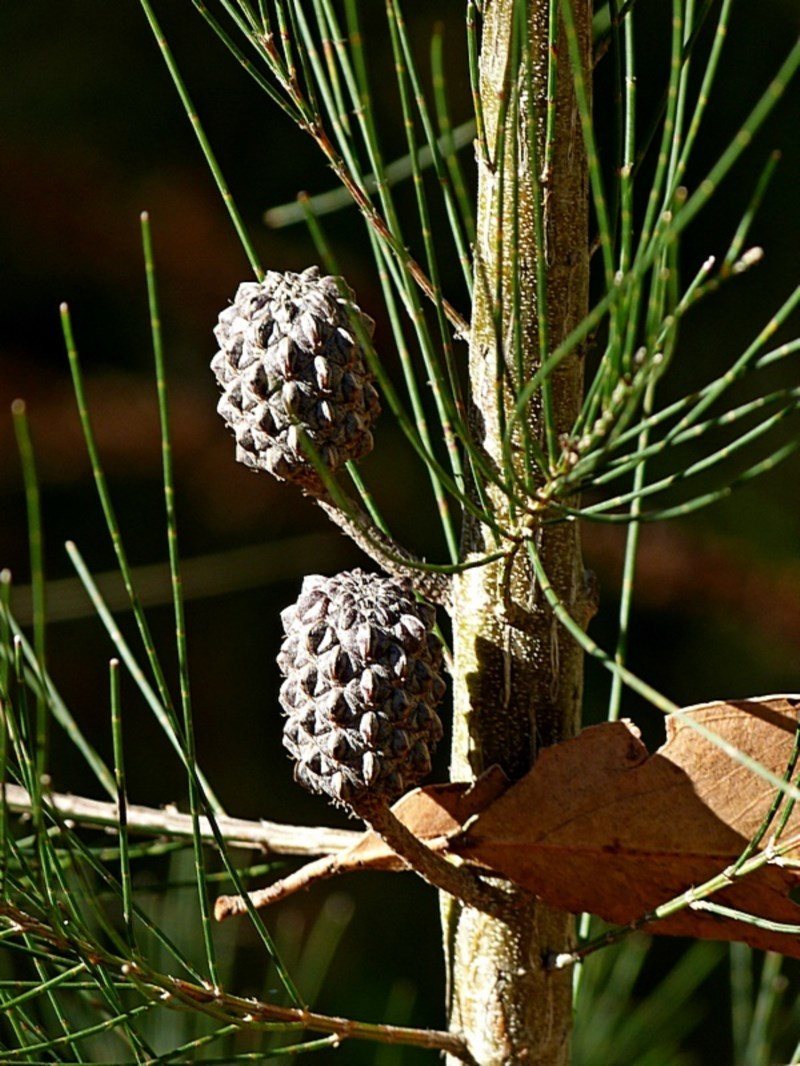
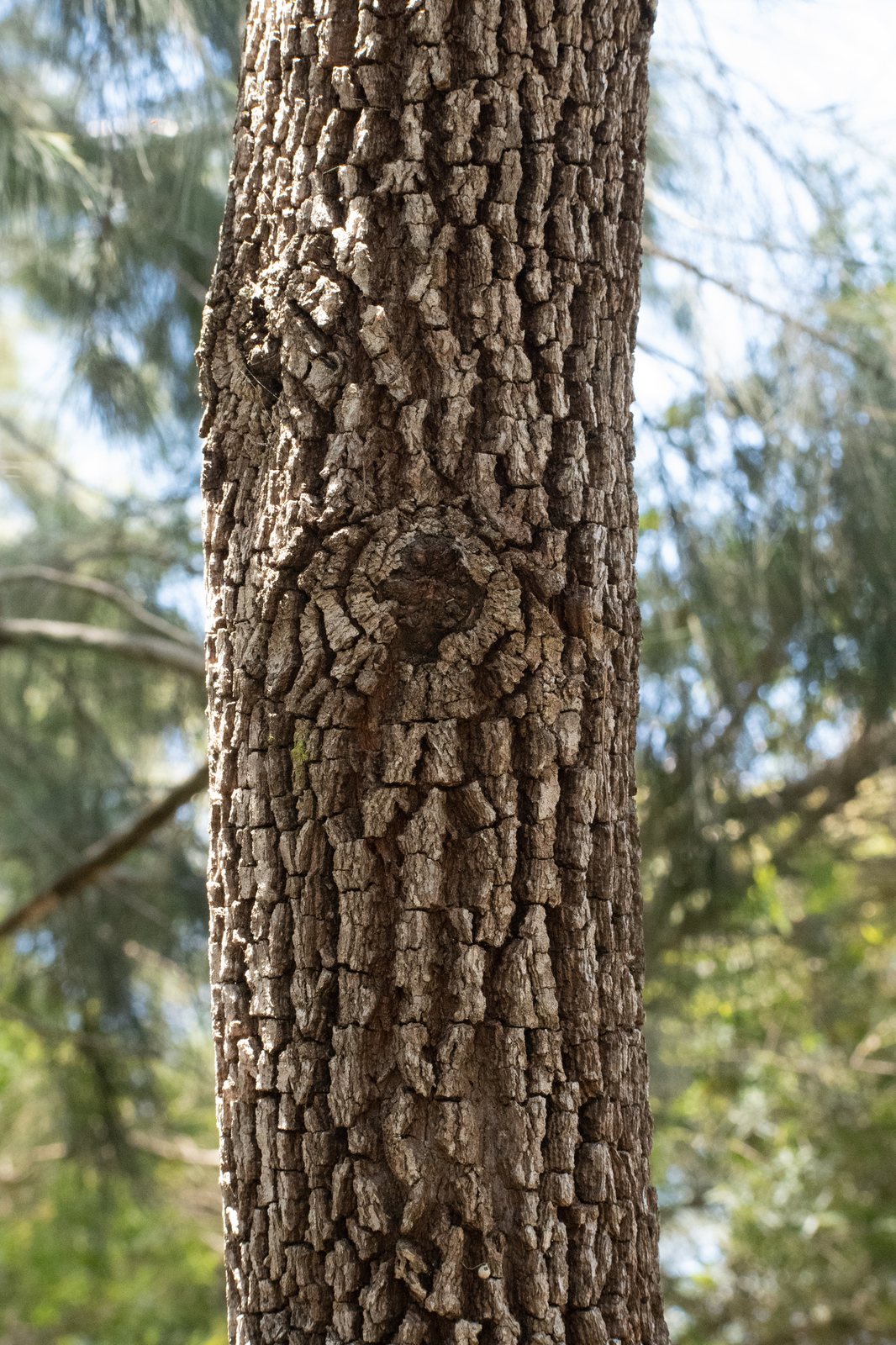
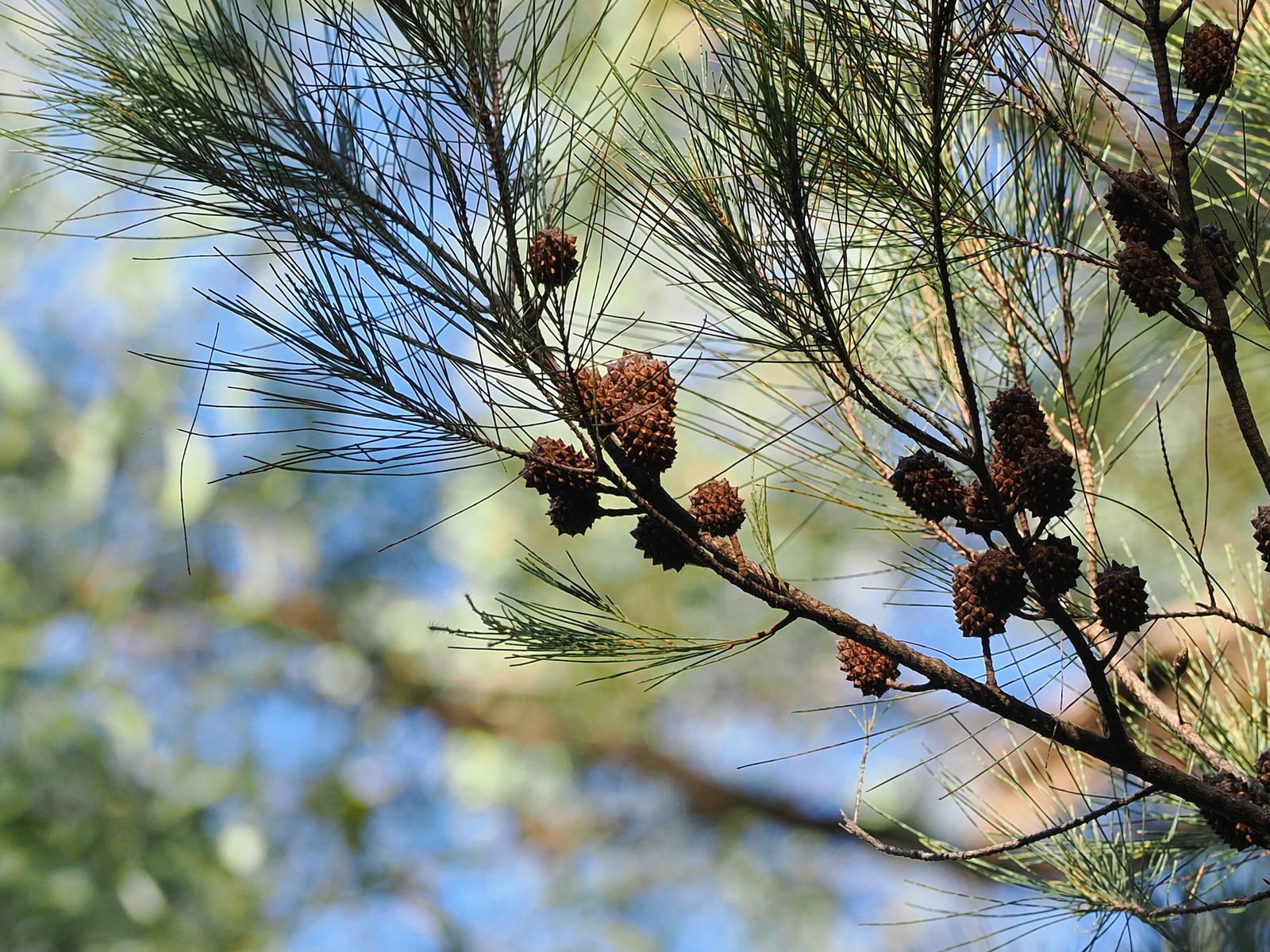
An evergreen tree from eastern Australia with dark, furrowed bark and fine, jointed green branchlets that resemble pine needles. Gardeners grow it for its light canopy, wind-filtering habit and tolerance of dry, relatively poor soil once established. Allow room for a mature tree rather than treating it as a small ornamental.
At a glance
- Sun
- Full sun; tolerates light shade but develops a more open crown.
- Water
- Water regularly while establishing; low water needs once established, with occasional deep watering during prolonged drought.
- Soil
- Well-drained sandy, gravelly or loamy soil, preferably acidic to neutral. Tolerates poor soil and some clay where drainage is good; avoid persistently wet ground.
- Height
- 20-40 ft (6-12 m), occasionally taller
- Spread
- 10-20 ft (3-6 m)
- Flowers
- Usually autumn to winter: small reddish female flowers and inconspicuous brownish male flower spikes, generally on separate trees.
- Foliage
- Evergreen. Fine, dark green, jointed branchlets form an airy canopy. The true leaves are tiny scales arranged in rings around the joints.
- Growth
- Moderate to fast in suitable conditions.
- Care needed
- Low
The year at a glance
- Drought tolerant
- Heat tolerant
- Wildlife
| J | F | M | A | M | J | J | A | S | O | N | D | |
|---|---|---|---|---|---|---|---|---|---|---|---|---|
| Flowers | ||||||||||||
| Fruit | ||||||||||||
| Plant |
Northern hemisphere months. In Australia, shift them by six.
- Difficulty
- Hard
- Toughness
- Fairly tough
Will it suit your garden?
Pick your zone, country, light and whether you have pets.
Full sun is 6 or more hours of direct sun a day, part shade 3 to 6 hours, shade under 3.
How it grows
Planting day
7 ft (2 m)
After 1 year
8 ft (2.4 m)
After 2 years
9 ft (2.9 m)
After 3 years
11 ft (3.3 m)
After 5 years
14 ft (4.2 m)
About 16 years to full size.
From a typical nursery size, at an average rate for this kind of plant. A rule of thumb, not a forecast.
Good to know
- Cats and dogs
- Safe
- Native to
- Australia
- Growth rate
- Fast
Care
Jobs through the year
- WaterApr–May, Sep–Oct, every 21 days
- Water established ground trees only during prolonged dry weather; young trees need more frequent watering.
- WaterJun–Aug, every 14 days
- Give established ground trees an occasional deep soak during drought, allowing soil to dry between waterings.
- WaterJan–Mar, Nov–Dec, every 21 days
- Check overwintered containers and water only as needed to prevent complete root-ball drying.
- MulchMay
- Maintain a broad mulch ring around young trees, keeping the trunk clear.
- PruneMar–Apr
- Remove damaged or crossing branches and lightly train young trees; never top or cut hard into bare wood.
- ProtectJan–Apr, Oct–Dec
- Not reliably hardy in zone 6–7; use frost-free container culture while manageable, not fleece alone.
- Water deeply through the first one or two growing seasons, allowing the soil surface to dry between waterings.
- Keep a broad mulch ring around young trees, leaving the trunk clear.
- Avoid routine feeding; on very poor soil, use a light application of low-phosphorus native-plant fertiliser.
- Stake only if the root ball moves in the wind, and remove supports once the tree is anchored.
- Plant away from drains, paving and buildings, allowing for its mature crown and root system.
Pruning. In late winter or after the main flowering period, remove dead, damaged or crossing branches and lightly correct the shape of young trees. Avoid topping or cutting heavily into old, bare wood.
Through the year
- Spring
- Plant in cooler districts after the risk of hard frost has passed; water the root ball thoroughly.
- Late spring
- Check ties and stakes, and renew mulch without piling it against the trunk.
- Summer
- Deep-water young trees during dry weather; check soil moisture before watering again.
- Autumn
- Plant in mild-winter districts while the soil is warm and rainfall is returning.
- Winter
- Protect recently planted trees from unusually severe frost and check that the planting site drains freely.
- Late winter
- Remove damaged branches and make minor formative cuts on young trees.
In the garden
- Use as a fine-textured specimen against a plain wall or an open lawn, with adequate clearance for its mature size.
- Plant in loose groups as a wind-filtering screen on a large site rather than as a tightly clipped hedge.
- Combine with banksias, wattles and native grasses in a dry Australian planting.
- Use its dark trunk and airy foliage as a backdrop to pale grasses and bold-leaved shrubs.
Garden styles it suits: Australian native, Coastal, Woodland, Wildlife garden, Low-maintenance and Desert / xeriscape.
Plant it with: Spiny-headed mat-rush, Kangaroo grass, Silver banksia, Coast banksia, Prickly Moses and Common everlasting.
Wildlife: The woody cones provide seed for some cockatoos, including glossy black-cockatoos where they occur naturally. The canopy offers shelter and nesting sites for birds; flowers are wind-pollinated rather than a major nectar source.
Problems to watch for
- Root rot and decline in wet soil: improve drainage before planting and avoid frequent irrigation around established trees.
- Frost injury on young trees: choose a sheltered position and protect young plants during severe cold; prune damaged growth after new growth shows what has survived.
- Scale insects: inspect stressed trees and treat accessible infestations with a labelled horticultural oil, following temperature restrictions.
- Sparse growth in deep shade: plant in a sunnier position rather than trying to correct the problem with fertiliser.
Safety
Not known to be toxic to people, cats, dogs or horses. Species-specific safety information is limited, so do not treat any part as food or allow pets to chew the hard cones and woody branchlets.
Easily confused with
Drooping she-oak (Allocasuarina verticillata)
Usually has more strongly drooping branchlets and larger, broader cones. Its branchlet joints generally carry 9-13 leaf teeth, compared with 6-8 in black she-oak.
Forest oak (Allocasuarina torulosa)
Typically has conspicuously corky bark and finer, often drooping branchlets with 4-5 leaf teeth at each joint, rather than the usual 6-8.
Swamp she-oak (Casuarina glauca)
Often suckers into colonies and favours wetter ground. Its branchlet joints have many more leaf teeth, usually 12-20.
The name
Allocasuarina means 'other Casuarina', referring to its separation from that genus, while littoralis means 'of the shore' and black she-oak refers to its dark bark.
Propagation. Grow from seed released by mature woody cones as they dry. Sow shallowly in a free-draining seed mix, keep evenly moist, and transplant seedlings while small to minimise root disturbance.
Checked against open data
- Accepted botanical name
- Allocasuarina littoralis
- Native range
- New South Wales, Queensland, Tasmania and Victoria.
- Measured
- Average height 1000 cm.
Sources: GBIF (CC BY 4.0) and Trefle (CC BY 4.0). The care and design notes are LandscapeGPT's own.
See it in your own yard.
Upload a photo of your yard and see it redesigned with plants that suit your climate, each checked against your zone.