Black walnut
Juglans nigra. Family Juglandaceae. Tree.
Also called Eastern black walnut, American black walnut.
Black walnut is a large, deciduous tree native to eastern North America, grown for its edible nuts, broad shade and valuable timber. It needs a spacious garden: falling nuts, staining husks and roots that compete with nearby planting make it unsuitable beside patios or small vegetable gardens. Nuts ripen most reliably where summers are warm.
At a glance
- Sun
- Full sun; allow plenty of open space for the crown.
- Water
- Moderate; water young trees during dry spells. Established trees tolerate some drought, but prolonged dryness reduces growth and nut production.
- Soil
- Deep, fertile, moist but well-drained soil, preferably loam with a slightly acidic to neutral pH. Avoid shallow, compacted or waterlogged ground.
- Height
- 75-100 ft (23-30 m)
- Spread
- 50-75 ft (15-23 m)
- Flowers
- Late spring: hanging greenish male catkins and small green female flowers, appearing with the new leaves.
- Foliage
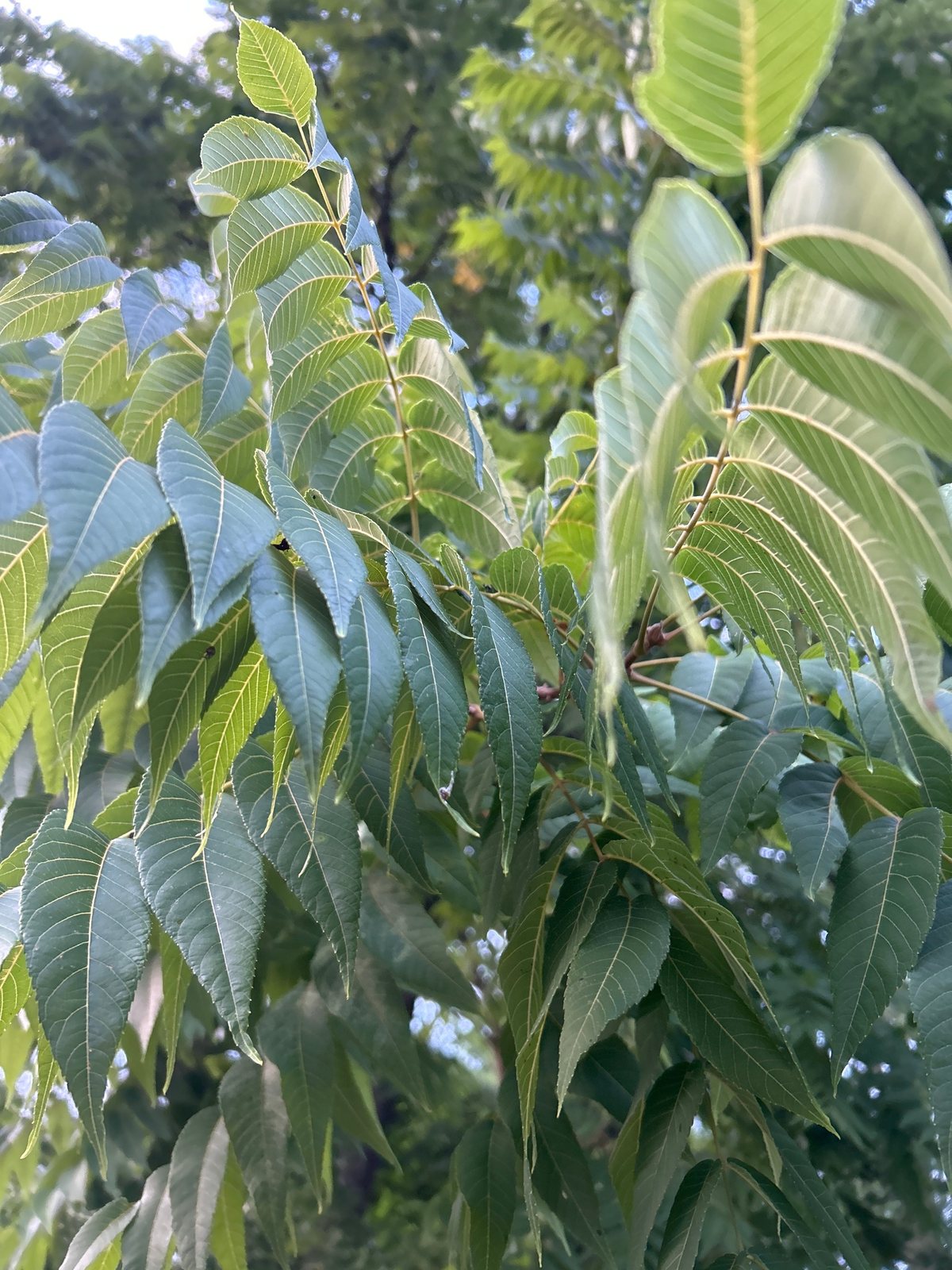
- Large, aromatic, pinnate leaves with numerous pointed leaflets; green in summer, turning yellow in autumn.
- Growth
- Moderate to fast on deep, moist soil; slower on dry or poor sites.
- Care needed
- Medium
The year at a glance
- Drought tolerant
- Cold hardy
- Heat tolerant
- Wildlife
- Edible
| J | F | M | A | M | J | J | A | S | O | N | D | |
|---|---|---|---|---|---|---|---|---|---|---|---|---|
| Flowers | ||||||||||||
| Fruit | ||||||||||||
| Plant |
Northern hemisphere months. In Australia, shift them by six.
- Difficulty
- Moderate
- Toughness
- Very tough
Will it suit your garden?
Pick your zone, country, light and whether you have pets.
Full sun is 6 or more hours of direct sun a day, part shade 3 to 6 hours, shade under 3.
How it grows
Planting day
10 ft (3.2 m)
After 1 year
14 ft (4.3 m)
After 2 years
18 ft (5.5 m)
After 3 years
22 ft (6.7 m)
After 5 years
30 ft (9 m)
About 20 years to full size.
From a typical nursery size, at an average rate for this kind of plant. A rule of thumb, not a forecast.
Good to know
- Cats and dogs
- Toxic
- Native to
- the US and Canada
- Growth rate
- Moderate
Care
Jobs through the year
- WaterApr–May, Sep–Oct, every 14 days
- Water established trees during prolonged drought; water young trees more frequently.
- WaterJun–Aug, every 7 days
- Water deeply during prolonged dry weather to support nuts; young trees need closer attention.
- MulchMar–Apr
- Renew a broad grass-free mulch ring without covering the trunk.
- FeedMar–Apr
- Feed only if weak growth or soil testing indicates a deficiency.
- PruneAug
- Train young trees to one leader with small cuts; avoid heavy pruning.
- HarvestSep–Oct
- Collect fallen nuts, remove husks with gloves, wash and cure in an airy, squirrel-proof place.
- ProtectOct–Nov
- Collect diseased fallen leaves and discard damaged nuts to reduce pest and disease carry-over.
- Choose a permanent site well away from buildings, paving and overhead wires; the deep root system makes established trees difficult to move.
- Water deeply through the first two or three growing seasons whenever the root zone becomes dry.
- Keep a broad, grass-free mulch ring around young trees, leaving the trunk clear.
- Feed only if soil testing or weak growth indicates a deficiency; avoid routine heavy nitrogen feeding.
- For better nut crops, plant two compatible trees with overlapping flowering times, allowing room for both mature crowns.
- Keep tomatoes and other sensitive crops outside the root zone; walnut competition and juglone may damage susceptible plants.
Pruning. Train young trees to one main leader and remove damaged or competing branches in late summer, when sap bleeding is less likely. Avoid topping or heavy pruning; use a qualified arborist for large branches.
Harvest
Gather nuts promptly as they fall in autumn, when the green husks begin to soften and darken; wear gloves to remove the staining husks, then wash and cure the nuts in a dry, airy, squirrel-proof place for several weeks. Grafted trees may give a worthwhile crop about 4-7 years after planting, while seedlings commonly take 10-15 years or longer. Discard mouldy nuts and expect variable crops between years.
Through the year
- Late autumn
- Plant dormant trees while the soil is workable, or postpone planting until spring in very cold or wet regions.
- Early spring
- Refresh mulch and remove grass around young trees without burying the trunk.
- Late spring
- Watch new growth for caterpillar colonies and inspect thinning crowns for branch dieback.
- Summer
- Water young trees deeply during dry weather and check that ties are not cutting into the bark.
- Late summer
- Carry out light formative pruning on young trees.
- Autumn
- Collect fallen nuts frequently, remove husks and cure sound nuts under cover.
In the garden
- A specimen shade tree in a large lawn or estate garden, positioned away from paths and seating.
- An upper-canopy tree in a spacious food forest, with compatible understory planting.
- A nut-producing tree in a homestead orchard with room for a second pollination partner.
- A native canopy tree in eastern North American woodland-edge planting, paired with shade-tolerant shrubs and perennials.
Garden styles it suits: Grand estate, Woodland, Wildlife garden, Food forest, Backyard orchard and Homestead.
Plant it with: Eastern redbud, Flowering dogwood, Spicebush, Christmas fern, Wild ginger and Virginia bluebells.
Wildlife: Nuts feed squirrels and other mammals, while the foliage supports several moth caterpillars. Mature trees provide nesting and roosting sites. Flowers are wind-pollinated rather than a significant nectar source.
Problems to watch for
- Walnut anthracnose causes dark leaf spots and premature leaf fall: collect fallen leaves, avoid wetting foliage and maintain tree vigour.
- Walnut caterpillars can strip branches: remove reachable colonies on young trees and seek local advice if defoliation is extensive.
- Thousand cankers disease, spread by walnut twig beetles, causes progressive crown dieback: report suspicious symptoms to local plant-health authorities and do not move walnut firewood.
- Poor nut crops can result from immature trees, frost, cool summers or poor pollination: allow time, provide a second compatible tree and recognise that some climates will not crop reliably.
Safety
Clean, sound kernels are edible for people, though walnut allergy can be severe. Dogs can suffer dangerous tremors or seizures after eating mouldy nuts or husks; shells can also cause choking or intestinal obstruction. Black walnut wood shavings used as horse bedding can cause severe laminitis and must never be used. Black walnut is not known to be specifically toxic to cats, but nuts, shells and mouldy material should be kept out of reach. Husk juice stains skin and may irritate it.
Easily confused with
English walnut (Juglans regia)
Usually has fewer, broader leaflets with mostly smooth margins and a well-developed terminal leaflet; its nuts generally have much thinner shells.
Butternut (Juglans cinerea)
Has elongated, pointed nuts in sticky, hairy husks rather than round ones, and its leaf undersides are conspicuously hairy.
Tree of heaven (Ailanthus altissima)
Its leaflets have mostly smooth edges with gland-bearing teeth near the base; it produces clusters of winged seeds rather than walnuts.
The name
Juglans comes from Latin for 'Jupiter's nut', while nigra means 'black', referring to the tree's dark features, especially its bark.
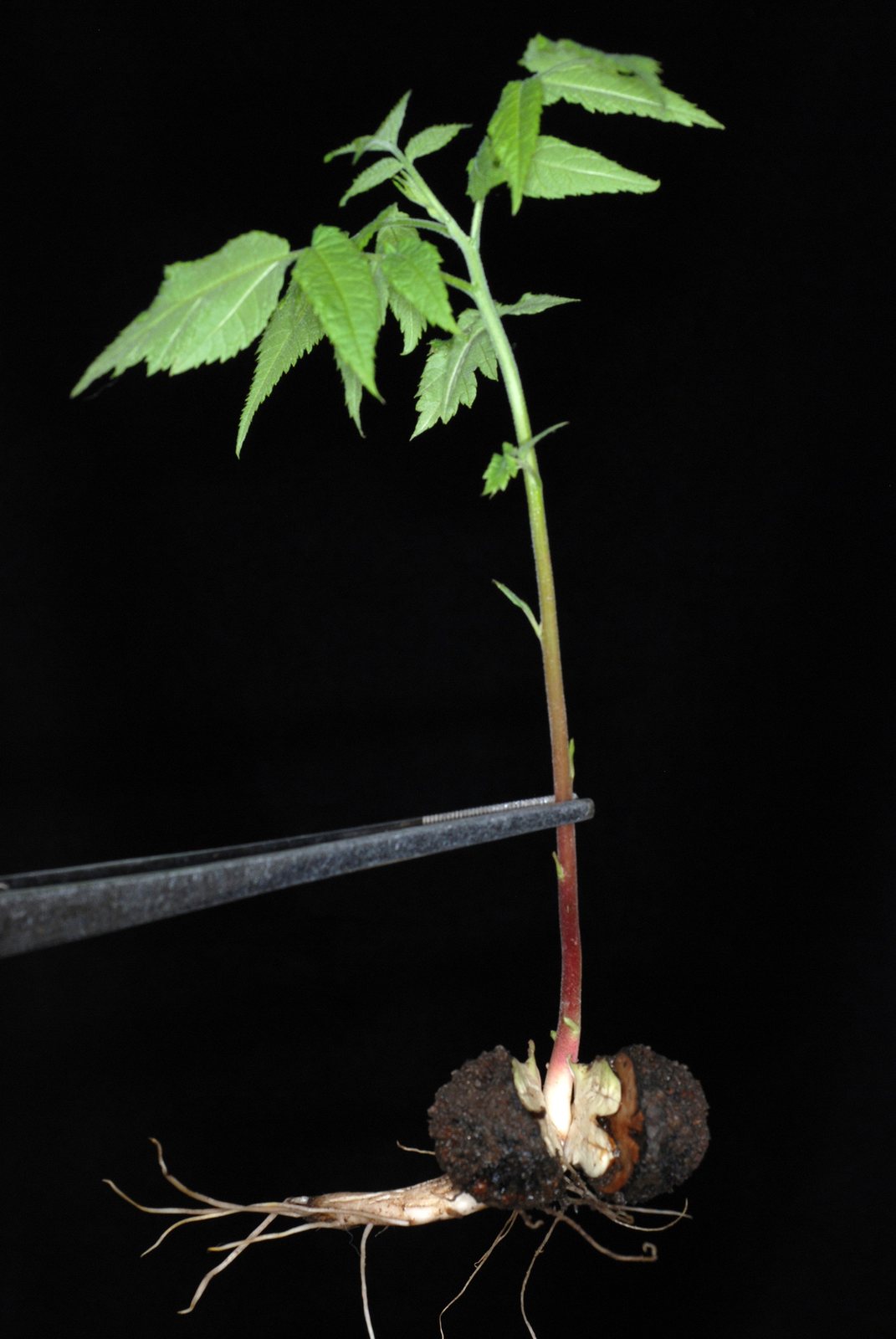
Propagation. Grow from fresh nuts given a cold, moist winter period; protect sown nuts from rodents. Seedlings vary in nut quality and are not true to a named cultivar. Grafting selected cultivars requires specialist skill.
Checked against open data
- Accepted botanical name
- Juglans nigra
- In the US and Canada
- Native in Canada and the lower 48 states.
- Native range
- Alabama, Arkansas, Connecticut, Delaware, District of Columbia, Florida, Georgia, Illinois, Indiana, Iowa, Kansas and Kentucky.
- Measured
- Soil pH 4.6 to 8.2. Average height 1550 cm.
Sources: GBIF (CC BY 4.0), USDA PLANTS and Trefle (CC BY 4.0). The care and design notes are LandscapeGPT's own.
See it in your own yard.
Upload a photo of your yard and see it redesigned with plants that suit your climate, each checked against your zone.