California fan palm
Washingtonia filifera. Family Arecaceae. Tree.
Also called Desert fan palm, California Washington palm, Petticoat palm.
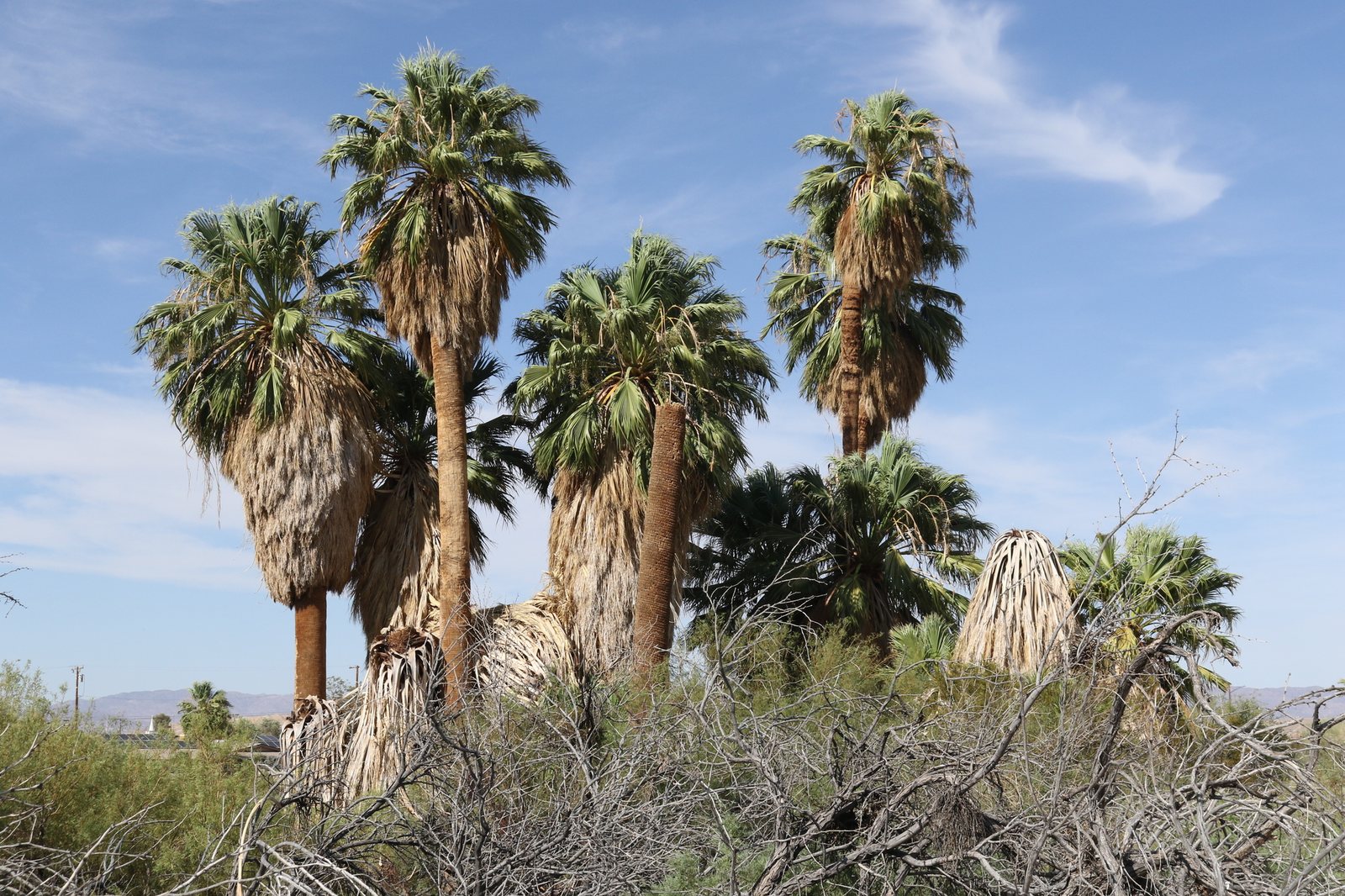
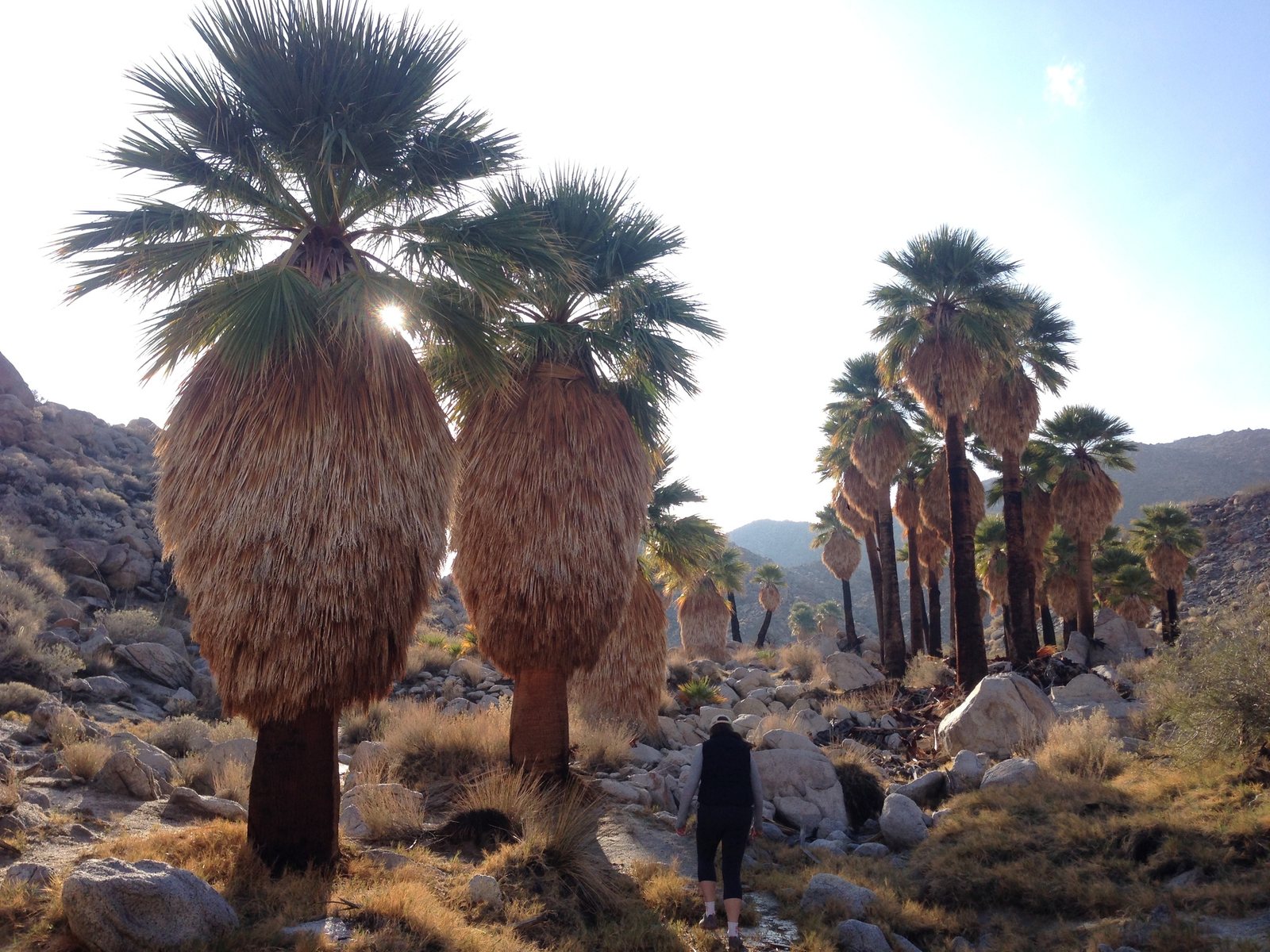
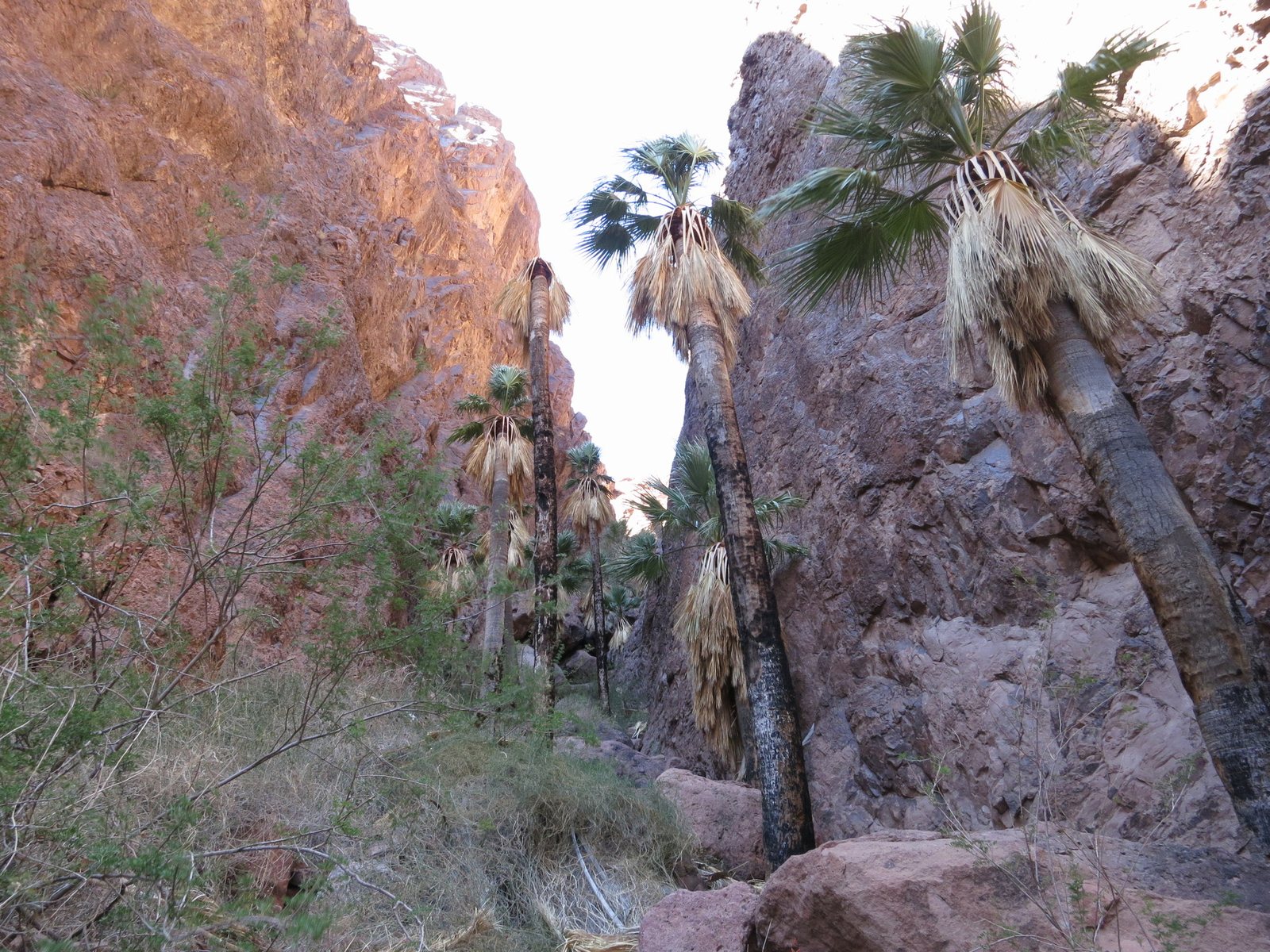
A large evergreen palm native to desert oases in the southwestern United States and northwestern Mexico, with a stout trunk and broad, fan-shaped leaves. Gardeners grow it for its strong silhouette and suitability for hot, dry landscapes, but it needs substantial space and tolerates cold much better in dry conditions than in wet winters.
At a glance
- Sun
- Full sun; choose a warm, sheltered position near the colder end of its range.
- Water
- Water deeply while establishing. Established palms tolerate drought, but grow better with occasional deep watering in prolonged dry weather; avoid constantly wet soil around the trunk.
- Soil
- Well-drained sandy, gravelly or loamy soil; tolerates alkaline conditions. Avoid poorly drained clay and sites that stay wet in winter.
- Height
- 40-60 ft (12-18 m), occasionally taller
- Spread
- 10-20 ft (3-6 m)
- Flowers
- Late spring to summer; small creamy-white flowers on long, branching sprays extending beyond the leaves, followed by small black fruits.
- Foliage
- Evergreen. Large grey-green to green fans with white, thread-like fibres along the leaf segments; leaf stalks have sharp teeth. Dead leaves can remain attached as a dense skirt.
- Growth
- Moderate; faster with summer warmth and adequate water.
- Care needed
- Medium
The year at a glance
- Pollinators
- Drought tolerant
- Heat tolerant
- Wildlife
| J | F | M | A | M | J | J | A | S | O | N | D | |
|---|---|---|---|---|---|---|---|---|---|---|---|---|
| Flowers | ||||||||||||
| Fruit | ||||||||||||
| Plant |
Northern hemisphere months. In Australia, shift them by six.
- Difficulty
- Hard
- Toughness
- Fairly tough
Will it suit your garden?
Pick your zone, country, light and whether you have pets.
Full sun is 6 or more hours of direct sun a day, part shade 3 to 6 hours, shade under 3.
How it grows
Planting day
7 ft (2 m)
After 1 year
9 ft (2.8 m)
After 2 years
12 ft (3.6 m)
After 3 years
15 ft (4.4 m)
After 5 years
20 ft (6.1 m)
About 16 years to full size.
From a typical nursery size, at an average rate for this kind of plant. A rule of thumb, not a forecast.
Good to know
- Cats and dogs
- Safe
- Invasive in
- Australia
- Growth rate
- Fast
Care
Jobs through the year
- WaterApr–May, Sep–Oct, every 28 days
- Deep-water established outdoor palms only during prolonged drought; young plants need more frequent watering.
- WaterJun–Aug, every 21 days
- Deep-water established outdoor palms in prolonged dry weather, letting the surface dry between soakings.
- FeedMay
- Apply slow-release palm fertiliser with micronutrients only if soil or growth indicates a need.
- MulchMay
- Refresh mulch over the root area without covering the trunk base.
- PruneMay–Jul
- Remove only fully dead fronds or unwanted flower stalks; use an arborist for tall palms.
- ProtectJan–Apr, Oct–Dec
- Not reliably hardy in zones 6–7; overwinter movable plants in bright frost-free shelter, not under fleece alone.
- Plant in spring or early summer once the soil is warming, keeping the root ball at its original depth.
- Water the root ball deeply during establishment, allowing the surface soil to dry between waterings.
- Apply a slow-release palm fertiliser with micronutrients during the warm growing season if growth or soil conditions indicate a need; follow the label rate.
- Keep mulch clear of the trunk and keep irrigation sprinklers from repeatedly wetting the crown.
- Allow room for the mature crown and keep the toothed leaf stalks away from paths, play areas and seating.
Pruning. In late spring or summer, remove only completely dead leaves and unwanted flower or fruit stalks; retain healthy green leaves and never cut the central growing point. Use a qualified arborist for tall palms or heavy dead-leaf skirts, which can fall unexpectedly and create a fire hazard.
Through the year
- Spring
- Check for winter damage; wait for new growth before deciding which leaves are dead.
- Late spring
- Plant or repot young palms when the soil is warm and severe frost has passed.
- Late spring
- Apply palm fertiliser if needed and refresh mulch without covering the trunk base.
- Summer
- Water establishing palms deeply and check established plants during prolonged drought.
- Summer
- Arrange safe removal of dead leaves or unwanted flower stalks before fruit develops.
- Autumn
- Remove unwanted seedlings and check that winter rain can drain freely.
- Winter
- In marginal climates, protect the growing point of young palms during severe cold without trapping moisture.
In the garden
- Use as a single architectural specimen in a large, sunny lawn or gravel garden.
- Plant widely spaced groups to create a desert-oasis setting with low shrubs and drought-tolerant grasses.
- Frame a broad entrance or driveway where mature crowns and falling debris will not obstruct access.
- Combine with agaves, yuccas and boulders in a warm-climate courtyard large enough for its eventual size.
Garden styles it suits: Architectural minimal, Desert modern, California native, Southwestern, Mediterranean and Luxury resort.
Plant it with: Red yucca, Desert spoon, Deer grass, California buckwheat, Blackfoot daisy and Parry's agave.
Wildlife: Flowers attract insects, and birds and other animals eat the fruits. Retained dead leaves provide shelter for wildlife but can also harbour rodents near buildings.
Problems to watch for
- Root or crown rot in cold, waterlogged conditions: improve drainage, reduce unnecessary irrigation and keep water out of the crown.
- Scale insects and mealybugs: inspect young leaves and leaf bases; treat reachable infestations with a labelled horticultural oil, avoiding application during extreme heat.
- Frost-damaged leaves or growing point: choose a sheltered site, protect young palms during exceptional cold and delay pruning until growth resumes.
- Potassium or magnesium deficiency causing discoloured older leaves: use an appropriate palm fertiliser after checking soil and watering conditions; do not remove affected leaves while they remain partly green.
Safety
Not known to be toxic to cats, dogs, horses or people. The fruit pulp has been eaten traditionally, but this does not make fallen fruit suitable for pets; hard seeds can pose a choking risk. Sharp leaf-stalk teeth can cause significant cuts.
Where it spreads. Naturalised in parts of Australia, including Western Australia, where escaped palms can establish around waterways and other moist sites. Remove unwanted seedlings and check local weed guidance before planting near natural areas.
Easily confused with
Mexican fan palm (Washingtonia robusta)
Usually develops a much slimmer, taller trunk and a smaller, brighter-green crown. California fan palm has a stockier trunk and generally greyer leaves; hybrids can blur these differences.
Hybrid Washington palm (Washingtonia × filibusta)
Combines features of California and Mexican fan palms, often with intermediate trunk thickness and leaf colour. Appearance alone may not reliably identify a hybrid.
Chinese fan palm (Livistona chinensis)
Its leaf-segment tips droop conspicuously, giving the crown a fountain-like appearance, rather than the firmer fans and conspicuous white threads of California fan palm.
The name
Washingtonia honours George Washington, while filifera means 'thread-bearing', referring to the white fibres along the leaves.
Propagation. Grow from cleaned, ripe seed sown in a warm, freely draining seed mix. Keep evenly moist but not waterlogged; germination usually takes several weeks. It does not produce offsets for division.
Checked against open data
- Accepted botanical name
- Washingtonia filifera
- Native range
- Arizona, California and Mexico Northwest.
- Measured
- Average height 1800 cm.
Sources: GBIF (CC BY 4.0) and Trefle (CC BY 4.0). The care and design notes are LandscapeGPT's own.
See it in your own yard.
Upload a photo of your yard and see it redesigned with plants that suit your climate, each checked against your zone.