Chalk dudleya
Dudleya pulverulenta. Family Crassulaceae. Succulent.
Also called Chalk liveforever, Chalk lettuce.
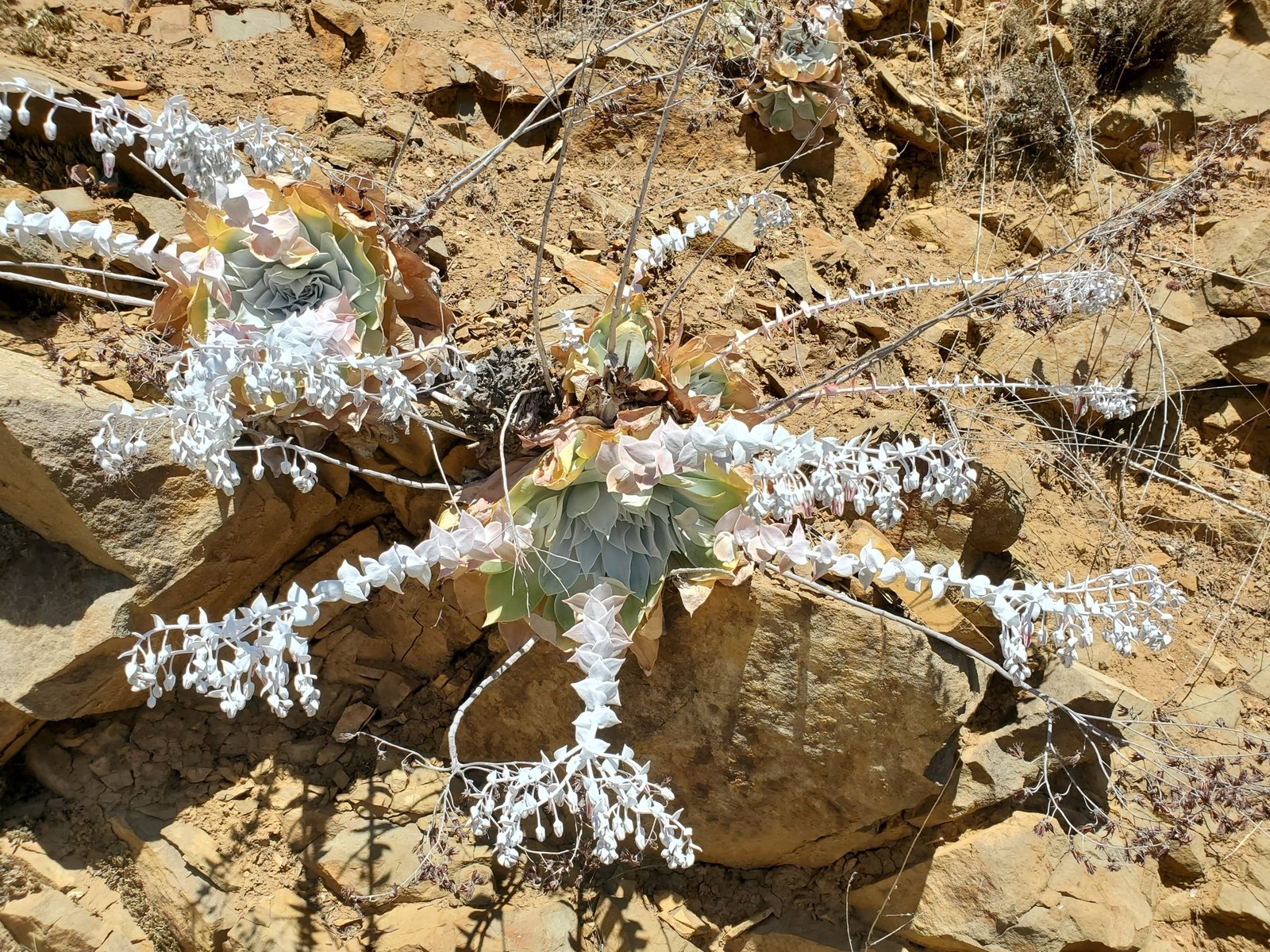
Chalk dudleya is a rosette-forming succulent native to southern California and Baja California, grown for its broad, chalk-white leaves and tall stems of red flowers. It suits dry rock gardens and containers where drainage is excellent and summer watering can be withheld. In cold or persistently wet climates, grow it in a pot with frost protection and shelter from excessive rain.
At a glance
- Sun
- Full sun near the coast; afternoon shade in hot inland gardens.
- Water
- Low; grows mainly during the cooler, wetter months and rests in summer. Avoid routine summer irrigation.
- Soil
- Sharply drained, gritty or rocky soil; use a mineral-rich cactus mix with added pumice or grit in containers.
- Height
- 1-2 ft (0.3-0.6 m) in leaf; flower stems can reach 3-5 ft (0.9-1.5 m)
- Spread
- 1-2 ft (0.3-0.6 m)
- Flowers
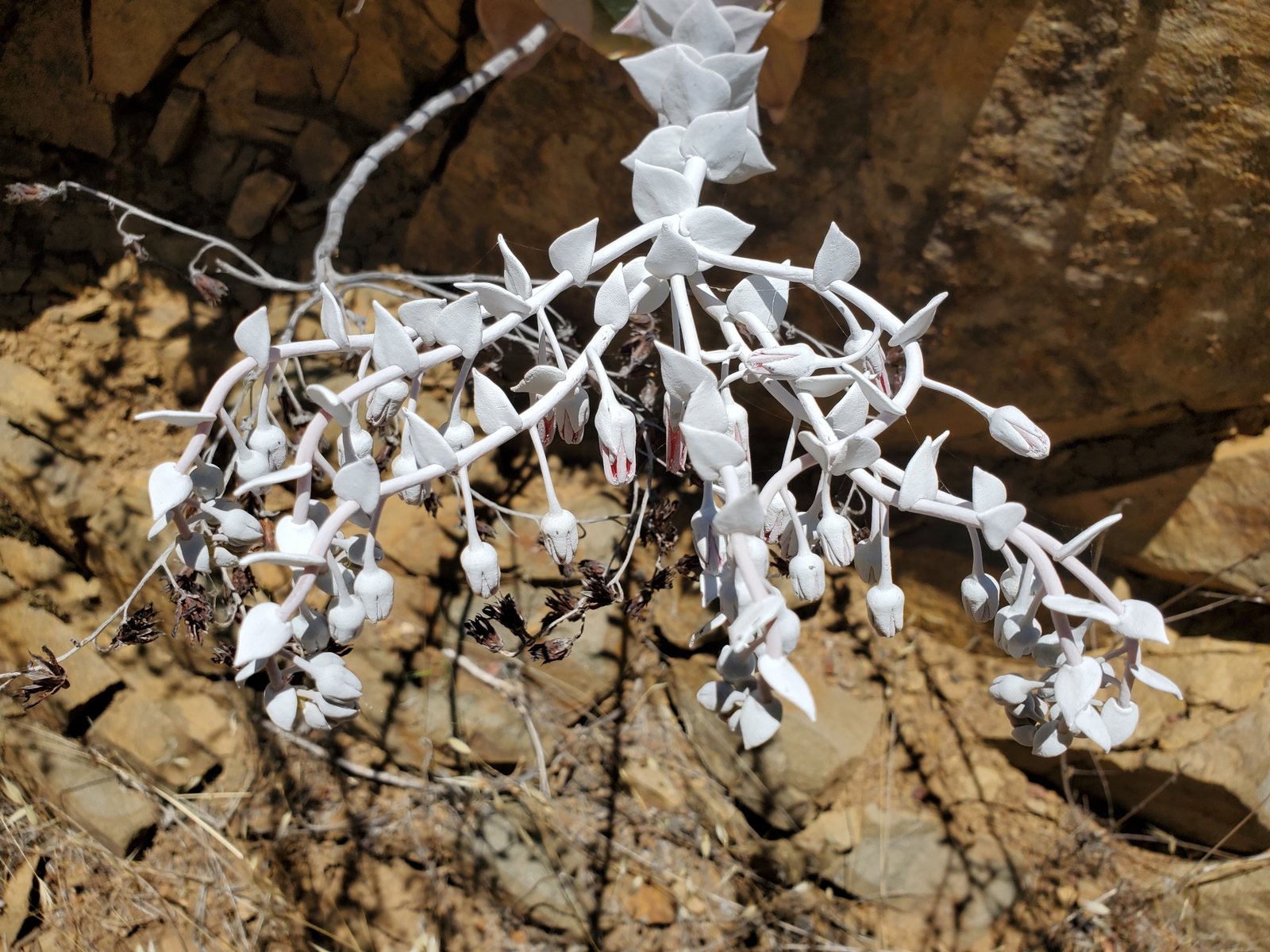
- Late spring to summer; hanging, tubular red flowers on tall, branching, often pinkish stems.
- Foliage
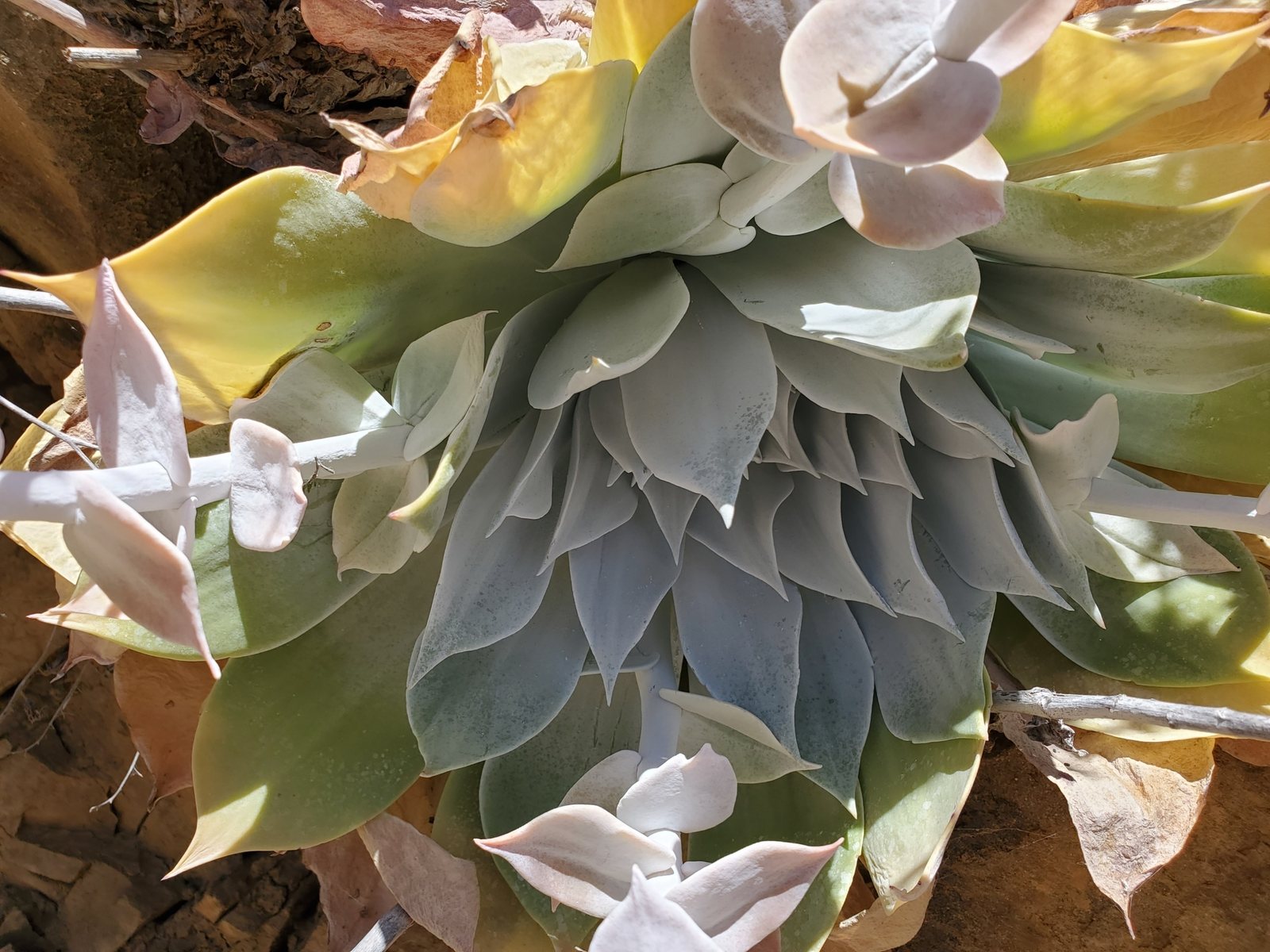
- Evergreen. Broad, fleshy, pointed leaves form a large rosette coated with white, powdery wax. Outer leaves may shrivel during summer dormancy.
- Growth
- Slow
- Care needed
- Medium
The year at a glance
- Pollinators
- Drought tolerant
- Heat tolerant
- Low allergen
| J | F | M | A | M | J | J | A | S | O | N | D | |
|---|---|---|---|---|---|---|---|---|---|---|---|---|
| Flowers | ||||||||||||
| Plant |
Northern hemisphere months. In Australia, shift them by six.
- Difficulty
- Hard
- Toughness
- Needs looking after
Will it suit your garden?
Pick your zone, country, light and whether you have pets.
Full sun is 6 or more hours of direct sun a day, part shade 3 to 6 hours, shade under 3.
How it grows
Planting day
0.8 ft (0.25 m)
After 1 year
0.9 ft (0.27 m)
After 2 years
1 ft (0.29 m)
After 3 years
1 ft (0.31 m)
After 5 years
1.2 ft (0.35 m)
About 10 years to full size.
From a typical nursery size, at an average rate for this kind of plant. A rule of thumb, not a forecast.
Good to know
- Cats and dogs
- Safe
- Native to
- the US
- Growth rate
- Slow
Care
Jobs through the year
- WaterMar–May, every 21 days
- For established plants, water soil only when fully dry and rain is insufficient; keep the rosette dry.
- WaterJan–Feb, Oct–Dec, every 28 days
- During cool-season growth, water only if completely dry; sheltered container plants need individual moisture checks.
- MulchMay
- Use gravel around the raised crown, with the rosette tilted to shed water.
- PruneAug–Sep
- Cut off dry flower stems and remove only loose dead leaves without touching the white leaf coating.
- ProtectJan–Apr, Oct–Dec
- Not hardy in zones 6–7; overwinter in a bright frost-free shelter protected from prolonged rain.
- ProtectJun–Aug
- Withhold routine summer watering during dormancy and shelter from persistent rain and severe afternoon heat.
- Plant on a slope or mound, with the rosette tilted slightly so water drains away from its centre.
- During cool-season growth, water only after the soil has dried; established plants may need no irrigation where winter rainfall is adequate.
- Keep summer-dormant plants dry and do not water simply because outer leaves shrivel.
- Use gravel around the crown rather than moisture-holding organic mulch.
- Avoid touching or spraying the leaves: their protective white coating rubs off and does not quickly return.
- Buy nursery-propagated plants, never wild-collected specimens; feed container plants only lightly during active growth.
Pruning. Cut spent flower stems near their base once flowering finishes, or leave them until seed has ripened. Remove only loose, fully dead leaves, without pulling on healthy foliage or damaging the crown.
Through the year
- Autumn
- As cooler weather brings fresh growth, resume cautious watering if rainfall is insufficient.
- Winter
- Check drainage and shelter containers from prolonged rain and freezing weather.
- Early spring
- Plant or repot while roots are active, keeping the crown above the surrounding soil.
- Late spring
- Watch developing flower stems for aphids and treat affected stems without scrubbing the leaves.
- Summer
- Withhold routine irrigation during dormancy and provide afternoon shade during severe inland heat.
- Late summer
- Collect ripe seed if wanted, then remove dry flower stems.
In the garden
- Set individual rosettes among dark rocks or gravel to emphasize their white leaves.
- Plant in crevices or on sloping rock-garden banks where water cannot collect around the crown.
- Use in a wide, freely draining container as a sculptural focal point.
- Combine with California-native shrubs on a dry bank, keeping it outside regularly irrigated planting beds.
Garden styles it suits: California native, Desert / xeriscape, Dry gravel garden, Coastal, Modern Mediterranean and Architectural minimal.
Plant it with: California buckwheat, California sagebrush, Cleveland sage and Deer grass.
Wildlife: The red tubular flowers attract hummingbirds within their native range; insects also visit the flowers.
Problems to watch for
- Root or crown rot: prevent standing water, keep the crown raised and avoid watering during summer dormancy; badly rotted plants usually cannot be saved.
- Mealybugs: inspect leaf bases and roots, isolate affected pots and treat with a product labelled for succulents, testing first to avoid damaging the waxy coating.
- Aphids on flower stems: remove small colonies by hand or use a targeted treatment, keeping sprays off the rosette where possible.
- Sun scorch after moving or planting: acclimatize gradually to stronger light and provide afternoon shade in very hot inland sites.
Safety
Not known to be toxic to people, cats, dogs or horses, but species-specific safety information is limited. No particular part is established as poisonous; it is an ornamental plant, not a food plant.
Easily confused with
Britton's dudleya (Dudleya brittonii)
Also forms large, chalk-white rosettes and can be difficult to distinguish without flowers. Its flowers are pale yellow rather than the red flowers of chalk dudleya.
Bluff lettuce (Dudleya farinosa)
Usually has much smaller rosettes, often forming clusters, with shorter leaves that may have red tips. Its flowers are yellow rather than red.
The name
Dudleya honours American botanist William Russell Dudley, while pulverulenta means powdery or dust-covered, referring to the white coating on the leaves.
Propagation. Usually grown from seed sown on the surface of a fine, freely draining mix during the cool growing season. Keep seedlings lightly moist with good ventilation. Separate offsets only if the plant produces them; this species is often solitary and is not reliably propagated from detached leaves.
Checked against open data
- Accepted botanical name
- Dudleya pulverulenta
- In the US and Canada
- Native in the lower 48 states.
- Native range
- California and Mexico Northwest.
Sources: GBIF (CC BY 4.0), USDA PLANTS and Trefle (CC BY 4.0). The care and design notes are LandscapeGPT's own.
See it in your own yard.
Upload a photo of your yard and see it redesigned with plants that suit your climate, each checked against your zone.